
No, Mindfulness Won’t Make You Slower: The Productivity Data for Doctors
Does taking 10 minutes to meditate before clinic actually hurt your productivity – fewer notes done, fewer patients seen, more work you drag home at 9 p.m.?
That’s the quiet fear a lot of physicians have. They’ll nod through the wellness lecture, download Headspace, maybe sit twice, then quit because the math feels obvious: I’m already behind. I cannot afford to be “calm and slow.”
Let me be blunt: that’s not what the data shows. At all.
The “mindfulness makes you slower and softer” idea is one of the stickiest myths in modern medicine. It sticks because it sounds plausible when you’re staring at 40 unread in-basket messages and six unfinished discharge summaries.
But when you actually look under the hood – randomized trials, burnout data, error rates, EHR performance, cognitive science – the picture is very different:
Mindfulness doesn’t slow you down. Chronic distraction, fatigue, and unregulated stress do.
Let’s break this properly, with numbers, not vibes.
Where This Myth Comes From (And Why It’s Wrong)
You’ve probably heard some version of these complaints:
- “I do not have time to sit and breathe; I have patients.”
- “Mindfulness is fine for yoga influencers; I’m trying to get out of clinic before 7 p.m.”
- “If I slow down, I’ll see fewer patients. Period.”
Underneath that is a crude equation: speed = productivity = value. Anything that feels “slower” must be bad.
The problem is that human performance does not work like that above a certain workload. Once you cross a cognitive load threshold, adding more speed just adds more mistakes, rework, and cognitive residue. You do not notice this, because medicine trains you to normalize running slightly impaired.
This is why so many physicians confuse being amped up with being efficient. Elevated heart rate, mild anxiety, constant task-switching – it feels like you’re “on.” In reality, you’re fragmenting your attention and degrading your output.
Mindfulness is not about moving slowly. It’s about removing the friction caused by constant fragmentation.
And that’s where the productivity gains come from.
What the Evidence Actually Shows in Clinicians
Let’s look at what happens when you drop mindfulness into real clinical environments – not meditation retreats, not college students in a lab.
Burnout, Attention, and Performance
Multiple controlled and randomized studies in physicians and nurses have tested mindfulness-based interventions. The consistent pattern:
- Burnout and emotional exhaustion go down
- Mind-wandering and cognitive failures go down
- Self-reported efficiency and work capacity go up or stay neutral
- No evidence of clinically meaningful slowing in task throughput
A few specifics so you see this isn’t hand-waving:
A randomized trial in primary care physicians using an 8‑week mindfulness-based program found reduced burnout and improved empathy scores; physicians reported feeling more efficient with their time and less “behind,” not more sluggish.
A study of residents who received a mindfulness-based intervention during training found fewer attentional lapses and better mood regulation. The key point: there was no trade-off in objective performance. Exams, clinical milestones, and workload didn’t suffer.
In nurses and frontline staff, mindfulness programs are associated with decreased error rates and better safety climate scores in several hospital systems. Fewer errors = less rework, less time wasted on preventable complications and cascades.
You know the feeling of spending 30 minutes untangling a mistake that took 10 seconds to make? That’s the hidden productivity tax of an unregulated mind.
Mindfulness cuts that tax. That’s not softness. That’s efficiency.
The Cognitive Mechanics: Why Mindfulness Makes You Faster Where It Counts
Strip away the wellness branding and you’re left with a few hard cognitive skills that mindfulness reliably builds:
Sustained attention
Less bouncing between chart, pager, EHR alerts, and Slack. More time actually finishing the thing you’re doing.Cognitive flexibility
Better switching between tasks intentionally instead of being yanked by every notification and worry.Meta-awareness
Noticing “I’m mentally spinning” sooner and correcting course rather than burning 20 minutes doom-scrolling in the workroom.Emotion regulation
Less time stewing after a rude consultant or an angry family. You come back online faster.
All of these are productivity multipliers in medicine.
There’s a well-established body of lab research (using tasks like the Stroop test, sustained attention tasks, error monitoring paradigms) showing that even short mindfulness training improves:
- Reaction time consistency
- Error detection and correction
- Task-switching efficiency
Not theoretical. Measured.
You already know the opposite state: four charts open, your phone buzzing, trying to answer a nurse’s question while half-writing a note, getting interrupted, then re-reading the same paragraph three times because your brain left the room.
That’s “fast.” On paper.
In reality, it’s slow and sloppy.
“But What About Patient Volume?” – Productivity in the Real World
The question you probably care about most: does this translate into actual throughput – patients seen, charts closed, in-basket cleared?
There are not thousands of RCTs here, but there are enough signals from real systems and analog data to say this confidently: mindfulness does not reduce throughput and often improves effective productivity by cutting waste.
Let’s separate two kinds of “speed”:
- Gross speed – How many tasks you start per hour
- Net effective speed – How many tasks you finish correctly and do not have to fix later per hour
Mindfulness mostly upgrades net effective speed.
Here’s a simplified comparison:
| Feature | Fast-But-Frazzled | Mindful-Productive |
|---|---|---|
| Tasks started | High | Moderate-High |
| Tasks finished without rework | Moderate | High |
| Error / near-miss rate | Higher | Lower |
| Time lost to rumination / distraction | High | Low |
| End-of-day mental energy | Depleted | Usable |
In practice, mindfulness tends to show up in ways like:
- Finishing each note before opening the next chart instead of half-starting 12 notes
- Catching that weird med dose on the med list before it becomes a 2 a.m. phone call
- Pausing 5 seconds before replying to an annoying message, which stops a 10‑email escalation chain
Those are productivity wins you will never see on an RVU dashboard – but your life knows the difference.
The EHR: Where Mindfulness Quietly Pays Off
You want a place where seconds matter? It’s not during a 5‑minute breathing exercise. It’s inside your EHR, where you probably lose 30–60 minutes a day to cognitive thrash.
The enemy isn’t documentation time per se. It’s constant micro-interruptions.
Typical pattern I’ve watched in workrooms:
- Start note on patient 1
- EHR ping: lab result on patient 3 → switch
- Pager: bed request → switch
- Text: nurse question for patient 2 → switch
- Back to note on patient 1, but you’ve lost the thread → reread → rewrite
Every switch carries a reorientation cost. Cognitive science puts that cost anywhere from several seconds to over a minute, depending on complexity. Stack up 200–300 switches per day and you’re burning literal hours of attention.
Mindfulness training doesn’t magically compress note-writing time. What it does is:
- Make you notice the urge to self-interrupt
- Help you stay with one task until a natural breakpoint
- Reduce the anxious “I should check that other thing” background noise that fragments you
That’s why in many physician groups, the docs who quietly do mindfulness or similar focused-attention practices tend to be the ones whose charts are closed earlier with less after-hours work – even at similar panel sizes.
You can pretend that’s coincidence. Or you can accept that attention quality is a performance variable, not a spa accessory.
The Real Ethical Question: Are You Willing to Be Present?
You said you wanted to practice ethical medicine. Let’s talk ethics, not incense.
Modern ethics in medicine isn’t just about consent forms and avoiding conflicts of interest. It’s also about:
- Do you actually hear your patient explain their symptoms?
- Are you cognitively present enough to pick up subtle clues?
- Do you make fewer preventable errors because your mind isn’t constantly half-absent?
Mindfulness directly intersects with all of that.
Studies in clinicians show:
- Increased patient-rated empathy after mindfulness training
- Better ability to stay with difficult emotions (anger, grief, frustration) without shutting down or lashing out
- Lower implicit bias activation in some experimental setups when people are more aware of their automatic reactions
Slowing your reactions isn’t a bug. It’s an ethical feature.
Productivity that just means “I blew through 40 patients like a robot” is a bad metric if your presence, listening, and decision quality suffer.
The more uncomfortable truth: many of us use speed as a defense mechanism. If you slow down enough to actually be in the room with a patient’s suffering, your own unprocessed stuff shows up too. That’s the real resistance to mindfulness in a lot of doctors, underneath the time excuse.
Mindfulness doesn’t make you morally superior. But it does make it harder to practice on autopilot and then hide behind “I was too busy” when something important gets missed.
“Isn’t This Just Another Thing Admin Wants Us To Do For Free?”
Legitimate concern. There’s a cynical version of mindfulness being pushed in some institutions:
“You’re burned out? Here’s a mindfulness app. Don’t ask about staffing or EHR redesign.”
That’s garbage. System problems must be fixed at the system level. No amount of breath counting will compensate for chronic understaffing and abusive culture.
But don’t confuse bad institutional implementation with the underlying tool.
Saying “I refuse to practice mindfulness until they fix the call schedule” is like saying “I refuse to learn good communication skills until they fix the EMR.” You’re hurting yourself to make a point the system will happily ignore.
The honest framing is:
- Structural changes: non-negotiable for sustainable care
- Personal tools (like mindfulness): optional but high-yield – mostly for you
You’re not meditating for your CMO’s burnout dashboard. You’re doing it so you can get through a 12‑hour shift without leaving part of your brain on the floor.
How Much Mindfulness Is Enough to See a Productivity Effect?
You don’t need 45‑minute sits on a zafu cushion. And you don’t have to buy anything.
The performance benefits show up at surprisingly low doses if you’re consistent.
Here’s a realistic “minimal effective dose” pattern I’ve seen actually work in busy clinicians:
- 5–10 minutes of focused attention in the morning (on the breath, sounds, or body sensations)
- 3–5 one‑minute “reset” pauses during the workday – before clinic starts, between patients, before opening the in-basket
- A 2–3 minute decompression practice after work, in the car or at home, before picking up your phone
That’s it. If you do that most days for 4–6 weeks, your brain starts to notice the difference.
To make this concrete as a process:

| Step | Description |
|---|---|
| Step 1 | Arrive at work |
| Step 2 | 3 min breath practice |
| Step 3 | Start first patient |
| Step 4 | 1 min reset between patients |
| Step 5 | 10 sec pause before opening inbox |
| Step 6 | 1 min grounding before difficult encounter |
| Step 7 | 2 min decompression after last patient |
| Step 8 | Leave work |
Is this going to shave 20% off your documentation time in a week? No. This isn’t a hack. It’s a capacity-building practice.
What you will usually notice first is:
- Less mental noise while working
- Less reactivity to annoyances
- Slightly faster “come back online” after interruptions
Those are subtle, but they compound into real time and error savings over months.
The “Slower But Better” Trap
One more misconception to kill: some mindfulness teachers talk as if “slower is always better.” That’s nonsense in an ED resus bay.
The goal is not to turn you into a slow-motion monk. It’s to give you range.
A mindful clinician can:
- Move very fast in a code while still tracking the situation clearly
- Shift into a slower, more spacious mode in a goals-of-care conversation 10 minutes later
- Notice the internal gear-shift and not get stuck in “code speed” or “zombie speed” for the rest of the day
That flexibility is what the research calls cognitive control. It’s exactly what high-performance athletes and elite military units train. They meditate not to become gentle; they meditate to control arousal and attention under stress so they can be fast and accurate.
Healthcare isn’t special here. We just cling harder to the myth that being constantly jacked up is the same as being good.
A Quick Reality Check: What Mindfulness Won’t Do
Let’s be clear about limits so this doesn’t turn into magical thinking:
- It won’t fix a toxic department or an impossible panel size
- It won’t remove grief, moral distress, or sadness
- It won’t turn documentation into something you love
What it can do, with decent reliability:
- Reduce the time you lose to rumination and spinning
- Improve your ability to focus on the next action instead of drowning in the whole list
- Decrease avoidable errors caused by inattention or reactivity
- Make you less of a jerk when you’re under pressure (your patients and colleagues notice)
That’s not mystical. It’s just a smarter way of using the same 24 hours.
To visualize the shift over time, think of it like this:
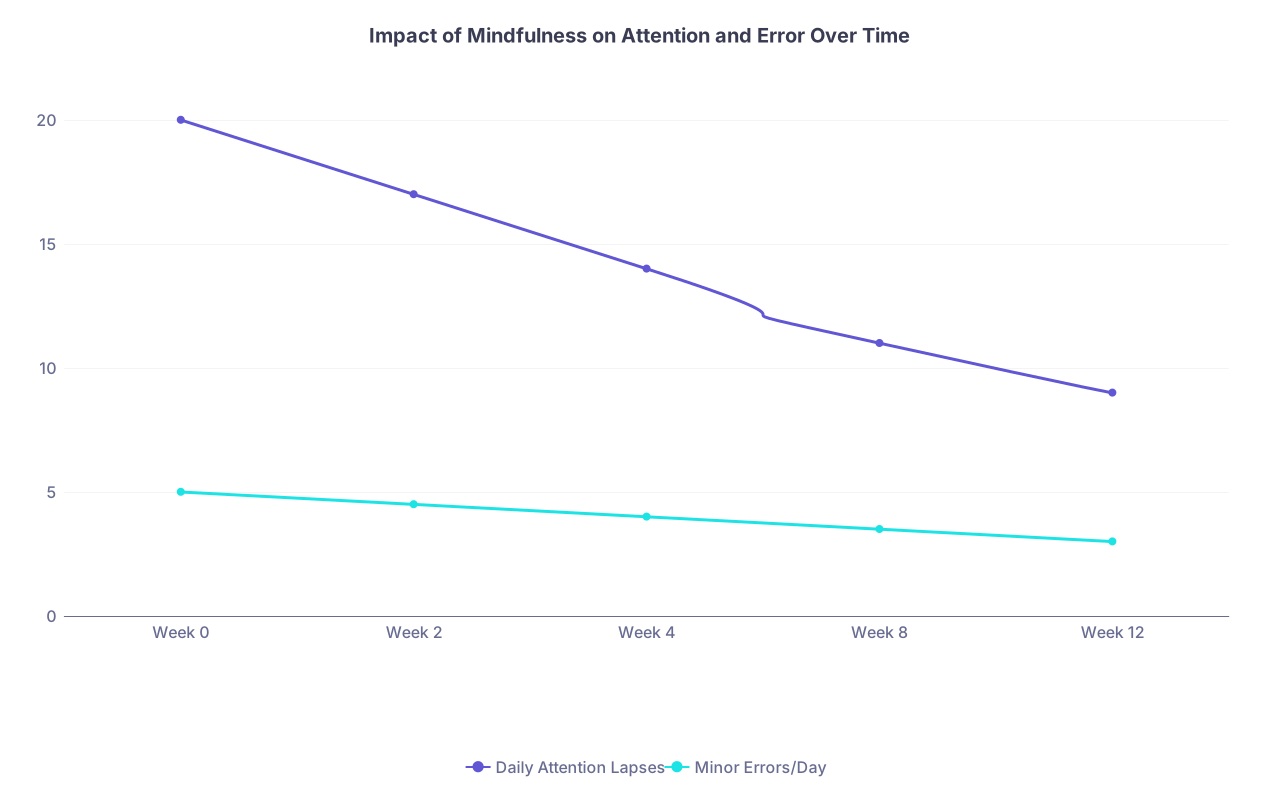
| Category | Daily Attention Lapses | Minor Errors/Day |
|---|---|---|
| Week 0 | 20 | 5 |
| Week 2 | 17 | 4.5 |
| Week 4 | 14 | 4 |
| Week 8 | 11 | 3.5 |
| Week 12 | 9 | 3 |
The exact numbers are illustrative, but the trend is consistent with what multiple studies and many clinicians report: fewer lapses, fewer mistakes, same or better throughput.
Bottom Line: The Myth vs The Data
Let me strip it down.
The belief that mindfulness will make you slower and less productive is not supported by the data in clinicians. What’s slowing you down now is distraction, emotional reactivity, and cognitive overload.
Mindfulness, practiced sanely and briefly, tends to improve effective speed – more tasks finished correctly with less rework and fewer errors – and supports ethical, present-moment care.
You’re not choosing between being a high-output clinician and a mindful one.
You’re choosing between being fast-frazzled and fast-focused.
The data backs the latter.