

The mindfulness techniques you use on a quiet Sunday off will absolutely fail you at 3:17 a.m. in a chaotic ICU. Different battlefield, different tools.
Here’s the blunt truth: on 24‑hour call, the “classic” mindfulness toolkit (20‑minute meditations, elaborate breathing rituals, yoga flows) is mostly useless. You do not have time. You do not have privacy. And you definitely do not have a candle and a playlist.
You need call‑room mindfulness: fast, portable, ethically grounded, and doable in 30–60 seconds between pages.
This is what actually works.
The Non‑Negotiable Rule: Mindfulness on Call Has One Job
On call, mindfulness is not about inner peace. It has one job:
Keep your brain clear enough to make safe decisions for patients.
If a technique makes you:
- too relaxed to think sharply
- more distracted
- guilty or self‑absorbed
…it’s the wrong tool for this context.
So I’ll break this into two buckets:
- Techniques that work during the chaos (pages, codes, cross‑cover madness)
- Techniques that work in the tiny gaps (bathroom, staircase, call room, elevator)
And I’ll flag what’s been most consistently effective for residents who are sleep‑deprived, overwhelmed, and still responsible for human lives.
1. The Single Most Useful Technique: Micro Grounding (10–60 seconds)
If you only remember one thing from this, make it this: ultra‑short, sensory grounding.
Not 10 minutes. Not 3 minutes. Often 20–30 seconds. I’ve watched this stop spirals in residents who are about to cry in the med room.
Here’s how it works on a 24‑hour call.
The 5‑Second Reset (on the ward, at the computer)
You just got paged five times, your senior wants one thing, your attending another, and the ED is trying to sign out two admissions.
Do this, literally in 5–10 seconds, without anyone knowing:
- Feel your feet in your shoes. Press them into the floor gently.
- Take one slow inhale through your nose (about 4 seconds).
- Long exhale through your mouth (about 6 seconds).
- During the exhale, mentally label: “Exhale.” That’s it.
It’s stupidly simple. It also works. The long exhale taps the parasympathetic system just enough to reduce adrenaline spikes so your prefrontal cortex doesn’t completely shut down.
The 3–3–3 Scan (when you’re starting to panic)
You’re behind on notes, the ED is impatient, and a nurse just said, “Can you come now, the patient doesn’t look right.”
Do this while walking:
- Name 3 things you see (just in your head): “Blue door. IV pole. Red sign.”
- Notice 3 sensations: “Left foot hitting the floor. Stethoscope on my neck. Air on my hands.”
- Take 3 slower breaths than usual.
You are not doing “mindfulness practice.” You are interrupting an anxiety loop so you can arrive at the bedside present and thinking.
2. Tactical Breathing You Can Use Without Looking Weird
No one cares if you’re “mindful” on call. They care if you’re functional. So the breathing has to be invisible.
What actually works well on 24‑hour call:
Physiological sigh (1–2 reps)
Best when you feel chest tightness or are about to cry.How:
- Quick inhale through the nose
- Tiny extra sip of air at the top
- Long, slow exhale through the mouth until empty
One or two rounds is enough. I’ve seen people do this while walking down the hall or at the workstation staring at the EMR.
4–6 breathing (simpler than box breathing)
Box breathing is fine but a bit fiddly for chaos. I prefer:- Inhale for 4 counts
- Exhale for 6 counts
- Do 3–5 breaths while waiting for a lab to load or the elevator to come
Long exhale again is the point. You’re not meditating; you’re reducing physiological arousal so you can chart, call, and think clearly.
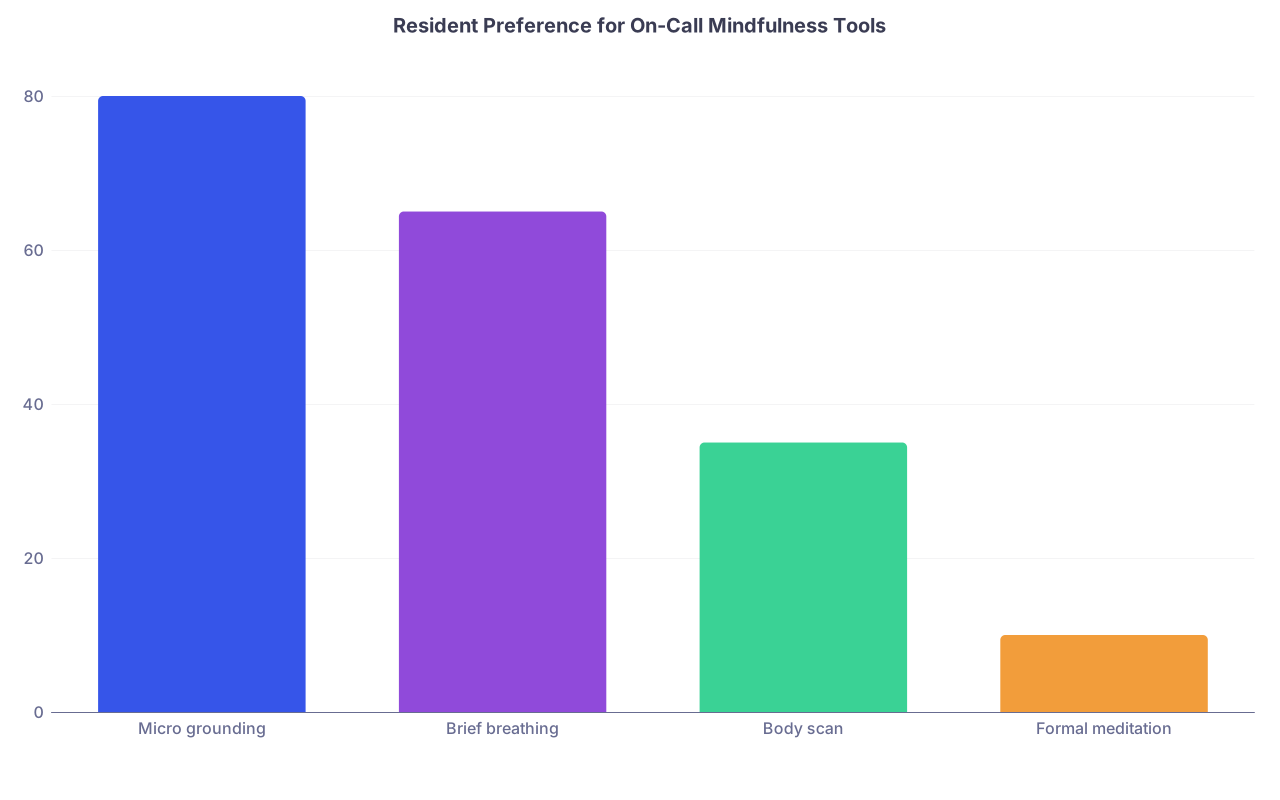
| Category | Value |
|---|---|
| Micro grounding | 80 |
| Brief breathing | 65 |
| Body scan | 35 |
| Formal meditation | 10 |
- No-count exhale focus (when you’re too tired to remember numbers)
Just: “Inhale normally, exhale slightly slower.” Repeat a few times. That’s it.
If you’re forcing yourself to remember a pattern and it stresses you, drop it. Use something simpler.
3. Ethical Anchor: “Why Am I Doing This Right Now?”
Here’s where the “medical ethics” part comes in. Mindfulness on call is not a self-care spa moment. It’s professional upkeep. It’s part of non‑maleficence and beneficence: you reduce your error risk by managing your cognitive overload.
A brutally effective question to use as a mental anchor:
“What is the most important thing I can do for patient safety in the next 5 minutes?”
Ask this whenever you feel scattered:
- after a rapid response
- after a tough family conversation
- after being humiliated on rounds
- when your to‑do list has 17 half‑done items
That question is a mindfulness practice. It pulls your attention out of rumination and back into reality and ethical responsibility.
Common answers:
- “Check that lab I ordered.”
- “Re‑examine the patient who looks a bit off.”
- “Clarify that med order.”
- “Eat and drink something so I do not make a stupid mistake in 2 hours.”
Yes, sometimes the ethical move is to take care of your body. You are part of the system that cares for patients; if you break, patient care suffers.
4. Micro Moments That Actually Fit in a 24‑Hour Call
You’ll rarely get long stretches. What you do get: 20–120 second fragments. Use them.
Here’s what works in each micro‑context.
In the elevator (15–60 seconds)
- Decide: “This ride is for me.”
- Look at one fixed spot on the wall.
- Let your shoulders drop 1–2 cm.
- One physiological sigh, then one 4–6 breath.
- Mentally label: “Leaving room X. Heading to room Y. I’m here now.”
You’re giving your nervous system a tiny reset during a transition that was happening anyway.
In the bathroom (30–90 seconds, door locked)
- Sit or stand. Hands on thighs.
- Feel your hands on your legs. Notice warmth, pressure.
- One slow head‑to‑shoulders scan: “Forehead. Jaw. Neck. Shoulders.” Relax each 5–10%.
- Ask yourself: “Am I about to forget something critical?” If something pops up, jot it (paper, phone, EMR sticky note) and then leave.
That brief body check plus a quick cognitive check can prevent those 3 a.m. “Oh no, I forgot to…” moments.
At the workstation (while labs load)
The computer is spinning anyway. Use it.
- As you wait, plant your feet, feel the chair.
- Take 2 conscious breaths.
- Mentally name what you’re about to do: “Review labs. Update note. Call nurse.”
- If your mind jumps to something else, notice and gently come back. No drama.
This turns dead time into steadying time.
5. What Does NOT Work Well on 24‑Hour Call (Usually)
I’ve watched people beat themselves up for not doing “real” mindfulness on call. Let’s be honest:
- 20–30 minute seated meditations – great on days off, lousy at 2 a.m. when you might be interrupted mid‑practice. You’ll just feel more frustrated.
- Elaborate rituals (candles, music, lying on the floor) – unrealistic and frankly unsafe if you might fall asleep and miss a page.
- App‑guided meditations requiring headphones – your pager/phone needs to stay audible, and you don’t always have both hands free.
These aren’t bad practices. They’re just wrong tool for the context. On call, simplicity wins.
6. Ethics, Emotions, and Not Becoming Numb
You’re not just tired on 24‑hour call. You’re absorbing suffering: deaths, angry families, system failures, your own mistakes.
The danger isn’t feeling too much. It’s going numb.
Mindfulness on call can keep you on the right side of that line.
30‑Second “Emotional Name and Park”
You just had:
- a code that did not go well
- an attending publicly tear apart your note
- a family member yell at you
You cannot process it fully right now. But you can do this:
- In your head, name it:
“Anger.” “Shame.” “Grief.” “Embarrassment.” - Add: “This belongs to me, but I will not unpack it here.”
- Picture a mental shelf or box where you place it for later.
- Take one slow breath and move to the next task.
That’s not avoidance. It’s containment. It’s ethically appropriate triage of your emotional bandwidth so you can still function for your patients.
Later—post‑call, therapy, peer support—that’s where you open the box. On call, you just label and park.
7. Putting It Together: A Simple On‑Call Mindfulness Plan
You don’t need a complicated system. You need a default pattern you can fall back on when your brain is mush.
Here’s a straightforward structure.
| Situation | Technique |
|---|---|
| Feeling overwhelmed | 3–3–3 micro grounding |
| Chest tight / panicky | 1–2 physiological sighs |
| Transition (elevator) | 4–6 breathing + body drop |
| After tough encounter | Emotional name and park |
| Scattered priorities | 5‑minute patient safety question |
And a very realistic example:
- Pager goes off for rapid response: feel feet, single long exhale while walking.
- After rapid: in bathroom, 30‑second body + “Did I forget anything?” check.
- Waiting for CT result: one 4–6 breathing cycle, mental note of what you’ll do depending on result.
- After being snapped at: silent “Anger. Park it.” One breath. Move on.
Not pretty. Highly functional.
8. How This Ties Back to Professionalism and Ethics
Some programs still treat resident distress as a personal failing. That’s lazy and wrong.
Well‑used mindfulness on call:
- Reduces cognitive overload → fewer dumb errors
- Improves communication because you’re less reactive and more present
- Keeps you connected to why you’re there in the first place, instead of sliding into pure cynicism
- Supports ethical duties to patients and to yourself as a professional who is expected to function safely
If anyone frames this as “self‑indulgent wellness,” they’re missing the point. This is mental hygiene so you don’t operate on emotional fumes.

FAQ: Mindfulness on 24‑Hour Call
1. Do I really have time to be “mindful” on call?
You do not have time for long practices. You absolutely have time for 10–60 second resets that you tuck into things you’re already doing—walking, waiting, riding the elevator, washing your hands. If you have time to scroll your phone or stare blankly at the screen while a note loads, you have time for two conscious breaths.
2. Won’t mindfulness just make me sleepy or too relaxed?
If you’re doing 20‑minute deep relaxation, yes, that’s a risk. The techniques I’ve described—micro grounding, brief breathing, emotional labeling—are designed to bring you to steady alertness, not sedation. You’re aiming for clear, present, and calm‑enough, not zen monk.
3. What if I try and my mind just races more?
Then your expectation is the problem, not the technique. The goal on call is not to empty your mind; it’s to interrupt spirals and give yourself 1–2% more space between stimulus and reaction. If your mind races but you still followed your plan (“I named my emotion and parked it; I did two slow breaths”), you succeeded. Raced mind, slightly more control, still counts.
4. Is this really “ethical practice” or just personal coping?
It’s both. Ethically, you’re obligated to provide competent, safe care. That requires a minimally functional nervous system. Micro mindfulness helps you maintain that under extreme conditions. It also keeps you from becoming so detached that you treat patients like tasks. In that sense, it directly supports respect for persons, beneficence, and non‑maleficence.
5. How do I build this habit when I’m already exhausted and overwhelmed?
Do not start on a brutal call. Practice 1–2 of these techniques on lighter days: in clinic, on short calls, even at home. Pick just one cue, like: “Every time I ride an elevator, I’ll do one long exhale.” After it becomes automatic, add another (bathroom = quick body check, before sign‑out = safety question). Small, consistent reps beat grand plans you never use.
Key takeaways: On 24‑hour call, the mindfulness that works is short, invisible, and tied directly to patient safety. Think 10–60 second grounding, simple breathing, and quick ethical re‑focusing, not long meditations. Your job isn’t to be perfectly calm; it’s to be clear enough to care for patients without losing yourself in the process.


