
The way most clinicians handle angry families is backwards. They try to “stay professional” while their nervous system is on fire.
You do not fix a hot encounter with a hot brain.
You fix it by giving your nervous system a script. A sequence. Something you can run even when your heart rate is 120 and the family is glaring at you.
That is what this article gives you: a step‑by‑step mindfulness script you can actually use in clinic. Not fluffy wellness talk. A concrete protocol you can run in real time, from the moment you see “upset family” in the chart to the second you close the exam room door afterward.
Use it exactly as written at first. Then adapt it to your style.
Step 0: The 30‑Second Reset Before You Enter
If you walk into a hot room with a hot mind, you are already losing. You will be defensive, rushed, and reactive. Families sense that in one second.
You need a 30‑second reset outside the door.
Script: “Pause at the Door”
Stand outside the room. One hand on the door handle, one hand on your own body (pocket, badge, or chest—whatever feels natural).
Say this silently, word for word at first:
Label the situation (3 seconds)
“This is anger. This is frustration. This is not an emergency.”Anchor in the body (10–15 seconds)
- Breathe in through the nose for a slow count of 4.
- Hold briefly for 1.
- Exhale through the mouth for a slow count of 6.
Do that two cycles.
While you exhale, think: “Soften shoulders. Unclench jaw.”
Name your own state (5 seconds)
“I feel [tense / anxious / annoyed / rushed]. That is allowed. I do not have to act from it.”Set your intention (5–10 seconds)
Pick one of these lines and silently commit to it:- “My job for the next 10 minutes is to listen and not escalate.”
- “My job is to understand what feels threatened here.”
- “My job is to protect the patient and the relationship.”
Then you enter.
Is this mindfulness? Yes. But stripped down to something that fits into half a minute in a real clinic.
Step 1: First 30 Seconds in the Room – Control the Temperature
The first 30 seconds can decide the whole encounter. If you come in brisk, arms crossed, laptop open, you are done.
You want to send three signals immediately:
- I am fully here.
- I am not rushing out.
- I am not your enemy.
Script: “Grounded Arrival”
Walk in, pause for half a second before speaking, and do this:
Eye contact and posture
- Feet evenly planted.
- Shoulders relaxed down, not squared like a drill sergeant.
- Hands visible, not clenched around your laptop.
Opening line (10 seconds)
Use a calm, slightly slower voice than your usual clinic speed. Pick one:- “I understand there is a lot of frustration right now. I am here to listen and work through this with you.”
- “Thank you for waiting. I know you are upset, and I want to hear exactly what happened from your perspective.”
- “I can see this has been really hard today. Let us talk through it.”
Do not start with:
- “What seems to be the problem?” (sounds dismissive)
- “We are really busy today.” (centers the system, not the family)
- “We only have a few minutes.” (guaranteed escalation)
One breath before they answer
Give a micro‑pause. Inhale gently once before they launch. This keeps your nervous system a half‑step slower than your reflex to interrupt.
Behind all of this you are running a silent mantra:
“Slow is smooth. Smooth is safe.”
You are not wasting time. You are buying yourself control.
Step 2: Let Them Vent – But With Boundaries
Angry families need to discharge energy. If you jump to problem‑solving too fast, they will just get louder, or repeat the same point again and again.
You need a structured way to let them vent without losing the clinical agenda.
Script: “Guided Venting”
Invite the story (one sentence)
“Can you walk me through what happened today, from your point of view?”Listen for ~60–90 seconds without interruption
While they talk, your internal script is:- “Notice feet on the ground.”
- “Relax shoulders again.”
- On each out‑breath: “Soft belly, soft face.”
This is mindfulness in motion. You are not zoning out; you are stabilizing your own physiology so you do not react to every sharp word.
Name the emotion you hear (10 seconds)
After a natural pause:- “I hear a lot of fear about him not getting better.”
- “I am hearing that you felt ignored and dismissed.”
- “It sounds like you felt blindsided by that decision.”
You are not agreeing with every detail. You are acknowledging the emotion. Huge difference.
Boundary statement (if needed)
If they start yelling, cursing, or getting personal, you need a calm boundary, not a lecture.Use this exact format:
- “I want to understand your concerns, and I will not continue this conversation if there is yelling / swearing / personal attacks. We can talk firmly, but it has to stay respectful.”
Then shut up. Hold the line with your posture: relaxed but non‑yielding.
If they escalate further, you repeat once:- “I am willing to continue this if we keep the volume and language respectful.”
If that fails, you step out and involve your charge nurse / security according to policy. Your safety and staff safety are not negotiable.
This is where mindfulness matters: you notice your own rising anger at being attacked, choose not to feed it, and respond from a stable place.
Step 3: The 3‑Part Reflective Response
After the first dump of anger, many clinicians either apologize vaguely or jump into defense mode. Both are mistakes.
You need a deliberate three‑part response: reflect → legitimize → focus.
Script: “Reflect – Legitimize – Focus”
Pick your words but keep the structure.
Reflect the core issue (10–15 seconds)
“Let me see if I have this right.”
Then summarize briefly:- “You were told the results would be ready yesterday, no one called, and when you came in today it felt like nobody knew what was going on.”
- “You feel that your mom’s pain has not been controlled for two days, you asked several times, and nothing really changed.”
Aim for two or three sentences. Not a paragraph.
Legitimize the reaction (10–15 seconds)
This is not about legal liability language. It is about human reality.Use simple phrases:
- “I can see why you are angry.”
- “That would be incredibly frustrating.”
- “Anyone in your position would be upset by that.”
Avoid the weak half‑acknowledgment: “I am sorry you feel that way.” Families hate that. They hear: “Your feelings are the problem.”
Focus the next step (10–20 seconds)
“Let us focus on what we can do right now.”
Then offer a fork in the road:- “We can talk first about what happened yesterday, or we can start with what you need today for your child / parent to feel safe going home. Which would you prefer?”
This gives them control over the agenda. Control reduces anger. Always.
During all this, keep a mindfulness anchor running in the background. For example:
- As you summarize: feel your feet in your shoes.
- As you legitimize: feel your breath in your nose.
- As you redirect: relax your shoulders again.
You are training your brain: “High emotion does not mean I abandon my body.”
Step 4: Mindful Listening While You Problem‑Solve
Once the heat drops a notch, you move into problem‑solving: clarifying facts, correcting misunderstandings, planning next steps.
This is where clinicians often stop being mindful and go into “fixer” autopilot. Then they over‑promise, miss emotional cues, and the family gets angry again 10 minutes later.
You need a simple mental loop you can run:
Script: “Listen – Check – Plan – Check”
Listen (content)
Short focused questions only.- “Who told you X?”
- “What time was that?”
- “What were you expecting to happen next?”
Check (emotion) every 1–2 minutes
Quick, explicit check‑ins:- “How is this landing so far?”
- “Does this explanation make any sense?”
- “Are you feeling more reassured, or still very worried?”
Plan (concrete actions)
For every concern, identify at least one observable action:- “I will personally message the specialist and ask for a response by the end of clinic.”
- “We will update the pain plan today and I will document that you want no missed doses.”
- “I cannot change yesterday, but I can change how you reach us next time something feels urgent. Let us set that up now.”
Check again (alignment)
- “If we do A, B, and C today, will that address most of your concerns, even if not all?”
- “Is there anything we have missed that you will be thinking about in the car ride home?”
While you are doing this, keep one micro‑practice running to hold your own center:
- Each time you feel defensive, silently label it: “Defensiveness.”
- Take one shorter in‑breath, longer out‑breath.
- Then answer from the part of you that is a professional, not the part that wants to win the argument.
You will be amazed how often that one‑breath pause stops you from saying the thing you would regret.
Step 5: When You Are Personally Being Blamed
Sometimes the anger is not about “the system.” It is about you. Or at least they think it is.
“You never called us.”
“You do not care about my mom.”
“You just want to get out of here.”
If you are not ready, this hits hard. Your chest tightens, your face gets hot, and suddenly you are arguing about your intentions instead of addressing their fear.
You need a very specific script here.
Script: “Separate Intention, Impact, and Limits”
Acknowledge impact without confessing to crimes you did not commit
- “You felt abandoned when you did not get that call.”
- “You experienced me as rushed and not attentive yesterday.”
You are accepting the impact on them, not agreeing with the entire story.
State your intention cleanly (if it matters)
- “My intention was not to ignore you. I was trying to manage several urgent calls, and I clearly did not communicate that well.”
- “I care about your father’s care. Yesterday I missed that you needed more time with me.”
Avoid long explanations. One sentence. Maybe two.
Place a limit if they attack your character
- “I understand you are angry, and I am open to feedback about what I missed. I am not willing to have my commitment to my patients questioned with phrases like ‘you do not care at all.’ We can talk about specific actions, not my character.”
You are modeling how adults handle conflict. Calm spine, open front.
Return to concrete next steps
- “So let us focus on what I can do differently from this point on. Here are the options…”
If you keep coming back to: impact → intention → limit → next step, you do not get sucked into endless character assassination.
And again, anchor your attention in your own body at each step. Feel the chair under you if you are sitting. Feel your hands on the desk or on your notebook.
Step 6: The Exit – How You End Matters
Many clinicians bolt at the end: “Okay, any questions? No? Great, I have to run.” That can undo 10 minutes of repair.
You want to close the loop in a way that leaves the door open, not slammed.
Script: “Recap – Check – Reassure”
Recap in 20–30 seconds
- “Just to summarize: we adjusted the medication plan, I will message Dr. X today, and you have the nurse triage number if there is a problem tonight.”
Check understanding and emotional state
- “Does this plan make sense to you?”
- “Do you feel at least a bit more heard and supported than when we started?”
That second question is optional but powerful. It shows you care about process, not just tasks.
Offer a realistic reassurance
Avoid vague “Everything will be fine.” Instead:
- “We cannot control everything about this illness, but we can control how responsive we are. I am committed to that.”
- “If things are not improving or you feel this plan is not working, reach out sooner rather than later. We would rather hear from you early.”
Micro‑closure for yourself
As you stand, do one slow breath.
Silently: “This encounter is complete. I did what I could with the time and tools I had.”
That is not spiritual poetry. It is a boundary for your own mind so you do not carry every angry encounter into the next room.
Step 7: The 3‑Minute Debrief After a Tough Encounter
If you see lots of angry families, you will burn out if you never process it. The emotion goes somewhere. Usually into your body and into your next patient.
You need a short, repeatable debrief.

| Step | Description |
|---|---|
| Step 1 | Leave Room |
| Step 2 | 1 minute body scan |
| Step 3 | 1 minute narrative check |
| Step 4 | 1 minute learning point |
| Step 5 | Return to clinic flow |
Script: “Body – Story – Learning”
Take three minutes between patients when possible. Yes, you are busy. Do it anyway at least after the worst encounters.
Body (1 minute)
- Sit or stand.
- Notice: Where is the tightness? Jaw, chest, stomach, shoulders?
- Take three slow breaths and imagine exhaling from that area.
- Deliberately relax one muscle group with each out‑breath.
Story (1 minute)
Ask yourself, quickly:
- “What story am I telling myself about this family or about me?”
Examples I have seen in residents and attendings:
- “They do not respect me.”
- “No matter what I do, families will attack.”
- “I am bad at this.”
Then, challenge it with one balanced sentence:
- “One family was very angry. That does not mean all families are like this.”
- “I handled parts of that well and parts poorly. That does not define my whole career.”
Learning (1 minute)
One concrete takeaway. Keep it small:
- “Next time I will set expectations earlier about call‑backs.”
- “I need to pause before defending the system.”
- “I will use the ‘Reflect – Legitimize – Focus’ structure sooner.”
Write it down quickly if you can. A sticky note, a brief note in your phone (HIPAA‑safe, no identifiers). Micro‑learning compounds over a year.
A Quick Reference Script You Can Memorize
Let me condense the full protocol into a skeleton you can actually hold in your head during clinic. Think of it as your “mindfulness macro” for angry families.
| Phase | Anchor Phrase |
|---|---|
| Outside door | "This is anger, not an emergency." |
| Entering room | "I am here to listen and help." |
| Venting | "Tell me what happened." |
| Reflection | "Let me see if I have this right." |
| Validation | "I can see why you are upset." |
| Focus | "Here is what we can do now." |
If you remember only these, you are already ahead of the average response pattern.
How to Practice This So It Actually Works Under Fire
Do not wait for a screaming family to try this for the first time. Under stress, you revert to your habits, not your ideals.
You have to practice deliberately, just like procedures.
1. Rehearse the words out loud
On your commute, in the call room, walking down an empty hallway:
- “I can see why you are angry.”
- “Tell me what happened from your point of view.”
- “I am not willing to continue if there is yelling, but I want to understand.”
Speak them until they do not feel awkward. You want them pre‑loaded.
2. Pair the script with the breath
Pick one or two of the phases and hard‑wire in a breath:
- Outside door: always do the 4‑1‑6 breath twice.
- During venting: every time you feel the urge to interrupt, one slow out‑breath.
You are creating a conditioned response: anger in the room → relaxation in your body.
3. Debrief with a colleague
After a particularly rough case, grab a colleague you trust and do a 2‑minute review:
- “Here is what they said. Here is what I said. Here’s where I lost my center.”
- Ask: “What would you have said in that moment?”
Steal good lines. The best scripts in medicine are plagiarized from people who have been doing this longer.

Special Situations: When Ethics and Mindfulness Collide
Since this sits in “Personal Development and Medical Ethics,” let us be blunt: anger from families often comes from real ethical failures. Not just misunderstandings.
Delayed disclosure. Poor communication about prognosis. Inconsistent messaging between clinicians.
Your mindfulness script does not replace ethical responsibility. It makes it possible to meet that responsibility without collapsing.
In ethically tricky encounters:
Do not use mindfulness to bypass accountability
The goal is not to make everyone calm so you avoid a complaint. The goal is to stay grounded enough that you can face legitimate grievances.
Use your centered state to say the hard, honest thing
- “We should have communicated that more clearly. That was our error.”
- “We did not meet the standard you deserved yesterday. I am sorry, and here is how we are addressing it.”
Know your own non‑negotiables
Mindfulness does not mean being passive. You still:
- Report safety events.
- Escalate repeated system failures.
- Protect staff from abuse.
Staying present and non‑reactive actually makes you more capable of acting ethically, not less.
Visual: Emotional Temperature Over the Encounter
To make this concrete, here is the typical emotional pattern when you use this protocol consistently.
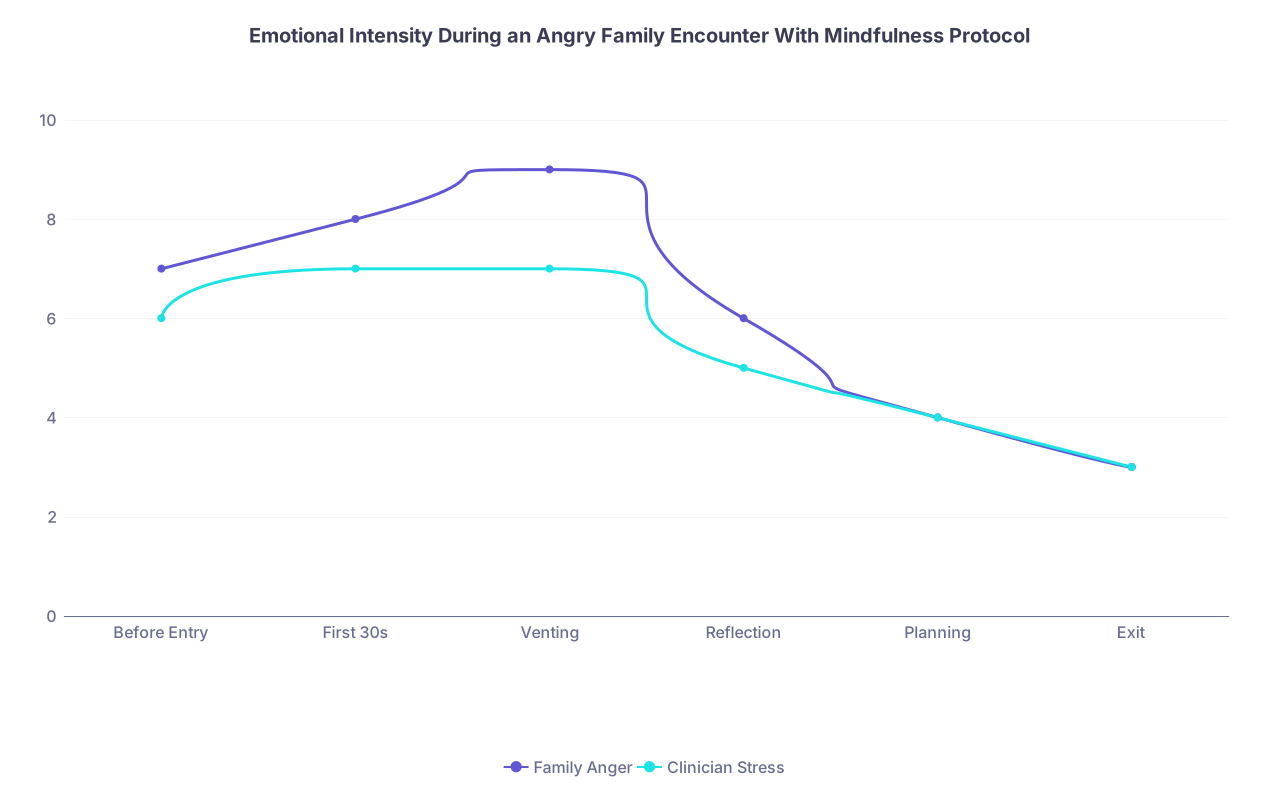
| Category | Family Anger | Clinician Stress |
|---|---|---|
| Before Entry | 7 | 6 |
| First 30s | 8 | 7 |
| Venting | 9 | 7 |
| Reflection | 6 | 5 |
| Planning | 4 | 4 |
| Exit | 3 | 3 |
Without a script, both lines often go up together and stay high. With a script, your stress line drops earlier, which allows theirs to follow.
Final Thoughts
You will not handle every angry family perfectly. No one does. But you can stop walking into these encounters unarmed.
Three key points to keep:
- You must stabilize your nervous system first. The 30‑second pause outside the door is not optional; it is foundational.
- Use structured language: invite venting, reflect, legitimize, then focus on next steps. Memorize a few anchor phrases and reuse them shamelessly.
- Always close with a clean exit and a short debrief. That protects you from carrying the emotional debris into the rest of your clinic and your life.
Treat this like any other core clinical skill. Practice the script. Refine it. And over time you will shift from “I dread angry families” to “I can handle this. I have a protocol.”