
The way most residents handle night float anxiety is broken. You white‑knuckle through the call, caffeinate the fear, and hope you do not miss something lethal at 03:00.
You do not need another wellness lecture. You need a protocol you can actually run in 5 minutes, in the middle of chaos, without candles or phone apps.
This is that protocol.
Why Night Float Feels So Bad (And Why “Just Cope” Fails)
Night float pressure is not just “being tired.” It is a nasty combination:
- Reduced staffing and supervision
- Higher acuity and sicker patients
- Constant interruptions, pages, and alarms
- Circadian disruption and sleep debt
- The quiet belief: If I screw up, someone dies
On top of that, you are expected to:
- Take cross‑cover on patients you barely know
- Respond to nursing concerns with instant decisions
- Present clearly and calmly in morning handoff after being slammed all night
I have watched smart residents melt down over:
- A rapid response that went sideways, then having to present it at 07:00
- A code that ended in death, followed by two more stat pages before they could even process it
- A senior snapping at them on sign‑out: “Why didn’t you do X?” while they could barely form sentences
The default “solutions” you are offered:
- “Take a deep breath” (vague, useless in a real crisis)
- “Sleep more” (thank you, revolutionary)
- “Practice self‑care” (with what time, exactly?)
What you actually need is something that:
- Fits into 5 minutes or less
- Works in a noisy hallway or call room
- Does not require privacy, equipment, or apps
- Can be used right after a panic spike and right before a high‑stakes presentation
That is exactly what this 5‑minute protocol is designed to do.
The 5‑Minute Night Float Mindfulness Protocol
Think of this as a short code for your nervous system. You call it when:
- Your heart is pounding after a brutal page or code
- You are walking to a difficult patient encounter
- You are about to present on rounds after a chaotic night
- You notice you are shaky, irritable, or mentally foggy
The protocol has 5 steps, roughly 1 minute each:
- Ground: 30–60 seconds
- Breathe: 60–90 seconds
- Label: 30–60 seconds
- Narrow: 60 seconds
- Prime for action: 30–60 seconds
Run it straight through, or use individual steps on the fly.
Step 1: Ground (30–60 seconds)
Goal: Pull your brain out of mental spirals and back into the room you are actually in.
Where: Literally anywhere – hallway, elevator, stairwell, outside a patient’s door.
How:
Plant your feet
- Stand still or sit. Feel your feet in your shoes, your back against a chair or wall.
- Quietly tell yourself: “Here. Now. This body.”
Use the 3–3–3 sensory reset
- Look: Silently name 3 things you can see. (Example: “Blue curtain. IV pump. Door sign.”)
- Hear: Name 3 things you can hear. (Monitor alarm. Footsteps. Vent hum.)
- Touch: Notice 3 points of contact. (Feet in shoes. Pen in hand. Badge on chest.)
That is it. No magic. Just dragging your attention from imagined disasters to concrete reality.
Why it works: Panic is future‑focused (“What if I missed something?”). Shame is past‑focused (“I screwed that up.”). Grounding pins you to the only place you can actually act: this exact moment, this exact hallway.
Step 2: Breathe – But Like a Clinician, Not a Spa Ad (60–90 seconds)
You have seen enough respiratory distress to know breathing is physiology, not poetry.
You are going to run a 90‑second controlled respiratory intervention. Two options. Pick one and memorize it.
Option A: 4–6 Breathing (good for general anxiety)
- Inhale through the nose for 4 seconds
- Exhale gently through the mouth for 6 seconds
- Aim for 6–8 breaths total
This slightly prolongs exhalation, which tilts your autonomic balance toward parasympathetic.
Option B: Physiological Sighs (good for acute panic)
Use when you feel like your chest is tight and you cannot get a full breath.
- Take a normal inhale through the nose
- At the top, take a second short inhale to “top off”
- Then exhale slowly and completely through the mouth
- Repeat 3–5 times
You can do this walking between patients. No one will notice.
Key rule: Do not overdo it. 60–90 seconds is enough. You are not trying to “zen out.” You are just dropping your arousal one notch so you can think.
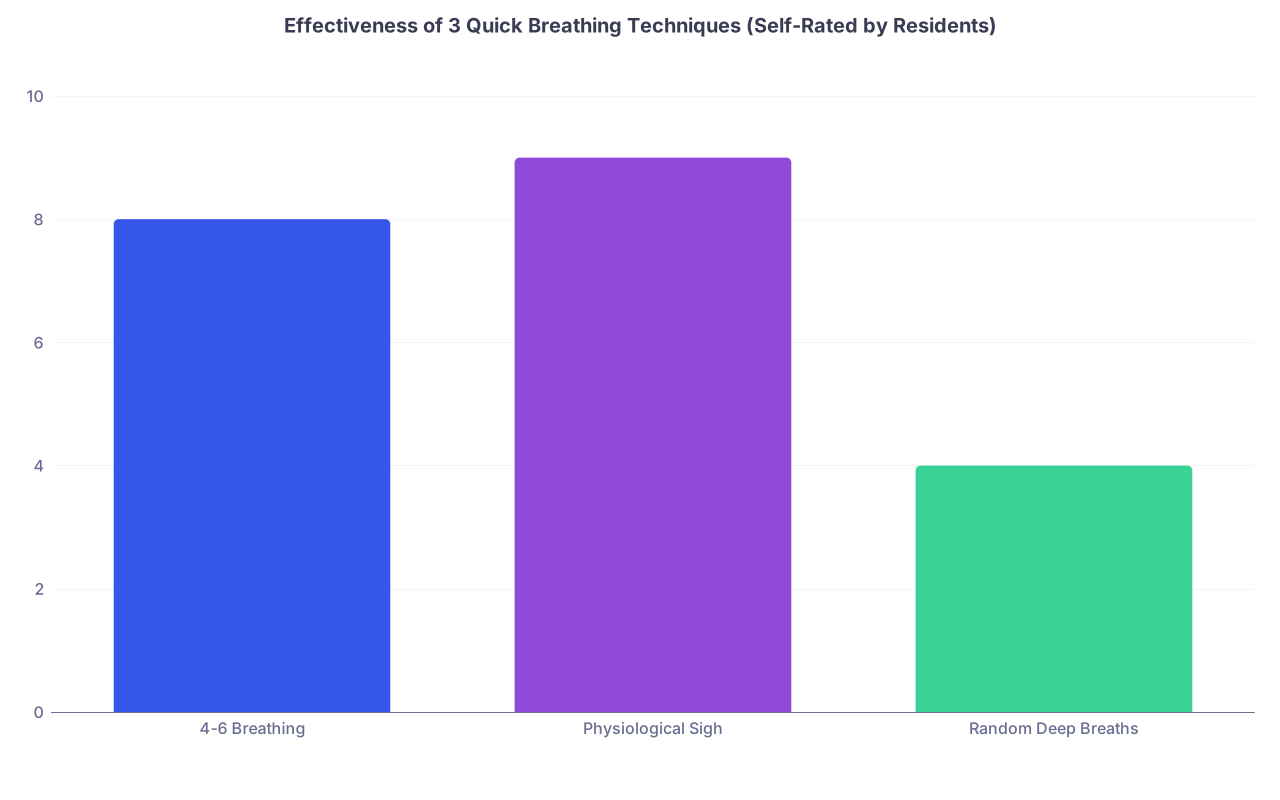
| Category | Value |
|---|---|
| 4-6 Breathing | 8 |
| Physiological Sigh | 9 |
| Random Deep Breaths | 4 |
(Scale: 0 = useless, 10 = reliably helps. This approximates what I have heard over and over when I ask residents what actually calms them fastest.)
Step 3: Label – The 20‑Second Shame Disruptor (30–60 seconds)
Your brain loves vague self‑attacks:
- “I am a disaster.”
- “I cannot handle this.”
- “They will realize I should not be here.”
You are going to slice that into something specific and observable.
Use a simple script, silently:
“Right now I am noticing: [emotion] in my [body location] while I am [actual situation].”
Examples:
- “Right now I am noticing anxiety in my chest while I am standing outside 814 about to tell a family their dad is crashing.”
- “Right now I am noticing shame in my stomach while I am walking to handoff after missing that potassium recheck.”
No analysis. No fixing. Just label.
Why: A ton of evidence shows that affect labeling (putting feelings into words) reduces amygdala activation. In human language: if you can name it precisely, it stops owning you as much.
Step 4: Narrow – One Task, 60 Seconds (60 seconds)
This is where most residents blow it. You ground, you breathe, you label, and then your mind immediately explodes again into:
- “What about the GI bleeder?”
- “Did I sign that tylenol order?”
- “What is the code status on 730?”
You are going to enforce brutal single‑task focus for one minute.
Ask one question:
“What is the very next concrete action I need to take in the next 60 seconds?”
Make it tiny and specific:
- “Walk to 622 and look at the patient with the desat.”
- “Open the chart and check the last blood pressure.”
- “Say the first sentence of my presentation aloud in my head.”
Then lock on to that. For one minute you are not allowed to worry about the whole night, the whole service, or your whole career. You are only allowed to execute that next action.
You can even say to yourself:
“Everything else can wait 60 seconds. This one thing, now.”
It feels almost stupidly simple. That is the point.
Step 5: Prime for Action – A 30‑Second Mental Script (30–60 seconds)
Last step. You are going to load a deliberately boring self‑statement before you walk into the room or start presenting.
You are not trying to hype yourself up. You are trying to be precise and functional.
Use one of these short scripts, or write your own:
Before a difficult patient encounter:
“My job for the next few minutes is to get the most accurate picture I can and keep this patient safe.”
Before presenting at morning sign‑out:
“My job is to clearly summarize what happened and what I am worried about. I am not here to be perfect, I am here to be clear.”
After a complication or near‑miss:
“My job now is to stabilize what I can, communicate clearly, and make sure this does not get repeated.”
Then move. Do the thing.
Putting It Together: The 5‑Minute Script
Here is the full sequence as something you can memorize:
- Ground – “Here. Now. This body.” 3 things I see, hear, and feel.
- Breathe – 6–8 breaths of 4–6 or 3–5 physiological sighs.
- Label – “Right now I am noticing [emotion] in [body] while I am [situation].”
- Narrow – “What is the next concrete action in the next 60 seconds?” Do only that.
- Prime – “My job right now is to [simple functional goal].” Then execute.
Use this after a panic spike, and use a shorter version before you present:
- 1 quick breath
- 1 label
- 1 prime sentence
30–45 seconds, tops.
Real Scenarios: How To Use It On Actual Night Float
Let us walk through a few situations I have seen play out.
Scenario 1: The 2 a.m. Rapid Response
You just had:
- Rapid on 6E
- BP 70s, sats in the 80s, delirious patient
- You fumbled the initial orders, nurse looked irritated, attending sounded frustrated on the phone
Your body: shaking hands, tight chest, brain replaying every misstep. Pager still going off.
Run the protocol in the elevator:
- Ground – Feel your feet, the wall behind you. “Elevator panel. Red emergency button. Floor sign.” Hear the hum, the distant alarms.
- Breathe – 3–4 physiological sighs.
- Label – “Right now I am noticing fear in my chest and shame in my stomach while I am riding the elevator back to the floor after a rapid that went badly.”
- Narrow – “Next action in 60 seconds: open the chart, confirm current vitals and meds, document key events.”
- Prime – “My job now is to document cleanly and make sure the follow‑up orders are correct.”
You are not fixing the whole night. You are executing the next step without your nervous system hijacking you.
Scenario 2: Presenting a Messy Night at Morning Handoff
It is 06:55. You have:
- 4 new admits
- 2 near‑misses
- Labs still pending
- A senior who likes to grill for “learning points”
Old pattern: You rush in, overtalk, ramble, and forget critical details. Then you beat yourself up all day.
New pattern: Run a 90‑second “micro‑protocol” just before sign‑out.
Standing in the hall:
- Ground – Look at 3 things, feel 3 contact points.
- Breathe – 4 slow 4–6 breaths.
- Label – “Right now I am noticing anxiety in my chest while I am waiting to present a complicated night.”
- Narrow – “Next 60 seconds: organize my mental outline for the sickest patient first.”
- Prime – “My job is to make sure they understand what happened, what I am worried about, and what needs follow‑up. Not to impress anyone.”
Result: Usually shorter, cleaner presentations. Less beating yourself up afterward.
Scenario 3: Ethical Gut‑Punch – Family Wants “Everything” For a Dying Patient
You are:
- The only resident in house for medicine
- Nurse calls: family upset, patient deteriorating, DNR/DNI status unclear
- You step into a room full of fear, denial, and anger
Use the protocol outside the door. This is not “self‑care.” This is ethical preparation.
- Ground – Door handle, room number, feel your feet.
- Breathe – 3–5 slow breaths.
- Label – “Right now I am noticing dread in my throat while I am about to walk into a family meeting about a dying patient whose code status is unclear.”
- Narrow – “Next action: introduce myself, listen for 30 seconds before explaining anything.”
- Prime – “My job is to tell the medical truth clearly and compassionately, and to align care with what we know of the patient’s values.”
You will handle that conversation better from this state than from panic, guilt, or rushing.
Why This Is Not Fluffy Wellness Nonsense
This protocol is not about feeling good. It is about:
- Reducing error – Panic and cognitive overload kill working memory. Short mindfulness resets improve attention and task accuracy.
- Ethical practice – When you are in fight‑or‑flight, you default to defensive medicine (“scan everything, admit everyone”) or avoidance (“just follow the last note”). Brief grounding lets you think about what is actually right for this patient.
- Durable performance – The goal is not to be calm. The goal is to stay functional across a 12‑hour night without mental collapse.
Here is how this approach stacks up against the usual “advice”:
| Strategy | Time Cost | Actually Calms Physiology | Improves Clarity | Usable Mid‑Shift |
|---|---|---|---|---|
| Extra caffeine | Low | No | Often worse | Yes |
| Venting in call room | 10–20 min | Maybe briefly | Often scattered | Sometimes |
| Scrolling phone | 5–30 min | No | Worse | Yes |
| 5‑minute protocol | 3–5 min | Yes | Yes | Yes |
You do not have time for 20‑minute meditations during a code‑heavy night. You do have 60 seconds in an elevator.
How To Make This Automatic (So You Actually Use It)
You will not remember this protocol at 03:30 unless you hard‑wire a few triggers.
1. Choose One Trigger Situation
Do not try to use it “whenever I feel stressed.” That is too vague. Pick a single, concrete trigger:
- “Every time I get a rapid response page.”
- “Every time I walk into morning sign‑out.”
- “Every time I leave a room after a bad outcome or angry encounter.”
For 1–2 weeks, use the protocol only in that context. Build the habit there first.
2. Use a 1‑Line Pocket Card
Write the 5 steps in dirty shorthand and stick it behind your badge:
Ground – Breathe – Label – Narrow – Prime
You do not need the full script once you know the structure.
3. Practice Once Off‑Shift
Run through it a couple of times during the day when you are not panicked:
- Sitting at your desk
- Walking between conference and clinic
- Lying in bed before sleep
If the first time you use this is in the middle of a code, you will butcher it. That is fine, but practice makes it smoother.
Ethics, Professionalism, and Self‑Regulation
This is under “Personal Development and Medical Ethics” for a reason.
Your ability to self‑regulate under pressure is not optional. It is part of being a safe, ethical physician.
Here is where this intersects directly with ethics:
- Informed consent and communication – If you are flooded, you rush explanations, you skip checking understanding, you default to “standard” instead of what fits this patient.
- End‑of‑life decisions – Your own discomfort with death can quietly push you toward “do everything” even when it means suffering without benefit. Grounding and labeling your dread makes space to actually hear the patient’s values.
- Fairness and bias – When you are exhausted and panicked, you are more likely to stereotype: “Frequent flyer,” “noncompliant,” “drug seeker.” A 60‑second reset before you walk in gives you a shot at seeing the person, not the label.
- Honesty with colleagues – If you are locked in shame, you hide near‑misses and mistakes. Mindfulness does not erase shame, but it stops it from turning into secrecy. You can say, “Here is where I think I messed up last night; we should talk about it.”
You will not always get this right. No one does. But having a protocol gives you a fighting chance.
Adapting The Protocol To Your Personality
Some people hate the word “mindfulness.” Fine. Call it a 5‑minute pre‑frontal reboot if that makes it more tolerable.
Adjust these elements:
- If you are very cognitive: Emphasize Step 3 (Label) and Step 4 (Narrow). Make it about precision of thought.
- If you are very somatic or anxious: Emphasize Step 2 (Breath) and Step 1 (Ground). Make it about body sensation first.
- If you are ashamed of “needing” this: Frame it as part of your error‑reduction strategy. Same way you double‑check allergies, you double‑check your nervous system.
You can also tie it to your existing habits:
- Religious? Treat it like a 1‑minute prayer before a hard case.
- Sports background? Think of it as your pre‑shot routine at the free‑throw line.
- Military background? It is your pre‑mission check‑in.

| Step | Description |
|---|---|
| Step 1 | Stress Spike |
| Step 2 | Mini Protocol |
| Step 3 | Full Protocol |
| Step 4 | Ground + 1 Breath + Prime |
| Step 5 | Ground + Breath + Label + Narrow + Prime |
| Step 6 | Act |
| Step 7 | Time Available |
Two High‑Yield Add‑Ons (If You Want Extra)
If you have the bandwidth, these two tiny add‑ons can make the protocol even more powerful.
Add‑On 1: One‑Line Debrief After the Shift
Before you leave the hospital or before sleep, ask:
“What is one moment from tonight that I want to remember, and one I want to learn from?”
Write them as single bullet points in your notes app or on paper. Not paragraphs.
Over weeks, this stops nights from becoming a blur of “everything sucked” and gives your brain structure: something you did well, something you will improve.
Add‑On 2: Brief Values Reminder Once a Week
Night float can turn medicine into a video game: labs, vitals, pages. People become objects.
Once a week, 2 minutes, write this down:
- “Why did I go into medicine?”
- “What kind of physician do I refuse to become?”
Then look at your answer right before a night shift. It quietly shapes how you show up in difficult calls.
FAQs
1. What if I literally have no time – I am being paged nonstop?
Then use an ultra‑compressed version:
- One grounding cue: feel your feet
- One physiological sigh
- One prime sentence: “My job in the next 60 seconds is to [X].”
That is 10–15 seconds. Use it in the elevator, walking down the hall, or even while the phone is ringing.
2. Is this supposed to replace therapy, meds, or formal support?
No. If you are dealing with significant anxiety, depression, PTSD, or burnout, this protocol is not a complete treatment. It is a field tool, like a tourniquet – useful, often essential, but not definitive care. Use it alongside proper medical and psychological support, not instead of them.
3. What if I try this and still feel terrible or panicked?
You probably will, sometimes. The point is not to erase the feeling, it is to be able to function anyway with a little more clarity and a little less chaos. Judge it by one metric: “Do I make slightly clearer decisions and communicate slightly better when I use this?” If the answer is yes, that is success. If the answer is consistently no after a few weeks, adjust the steps or talk with someone who can help you troubleshoot.
Key takeaways:
- Night float will never feel easy, but a 5‑minute, in‑place protocol can reliably drop your arousal just enough to think straight.
- Ground–Breathe–Label–Narrow–Prime is simple, portable, and built to work in hallways, not meditation studios.
- Using this is not self‑indulgence; it is part of being a safe, ethical physician who can act clearly under pressure.