
The way most ICU physicians handle post‑code stress is broken. White‑knuckling it and “just moving on” is not resilience. It is slow, quiet erosion.
You need a protocol. Not vague self‑care platitudes. A tight, repeatable post‑code decompression checklist you can run in 3–7 minutes without disrupting patient care, that keeps you clinically sharp and ethically grounded.
That is what we are building here.
Why You Need a Post‑Code Checklist (Even If You Feel Fine)
In the ICU, you do not get clean emotional endings. You go from chest compressions to family updates to insulin drips in the next room. If you do not deliberately reset, three things start to happen:
- Your micro‑errors increase: sloppy orders, missed trends, shorter fuse with nurses.
- Your moral fatigue builds: you start resenting families, labeling patients as “train wrecks.”
- Your inner compass dulls: it gets easier to justify cutting small ethical corners because you are exhausted.
I have watched strong intensivists go from calm leaders to brittle, sarcastic shells over five years of “just doing the job.” Not because they lacked grit. Because they had no post‑event hygiene.
Think about your usual code sequence:
- Pre‑code: already tired, multiple tasks in progress.
- Code: surge of adrenaline, rapid decisions, high stakes.
- Post‑code: documentation, calls, order clean‑up, move on.
Where in that pipeline have you built in any moment to:
- Off‑load the somatic residue,
- Check your own cognitive function,
- Align what just happened with your ethics?
Exactly. Nowhere.
So we fix it. Like you would fix any broken process in the unit: with a checklist.
The Core: The Post‑Code Decompression Checklist
This checklist is designed to be:
- Fast – 3 to 7 minutes max, usually done in two short blocks.
- Repeatable – same sequence after every significant resuscitation (even “easy” ones).
- Portable – works on nights, in crowded units, with short staffing.
Here is the skeletal framework first. We will then break it down step‑by‑step.
| Step | Focus |
|---|---|
| 1 | Immediate physiological reset |
| 2 | Micro‑cognitive check |
| 3 | Ethical / narrative framing |
| 4 | Team micro‑debrief |
| 5 | Short follow‑up later |
We are going to turn this into a very concrete, almost mechanical sequence. So that even on your worst shift you have something reliable to fall back on.
Step 1: Immediate Physiological Reset (60–120 seconds)
Your body is flooded with catecholamines after a code. If you ignore that, you carry jittery, narrowed‑focus thinking into the rest of your shift.
You need a quick downshift protocol you can run as soon as the dust settles and the patient is either stabilized or pronounced.
Where to do this:
- In the empty room after the team leaves.
- Or in the medication room.
- Or in a quiet corner of the hallway, back against the wall.
A. Grounding: 3‑Point Contact
Time: ~15 seconds.
- Plant both feet flat on the floor.
- Notice three points of contact:
- Feet on the ground
- Back or shoulders against wall/chair
- Hands (on thighs or folded)
- Silently label: “Feet. Back. Hands.”
That is it. You are giving your nervous system a signal: we are not coding anymore.
B. Box Breathing: 3 Cycles
Time: ~60 seconds.
Use a very simple pattern:
- Inhale through nose for 4 seconds.
- Hold for 4 seconds.
- Exhale slowly through mouth for 4 seconds.
- Hold empty for 4 seconds.
Repeat this three times.
You can do this with your eyes open, staring at a spot on the floor. Nobody will know what you are doing. To keep your brain engaged, you can pair it with a short phrase on each exhale:
- On exhale: “Reset.”
- Or: “Next patient.”
One word. Nothing fluffy.
C. Quick Body Scan: Red‑Flag Check
Time: ~30–45 seconds.
Scan from head to toe with one simple question:
“Is there any tension I can release by 5% right now?”
Hit the usual suspects:
- Jaw (unclench)
- Shoulders (drop them)
- Hands (uncurl fists)
- Belly (loosen)
You are not doing spa‑day relaxation. You are shaving off the peak of tension so you think more clearly.
Non‑negotiable rule:
You complete Step 1 before you start major new tasks, unless another patient is actively crashing. If there is another active emergency, you at least do one slow exhale and a quick “feet‑back‑hands” grounding as you move.
Step 2: Micro‑Cognitive Check (30–60 seconds)
Right after a code, physicians often:
- Miss orders,
- Forget to call a consultant,
- Miscommunicate to the nurse.
Your next errors are not usually about knowledge. They are about a flooded, scattered brain.
So you run a 30‑second cognitive system check.
A. Three‑Question Self‑Check
Quietly ask yourself, in order:
- “Do I know the current status of my other sickest patient?”
- If no, that is your next stop.
- “Is there any outstanding stat task from this code?”
- Examples: post‑intubation sedation, EKG, lactate, calling family.
- “Do I feel rushed, angry, or foggy right now?”
- If yes, mentally flag: “No complex decisions for 5 minutes if avoidable.”
You are not fixing feelings here. You are identifying high‑risk cognitive states.
B. Micro‑List: 3 Most Critical Next Actions
Grab your rounding list or a scrap of paper.
Write down exactly three bullet points:
- One task related to this code (e.g., “document code summary,” “update family,” “adjust pressors”)
- Two tasks for your next priority patients.
Just three. You are anchoring your mind to a defined next sequence instead of spinning.
Step 3: Ethical and Narrative Re‑Centering (90–180 seconds)
Here is where mindfulness meets medical ethics. Codes mess with your moral terrain:
- You may doubt whether it was right to keep going.
- You may feel guilt for what you could not do.
- You may feel angry at systemic failures or delayed recognition.
If you never work with those reactions, they calcify into cynicism.
You need a fast narrative reset that honors the gravity without dragging you into rumination.
A. 3‑Line Ethical Reflection
This is not a diary. It is a tight script you can run mentally or whisper under your breath while walking.
Fill in these three internal sentences:
- “The central ethical tension in that code was: ______.”
- Example: “balancing low chance of meaningful recovery vs family hopes.”
- “Given what I knew at the time, I chose to prioritize: ______.”
- Example: “honoring prior patient wishes for full code documented last month.”
- “One thing that aligned with my values was: ______.”
- Example: “we treated the patient with dignity and clear communication.”
Notice: you are not asking “Did I do it perfectly?” You are asking “Where did I stand, ethically, in that storm?”
That distinction matters. It prevents the lazy self‑attack that leads to burnout.
B. One‑Line Compassion Statement (for Patient and Self)
You will roll your eyes the first time. That is fine. Do it anyway.
For the patient (silently):
“May you be free from suffering.”
Or: “I acknowledge your struggle and your life.”For yourself (silently):
“I showed up fully for that code.”
Or: “I did the best I could with what I had.”
You do not have to feel compassion to say it. The practice is about direction of attention, not warm fuzzies.
Step 4: Team Micro‑Debrief (2–4 minutes)
Skipping this is a mistake. You are not the only one carrying that code.
If you want a stable ICU culture and fewer moral injuries, you make mini‑debriefs routine. Not long formal sessions. Two to four minutes. Standing. Right there.

| Step | Description |
|---|---|
| Step 1 | Code Ends |
| Step 2 | Stabilize or Pronounce |
| Step 3 | Quick Personal Reset |
| Step 4 | Micro Debrief |
| Step 5 | Schedule Later Check |
| Step 6 | Return to Patient Care |
| Step 7 | Team available 2 minutes |
A. When and Where
- Right after the main flurry of orders is done.
- In the room or just outside.
- Only necessary people: MD, primary nurse, RT, maybe charge nurse.
If the unit is on fire, you postpone. But you try to catch it within an hour.
B. The 4‑Question Script
Keep it brutally simple. You, as team leader, can own this.
Ask, in order:
- “What went well in that code?”
- “What, if anything, should we do differently next time?”
- “Is there anything from that case that is sitting heavily with anyone?”
- “Does anyone need a quick break before we move on?”
You are trying to achieve three things:
- Surface learning points (systems/technical).
- Acknowledge emotional load without forcing disclosure.
- Give explicit permission to step away briefly.
You are not running group therapy. You are normalizing that:
- Codes are ethically heavy.
- It is acceptable to say, “That was hard.”
C. Set One Concrete Change
If a real systems problem surfaces (e.g., delay in meds, confusion about roles), lock in one action:
- “We will update the code cart layout before next week.”
- “Charge will assign a clear recorder at the start of every code.”
- “We will put the family communication plan in the code protocol.”
Write it down. Send one email. Minimal but real.
Step 5: Short Follow‑Up Later (5–10 minutes in Off‑Peak Time)
Some codes stick. You find yourself replaying them at 2 a.m. two nights later. That is a sign you need a second‑pass decompression, not more coffee.
This is not after every code. This is when one of the following is true:
- Unexpected outcome (young patient dying, missed diagnosis).
- Ethical conflict (team disagreement about futility).
- Personal trigger (reminds you of your own family, prior trauma).
A. 5‑Minute Solo Review
At some point in the next 24 hours (or at worst 72):
- Sit somewhere you will not be interrupted for 5 minutes.
- Grab a notepad or open a blank note.
Write very briefly under four headings:
- Facts: 3–6 bullet points of what actually happened.
- Feelings: 3 words only (e.g., “frustrated, sad, doubt”).
- Lessons: 1–2 specific improvements, clinical or procedural.
- Let‑Go: 1 sentence of what you are consciously not going to keep carrying.
Example of “Let‑Go” line:
“I am letting go of the fantasy that a perfect code would have saved this patient with end‑stage cirrhosis.”
You are turning a looping memory into a structured narrative with an endpoint.
B. Moral Distress Triage
Moral distress is not just “feeling bad.” It is that specific stomach knot when you feel you could not do what you believed was right.
Use this triage:
- Green – Discomfort but no lingering conflict. The checklist is enough.
- Yellow – Ongoing unease about decisions; thinking of it daily. Share with a peer, ethicist, or mentor.
- Red – Intrusive thoughts, sleep disruption, dread about similar cases. That is not weakness. That is an alarm. You need structured support: wellness, ethics consult, or counseling.
You would not ignore a rising lactate. Do not ignore this either.
Making It Real: Integrating the Checklist Into Your Day
A protocol is useless if it dies in your notes app.
You need to operationalize this. Like any ICU procedure.
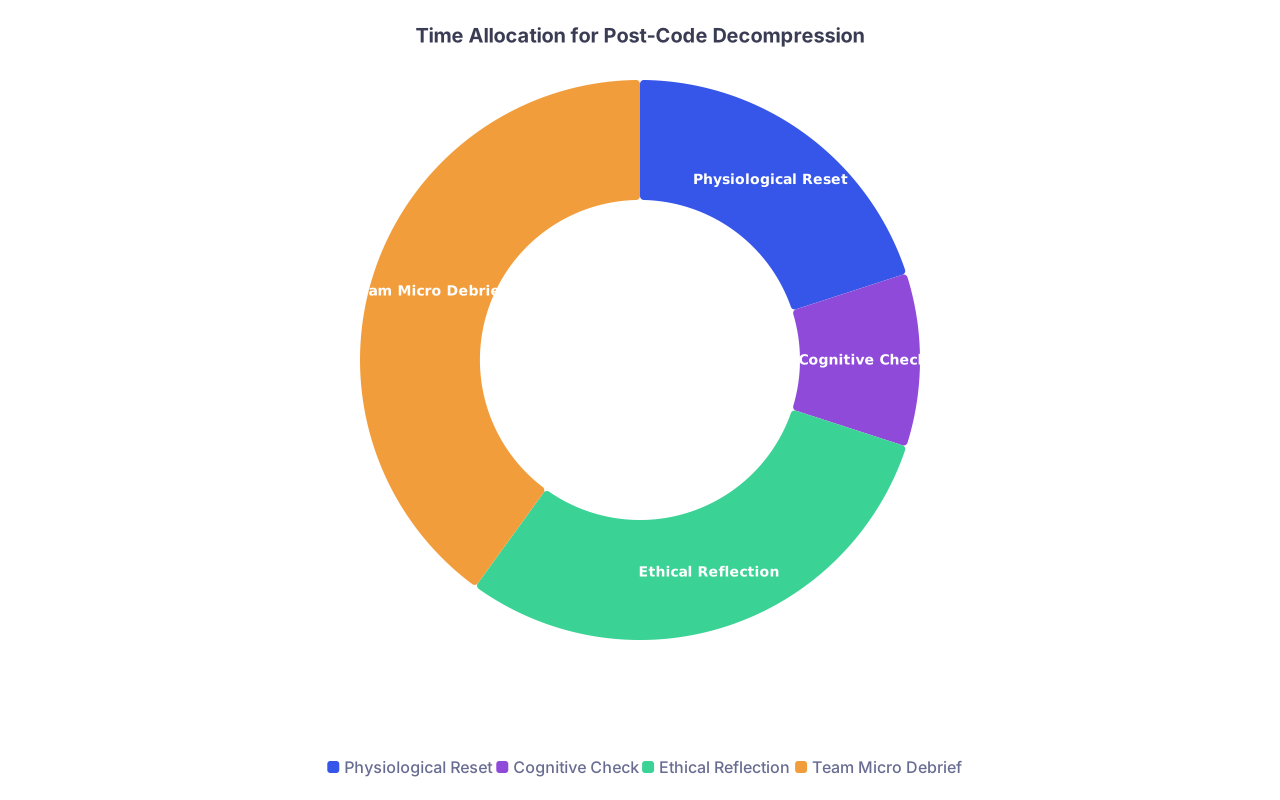
| Category | Value |
|---|---|
| Physiological Reset | 2 |
| Cognitive Check | 1 |
| Ethical Reflection | 3 |
| Team Micro Debrief | 4 |
A. Physical Reminders
Concrete ideas I have seen work:
- A small sticker on your ID badge: “3–1–3–2” (your customized step times in minutes).
- A mini card in your white coat pocket with the four debrief questions.
- A note taped inside the code room cabinet: “Code done? Breathe x3. Debrief x3 Qs.”
This keeps the checklist from living only in your head, where it will lose to adrenaline every time.
B. Team Norms
You are not doing this alone in a vacuum. That burns out faster.
At your next ICU team meeting or resident teaching session, say something like:
“We are starting a 3‑minute post‑code micro‑debrief with four fixed questions. I will lead it at the end of codes whenever staffing allows. It is part of safe care, not optional fluff.”
Then do it. Consistently. After 2–3 weeks, the nurses and RTs will start expecting it. Some will even nudge you if you forget.
C. Protecting the Time Without Abandoning Patients
Yes, you are busy. No, you are not too busy to take 180 seconds to keep yourself from making stupid, preventable mistakes.
Tactics:
- When the code ends, say aloud:
“We are going to take 2 minutes to reset and debrief, then we will move on to other patients.”
That signals to everyone: this is part of the work. - If another room is unstable:
- Do a 30‑second version now (3 breaths + 1 debrief question: “What should change next time?”)
- Commit to a shorter follow‑up debrief later in the shift.
Layering Mindfulness Without Making It Woo‑Woo
You might hate the word “mindfulness.” Fine. Call it operational awareness. The content is the same.
Here is what you are actually doing in each step:
- Step 1 (Physiological Reset) – Built‑in down‑regulation. You are preventing tunnel vision.
- Step 2 (Cognitive Check) – Real‑time metacognition. You are checking if the “pilot” is impaired before you take off again.
- Step 3 (Ethical Reflection) – Moral alignment. You are tying actions to values in the middle of chaos.
- Step 4 (Team Debrief) – Collective sense‑making. You are preventing isolated, corrosive stories from taking root.
- Step 5 (Follow‑Up) – Memory consolidation with agency. You are shaping the narrative instead of being dragged by it.
That is all mindfulness is here: paying directed attention to your inner state and its impact on your actions, on purpose, for a few minutes.
You are not trying to feel calm. You are trying to stay effective and humane.
Example: Running the Checklist After a Brutal Code
Let me give you a concrete run‑through.
Scenario:
56‑year‑old with septic shock. Prolonged code, 40 minutes. Family outside the room. Patient does not make it. You call time of death.
What this looks like with the checklist:
- Code ends. Orders completed. Nurse starts post‑mortem care; family is being updated by social work for 2 minutes.
- You step to the corner of the room, lean lightly on the counter.
- Feet flat. Back on wall. Hands on pockets.
- Three cycles of box breathing.
- Quick release of jaw and shoulders.
- In your head:
- “Central tension: low chance of meaningful recovery vs family hope.”
- “I prioritized: giving a full effort consistent with their expressed wishes.”
- “Aligned with values: we maintained respect and clear communication throughout.”
- Walk out; in the hallway you find the nurse and RT.
- “Two‑minute debrief, team.”
- “What went well?” (RT: “Airway was fast, meds were ready.”)
- “What do we change next time?” (Nurse: “We should have assigned a second IV person early.”)
- “Anything sitting heavy with anyone?” (Nurse: “Feels awful that family did not really understand her prognosis before this.”)
- “Anyone need a quick break?” (RT: “I am good; nurse steps out for 2 minutes.”)
- You glance at your list. Write:
- “Call son; clarify events and prior prognosis.”
- “Check on ARDS patient in 14.”
- “Update antibiotics on patient in 9.”
Then move.
Later, during a lull:
- 5‑minute solo review.
- You note: “Let‑Go – I am releasing the idea that more compressions would have created a different outcome.”
That is the full loop. Less than 10 minutes of “non‑productive” time, which in reality protects hours of sharper, more ethical practice.
Ethics, Professional Identity, and Long‑Game Sustainability
This is not just stress management. It is professional identity work.
Every code is an ethical event:
- Autonomy vs beneficence.
- Goals of care vs technological capability.
- System delays vs individual responsibility.
If you ignore that layer, you start to split yourself:
- Public persona: competent, decisive, unbothered.
- Private mind: conflicted, guilty, checked‑out.
Over time, that gap hurts. It shows up as:
- Sarcasm about families “not getting it.”
- Numbness about death.
- Or avoidance of the sickest patients.
The checklist keeps you in dialogue with your own ethics while still doing the job.
It also sends a message to trainees:
“We do not just run codes. We metabolize them. Together.”
That has ethical weight. You are modeling that moral reflection is part of competence, not a luxury.
Customizing the Checklist to Your Reality
You do not need to adopt my version verbatim. You do need to standardize something.
Ask yourself:
- How many minutes can I realistically protect after most codes?
- What minimum elements must I hit? (I recommend at least: 3 breaths, 3‑question debrief.)
- What phrasing feels natural out of my mouth?
You could collapse it into a 3‑step version if time is brutal:
- Reset: 3 box breaths + feet‑back‑hands.
- Reflect: 2 internal lines – “Ethical tension was… I prioritized…”
- Debrief: 3 questions – “What went well? What to change? Anyone need a break?”
Or if you are attending with trainees, expand Step 3 to teach ethical reasoning explicitly for 2–3 minutes.
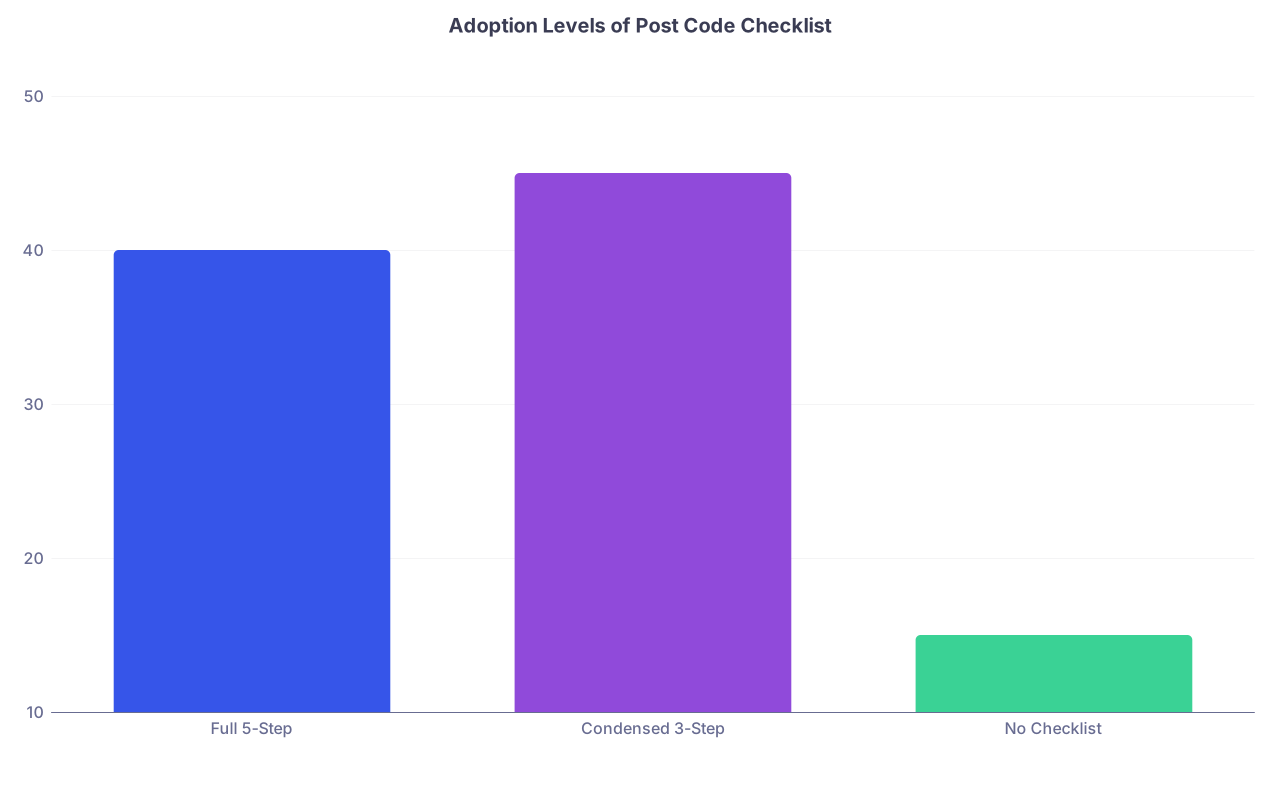
| Category | Value |
|---|---|
| Full 5-Step | 40 |
| Condensed 3-Step | 45 |
| No Checklist | 15 |
When This Is Not Enough
There are situations where a checklist is necessary but not sufficient:
- Multiple catastrophic outcomes in a single shift.
- Cases that mirror your own personal history too closely.
- Chronic under‑resourcing turning every code into moral injury.
Warning signs you need more than this:
- You are dreading going to work mainly because of codes and deaths.
- You are self‑medicating heavily after shifts.
- You feel detached and indifferent even during resuscitations.
At that point, the most ethical move is to escalate:
- Peer or mentor conversation focused on ethics, not just logistics.
- Institutional wellness or confidential counseling.
- Ethics consults for recurrent patterns (e.g., chronic futility cases).
You would not keep managing refractory shock with only fluids. Do not manage refractory moral shock with only a breathing exercise.
Bringing It All Together
You work in a place where people die in front of you while you are trying to stop it. That does not become “normal.” It becomes familiar. There is a difference.
A post‑code decompression checklist is how you respect that difference, protect your judgment, and stay aligned with the physician you meant to be.
To keep it simple, remember:
- Build a short, non‑negotiable ritual after codes: reset your body, check your mind, name the ethical tension.
- Make micro‑debriefs standard practice for your team: four questions, two to four minutes, every significant code.
- Use a brief follow‑up for sticky cases so they become integrated lessons, not endless mental replays.
You do not control outcomes. You absolutely control whether you treat yourself and your team as disposable in the process. The checklist is how you refuse to do that.