
You are at the doorway of the conference room.
The patient is crashing upstairs. Three family members are already seated, arms crossed, one visibly angry. Someone said on the phone, “If he dies, it’s on you.” Your pager just went off. Again.
You have exactly 90 seconds before you walk in.
If you try to “wing it” on grit and good intentions alone, you will get hijacked by the conflict. Not maybe. You will. That is how human brains are wired under threat.
You need a game plan. A concrete, repeatable, almost muscle‑memory protocol that lets you:
- Keep your nervous system out of meltdown
- Stay ethically clear when everyone else is spinning
- Communicate in a way that reduces—not fuels—conflict
That is what this is: a practical mindfulness playbook specifically for high‑conflict family meetings in medicine.
1. The 90‑Second Pre‑Meeting Reset
If you only implement one piece of this article, make it this one.
You need a micro‑protocol you can run between the elevator and the conference room that shifts you from “reactive clinician” to “regulated leader.”
Use this 4‑step sequence. It takes about 60–90 seconds.
Step 1: Ground in your body (15–20 seconds)
You cannot think ethically when your body thinks you are under attack.
While walking or standing outside the room:
Feel your feet.
- Notice where your heels and toes press into the floor.
- Silently label: “Feet. Floor.”
Drop your shoulders.
- Inhale normally.
- Long exhale through pursed lips, as if you are slowly cooling hot soup.
Micro‑scan.
- Jaw, neck, hands, stomach.
- Loosen whatever is clenched.
- If you cannot relax it fully, just soften it 5–10%.
That is enough to start to shift out of full fight‑or‑flight.
Step 2: Three‑breath reset (20–30 seconds)
You do not need a 10‑minute meditation. You need 3 deliberate breaths.
Breath 1 – Arrive
- Inhale through the nose.
- Exhale and think: “Here.”
Breath 2 – Anchor
- Inhale.
- Exhale and think: “Grounded.”
Breath 3 – Intention
- Inhale.
- Exhale and think: “Help.”
This sounds soft. It is not. It is a rapid autonomic nervous system intervention that lowers sympathetic tone enough so your prefrontal cortex comes back online.
Step 3: Name your reactive story (15 seconds)
Your mind is already running a script:
- “They are unreasonable.”
- “I do not have time for this.”
- “If they sue, I am screwed.”
Name it. Out loud in your head:
- “Story: They are going to attack me.”
- “Story: I’m going to fail this family.”
Then add: “This is a story, not a fact.”
You are not deleting it. You are disarming it. Naming the story creates a bit of cognitive distance so you do not unconsciously act from it.
Step 4: Set 1 ethical intention (10–15 seconds)
High‑conflict meetings go bad when you walk in with 6 half‑formed goals. Choose one clear intention that is within your control:
- “My job is to be honest and kind.”
- “My job is to protect the patient’s values.”
- “My job is to listen deeply before I speak.”
Pick one. Repeat it once on the doorknob. Then walk in.
2. A Simple 3‑Phase Structure For Any High‑Conflict Meeting
Most meetings blow up not because families are terrible, but because the conversation is chaotic. People feel unsafe, unheard, and disrespected.
So give the meeting a spine.
Use this 3‑phase structure. Do not announce it as “my 3‑phase protocol” unless you want to sound like a webinar. Just follow it.

| Step | Description |
|---|---|
| Step 1 | Pre Reset |
| Step 2 | Phase 1 Stabilize |
| Step 3 | Phase 2 Clarify |
| Step 4 | Phase 3 Decide and Close |
Phase 1: Stabilize the room (first 5–10 minutes)
Goal: Reduce emotional voltage and signal psychological safety.
Concrete moves:
Own the structure upfront
- “I am glad you are all here. These conversations are hard, so I want to suggest how we spend our time: first I listen and make sure I understand your concerns, then I share what is happening medically, and together we talk about next steps. Does that sound okay?”
You are doing three things:
- Lowering uncertainty (huge for anxiety)
- Showing you expect to listen first
- Establishing that “together” is the frame
Name the elephant quickly but neutrally
- “I know there is a lot of frustration and fear right now.”
- “I heard on the phone earlier that some of you are worried we are giving up.”
You are not debating. You are telling the room: “I see the conflict; I am not running from it.”
Seat and eye‑contact strategy
- Sit at eye level, not towering over anyone.
- Angle your chair slightly—not directly squared off like a debate, not turned away.
- When someone is angry, give them short but steady eye contact while they speak, then briefly look down to your notes before answering. It dials down the sense of confrontation.
Phase 2: Clarify before you educate (10–20 minutes)
Too many clinicians lead with a lecture. Chest X‑rays, labs, prognosis curves. Families are drowning in emotion; you hand them a journal article.
Reverse it.
Use this sequence:
Ask a single open question first
- “Can you tell me what you understand about what is going on with your mom right now?”
- “What worries you most about what might happen in the next few days?”
Then do not interrupt. Let them unload.
Reflect back key emotional content
You want one line that shows you caught the emotional core, not just facts:
- “So you are scared we are not doing everything we can.”
- “You are worried he is suffering and you do not want that for him.”
- “You feel like this was sudden and you have not had time to catch up.”
Short. Plain. No therapy‑speak.
Briefly summarize and ask permission to add
- “Let me make sure I have it: you are scared we are missing something, and you want to be sure we are not giving up too soon. Is that right?”
- [They respond.]
- “Would it be okay if I share what we are seeing from the medical side?”
That last sentence is a power move. You are restoring agency by asking permission. That lowers resistance. People rarely say no. When they say yes, you have a micro‑contract: they just agreed to listen.
Deliver information in one‑minute chunks
Fight the urge to give a full grand rounds.
- Use 1–2 sentence pieces.
- Pause after each chunk.
- Ask, “Does that make sense so far?” or “What questions does that bring up?”
Example:
- “Right now, your dad’s lungs are so damaged that even with the ventilator, his blood is not getting enough oxygen. That is why his other organs are starting to struggle.”
- [Pause, look around, wait.]
- “Because of that, even if we keep doing CPR and shocks if his heart stops, the chance of him surviving and waking up to anything like his usual self is very, very low—less than 1 in 100.”
Phase 3: Decide and close (last 10–15 minutes)
You are not doing “shared suffering.” You are doing shared decision making. The point is to move from endless venting / explaining to a direction.
Use a simple 4‑step move:
Re‑center on patient values
- “When your mom was more herself, what did she say about situations like this? What would she say counts as an acceptable quality of life for her?”
If no explicit prior conversations:
- “Knowing her as you do, what do you think she would say is most important right now—more time at any cost, or comfort and dignity even if that means less time?”
Name the ethical frame out loud
This is where mindfulness meets ethics.
- “My job is to recommend what I think best honors her values, and also what is medically realistic and not harmful.”
You are reminding yourself and the family: this is not “customer service medicine.” There are constraints.
Make a clear recommendation
Stop hiding behind “options.”
- “Based on what you have shared about your father, and what we see medically, I recommend we shift our goal to keeping him comfortable and stop the treatments that are prolonging his dying but not helping him recover. That means we would not do CPR or shocks if his heart stops.”
Then shut up. Do not instantly soften or over‑explain. Let them react.
Negotiate, do not capitulate
They might:
- Demand continued full code “for a few more days”
- Ask for “everything” despite futility
- Split: one sibling wants comfort care, one wants maximal treatment
Here is where your internal mindfulness work matters. You can stay firm without being rigid.
Examples:
“I hear that you want to feel we have tried everything. There are treatments we can continue for now that do not cause extra suffering, and I am comfortable with that. But I am not comfortable doing CPR or shocks given how certain we are that it would not restore him to any meaningful life and would cause significant harm. So that is not something I can offer as good medical care.”
“You do not have to agree with my recommendation. You do need to understand why I am making it. We share the goal of honoring your mom; we may differ on how. Let us walk through what each path would actually look like for her in the next 24–48 hours.”
3. On‑The‑Spot Mindfulness Tools When Conflict Spikes
Even with the best structure, there will be spikes. Someone will yell. Someone will cry. Someone will throw a legal threat into the room.
Your job is not to be a stone. Your job is to stay regulated enough to respond on purpose rather than from reflex.
Here are specific tools you can deploy in‑the‑moment.
Tool 1: “Name + Breath + Decide” in 10 seconds
When you feel your own surge—anger, panic, shame—run this micro‑loop:
Name (internally)
- “Anger.”
- “Fear.”
- “Shame.”
Not: “I am angry.” Just: “Anger.” You are naming a passing state, not an identity.
Breath
- One slow inhale, longer exhale.
- Feel your seat in the chair as you exhale.
Decide
- Ask: “What is the next helpful move?” Not “How do I win?”
Often the helpful move is a strategic pause:
- “I want to make sure I am understanding you. Give me a second to think about how to respond to that.”
Tool 2: Use physical anchors
Have at least one physical anchor you can touch without looking weird:
- Thumb and index finger pressing together
- Heel of your hand on your knee
- Edge of your notepad
When conflict spikes, lightly squeeze or feel that contact and silently think: “Anchor.” It gives your mind something simple and physical to latch onto while the emotional wave peaks.
Tool 3: Normalize emotion, set boundaries on behavior
Families often test you to see if you will abandon them or fight them.
You can be very clear:
- “It is completely understandable to be angry in a situation like this.”
- “I can keep talking with you as long as we are not yelling over each other or using personal insults. If it gets there, I will need to pause the meeting and come back.”
This is mindful boundary setting: acknowledging emotional reality without letting it run the show.
4. Ethical Clarity Under Pressure: A Mini‑Checklist
You are not just managing emotions. You are making ethically loaded calls in real time. Mindfulness is not separate from ethics; it is what lets you see the ethical landscape clearly.
Use this quick internal checklist mid‑meeting or right after:
| Domain | Question to Ask Yourself |
|---|---|
| Autonomy | Have I clearly explored and represented patient values? |
| Beneficence | Am I recommending what truly benefits the patient? |
| Nonmaleficence | Am I avoiding treatments that are more harmful than helpful? |
| Justice | Am I being consistent with how I treat similar cases? |
| Integrity | Am I saying anything just to avoid discomfort or conflict? |
Run through it in 30 seconds:
- Autonomy: “Do I actually know what this patient would want, or am I guessing from family distress?”
- Beneficence / Nonmaleficence: “Would I be okay if someone did this to my own family member in the same situation?”
- Justice: “If this were a well‑connected VIP vs an uninsured patient, would I be making the same recommendation?”
- Integrity: “Did I just promise something I know is not medically appropriate?”
If you feel off on any one of these, pause:
- “I want to be careful here. Let me step out for five minutes to review something with the team, and I will be right back.”
That 5‑minute pause is often the most ethical move you can make.
5. Build a Team‑Based Mindfulness Game Plan
You do not have to carry high‑conflict meetings alone. In fact, you should not.
A real game plan involves your team. Here is a simple build‑out.
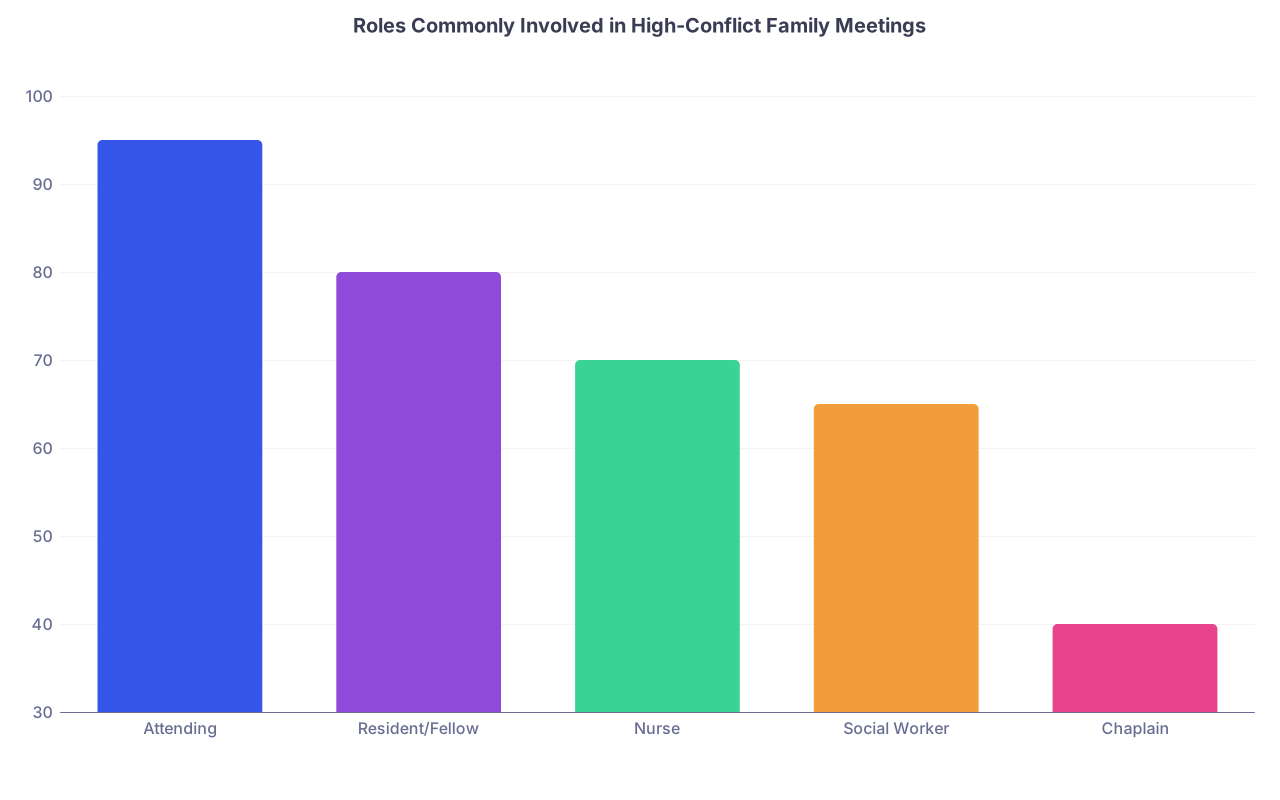
| Category | Value |
|---|---|
| Attending | 95 |
| Resident/Fellow | 80 |
| Nurse | 70 |
| Social Worker | 65 |
| Chaplain | 40 |
Before the meeting
Pre‑brief (5 minutes)
Gather whoever is involved (attending, trainee, nurse, social worker, chaplain).Cover:
- One‑sentence medical summary
- One‑sentence ethical tension
(“Likely futile treatment vs family demanding full code.”) - One primary intention
(“Clarify goals of care aligned with patient values.”) - Clear role assignment
- Attending: primary medical voice
- Nurse: patient experience voice, clarifies practicalities
- Social worker/chaplain: emotional support, watches family distress and signals breaks
Agreement on red‑line boundaries
- “We will not offer CPR.”
- “We can continue vasopressors for 24 hours while we re‑assess.”
During the meeting
Have pre‑agreed signals:
Nurse or social worker can say:
- “I am noticing this is feeling very overwhelming. Would a short break help?”
That is code for: “The room is about to blow.”
- “I am noticing this is feeling very overwhelming. Would a short break help?”
Trainee can ask:
- “Dr. Smith, can you walk us again through how the lungs are affecting the heart?”
That allows the attending 10 seconds to re‑center and reset the narrative.
- “Dr. Smith, can you walk us again through how the lungs are affecting the heart?”
After the meeting: 3‑minute debrief
Skipping this is how burnout accumulates.
In the hallway or team room, answer three questions:
- “What went reasonably well?”
- “What felt off or too reactive from our side?”
- “Is there any unfinished business—for the family or for us?”
If someone on the team is clearly rattled, say it out loud:
- “That was brutal. Let us take five minutes before the next patient.”
That five minutes is not indulgence. It is risk management for moral injury.
6. A Daily Mindfulness “Training Dose” So This Actually Works
You will not be able to use these tools under fire if you only practice them in catastrophe.
You need a small daily dose of mindfulness training—think brushing your teeth, not going on retreat.
Aim for 5–10 minutes per day of any of the following:
1‑minute breath practice × 5
- Once per clinic session, between patients
- Put a sticky note on your workstation: “1 minute: breathe”
Protocol:
- 4 seconds in, 6 seconds out
- Repeat 6–8 cycles
“Name the story” journaling (3 minutes at the end of the day)
- Write: “Story of today’s conflict:” and dump the narrative
- Then write: “What actually happened:” and list only observable facts
You are training the same muscle you need in the room: separating narrative from reality.
Values reminder (30 seconds before first patient)
- Ask: “What kind of clinician do I want to be today, regardless of what happens?”
- Pick one word: “Steady.” “Honest.” “Compassionate.”
- Keep that word in your pocket, mentally, for when things go sideways.
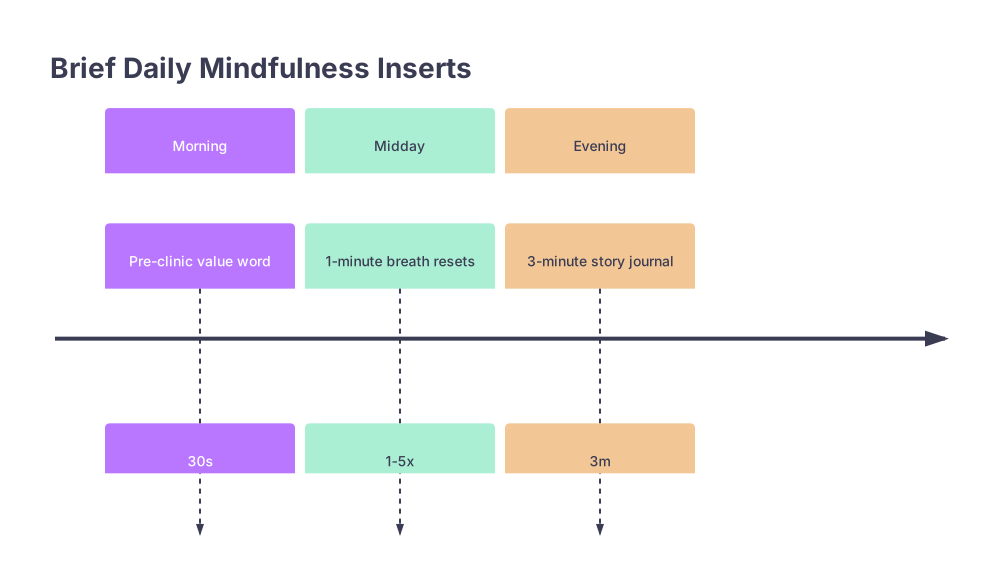
| Period | Event |
|---|---|
| Morning - Pre-clinic value word | 30s |
| Midday - 1-minute breath resets | 1-5x |
| Evening - 3-minute story journal | 3m |
This is not spiritual performance art. It is nervous system conditioning for ethically hard work.
FAQs
1. What if the family is completely unreasonable and refuses to accept reality?
You still do not abandon ethics to appease them. A mindful stance here looks like:
- Acknowledge their fear and pain directly.
- Be relentlessly clear and consistent about what is medically realistic.
- Offer what you can in good conscience (time‑limited trials, second opinions, palliative involvement).
- Set firm boundaries on non‑beneficial or harmful interventions.
You are responsible for offering good care, not for forcing acceptance. If they do not accept, you continue to show up consistently, document carefully, and seek institutional support (ethics consults, risk management) rather than escalating in isolation.
2. How do I practice this if my schedule is already packed and I barely have time to sit down?
You embed practice into what you are already doing:
- One breath while washing your hands before each patient.
- One “name the story” while waiting for the EMR to load.
- A 60‑second reset walking between wards or clinics.
You do not need a Zen cushion. You need tiny reps repeated daily. Those reps make the in‑room protocols—90‑second pre‑reset, name‑breath‑decide—feel natural instead of like extra work.
3. What if I lose my cool in a meeting—do I repair it or just move on?
You repair it. That is both ethical and powerfully de‑escalating.
You can say something like:
- “I realize I raised my voice just now. That is not how I want to talk with you. Let me step back and try again.”
You are modeling self‑regulation and accountability. Most families will soften when they see you are willing to own your part. Then, after the meeting, you debrief with your team and look at what triggered you, so the next time you can catch that moment one step earlier.
Key points to walk away with:
- Use a 90‑second pre‑meeting reset every time; it is not optional.
- Give the meeting a clear 3‑phase structure: stabilize, clarify, decide.
- Treat mindfulness as practical nervous system training in service of ethical, steady care—built with small, daily reps, not heroic efforts once a year.