
The way most clinicians handle diagnostic uncertainty is broken. They either pretend it is not there, or they drown in it.
You need a third option: a structured, mindful way to think when the diagnosis is not obvious and the stakes are high. That is where a Mindfulness Decision Ladder comes in.
I will show you a practical, repeatable protocol you can use on the wards tomorrow. Not a vague “be more mindful” lecture. A specific mental checklist that keeps you safe, honest, and clear-headed when you are staring at a confusing patient and a blinking cursor in the assessment box.
Why Diagnostic Uncertainty Feels So Threatening
You are not just fighting disease. You are fighting three other forces:
Cognitive shortcuts
- Premature closure: “It’s just a viral URI, done.”
- Confirmation bias: Ordering tests that only support your favorite diagnosis.
- Anchoring: Sticking with the ED triage label even when the story falls apart.
Culture and hierarchy
- Attendings who say, “So what’s the diagnosis?” as if “I don’t know yet” is malpractice.
- Notes that demand one “primary diagnosis” and penalize “differential: broad.”
- Rounds where people reward confident answers more than accurate thinking.
Fear and ego
- Fear of missing a bad diagnosis.
- Fear of looking stupid.
- Ego attachment to your first impression.
Mindfulness is not just about calm. It is about seeing what is actually happening in your mind and in the patient, so you can choose wisely instead of reacting out of fear or pride.
The Mindfulness Decision Ladder gives you rungs to climb when your brain wants to jump.
The Mindfulness Decision Ladder – Overview
Think of the ladder as seven rungs. You do not always need all of them, but you should know where you are on it.

| Step | Description |
|---|---|
| Step 1 | Notice Uncertainty |
| Step 2 | Name Mind State |
| Step 3 | Clarify Clinical Question |
| Step 4 | Sort Risk Level |
| Step 5 | Choose Next Safe Step |
| Step 6 | Document and Communicate |
| Step 7 | Debrief and Learn |
Quick view:
- Notice uncertainty in real time.
- Name your mind state and emotional load.
- Clarify the exact clinical question you are trying to answer.
- Sort the situation by risk level (benign vs time-sensitive vs catastrophic).
- Choose the next safe, smallest step that reduces risk or narrows the picture.
- Document and communicate uncertainty explicitly and ethically.
- Debrief afterward to build your pattern recognition and resilience.
We will walk each rung with concrete phrases and behaviors you can use.
Rung 1: Notice – Catch the Moment You Are Guessing
Diagnostic error often starts in the first 30 seconds. You decide “this is probably X” and spend the next hour proving yourself right.
Your first task: catch the internal signals that you are in uncertain territory.
Common signals:
- You feel subtle irritation or impatience with the patient’s story.
- You keep re-reading the labs, hoping they will “make more sense.”
- You feel compelled to pick a label to satisfy someone else (ED sign-out, attending, insurance).
- You notice a quiet phrase in your head: “This does not quite fit.”
I force myself to use a silent trigger phrase when I hear that inner voice:
“Pause. I might be wrong.”
Micro-protocol you can use in <30 seconds:
- Push your chair back an inch. Literally. A physical cue.
- Exhale fully once, slowly.
- Ask yourself: “If I had to say it in one sentence, what exactly am I unsure about?”
If you do just that, you interrupt autopilot. That is enough to climb to the next rung.
Rung 2: Name – Label Your Mind State and Emotions
This is the mindfulness piece that most clinicians skip because it sounds “soft.” Skipping it is a mistake. Your emotional state drives bad decisions more than any lab value.
Common mind states in diagnostic uncertainty:
- “Rushing – too many patients, I want this done.”
- “Performing – I want to sound smart on rounds.”
- “Defending – I am invested in my earlier diagnosis.”
- “Avoiding – I am afraid this is something serious.”
I use a simple script with myself:
“Mind state: performing and rushed. Emotion: anxious, mildly frustrated.”
You are not journaling. You are tagging. Two sentences in your head, 5 seconds.
Why it matters:
- Naming “rushed” reminds you to slow the heck down on high-risk decisions.
- Naming “defensive” alerts you you are protecting your ego, not the patient.
- Naming “afraid of missing something bad” can push you to use a safer default (observe, admit, consult).
If you are attending or senior resident, do this out loud occasionally:
“I feel a little anchored on UTI because that is what ED thought, but some things are not lining up. Let us step back.”
You normalize mindful uncertainty for your team.
Rung 3: Clarify – What Exact Question Are You Trying to Answer?
Most bad decisions come from answering the wrong question.
The naïve question: “What is the diagnosis?”
Better questions:
- “What is the most dangerous thing this could be that I cannot miss today?”
- “What is the minimum safe information I need before sending this person home?”
- “What could kill or permanently harm this patient in the next 24–48 hours?”
Turn vague worry into a concrete clinical question. For example:
- Not: “This syncope is weird.”
- Instead: “Is this syncope cardiogenic / arrhythmic, or likely benign vasovagal / orthostatic?”
Once the question is clear, your next steps become obvious.
Practical exercise:
- Write a one-line clinical question in the “Assessment” section:
- “Key question: Is this chest pain ACS versus noncardiac?”
- “Key question: Is this delirium due to sepsis vs medication vs metabolic vs structural?”
Your brain now has a target. You stop ordering scattershot tests and start building a designed workup.
Rung 4: Sort – Risk Stratification Before Diagnosis
This is where many trainees blow it. They chase the precise diagnosis before they stabilize risk.
Do not. The sequence is:
- Stabilize or escalate if unstable or potentially catastrophic.
- Risk-stratify if stable.
- Then refine the diagnosis.
Think in three bins:
| Category | Example Situations | Default Strategy |
|---|---|---|
| Catastrophic Possible | Chest pain with concerning features, focal neuro deficits, sepsis signs | Escalate, involve senior/consult, consider admission and urgent imaging |
| Time-Sensitive but Stable | New GI bleed without shock, possible PE in stable patient, new onset psychosis | Structured risk tools, early testing, low threshold to admit/observe |
| Likely Benign / Self-Limited | Simple viral symptoms in young healthy adult, musculoskeletal pain with clear trigger | Conservative management, safety netting, clear return precautions |
You do not need to be 100% sure which bin, but you need a defensible, mindful decision, not “I was busy.”
Sample internal script:
- “Where does this fall on my risk ladder: could this kill them tonight, this week, or almost certainly not?”
If “tonight” is on the table, you default to:
- More observation time
- Lower threshold for imaging
- Earlier involvement of someone more experienced
You can be uncertain about diagnosis and still be safe about risk.
Rung 5: Choose – The Next Safe, Small, High-Yield Step
This is the core of the ladder: you do not need the whole staircase, just the next step that reduces uncertainty or reduces risk.
Categories of next steps:
- Do nothing yet – but watch more closely
- ED: 2–3 hours of observation, repeat vitals, serial exams
- Ward: overnight telemetry, q4h neuro checks
- Get more data
- Focused physical exam you have not done properly
- Targeted labs/imaging based on your refined question
- Old records, outside imaging, call family, call PCP
- Get more brains
- Call your senior or attending with a structured question
- Early consult (neuro for atypical headache, cards for weird syncope)
- Huddle with nurse or pharmacist for pattern recognition
- Act on worst-plausible-case
- Start empiric antibiotics in sepsis-like picture before full clarity
- Give aspirin in possible ACS while you wait on troponins/ECG
- Reverse or hold anticoagulation in suspected major bleed
When you are stuck, use this quick mental checklist:
“In the next 30 minutes, what is the smallest action that:
– Lowers the chance of catastrophic outcome, or
– Clarifies the highest-risk possibilities?”
Default to small, reversible moves. Do not leap to giant, irreversible ones unless clearly justified.
Concrete example:
- 52-year-old with atypical chest pain, normal ECG, negative first troponin, risk factors present.
- Next mindful step:
- Admit to observation, serial troponins and ECGs, risk scoring. Not: “Discharge with GI cocktail” because ED is crowded.
- Next mindful step:
This is also where mindfulness prevents over-testing. Once your high-risk diagnoses are ruled out and the patient is low-risk, more tests will not help. They will create noise and incidentalomas.
Rung 6: Document and Communicate Uncertainty Ethically
Pretending certainty in the chart is both dangerous and dishonest. It also destroys trust with patients and colleagues.
Good documentation of uncertainty has three parts:
- What you think it might be (your current leading hypothesis and differential).
- What you are actively ruling out or watching for.
- What your plan is if the situation worsens or does not improve.
Sample note language:
- “Diagnostic impression: Most consistent with viral bronchitis. However, due to age and smoking history, low but non-zero concern for early pneumonia or evolving COPD exacerbation. Current plan is outpatient management with strict return precautions for fever, dyspnea, or pleuritic chest pain. If symptoms worsen or fail to improve in 48–72 hours, will require repeat exam and possible chest imaging.”
That paragraph buys you:
- Ethical transparency
- Medico-legal protection
- A clear roadmap for future clinicians and the patient
Communicating with the patient:
- Avoid the fake certainty: “You’re fine, it’s nothing.”
- Use calm honesty instead:
- “Right now, based on your exam and tests, the dangerous causes look unlikely. I want to be upfront that medicine cannot be 100%. So here is what to watch for and exactly when to call or return.”
You will be surprised how much patients appreciate straight talk.
Rung 7: Debrief – Turn Uncertainty into Learning
If you skip this rung, you stay stuck. You will keep having “weird cases” that never feel less weird.
Two kinds of debrief:
Immediate micro-debrief (2–3 minutes)
- After the shift or after rounds:
- “Where did I feel most uncertain today? What did I actually do?”
- “Did I confuse low probability with low impact?”
- “Did my fear of looking stupid change my clinical decisions?”
- After the shift or after rounds:
Scheduled review (weekly or monthly)
- Keep a “diagnostic uncertainty log.” Simple, not fancy:
- Date
- Age / sex
- Problem (“atypical chest pain,” “recurrent syncope,” “odd fever”)
- Your initial thought
- Final diagnosis (if known later)
- 1–2 lessons
- Keep a “diagnostic uncertainty log.” Simple, not fancy:
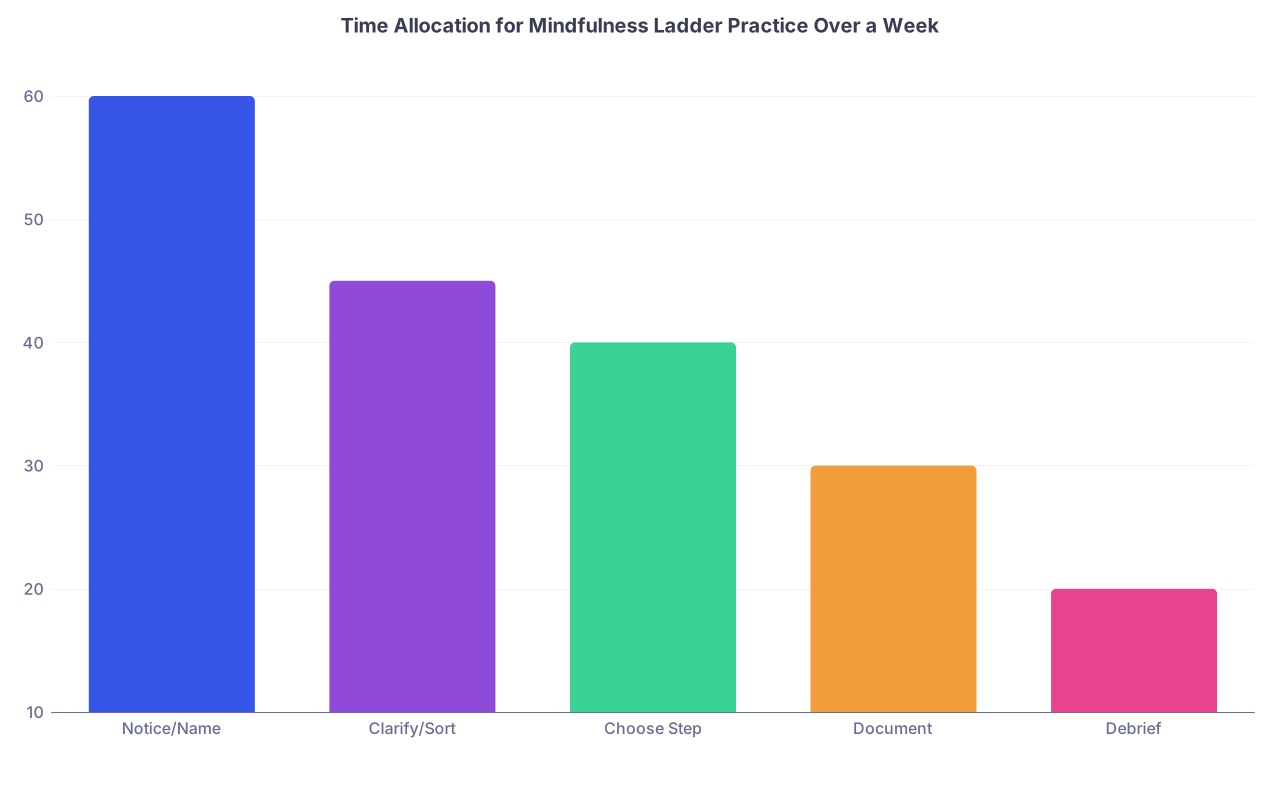
| Category | Value |
|---|---|
| Notice/Name | 60 |
| Clarify/Sort | 45 |
| Choose Step | 40 |
| Document | 30 |
| Debrief | 20 |
Patterns you will notice:
- Where your anchoring happens (e.g., on triage labels, on prior outpatient diagnoses).
- Which symptoms you habitually under-estimate (e.g., elderly abdominal pain, subtle neuro changes).
- Which emotional triggers lead you to overtest or undertest.
Bring one case per week to:
- Morning report
- Morbidity and mortality (if relevant)
- A trusted attending or mentor
Explicitly frame it:
“I want feedback on how I handled uncertainty here, not just whether my diagnosis was eventually right.”
You grow not just as a diagnostician, but as a professional who is comfortable walking the line between certainty and humility.
A Mindfulness Mini-Protocol for Diagnostic Decisions
You do not have time on a busy call night for a 20-minute meditation. Fair. So build an under-2-minute protocol you can run whenever you feel that “uh-oh” feeling.
Here is one you can memorize:
Stop for one full breath.
- Exhale slowly. Feel the chair. Hands still.
Silently say: “Uncertain – and that is OK.”
- This de-shames the feeling.
Name your state and risk.
- “I feel rushed and worried about missing something bad. Risk: possibly time-sensitive.”
Ask: “What is the worst thing this could be in the next 24 hours?”
- Name 1–3 items.
Pick one next safe step.
- Observe, test, consult, or treat for worst case.
Tell the patient or team your plan out loud.
- “Here is what I am worried about, here is what we have ruled out, here is what we are doing next.”
You can do this between patients, in the stairwell, or even in front of the computer. Nobody needs to know you are running a “mindfulness protocol.” They just see better decisions.
Case Walkthrough: Applying the Ladder
Let us make this real.
Scenario
A 68-year-old woman with diabetes and hypertension presents with 3 days of vague abdominal pain, some nausea, and “feeling off.” Triage says “gastroenteritis.”
Vitals: HR 98, BP 110/68, T 37.8°C, RR 18, sat 97% RA.
Exam: Mild diffuse tenderness, no rebound, no guarding. Slightly dry mucous membranes.
Labs: Mild leukocytosis, borderline lactate, creatinine slightly up from baseline.
You feel tug-of-war:
- ED is slammed, staff is pushing for quick dispositions.
- Triage label says “gastroenteritis.”
- Something about her age and vague symptoms bothers you.
Walk the ladder:
Notice
- Thought: “This could just be a viral thing; I should dispo quickly.”
- Counter-thought: “Pause. I might be wrong.”
Name
- “Mind state: rushed, slightly pressured by ED crowding. Emotion: uneasy.”
Clarify
- “Key question: Is this benign gastroenteritis or an early serious intraabdominal process (ischemia, evolving perforation, sepsis) in an older diabetic?”
Sort risk
- Age, comorbidities, leukocytosis, rising creatinine, borderline lactate.
- You put her in “time-sensitive but stable.” Not “send home with zofran.”
Choose next step
- Next safe action:
- Get CT abdomen/pelvis with contrast.
- Repeat exam and vitals after fluids.
- Consider early surgery or GI consult if imaging abnormal or clinical picture worsens.
- Next safe action:
Document and communicate
- Chart:
- “Diagnostic impression: Symptoms may represent viral gastroenteritis, but given age, diabetes, mild leukocytosis, and rising creatinine with borderline lactate, concern for early serious intraabdominal pathology remains. Plan: CT A/P with contrast, IV fluids, serial exams. Will admit or consult surgery if imaging or clinical status concerning.”
- To patient:
- “This could be a simple stomach bug, but because of your age and health, I do not want to miss a more serious cause. We are going to get a CT scan and watch you more closely before making a final decision about going home.”
- Chart:
Debrief later
- If CT shows mesenteric ischemia: you caught it early. You review: what tipped you off, how the ladder helped.
- If CT negative and she truly had gastroenteritis: you review whether your caution was still justified (likely yes, given risk factors).
Either way, the process was sound. You practiced mindful medicine, not panic or laziness.
Training Your Team on the Ladder
You are not going to change a department’s culture overnight, but you can start small:
- On rounds, explicitly say:
- “I am 60% on diagnosis X, 30% on Y, and 10% on ‘something we have not thought of yet.’ Our plan covers the dangerous possibilities.”
- Ask your interns:
- “What is the worst thing this could be? What is our next safe step?”
- Normalize “I am not sure yet” followed by a structured plan instead of vague hand-waving.
If you teach, make a habit of debriefing not just what the learner decided, but how they thought when they were uncertain.
Common Pitfalls and How to Fix Them
You will still mess this up sometimes. So will I. Here are the big traps:
Using mindfulness as an excuse to be indecisive
- Fix: The ladder must end in an action. Mindfulness is before the move, not instead of it.
Over-correcting into over-testing everything
- Fix: Tie testing to risk category and specific clinical questions. When catastrophic and time-sensitive diagnoses are reasonably excluded, stop.
Performative uncertainty (“Look how thoughtful I am”)
- Fix: Be concise. Avoid five-paragraph differentials that do not change what you do. Focus on how uncertainty changes management.
Ignoring the emotional component
- Fix: Keep using two-word tags for your state (“rushed + defensive,” “worried + humble”). It takes seconds and pays off.

Summary: What Actually Changes If You Use This
If you apply the Mindfulness Decision Ladder consistently:
- You stop pretending you are certain when you are not and start making safer, more transparent decisions.
- You reduce both premature closure and defensive over-testing by tying actions to risk and clear questions.
- You build a quiet, internal habit of pausing, labeling your state, and then choosing a deliberate next step.
You will still be wrong sometimes. That is medicine. But you will be wrong for better reasons—and you will learn from it faster.