
It is 8:45 p.m. You signed out at 7:15. You are still in the workroom, staring at a column of yellow triangles and red exclamation points in the EMR. Fifteen incomplete notes. Four unsigned orders. One “Please addend” message from an attending. Your co-resident just texted, “You leaving soon?” You are not.
You are mentally replaying the afternoon: codes, admissions, cross-cover nonsense. You know you took good care of patients. But the screen makes you feel like you failed. Again.
This is where most residents live: clinically solid, digitally drowning.
Let me be blunt: no one is going to fix the EMR for you. The system is clunky, bloated, and poorly aligned with how doctors actually think. Waiting for “EMR optimization” is like waiting for hospital food to become Michelin-starred. Not happening.
You need a personal, deliberate, mindful EMR workflow. One that:
- Prevents chart backlog before it starts
- Shrinks documentation time without turning your notes into garbage
- Lowers stress instead of jacking it up
- Lets your conscience sleep at night (ethically sound, not box-checking medicine)
That is what we are going to build.
Step 1: Redefine What “Done” Looks Like
Most residents have a vague internal standard for charting: “I’ll know it’s enough when it feels right.” That is a recipe for anxiety and 11 p.m. addenda.
You need a clear, explicit definition of “done” for your documentation day.
Create Your Daily Documentation Checklist
This is your non-negotiable baseline. Not perfection. Just safe, ethical, complete enough.
For a typical inpatient day, “done” might mean:
Every patient on your list has:
- A dated, signed daily progress note
- Updated problem list (or at least major active problems adjusted)
- Up-to-date medication reconciliation for major changes
- Critical events documented (rapid responses, seizures, significant decompensation, goals-of-care changes)
Orders and communications are aligned with your notes:
- High-risk orders (insulin, anticoagulation, antibiotics) match what you wrote
- New consults and major plan changes documented in the note or a brief addendum
EMR inbox and messages:
- Critical results: acknowledged and acted on
- Attending “Please addend” or “Clarify plan” messages: addressed the same day unless impossible
That is it. Anything beyond that is “nice to have,” not mandatory.
Write your version of this in a 3x5 card or your notes app and keep it visible. When your brain starts screaming, “You forgot something!” you can check it against your actual standard instead of your vague perfectionism.
Step 2: Break the Day into Charting Units, Not Just Clinical Tasks
The biggest EMR mistake I see: residents treat charting as something that happens after the real work. So documentation becomes the shadow at the end of the day.
You need to treat documentation as part of the clinical act, not its annoying cousin.
Use a Simple Time-Block Structure
The exact times will vary by service, but the structure holds:

| Step | Description |
|---|---|
| Step 1 | Pre-round Chart Review |
| Step 2 | Bedside Rounds |
| Step 3 | Midday Charting Block |
| Step 4 | Afternoon Tasks and Admissions |
| Step 5 | Final Charting and Sign-out Check |
1. Pre-round (Chart-First) Block – 20–40 minutes
- Purpose: gather data, start the note, clarify your plan.
- What you actually do:
- Quick scan: vitals, overnight events, labs, imaging, consult notes.
- Open each patient’s note and drop in:
- Interim history from overnight
- Key objective data
- A draft assessment/plan skeleton (even bullets)
This means by the time you see the patient, your brain is not half in the EMR, half in the room. You already know what you are looking for.
2. Midday Charting Block – 30–60 minutes
- Timing: after rounds, before you dive into the afternoon chaos.
- Purpose: convert your skeleton into real notes before fatigue sets in.
- What you do:
- Turn your pre-round skeleton into a real assessment and plan.
- Close out routine follow-ups and stable patients first.
- Leave the complex train wreck for last—your mind will already be in “note mode.”
3. Final Charting Block – 30–45 minutes
- Timing: before sign-out, not after.
- Purpose: clean up, not create from scratch.
- What you do:
- Work your checklist (from Step 1) like a pilot running a pre-flight list.
- Confirm: “Every patient has a today note. Every critical event is documented. Inbox triaged.”
The mindful piece: you decide on purpose when you will chart. Not whenever the system or your anxiety screams loudest.
Step 3: A Mindful, Repeatable Note Template That Does Not Suck
Templates can either save your sanity or bury you in nonsense. The bad ones are legal wallpaper. The good ones are mental scaffolding.
You need one or two personal templates you can use almost every day without thinking.

Build a Lean, Ethical Template
Here is a structure that works for most inpatient services:
One-line ID and reason
- “65-year-old with COPD admitted for pneumonia and acute hypoxemic respiratory failure.”
Interim summary (1–3 sentences)
- “Overnight: No fevers, weaned from 6L to 4L. No chest pain. One episode of desaturation with ambulation.”
Focused subjective
- Not a novel. Symptoms that changed, new complaints, response to treatment.
High-yield objective
- Vitals trend, O2 needs, one-line exam changes, key labs/imaging.
- Not a full copy-paste of yesterday’s CT.
Assessment/Plan by problem (this is the core)
For each active problem:- Problem name (severity if relevant)
- 1–2 line assessment: what you think is happening and trajectory
- Bullet plan with:
- What you are continuing
- What you are changing
- What you are watching for
Disposition and contingency
- “Anticipate discharge in 1–2 days if O2 needs continue to improve.”
- “If increasing work of breathing or rising O2 needs, low threshold for ICU consult.”
This structure respects ethics: it is honest, interpretable, and justifiable if a lawyer, a family, or another doctor reads it later.
Strip Out Template Garbage
If your hospital template auto-populates:
- A full, unchanged 10-point review of systems
- Full systems normal exam you did not do
- Pages of unchanged lab data that you did not actually look at today
…turn that off or delete it aggressively.
Why? Because ethically, that is false precision. It pretends you did more than you did. That is how documentation drifts into dishonesty without anyone noticing.
Your rule: if you did not look, do not pretend you did. Choose shorter and true over longer and misleading.
Step 4: In-the-Moment Micro-Workflow: 5-Minute Per-Patient Pass
Residents get crushed by context-switch cost. Every time you open a chart cold, your brain has to reload the patient from scratch.
You need a simple, repeatable micro-workflow every time you click into a patient.

| Step | Description |
|---|---|
| Step 1 | Open Patient Chart |
| Step 2 | 30s Context Summary |
| Step 3 | 90s Data Scan |
| Step 4 | 90s Note Update |
| Step 5 | 60s Orders and Tasks |
| Step 6 | 10s Sanity Check |
The 5-Minute Pass
Aim to do this in one continuous pass, not fragmented.
30 seconds – Context summary (in your head or in the note header)
- Why is this person here? What are the top 1–2 active problems?
- “PNA on 4L, improving. DM2 with BG 150–220. Needs PT eval and discharge planning.”
90 seconds – Data scan
- Vitals and last 24-hour trends
- New labs and imaging since your last review
- New notes/consult recommendations
90 seconds – Note update
- Type directly into your assessment/plan:
- What changed
- What today’s plan actually is
- Do not leave yourself cryptic fragments like “trend labs” with no context.
- Type directly into your assessment/plan:
60 seconds – Orders and tasks
- Make the orders match your plan: de-escalate antibiotics, adjust insulin, stop redundant meds.
- Fire off quick messages/consult orders that directly flow from your assessment.
10 seconds – Sanity check
- Literally ask yourself: “If I leave now and do not see this chart again today, is this safe and understandable?”
This keeps you from the worst EMR sin: “I will fix the note later when I have more time.”
You will not. And you know it.
Step 5: Build Ethical Shortcuts, Not Dishonest Ones
You are under pressure—from attendings, hospital billing, and your own guilt—to document a lot in very little time. Cut corners the right way.
Good Shortcuts
Smart phrases for recurring assessments
For example, for stable CHF on diuresis:“Stable chronic HFrEF, euvolemic on exam. Continue current diuretic dose, maintain 2L fluid restriction, daily weights, strict I/O. No signs of acute decompensation.”
Reuse this, but change “stable/euvolemic” if it is no longer true. That is ethical.
Problem-based templates for very common issues:
- DKA
- COPD exacerbation
- Uncomplicated cellulitis
- Post-op day 1
Each with:
- Typical assessment language
- Checklist of plan items (fluids, monitoring, labs, consults)
Decision trees for difficult conversations
Have a structure for documenting goals-of-care, capacity assessments, and family meetings. This is emotionally and ethically better than improvising each time.
Bad Shortcuts
- Copying yesterday’s note and changing two words
- Documenting full physical exams you did not do
- Auto-populating 14-system ROS when you asked about three things
- Writing a perfect physiologic explanation when you are actually unsure and did not discuss it with anyone
This is the ethical line: shortcuts that preserve truth and clarity are good. Shortcuts that inflate or fabricate what happened are not.
Ask yourself: “If another clinician used my note to make decisions, would it help them or mislead them?”
If the answer is “it might mislead,” delete and rewrite.
Step 6: Manage the Emotional Side: Charting Without Meltdown
The EMR does not just eat time. It eats peace of mind. The endless to-dos, red alerts, and pop-ups are designed for liability, not for your nervous system.
You need a few psychological rules of engagement.

1. Single-Task Your EMR When Possible
Three tabs open. Pager going off. Someone asking “Can you quickly look at this EKG?” Meanwhile you are trying to finish a progress note.
Pick one: either:
- Finish the note you are in, or
- Stop and fully switch to the new task.
Half-writing three notes is how you end up with four incomplete ones and no memory of what you planned for anyone.
2. Micro Mindfulness at the Computer
I am not talking about lotus pose in the workroom. I mean 20–40 seconds between charts.
Before you open the next chart:
- Feet flat on the floor
- One slow inhale through the nose to a count of 4
- 1–2 second pause
- Long exhale to a count of 6
As you exhale, mentally label: “New patient. New plan. Start fresh.”
It sounds trivial. But I have watched residents go from rage-clicking to functional just by inserting that pause.
3. Detach Your Self-Worth from Note Volume
You will see co-residents who write phone-book-length notes with 19 dot phrases and 3 pages of labs. You will see attendings occasionally praise that.
Do not confuse verbosity with quality.
Judge your performance by:
- Safety: Did your documentation support safe care?
- Clarity: Could someone else understand what you did and why?
- Integrity: Does your note honestly reflect reality?
If the answer is yes, you are fine—even if your note is one page instead of five.
Step 7: Team-Based EMR Sanity: Do Not Suffer Alone
The EMR is technically “yours,” but charting does not have to be a solo sport. Smart teams reduce the total documentation burden.
| Team Member | Primary EMR Focus | Practical Examples |
|---|---|---|
| Intern | Daily notes, basic orders | Progress notes, routine med adjustments |
| Senior Resident | Complex plans, high-risk orders | ICU transfers, anticoagulation, code documentation |
| Attending | Oversight, addenda | Co-sign notes, clarify complex decisions |
| Nurse | Flowsheets, PRN med documentation | Intake/output, vitals, symptom responses |
| Case Manager | Disposition documentation | Discharge needs, placement, home services |
Clarify Who Documents What
On day 1 of a new rotation, have a literal 3-minute conversation:
- Which notes are the intern’s vs senior’s?
- Who documents cross-cover events (senior vs night float)?
- How does the team want consult recommendations documented—by the primary team or just by the consultant?
Ambiguity here is how the same event gets partially documented in three places and still ends up unclear.
Use Your Team as a Documentation Safety Net
If you are drowning:
- Ask your senior: “I have three new admissions and seven incomplete notes. Which notes are essential to finish before I leave? Can we divide?”
- During sign-out, explicitly mention any incomplete narratives: “I documented the code event as a brief note, but did not finish a full summary—can you add detail if needed?”
This is not weakness. It is ethical transparency.
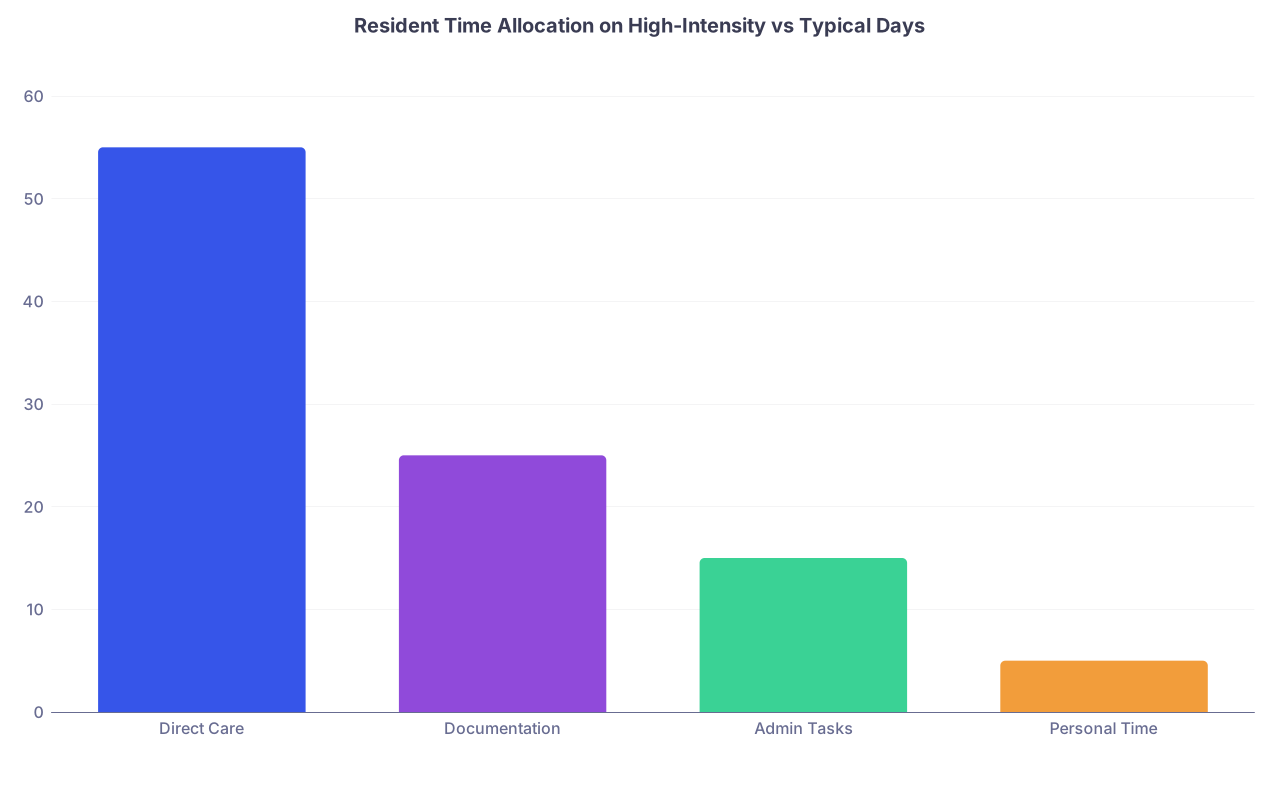
Step 8: Handling High-Intensity Days Without Carryover Chaos
Some shifts are simply impossible. Ten admissions, a code, two ICU transfers. On those days, a “perfect” documentation day is fantasy.
You still need a damage-control protocol.
| Category | Value |
|---|---|
| Direct Care | 55 |
| Documentation | 25 |
| Admin Tasks | 15 |
| Personal Time | 5 |
The Triage Documentation Protocol
When the day explodes, your charting priority shifts to:
Life-or-death decisions and events first
- Codes, intubations, ICU transfers, major status changes.
- Minimum: a brief narrative note that captures:
- What happened
- Your key decisions
- Patient/family discussions
New admissions – skeleton now, detail later
- Get in:
- Chief complaint
- Working diagnosis
- Initial plan (ABX, monitoring, consults)
- You can fill in the full H&P details once the dust settles, but do not leave an admission with no explanation of why they are there or what you did.
- Get in:
Stable follow-ups – very lean
- For truly stable patients, a brief “no significant change, plan unchanged” progress note is acceptable. Do not spend 20 minutes wordsmithing someone discharging tomorrow.
Explicit carryover list
- Before you leave (even late), make a list in your personal task system:
- “Tomorrow a.m.: Expand H&P on Mr. X, add detail to code note for Ms. Y, update problem list for Z.”
- This prevents the 3 a.m. “I forgot something critical” guilt spiral.
- Before you leave (even late), make a list in your personal task system:
This is how you stay ethically intact when the system is not.
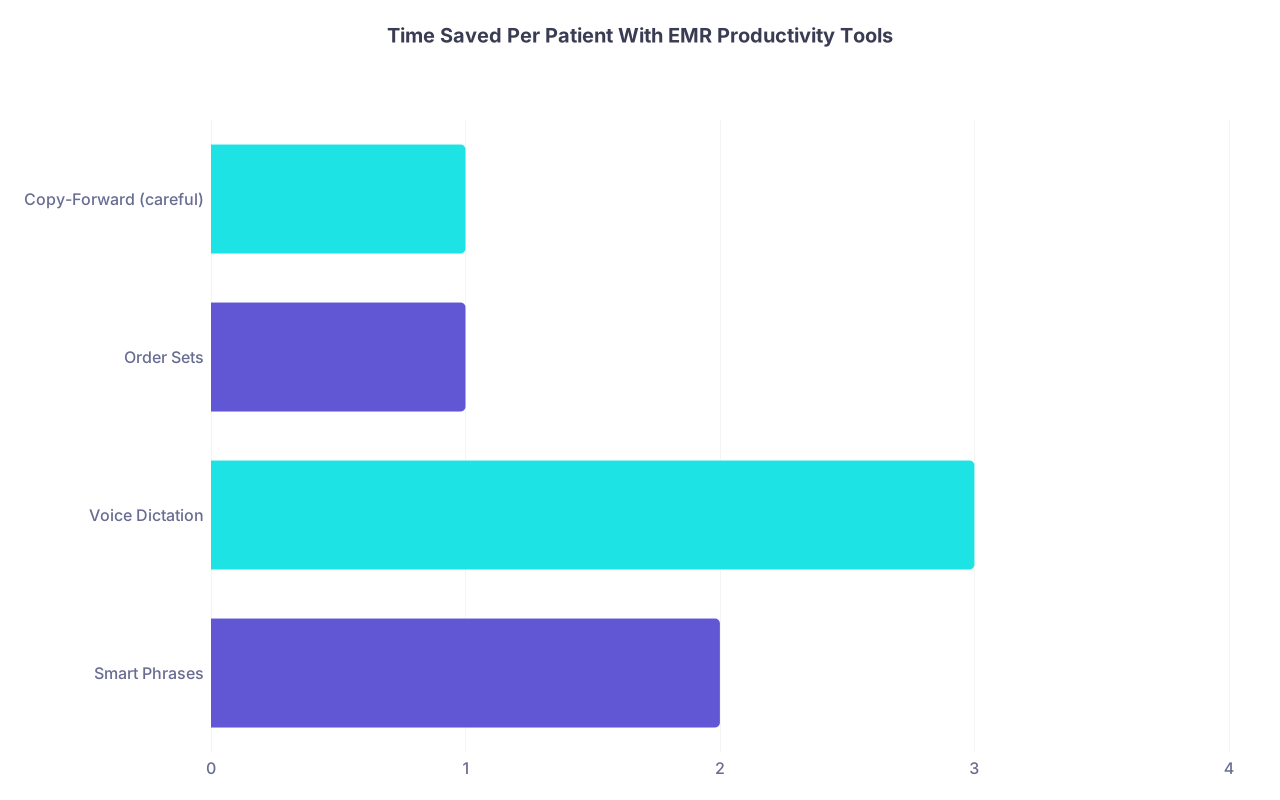
Step 9: Use the Tech You Have—But Tame It
You probably have more tools than you are using: dot phrases, voice recognition, order sets, clinical decision support. Some are trash. Some are gold.
| Category | Value |
|---|---|
| Smart Phrases | 2 |
| Voice Dictation | 3 |
| Order Sets | 1 |
| Copy-Forward (careful) | 1 |
High-Yield Tools
Voice dictation for long narratives
- Use for:
- H&Ps
- Complex events (code summary, difficult family meeting)
- You will talk faster than you type. Just commit to a quick proofread for speech-recognition nonsense.
- Use for:
Order sets for standard problems
- Sepsis, DKA, chest pain, stroke protocols.
- Let the system handle the 18 routine orders so your brain can think about nuance.
Personal dot phrases
- For:
- Common counseling (smoking cessation, insulin teaching)
- Standard assessments (stable COPD, controlled DM)
- Keep them short and customizable. Nothing worse than a 20-line dot phrase you have to delete half of.
- For:
Turn Off What Harms Your Focus
- Non-critical pop-ups that add zero value? Ask IT if they can be suppressed.
- Useless reminder boxes: click “Do not show me this again” whenever allowed.
- Email/chat notifications while charting: silence them during your chart blocks.
You are allowed to protect your attention. That is not laziness; it is good medicine.
Step 10: Closing the Day: A 5-Minute Ethics and Sanity Check
Your end-of-day ritual matters. Walking out with a spinning head and 12 unknown loose ends will burn you out fast.
Create a short shutdown procedure.

The 5-Minute Shutdown
Before you leave:
Run your checklist (from Step 1)
- Every patient has a note
- Major events documented
- High-risk orders match the plan
Scan your incomplete documentation list
- If anything truly critical is missing, do it now.
- If it is detail, add it to your “tomorrow a.m.” task.
Brief reflection—30 seconds is enough Ask yourself:
- “Did my documentation today help or hinder patient care?”
- “Is there anything I want to do differently tomorrow?”
Not as self-flagellation. As calibration.
- Consciously “sign out” of the EMR mentally
When you log out, say (in your head if you want):
“I did enough for today. I will handle the rest tomorrow.”
This sounds cheesy. It is not. It is a boundary. Without that boundary, the EMR follows you home, into bed, into your dreams.
Your Next Step: Design Tomorrow’s EMR Plan in 10 Minutes
Do not wait for a rotation change or a mythical lighter week.
Right now, do this:
- Write your “good enough” documentation checklist for your current service. 5–8 items max.
- Block three charting windows for tomorrow in your planner or on a sticky note:
- Pre-round chart review
- Midday chart block
- End-of-day shutdown
- Create one lean, ethical template for your most common note type (e.g., inpatient progress note) and save it as a dot phrase or favorite.
That is it. Ten minutes.
Tomorrow, when you sit down and the EMR screen lights up, you will not be improvising. You will be running your system, not reacting to theirs.
Open your EMR note template right now and rewrite just the Assessment/Plan section to be problem-based, brief, and honest. That one change will cut your charting stress more than any “efficiency tip” your hospital will ever email you.