
The usual advice about “just sleep when you can” after call is garbage for your nervous system.
You are asking your brain to slam from hyper‑vigilant, pager‑conditioned, adrenaline‑spiked work mode into restorative, deep sleep. That transition does not happen by accident. It happens by protocol.
You need a repeatable, 20–30 minute bedtime mindfulness plan that tells your nervous system, “We are off duty now.” Not fluffy wellness talk. A concrete sequence you can run after a brutal call night, whether it is 10 a.m. or midnight.
Here is that protocol.
1. Core Problem: Why Post‑Call Sleep Fails
You already know you are tired. That is not the problem.
The problem is that your arousal systems are still red‑lined:
- Sympathetic tone is high (catecholamines still humming).
- Cortisol is irregular from circadian disruption.
- You have mental “afterimages” of codes, angry families, and charting.
- Your body associates hospital + pager + phone with threat, and it does not switch that off because you drove home.
So when you lie down, this happens:
- Body: exhausted.
- Brain: reviewing labs, replaying near‑misses, planning follow‑ups.
- Result: shallow, fragmented sleep, early awakenings, or full‑blown insomnia.
You do not fix this by “trying harder to sleep.” You fix it by walking your nervous system down through specific steps: discharge, downshift, then sleep.
Think of it like a structured sign‑out, but for your brain.
2. The 6‑Step Post‑Call Bedtime Mindfulness Protocol
This is the backbone. You can run the full version (25–30 minutes) or a compressed one (10–15 minutes) when you are wrecked.
Overview Flow

| Step | Description |
|---|---|
| Step 1 | Arrive Home |
| Step 2 | 2 Minute Decompression |
| Step 3 | Remove Signals of Work |
| Step 4 | Physical Downshift 5 10 min |
| Step 5 | Mindfulness Block in Bed |
| Step 6 | Sleep |
| Step 7 | Repeat Short Cycle or Journal 5 min |
| Step 8 | Still Wired |
Step 1: Two‑Minute Decompression at the Door
Before you touch your phone. Before you open your laptop. Before you start rehashing the night.
- Close the door. Stand or sit.
- Set a 2‑minute timer.
- Do this breathing pattern:
- Inhale through the nose for 4 seconds.
- Exhale through the mouth for 6 seconds.
- Gentle, not forced. Aim for 10 breaths total.
While you breathe, silently label your state:
- “Body: exhausted.”
- “Mind: racing.”
- “Emotion: irritated/grateful/numb/whatever.”
You are not fixing anything here. You are marking the transition: I am no longer in the hospital. That is the point.
Step 2: Strip Out the Work Signals (5 minutes)
Your environment is full of triggers that keep your brain in “on call” mode.
Remove or mute what you can, quickly:
- Put your phone on Do Not Disturb with:
- Favorites allowed (family, covering resident/attending if you are actually on backup).
- All other alerts silenced.
- Drop your badge, pager, stethoscope, white coat in a specific box or hook that literally means, “work ends here.”
- Change out of scrubs into separate sleep clothes. Teach your brain that scrubs ≠ bed.
This part takes 3–5 minutes and sets the stage: you are not the code team anymore; you are a human about to sleep.
3. Physical Downshift: Tell Your Body It Is Safe
You cannot mindfulness your way out of a body that still thinks it is in a trauma bay.
You need a short, physical downshift before you get into bed. 5–10 minutes, max.
Option A (Fast): Heat + Stretch (5–7 minutes)
If you are destroyed and want the shortest path:
Warm rinse or shower (2–3 minutes).
- Not a spa event. Just warm water on the neck, upper back, and face.
- No screens, no music, no news.
Floor stretch (3–4 minutes):
- Lie on your back on a mat or rug.
- Knees bent, feet on floor.
- Slowly rock knees side to side for 1 minute.
- Pull both knees to chest, hold 30 seconds.
- Simple neck stretch: gentle turn head right, then left, holding 15–20 seconds each.
Keep breathing slow and through the nose. Long exhale. That is the switch.
Option B (Better): Brief Somatic Unwind (8–10 minutes)
If you have any reserve at all, do this:
Wall‑supported legs (3–5 minutes):
- Lie on your back near a wall, legs up, knees slightly bent.
- Feel your low back and shoulders melt into the floor.
- Breathe: inhale 4 seconds, exhale 8 seconds.
Progressive muscle release (4–5 minutes): Start at your feet and move upward:
- Feet: gently tense for 5 seconds, release for 10 seconds.
- Calves and thighs: same pattern.
- Abdomen and chest.
- Shoulders and hands.
- Face (squeeze eyes and jaw, then release).
Do not push to 10/10 effort. Aim for 4–5/10. The goal is contrast between tension and release, not a workout.
4. The Bedside Mindfulness Block (12–20 minutes)
Now you are in bed. Lights dim. No TV. Phone on DND, screen face down.
This block has 3 parts, in order:
- Cognitive sign‑out (2–3 minutes)
- Body + breath awareness (5–8 minutes)
- Guided imagery or compassion practice (5–10 minutes)
4.1 Cognitive Sign‑Out (2–3 minutes)
You know that cascade: “Did I order that MRI? Did I sign that note? What if that kid crashes?”
Your brain is trying to stay on duty. You need to formally sign out to your future self.
Keep a small notebook and pen by the bed. Not your phone.
- Set a 2–3 minute timer.
- Write in short bullet points:
- “Follow up: Mrs. R CT read.”
- “Check Mr. L sodium tomorrow.”
- “Discuss with chief: cross‑cover staffing issue.”
Then add one line:
- “This is now on my list for later. Not for sleep time.”
Close the notebook. Physically put it face down.
If a thought pops up later, your script is: “Captured. I will see it on the list.” Then back to breath.
This prevents the mental loop of “I must not forget.” The notebook is the memory.
4.2 Body + Breath Awareness (5–8 minutes)
Now you get into classic mindfulness, but stripped of fluff and tuned for post‑call.
Position: On your back or side, whatever is most comfortable. One hand on chest, one on abdomen.
Sequence (you can memorize this):
- Take 3 slow breaths. Feel your abdomen rise and fall under your hand.
- Shift attention to your feet:
- Notice contact with sheets.
- Warmth, coolness, tingling. No judgment.
- Move attention slowly upward:
- Feet → calves → knees → thighs → pelvis → abdomen → chest → hands → arms → shoulders → neck → jaw → eyes → forehead.
- At each region, silently label:
- “Tight.”
- “Heavy.”
- “Buzzing.”
- Or “neutral.”
You are not trying to relax them. You are letting the body report its status.
Whenever your mind jumps to a thought:
- Silently label it: “planning,” “worry,” “replay,” “self‑critique.”
- Then, gently drag your attention back to the next body region or to the feeling of the breath under your hand.
If you prefer a script, you can record your own 6–8 minute body scan on your phone once on a day off and play it post‑call.
4.3 Choose Your Closer: Imagery or Compassion (5–10 minutes)
You end with one of two practices, depending on how the call felt.
Option 1: Guided Safe‑Place Imagery (for wired, anxious, overstimulated)
Pick a real place you know well that feels safe and non‑medical. Beach, mountain cabin, your grandmother’s kitchen. Not the hospital, not the call room.
Run this script in your head, slowly:
- See yourself arriving there. What time of day is it?
- Name 3 things you can see. (“The blue chair, the wooden table, the tree outside the window.”)
- Name 3 things you can hear. (“Distant traffic, a clock, wind.”)
- Name 3 sensations in the body. (“Cool air on my face, soft blanket, pillow under my head.”)
- Breathe there. With each exhale, silently say “arriving” or “safe.”
Let the image stay fuzzy if needed. You are not shooting a movie. You are giving your brain a non‑hospital template to inhabit while it powers down.
If you fall asleep mid‑imagery, that is the win.
Option 2: Brief Self‑Compassion (for guilt, anger, moral distress)
After some calls, your problem is not adrenaline. It is moral residue:
- The patient who died in the hallway.
- The near‑miss that could have gone bad.
- The family you snapped at because you were stretched too thin.
Here you do a tight, 3‑part practice:
Name the hit:
- “Today was heavy.”
- “That code bothered me.”
- “I am holding a lot of guilt about that consult.”
Normalize:
- “Anyone in my role would feel this.”
- “This reaction is human, not a flaw.”
Offer a phrase to yourself (pick one and repeat for 3–5 minutes with the breath):
- “May I rest, so I can care again.”
- “I did the best I could with what I had.”
- “I am allowed to sleep, even when the day was unfinished.”
Anchor each phrase to your exhale. That linkage matters.
This is not about letting yourself off the hook for true errors. You can still debrief, report, and improve. But at 2 a.m. after a 28‑hour shift is not the time. This practice is about protecting your capacity to show up tomorrow without being hollowed out.
5. The 10‑Minute “I’m Completely Wrecked” Version
Some nights you will not do a 25‑minute ritual. Fine. You still need a minimum viable protocol, not collapse‑and‑pray.
Here is the compressed version:
- Doorway breath – 2 minutes
- 4‑second inhale, 6‑second exhale.
- Strip work signals – 3 minutes
- Phone on DND, badge/pager in box, change clothes.
- In bed: 5‑minute combo
- Set a 5‑minute interval timer with soft chime.
- 1 minute: write 3–5 bullet “follow‑ups for later” in notebook.
- 2 minutes: body awareness from feet to head (fast scan).
- 2 minutes: pick one phrase: “May I rest,” repeated silently on each exhale.
Then lights out. No scrolling “just for a minute.” That single choice will ruin this protocol faster than anything else.
6. Timing and Day‑Night Conflicts: Making This Work Post‑Call
Post‑call timing is messy. You might be going to bed at 9 a.m., 2 p.m., or midnight.
The mindfulness protocol barely cares about clock time. What matters is sequence and repetition.
Still, there are a few decisions to standardize.
| Scenario | Target Main Sleep | Protocol Timing |
|---|---|---|
| Off at 8–9 a.m. | 9 a.m.–1 p.m. block | Run full or 10‑min protocol immediately at home |
| Off at noon | 1–4 p.m. block | Light meal, then protocol and sleep |
| Off in evening | 9 p.m.–6 a.m. | Normal bedtime with full protocol |
| Short nap then day | 90–120 min nap | Run 10‑min version before nap |
Rule of thumb:
Whenever you are intentionally going to sleep for ≥90 minutes, you run some version of this protocol first. Even if that “bedtime” is 11 a.m.
Light, Caffeine, and the Protocol
You cannot ignore the basics and expect mindfulness to carry you.
- Caffeine: No caffeine in the last 6 hours before plan‑to‑sleep. If you are on night float, set your own cut‑off time and defend it.
- Light exposure on commute home: If you are driving home at sunrise and plan to sleep soon, consider:
- Sunglasses, cap, minimal bright light until you are home.
- After sleep: When you wake post‑call, you do the opposite:
- Open blinds, get bright light within 15–30 minutes if it is daytime.
- Brief walk outside if possible.
None of this overrides the protocol. It supports it.
7. Dealing with Common Failure Modes
I have seen the same problems derail residents and attendings over and over. Here is how to fix them.
Failure Mode 1: “My mind will not shut up no matter what I do.”
You are expecting mindfulness to erase thoughts. That is not its job.
The job is to change your relationship to the thoughts:
- You shift from “I am thinking this” to “I am noticing that the mind is producing thoughts.”
Concretely:
- When you catch a thought, label it in one word: “worry,” “planning,” “criticizing,” “remembering.”
- Then return to the breath or body part.
If you are still spinning after 20 minutes:
- Sit up in low light.
- Open the notebook.
- 5 minutes of unfiltered brain dump:
- Write every thought phrase that keeps looping. No full sentences required.
- Close the notebook. Back to bed. Short 3‑minute breath focus.
You are not broken if you need this. It is part of the protocol, not a failure of it.
Failure Mode 2: “I wake up 2–3 hours later and feel horrible.”
Post‑call, this is almost guaranteed at first. The goal is not perfect 8‑hour sleep. The goal is more restorative sleep and less time in torture‑insomnia.
When you wake and feel wired:
- Do not grab your phone. You know this, but do it anyway and the game is over.
- Stay lying down, or sit up if you are restless.
- Run a 3–5 minute mini‑sequence:
- 1 minute: notice 5 things you can feel (sheet on skin, pillow under head, contact points).
- 2 minutes: slow breathing (4 in, 6–8 out).
- 2 minutes: repeat your chosen phrase (“May I rest,” etc.).
If after 20–30 minutes you are fully awake and irritated:
- Get out of bed.
- Dim light, chair or couch.
- Read a physical book or low‑stimulus non‑medical content.
- When drowsy again, return to bed and run a 3–5 minute protocol.
This keeps your bed associated with sleep + the protocol, not hours of rumination.
Failure Mode 3: “I start this, then drift back into email / Epic / social media.”
That is not a time problem. That is a boundary problem.
You need one clear boundary rule:
No screens for 30 minutes before target sleep time, unless it is playing a non‑medical, audio‑only mindfulness or sleep track you already picked when you were alert.
That means:
- No checking “just one message” in the middle of the protocol.
- If you use an app for guided meditation, you set it up before you begin, then do not touch it again.
If you keep breaking this, you are effectively telling your brain, “bedtime is a maybe.” Do not be surprised when it believes you.
8. Ethical Layer: Why This Is Not Selfish
You and I both know the hidden belief a lot of physicians carry:
“If I really cared, I would be available, thinking about my patients, ready to respond. I can sleep later.”
That belief is ethically upside‑down.
Here is the hard truth: chronic post‑call sleep damage makes you dangerous. Slower, less empathetic, more error‑prone. I have watched brilliant residents become cynical, sloppy, and numb simply because they never had off‑ramps from hyper‑arousal.
Practicing a structured wind‑down is not “self‑care for its own sake.” It is risk management and moral maintenance.
This protocol does three ethically relevant things:
- Protects patient care: Better sleep = improved attention, decision‑making, and emotional regulation on your next shift.
- Reduces moral injury: You cannot process ethical pain at 3 a.m. in a sleep‑deprived brain. You need rest as a precondition for real reflection and repair.
- Respects your own humanity: You are not hospital infrastructure. You are a person. Ethics in medicine includes how the system treats its clinicians, and that starts with how you treat yourself when you finally get off service.
The mindfulness here is not about pretending everything is fine. It is about creating a nightly ceasefire so you can come back to the battle tomorrow with your integrity intact.
9. Building the Habit: Make It Automatic
A plan is useless if you only remember it after “good” call nights.
Turn this into a protocol, not a mood‑based option.
Set Up Once on a Day Off
Do this when you are not exhausted:
- Place a small notebook and pen on your bedside table.
- Designate a “work drop zone” for badge, pager, stethoscope near your door.
- Decide your standard phrase for compassion practice (e.g., “May I rest so I can care again.”)
- If you like audio:
- Record a 6–8 minute body scan on your phone in your own voice.
- Save 1–2 non‑medical, sleep‑oriented tracks or apps you trust.
Now you have your toolkit.
Simple Tracking (2 Weeks)
For 14 post‑call or post‑late‑shift sleep attempts, track just 3 things in that notebook:
| Day | Did protocol? (Y/N) | Time to sleep (guess, min) | Night awakenings (count) |
|---|---|---|---|
| 1 | Y | 25 | 3 |
| 2 | N | 60 | 4 |
| 3 | Y | 20 | 2 |
| 4 | Y | 15 | 2 |
You are not aiming for perfection. You are looking for trend, not miracle:
- Time to fall asleep gradually dropping.
- Fewer or less intense awakenings.
- Slightly less dread about post‑call nights.
You will not fix years of sleep abuse in a week. But you can start pulling the nose up.
10. Visualizing the Payoff
Just to put numbers to it, here is a rough sketch of what usually happens if someone actually sticks to this for a month.
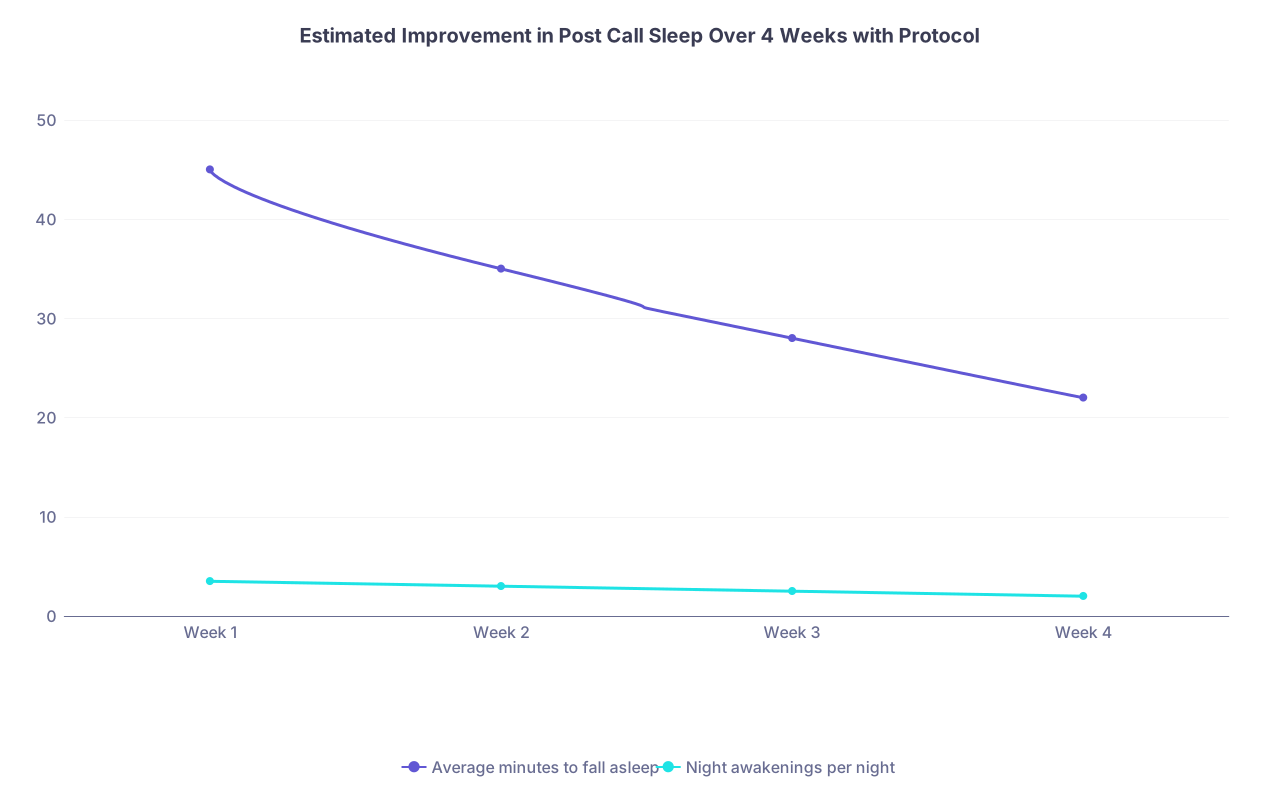
| Category | Average minutes to fall asleep | Night awakenings per night |
|---|---|---|
| Week 1 | 45 | 3.5 |
| Week 2 | 35 | 3 |
| Week 3 | 28 | 2.5 |
| Week 4 | 22 | 2 |
These numbers are not magic. They are realistic. I have seen people move from “I dread going home because I cannot sleep” to “Post‑call is still rough, but at least I have a way down.”
FAQ (Exactly 2 Questions)
1. What if I only have 30–60 minutes to sleep post‑call before I need to be up again (kids, conference, rounds)? Is the protocol still worth it?
Yes, but shrink it aggressively. Run a 5‑minute version:
- 1 minute: doorway breathing.
- 1 minute: write 3 bullets in the notebook for “later‑today follow‑up.”
- 3 minutes: in bed, slow breathing with a single phrase (“May I rest,” etc.).
Then sleep. Even if you only get 30 minutes, this will be deeper and less panicked than collapsing without any ramp down. You are training the association between “I run this micro‑sequence” and “my brain is off duty now,” which pays off later when you do have more time.
2. Is this enough if my post‑call insomnia is severe and chronic?
If you have months of frequent, severe insomnia, this protocol is necessary but probably not sufficient. At that point, you should:
- Talk to your PCP or an occupational health provider about:
- CBT‑I (cognitive behavioral therapy for insomnia) – gold standard, more effective than meds long‑term.
- Screening for depression, anxiety, PTSD, or sleep disorders like sleep apnea.
- Look hard at work patterns:
- Repeated unsafe call schedules.
- Lack of protected recovery time.
Use this mindfulness plan as a stabilizing nightly tool while you pursue real structural and medical help. Do not use it as a way to tolerate blatantly unreasonable schedules forever.
Open your calendar and look at your next post‑call or post‑late‑shift day. Block a 30‑minute window labeled “Mindfulness Sleep Protocol” starting when you expect to get home. Then, tonight, put a notebook and pen next to your bed and choose your one compassion phrase. Your protocol begins the next time you walk through your front door after call.