

The mental replay after a bad outcome is not “just stress.” It’s a predictable brain glitch—and you can train around it.
If you’re a clinician or trainee and your mind keeps replaying one case, one mistake, one awful code… you’re not broken. You’re doing what a conscientious, ethically serious professional does. But if the replay is constant, intrusive, and sabotaging your sleep, your learning, and your presence with other patients, you need a plan. Not vague “practice mindfulness” fluff. A concrete, one-week protocol.
This is that plan.
Step 0: Name What’s Actually Happening
Before we touch mindfulness, you need a clear diagnosis of the situation—not in DSM terms, in practical terms.
You’re probably experiencing a mix of:
- Intrusive images or mental videos of the bad outcome
- Counterfactuals: “If I had just ordered that CT…”, “If I had spoken up…”
- Shame and moral distress: “I failed them”, “I shouldn’t be a doctor”
- Hyper-focus on this one case, ignoring the other 50 you did well
- Physical tension: tight chest, clenched jaw, racing heart when the memory pops
That’s not just “stress.” It’s your brain’s threat system in overdrive, trying to:
- Protect your identity as a “good doctor” by dissecting every detail, and
- Prevent future harm by over-learning this one experience.
Useful intention. Terrible implementation.
The point of this next week is not to erase the memory. It’s to:
- Turn off the 24/7 replay
- Extract the real learning points
- Re-anchor you in your actual values, not your inner prosecutor
Keep that in mind: we’re not doing spiritual anesthesia. We’re doing surgical focus.
The One-Week Mindfulness Plan: Overview
Here’s the structure you’re going to run for 7 days:
| Day Range | Primary Focus | Time Needed (per day) |
|---|---|---|
| Day 1 | Grounding & Safety | 15–20 minutes |
| Days 2–3 | Containment of the Replay | 20–25 minutes |
| Days 4–5 | Ethical Reflection & Learning | 25–30 minutes |
| Days 6–7 | Integration & Forward Focus | 20–25 minutes |
You can do this while on service, during residency, or with a full attending schedule. It’s built for real life, not retreats.
You’ll need:
- A notebook or notes app (non-negotiable)
- 10–15 minutes before bed
- 5–10 minutes you can steal during the day (call room, car, bathroom stall—whatever)
If you’re already in active crisis—can’t function, persistent thoughts of self-harm, panic attacks—you need parallel professional support (occupational health, your physician, mental health services). This plan can still help, but it is not enough on its own in that scenario.
Day 1: Stop the Freefall – Grounding and Safety
Today’s goal is not “processing.” It’s stopping the spiral.
Morning (or first available break): 5–7 minutes
Sit somewhere you won’t be interrupted for 5 minutes.
Put both feet on the floor. Hands on your thighs.
Box breathing:
- Inhale through your nose for 4 seconds
- Hold for 4 seconds
- Exhale through your mouth for 4 seconds
- Hold empty for 4 seconds
Do 5–8 rounds.
While breathing, silently label: “Right now, I am safe. The event is not happening now.”
This is not positive thinking. It’s time orientation. Your nervous system needs a timestamp: “This is over. I am here.”
Evening: 10–15 minutes
You’re going to write, but with strict rules.
At the top of the page, write:
“This is what happened, not who I am.”Briefly (10–15 lines max) describe the event:
- Objective facts only
- No “I should have”, “I failed”, “I knew.”
- Imagine a camera recording the shift.
Example:
“54-year-old male, chest pain, vitals X, labs Y, initial impression Z, ordered A/B/C, outcome D.”Stop. When you feel the urge to launch into self-attack, write this sentence instead:
“My brain wants to punish me to feel in control. I will evaluate later. Not now.”End with 3 concrete sensory facts about your current reality:
“I am sitting in my room. My feet are on the carpet. I can hear the AC hum.”
That’s Day 1. No deep analysis yet. Your system isn’t stable enough for that.
Days 2–3: Contain the Replay, Don’t Wrestle It
Over these two days, you’re going to set boundaries with the replay. Not by suppressing it (that backfires) but by putting it in a container.
Technique 1: Scheduled Worry Window (yes, even for doctors)
You’re going to give your brain an appointment to obsess. So it doesn’t crash rounds with you.
Pick a daily 15-minute slot, preferably late afternoon or early evening, not before bed (bad idea). Same time both days.
During that 15 minutes:
- You’re allowed to think about the case as much as you want
- You’re allowed to write, cry, swear, whatever
- You’re not allowed to:
- Open Epic
- Read the chart
- Text colleagues about it
- Spiral on “What do they think of me?”
When the replay shows up outside that window, your line is:
“Not now. 7:30 pm is for this. I’ll see you then.”
Repeat it like a broken record. You’ll feel silly. It still works.
This isn’t avoidance. It’s containment. Same way you contain sepsis while you figure out source control.
Technique 2: 3-Minute Grounding Reset (during the day)
When an intrusive image hits mid-shift:
- Name it: “There you are. The replay.”
- Feel your feet on the floor.
- Out loud or silently, describe 5 things you see, 4 you can feel, 3 you can hear, 2 you can smell, 1 you can taste.
- Take one slow breath in through the nose, slow out through the mouth.
That’s enough to cut the automatic loop. Do not argue with the thought. Just re-anchor in this moment.
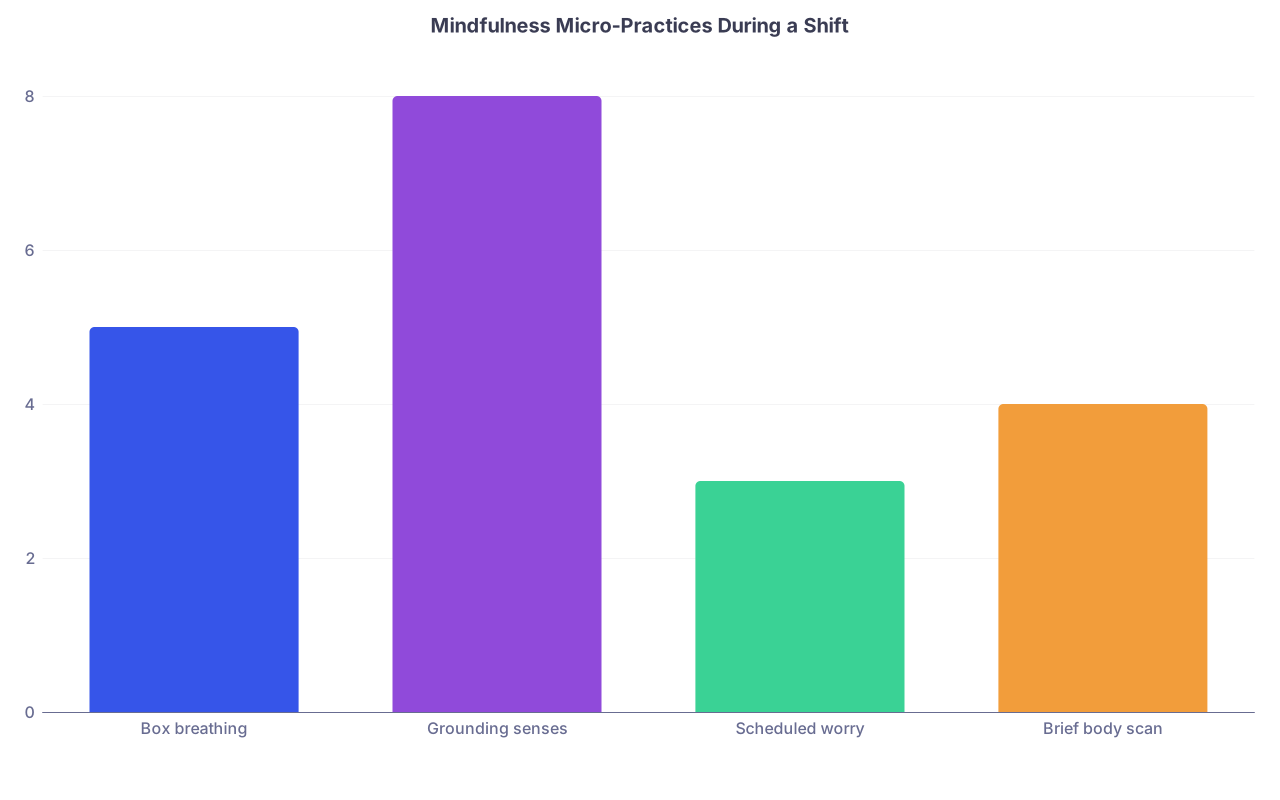
| Category | Value |
|---|---|
| Box breathing | 5 |
| Grounding senses | 8 |
| Scheduled worry | 3 |
| Brief body scan | 4 |
The numbers here represent approximate uses per week for each tool if you actually implement this. Reps matter more than perfection.
Evening (Days 2 and 3): 10–15 minutes
You’re going to move from raw replay into structured observation.
New page. Two columns:
Left side: “What my mind is saying”
Right side: “Plain fact or story?”
Examples:
- “I killed that patient.” → “Story. I was one clinician in a complex case.”
- “Everyone thinks I’m incompetent.” → “Story. I’ve heard no direct feedback.”
- “I missed X earlier than I should have.” → “Partly fact, partly hindsight.”
Don’t pretty it up. Just label which parts are verifiable and which are your mind’s prosecution brief.
This is mindfulness of cognition: seeing thoughts as mental events, not truths.
Days 4–5: Ethical Reflection Without Self-Execution
Now that the nervous system is less on fire, we can do what your conscience has been trying (badly) to do: reflect ethically and learn.
Here’s the distinction that matters:
- Guilt says: “I did something wrong or could have done better.”
- Shame says: “I am wrong. I am bad.”
Guilt can be a teacher. Shame just burns the house down.
Exercise A: Values-Based Questions (20–25 minutes)
On Day 4 or 5 (whichever you feel mentally stronger), sit down and answer these in writing:
“In this case, what did I actually do that aligned with my values as a clinician?”
Examples: “I spoke honestly with the family.” “I sought help.” “I stayed with the patient to the end.”“Where did my actions or inactions fall short of the clinician I want to be?”
Be specific and behavioral, not identity-based.
Bad: “I was incompetent.”
Better: “I delayed considering diagnosis X despite red flags A and B.”“What factors contributed that were not under my full control?”
System issues, workload, information gaps, noise, fatigue, communication breakdowns.“If I saw a colleague in my exact situation, what would I realistically think of them?”
Write what you’d actually think about a co-resident, not the harsh fantasy standard you use on yourself.
This is ethical self-audit, not a public M&M where you’re performing contrition. Be honest, but be proportionate.
Exercise B: One Concrete Learning Target
Out of that reflection, you pick one (not five, not ten) concrete practice change.
Examples:
- “For chest pain patients, I will pause after initial labs to explicitly consider 3 worst-case diagnoses before disposition.”
- “During overnight admits, I will use a checklist to confirm key red flags before signing off.”
- “If I feel out of my depth, I will call for help before I try ‘one more thing’.”
Write it in a single sentence. First person. Then place it where you’ll see it: work badge, locker, phone wallpaper.

| Step | Description |
|---|---|
| Step 1 | Intrusive replay |
| Step 2 | Grounding and safety |
| Step 3 | Contain with worry window |
| Step 4 | Ethical reflection |
| Step 5 | Identify one learning target |
| Step 6 | Apply change in future cases |
This is how you convert psychic pain into professional growth without sacrificing your sanity.
Days 6–7: Integration, Not Erasure
By now, if you’ve actually done the work, a few things should be different:
- The replay still shows up, but it’s less sticky
- You can think about the case without immediate adrenaline
- You have at least one clear learning point
Now we shift from “this horrible thing that defines me” to “this painful event that is part of my story as a physician.”
Evening Practice: 10–15 minutes (both days)
You’re going to do a short, structured mindfulness meditation. Nothing mystical. Very practical.
- Sit comfortably, eyes closed or soft gaze.
- Set a timer for 8–10 minutes.
- Focus on the sensation of the breath in one place: nostrils, chest, or belly.
- When the mind inevitably goes to the case:
- Silently label: “Remembering.”
- Notice body sensations briefly (tightness, heat, heaviness).
- Return to the breath.
Imagine you’re training a dog on a leash. It runs off (to the replay), you gently bring it back. Over and over. No yelling, no drama. That repetition is literally rewiring your attention circuits.
Integration Writing (Choose One Night, 10–15 minutes)
Write a letter. Not to the patient. To your future self 5 years from now.
Prompts:
- “Here’s what happened.” (2–3 sentences max)
- “Here’s what I felt for days and weeks afterward.”
- “Here’s what I learned and changed because of it.”
- “Here’s what I hope you remember about this when you’re a more senior clinician.”
End with one sentence beginning with: “Even though this was terrible, it does not mean that I am ____.” Fill in whatever your shame story has been saying: “unsafe,” “a fraud,” “unfit to practice.”
Will this magically resolve everything in a week? No. But you’ll have moved from drowning to swimming with a clear direction.
Where Mindfulness Meets Medical Ethics
Let’s be direct. The culture of medicine still quietly promotes two bad ideas:
- “If you suffer enough after a bad outcome, you care enough.”
- “If you move on at all, you’re callous.”
Both are garbage.
Ethical practice is not measured in duration of self-torture. It’s measured in:
- Honesty about your role
- Willingness to learn
- Efforts to repair and prevent future harm
- Capacity to stay present for the next patient
Mindfulness here is not about “being chill.” It’s about:
- Seeing clearly what happened and what didn’t
- Separating your identity from one event
- Calming your nervous system so your ethical analysis isn’t hijacked by panic
You are allowed to forgive yourself and take responsibility. Those are not opposites. In fact, people who can forgive themselves are more likely to make sustained changes rather than hiding, avoiding, or defensively doubling down.
When You Need More Than This Plan
Use this week as data. If you:
- Still can’t sleep most nights
- Have intrusive memories that feel like you’re back in the room (not just recalling it)
- Notice you’re avoiding certain patients, procedures, or settings
- Are having persistent thoughts like “Everyone would be better off if I weren’t in medicine”
then this is beyond “normal processing a bad outcome.” That’s not weakness, that’s injury. Moral injury, maybe PTSD, maybe depression.
You would not tell a patient to “just breathe more mindfully” through crushing chest pain. Do not do the emotional equivalent to yourself.
Loop in:
- Occupational health / employee assistance
- A therapist familiar with clinicians and trauma
- A trusted attending or mentor who actually has emotional intelligence (not the “I drank through residency, you’ll be fine” guy)
Mindfulness is one tool. Not the entire toolbox.
FAQ (Exactly 5 Questions)
1. What if I genuinely did make a serious mistake—won’t mindfulness just let me off the hook?
No. That fear is common, and it’s wrong. Mindfulness doesn’t erase responsibility. It stops you from turning responsibility into self-destruction. You can acknowledge, “I missed X,” identify contributing factors, change your practice, disclose appropriately—and do all of that more effectively when your brain isn’t flooded with shame and panic 24/7. The people who cling hardest to self-attack often change the least, because they’re too afraid to look clearly at what happened.
2. How do I handle the replay when I’m literally back in the same clinical situation (same chief complaint, similar patient)?
Use a micro-ritual. Before entering the room, pause for 15–20 seconds. One breath in, one breath out. Silently say, “This is a different patient. This is a different moment.” Then consciously apply your one concrete learning target—“Consider worst cases,” “Check for X lab,” whatever you chose. You’re not trying to make the feeling disappear. You’re channeling it into focused vigilance rather than frozen fear.
3. Should I talk to the patient’s family again if I keep thinking about them?
Sometimes yes, sometimes no—and this is where you seek local, senior guidance. From a mindfulness and ethics standpoint, don’t act purely from your need for relief (“I need them to forgive me”). That’s about you, not them. Discuss with an attending, risk management, or a mentor: What would genuinely serve the family? Is there new information? Clarification they might want? If a conversation is appropriate, prepare for it grounded and clear, not as an impulsive move from unresolved guilt.
4. What if I don’t feel anything but numbness? No replay, just flat.
Numbness is a signal too. It’s often a protective freeze response when the system decides, “This is too much to feel right now.” The mindfulness move isn’t to force tears or drama. Start with very small body-awareness practices (2–3 minutes scanning from head to toe, noticing tension or lack of sensation), and simple journaling of facts. Sometimes the emotions surface slowly over days or weeks. If the numbness persists and bleeds into the rest of your life—no joy, no interest, can’t connect with anyone—that’s a sign to pull in professional help.
5. I’m a trainee. What do I actually say to my attending about this without looking weak or incompetent?
You can be both honest and professional. Something like: “That case from last week has stayed with me. I’ve been replaying it and I’m working on processing it productively. I’d appreciate 10 minutes to review what I could learn from it and how to approach similar situations in the future.” That frames you as reflective, not fragile. If their response is dismissive (“You’ll see worse, get used to it”), treat that as data about them, not about you. Then find someone else—another attending, chief resident, program director—who understands what good clinicians actually look like.
Open your calendar right now and block a 15-minute slot today for your first grounding and writing session. Label it with exactly this: “This is what happened, not who I am.” Then keep the appointment.


