

It is 11:47 p.m. You just got home, dropped your bag in the hallway, and the second the door clicked shut you started crying. Not a tear or two. The ugly, chest-tight, “what is happening to me?” kind of crying.
Four hours earlier you were in the ICU, watching a patient code. You charted. You gave the update to the family. You grabbed a coffee and went to the next room. You were… fine. Calm. Efficient. Almost disturbingly okay.
Now your brain is replaying the whole shift on a loop and your body has finally decided it is not okay. At work: numb and robotic. At home: flooded and falling apart.
You’re not broken. But you are in a risky place. This “numb at work, unravel at home” pattern is one of the classic early warning signs that your emotional system is trying to protect you in the moment and then dumping the overload when it senses you’re “safe.”
Here’s how to handle it without just “pushing through” until you either burn out, make a serious mistake, or both.
1. Understand What’s Actually Happening (You’re Not Defective)
Let me translate what your nervous system is doing.
At work, especially in acute or high-volume settings, you’re living in a state that’s a mixture of:
- Hyper-focus and adrenaline
- Emotional suppression (conscious or not)
- Rule-following autopilot: “Next task. Who’s sickest. What’s the plan?”
Your brain has quietly decided: “If I let you feel this right now, you might freeze or crumble, and we’ve got 18 more patients and 40 notes to do.” So it switches gears into:
- Narrowed attention
- Reduced emotional bandwidth
- Dissociation-lite: you’re present but not fully there
Then you get home. The pager is off. No one needs you. Your body finally believes: “Safe enough.” And all the emotions and unprocessed stress that got blocked during the shift pour out.
Your system isn’t failing. It’s overcompensating.
But here’s the problem:
If you stay in this pattern, three big risks show up:
- Ethical erosion – You start to tolerate things you shouldn’t because you “can’t feel it anymore.”
- Compassion fatigue – Patients become “the appy in 12” or “the GI bleed” not because you’re evil, but because your brain is protecting itself.
- Personal collapse – Crying after every other shift, dreading work, fantasizing about just walking out. I’ve watched good people hit that wall.
So no, you’re not weak. You’re overloaded and under-supported. The fix is not “be tougher.” The fix is “retrain how you process what hits you, when, and with what support.”
2. A 3-Stage Plan for Your Next Shift (Before, During, After)
You do not need a 30-day retreat. You need something you can actually use on a 14-hour call day. So we’re going to carve this into three parts: pre-shift, mid-shift, and post-shift. Small interventions, repeated, are how you change the pattern.

| Step | Description |
|---|---|
| Step 1 | Pre shift check in |
| Step 2 | On shift micro resets |
| Step 3 | Post shift decompression |
| Step 4 | Sleep and recovery |
2.1 Pre‑Shift: 3–Minute Reality Check
This is not meditation on a mountaintop. This is you, in call room scrubs, sitting on the side of your bed or in your car before walking in.
Three minutes. That’s it.
Name your baseline
Literally say in your head or quietly out loud:- “I feel: tired / anxious / numb / okay-ish / angry / sad.”
No poetry. Just labels. This forces a minimal reconnection to your internal state.
- “I feel: tired / anxious / numb / okay-ish / angry / sad.”
Orient to purpose (not perfection)
Say one sentence that defines your job for this shift, not forever.Examples:
- “My job tonight is to give safe care and not pretend I’m a robot.”
- “My job is to notice one human moment with at least one patient.”
- “My job is to ask for help early if I’m overloaded.”
You’re setting a realistic ethical anchor, not a hero fantasy.
Set a containment rule
You’re not going to process the entire trauma history of your training in the middle of a rapid response. So set this boundary:- “I will notice what I feel, but I won’t unpack it fully until after shift.”
That simple contract with yourself makes mid-shift feelings less threatening. You’re telling your brain: “We will come back to this. Later.”
2.2 On‑Shift: Micro‑Resets That Don’t Blow Up Your Workflow
You do not have 20 minutes every 2 hours. You barely have 3 minutes to pee. So we’re talking micro‑interventions – 20 seconds to 2 minutes, woven into what you already do.
A. Doorframe Check (10–20 seconds)
Every time you enter or exit a patient room, use the doorframe as a cue.
As your hand touches the handle, ask: “Where am I at from 0–10 right now?”
0 = completely shut down, 10 = about to cry or explode.If you are 0–3 → say internally: “Ok, I’m too flat, I’ll try to make one genuine connection.”
If you are 7–10 → say internally: “Too hot. One slow breath before I walk in.”
It takes literal seconds. The goal is not perfect regulation. It is awareness plus a tiny correction.
B. One Breath, On Purpose (20–30 seconds)
You’re washing your hands. Or waiting for the EMR to load. Instead of just staring at the lagging screen:
- Inhale slowly through your nose for a count of 4.
- Hold 1–2 seconds.
- Exhale through your mouth for a count of 6.
Do that once. Maybe twice.
Numbness lessens when you stop running purely on shallow chest-breathing all shift. This is physiology, not spirituality.
C. One Human Detail Per Patient (5–10 seconds)
If you’re drifting into pure task mode, anchor back with one human detail:
- Notice their hands. Calloused? Tremor? Fidgeting with the blanket?
- Ask one small non-medical question: “Who’s at home with you?” “What do you do outside of work?”
- Or just silently notice: “This is a scared 52‑year‑old, not just a creatinine of 4.3.”
You don’t need deep talks in every room. You just need a thread of “this is a human, and so am I” to prevent full emotional anesthesia.

2.3 Post‑Shift: Do Not Just Collapse. Decompress Deliberately.
The mistake most people make: they walk out of the hospital, shove everything into a mental closet, go home, open Instagram or Netflix, and then wonder why they suddenly start sobbing in the shower.
You need a decompression bridge between “on” and “off.”
Pick one of these. 10–15 minutes. Non‑negotiable on bad shifts.
Option 1: The 3‑Box Mental Debrief (10 minutes)
On your walk home, in your car, or sitting on your couch, mentally put the shift into three boxes:
Box 1 – Facts:
“Patient in 308 died. I missed lunch. Family in 412 was angry. I did X well. I forgot Y.”Box 2 – Feelings:
Quick labels: “Sad. Guilty. Irritated with attending. Scared I’ll make a mistake like that again. Proud I caught that lab.”Box 3 – Actions for Later (not now):
- “Read up on X tomorrow.”
- “Ask senior about that decision.”
- “Check in with nurse who cried in the hallway.”
This stops the post‑shift spiral of vague distress. You’ve named facts, named feelings, and placed future tasks in a bucket so you can actually rest.
Option 2: Physical Shake‑Out (5–10 minutes)
You’ve been clenching your jaw and shoulders for 12 hours. Your body needs proof that the emergency is over.
- Change out of scrubs immediately when you get home. Don’t wear your “armor” on your couch.
- Do a 5–10 minute walk, stretching, or even a short, slightly ridiculous shake‑out routine (yes, literally shaking your arms/shoulders/legs for a minute or two).
The point is to tell your nervous system: “We are not in the hospital anymore.” It sounds stupid. It works.
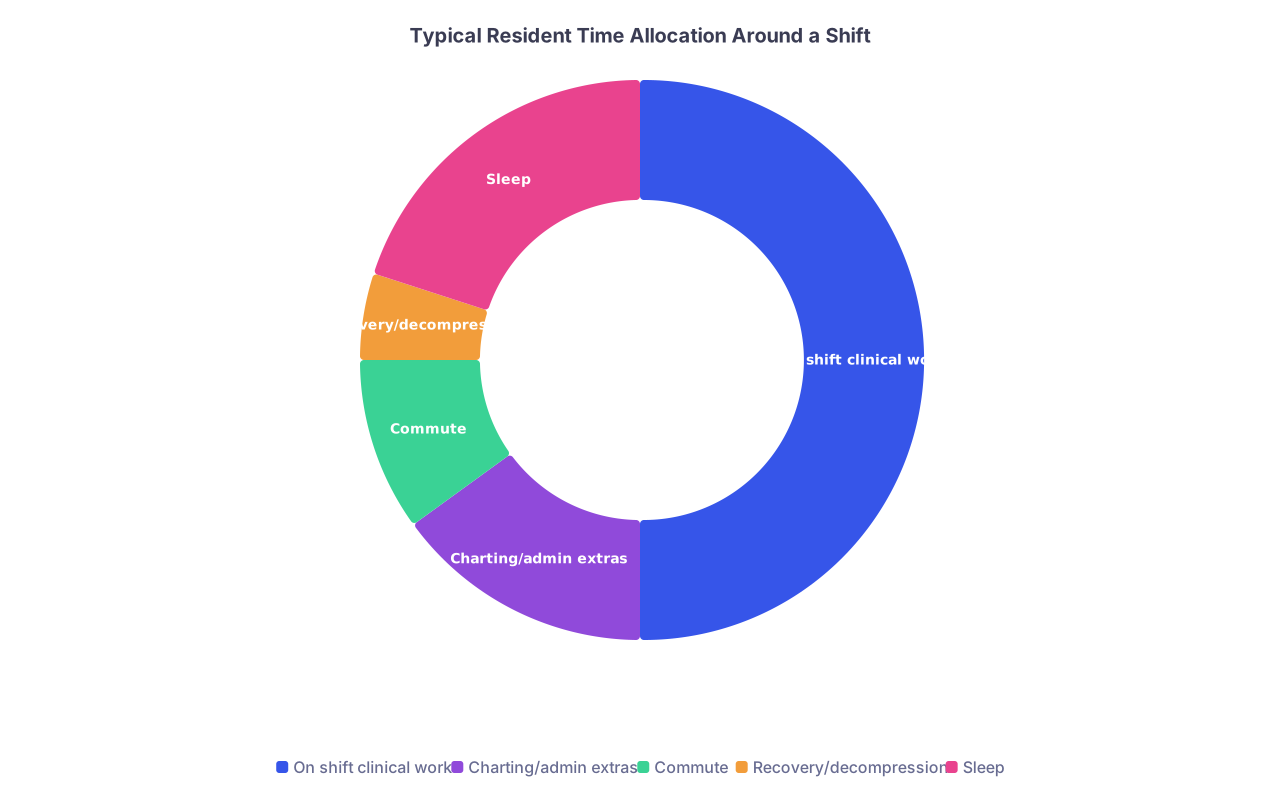
| Category | Value |
|---|---|
| On shift clinical work | 50 |
| Charting/admin extras | 15 |
| Commute | 10 |
| Recovery/decompression | 5 |
| Sleep | 20 |
3. Handling the Crying at Home Without Drowning in It
So you’re on your couch, or in the shower, and you’re crying again. Or feeling like you want to, but you’re stuck in that pressure‑in‑the‑throat place.
Here is what to do in the moment.
Step 1: Drop the Judgment Sentence
If the first thing your brain says is, “What is wrong with you, pull it together,” you just doubled the pain. You’re not only sad; now you’re ashamed of being sad.
Replace that with something boringly factual:
- “Tough shift. My body is dumping stress.”
- “This is a normal response to an abnormal day.”
Not affirmations. Just neutral statements that don’t pour gasoline on the fire.
Step 2: Contain the Flood – 5 Minute Window
Tell yourself: “For 5 minutes, I’m going to let this happen. After that, I’ll get up and do one small concrete task.”
During those 5 minutes:
- Let the crying come.
- Put a hand on your chest or neck if that feels grounding.
- Breathe with the crying instead of fighting it.
At 5 minutes (set a timer if you have to), stand up. Drink water. Brush your teeth. Put clothes in the hamper. Something physical and small.
Why? Because processing feelings is good. Drowning in them for 90 minutes, then sleeping 4 hours and going back to a 12‑hour shift, is not.
Step 3: Name One Specific Thing That Hurt
The crying often feels vague: “Work is awful. I can’t do this.” That’s overwhelming. We bring it down to real size by naming something specific:
- “Watching that family say goodbye wrecked me.”
- “Being snapped at in front of the team stung more than I admitted.”
- “I felt useless during that code.”
When you name a specific emotional bruise, your mind can start to process it. Otherwise, it just feels like a giant, formless storm cloud.
4. How to Reconnect Without Getting Overwhelmed on Shift
Your fear, whether you’ve said it out loud or not, is usually this: “If I let myself feel this stuff at work, I will fall apart and not be able to function.”
That’s not paranoia. It’s a valid concern. So the strategy is graded reconnection.
4.1 Start Small: One Patient Per Shift
Pick one patient per shift to be consciously “more human” with.
- You look them in the eyes for a full sentence or two.
- You allow a small wave of sadness or concern to register.
- You silently say something like, “This is hard for you,” or “I’m here for this few minutes.”
Then you leave the room and do one grounding breath. That is all.
You are telling your nervous system: “We can feel a tiny bit, and the world does not end.”
4.2 Use the “Half‑Open Door” Approach
You don’t have to swing the emotional door wide open. Think of it as cracking the door open halfway. Enough to notice your reaction, not enough to get swept under.
Example:
- You see a young patient with a new cancer diagnosis.
- Old pattern: slam door shut, treat them like a staging problem.
- “Half‑open door” pattern:
- Notice: “I feel a pang in my chest.”
- Let that pang be there for 2–3 seconds.
- Take one soft breath.
- Then shift into: “What do they need medically and practically from me right now?”
You’re not numbing; you’re sequencing: feel → breathe → act.
5. Ethics Check: When Numbness Becomes Dangerous
This isn’t just about your mental health. It’s about the kind of clinician you are becoming.
Here are red flags that the numbness has crossed from protective to corrosive:
| Red Flag | What It Often Looks Like |
|---|---|
| Contempt for patients | Calling them “trainwrecks,” mocking them consistently |
| Indifference to suffering | Feeling nothing when someone is clearly terrified or grieving |
| Cutting corners | Skipping key parts of an exam or consent because you “can’t be bothered” |
| Ethical shrug | Thinking “everyone does it” when something clearly feels wrong |
If you see these in yourself, do not wait.
Minimum actions:
- Tell one trusted person (chief, mentor, therapist, or colleague) exactly what you’re noticing. Not the polished version. The real one.
- Reduce avoidable overload where you can: saying no to extra shifts when possible, asking co‑residents to trade a particularly brutal call if you’re at a breaking point.
- If your environment punishes you for raising these concerns, that’s an institutional problem. But your responsibility is still to not silently let yourself slide into someone you’d be ashamed of.
6. When to Get Outside Help (Therapy, Peer Support, or Both)
Some lines mean you’re beyond DIY strategies.
If any of these sound familiar, you should not handle this alone:
- Crying after most shifts, for weeks.
- Feeling detached not only at work but also with friends, partners, or family.
- Using alcohol, benzos, or other substances to “shut it off” regularly.
- Having thoughts like “I wish I’d get in a car accident so I’d get a break” or any version of “they’d be better off without me.”
That is not “normal burnout.” That is your brain waving a flare.
Concrete steps:
Check what your institution actually offers:
- Employee Assistance Program (EAP)
- Confidential counseling
- Resident support services
Usually buried in an onboarding email you never opened. Go find it.
Consider a therapist who understands medical training. Not your uncle’s golf buddy. Someone who has actually seen residents, physicians, nurses.
Use peer spaces wisely: some programs have Balint groups, Schwartz Rounds, or informal debrief spaces. They’re not perfect, but they can short‑circuit the “I’m the only one” shame loop.
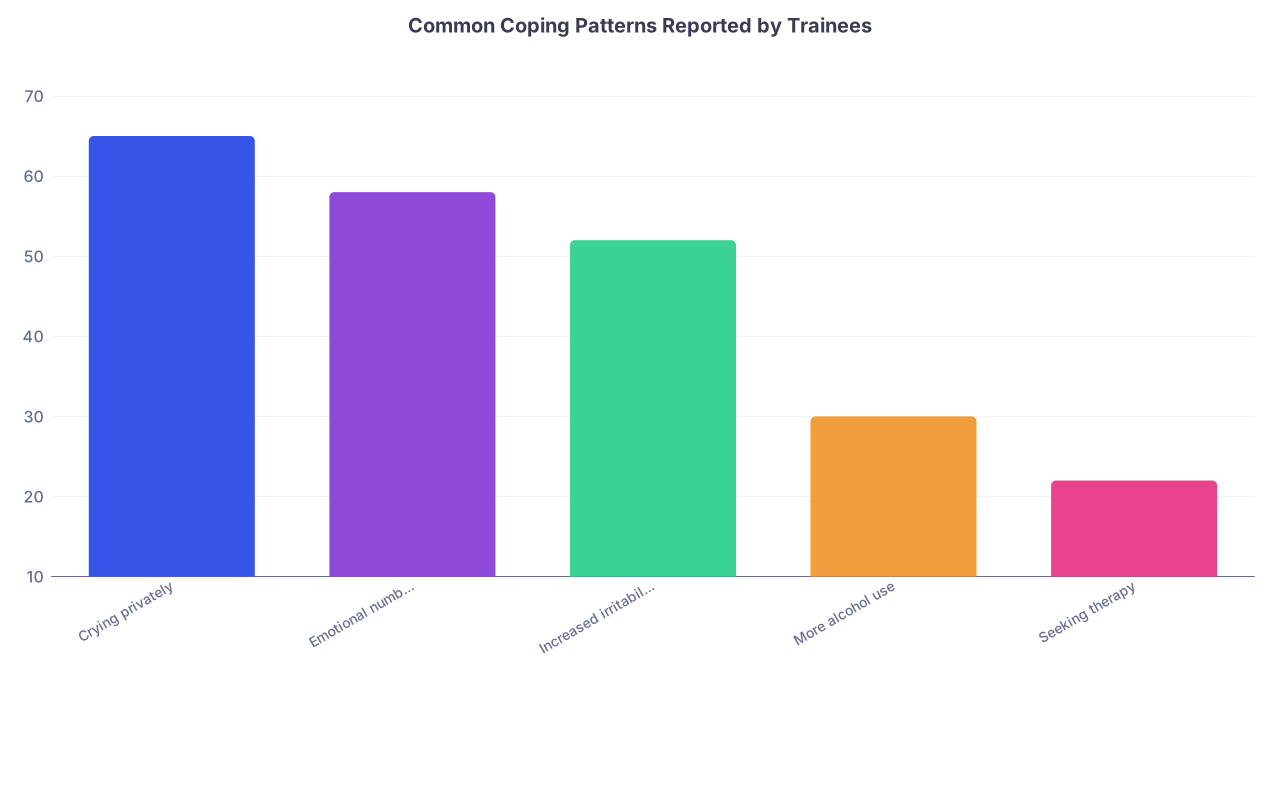
| Category | Value |
|---|---|
| Crying privately | 65 |
| Emotional numbness | 58 |
| Increased irritability | 52 |
| More alcohol use | 30 |
| Seeking therapy | 22 |
7. How to Talk About This Without Torching Your Reputation
You’re probably also thinking: “If I admit this to anyone at work, I’ll be labeled weak or unstable.”
Legit fear. So you choose who and how you tell.
Some scripts that stay honest but professional:
To a peer you trust:
“Lately I’ve been totally flat on shift and then losing it when I get home. Are you seeing anything like that?”To a chief or mentor:
“I’m functioning clinically, but my distress level after shift is high. I’m working on coping strategies, but I’d like to talk through options to make this sustainable.”To a therapist/doctor:
“I’m emotionally numb during work and having intense crying spells after. I’m concerned about burnout and about how this might affect my care.”
You do not have to bleed out your soul in the workroom. You do need at least one or two people who know what’s actually going on.

8. A Simple Weekly Reset to Keep You from Drifting
If you’re serious about not becoming either a wreck or a robot, do this once a week. 15–20 minutes. Coffee, notebook, no pager.
Answer these four questions. Briefly. Bullet points are fine.
When did I feel most like a clinician I respect this week?
(Specific moment, not general vibe.)When did I feel most checked out or numb in a way that felt wrong?
What am I avoiding feeling or thinking about from this week?
One small adjustment for next week:
- “Doorframe check on ICU days.”
- “Call my cousin who always makes me laugh.”
- “Email EAP to schedule one session.”
This is how you course‑correct before you’re sobbing every night and Googling “how to quit residency at 2 a.m.”
FAQ (4 Questions)
1. How do I know if this is just a rough month versus real burnout?
Short version: frequency, duration, and spillover. A rough month still has some good days, some genuine moments of connection, and your emotions outside work eventually return to baseline. Burnout looks like: persistent numbness or dread most days for weeks, no real recovery even after a day off, and your relationships and hobbies feeling flat or like chores. If you’re unsure, assume you’re closer to burnout than you think and act now rather than waiting for a formal diagnosis.
2. Is it unprofessional to cry at work or in front of patients?
Not automatically. A few quiet tears with a family during a devastating conversation can be deeply human and appropriate. The line is whether your emotion is in service of the patient or hijacking the interaction. If you cannot speak, think, or attend to their needs because you’re overwhelmed, that’s a problem. But a voice that cracks, a tear that falls, a brief “This is really hard, I’m so sorry you’re going through this” – that’s not unprofessional. That’s human.
3. What if my program culture glorifies toughness and mocks any show of vulnerability?
Then you are working against a current, not with it. You probably will not change the culture alone. So you build a micro‑culture: 1–3 people you trust where you can be real. You use institutional resources that are outside the immediate hierarchy (EAP, external therapy). And you quietly commit to not becoming the kind of attending who perpetuates that garbage. You don’t have to bleed in front of people who will weaponize it, but you also don’t have to buy into their definition of strength.
4. I’m scared that if I reconnect emotionally, I’ll lose my edge and make more mistakes. Is that real?
When done badly—yes, if you’re flooded all shift, you will miss things. But that’s not what I’m advocating. The goal is not “feel everything, all the time.” The goal is calibrated awareness: enough connection to notice red flags, communicate well, and maintain your ethical compass, paired with skills to contain and process emotion after the acute task is done. People who are chronically numb actually miss subtle cues, rush, and cut corners more, not less. A grounded, emotionally aware clinician is sharper, not sloppier.
Key points to walk away with:
- Being numb at work and crying after shift is a common, understandable response to overload—but it is also a warning sign you should not ignore.
- Small, concrete practices before, during, and after shift can start to reconnect you to yourself without overwhelming you: doorframe checks, one conscious breath, one human detail, and a brief decompression ritual.
- If this pattern is persistent, escalating, or bleeding into the rest of your life, pull in help—peer, professional, or both—before it hardens into full-blown burnout or ethical erosion.


