
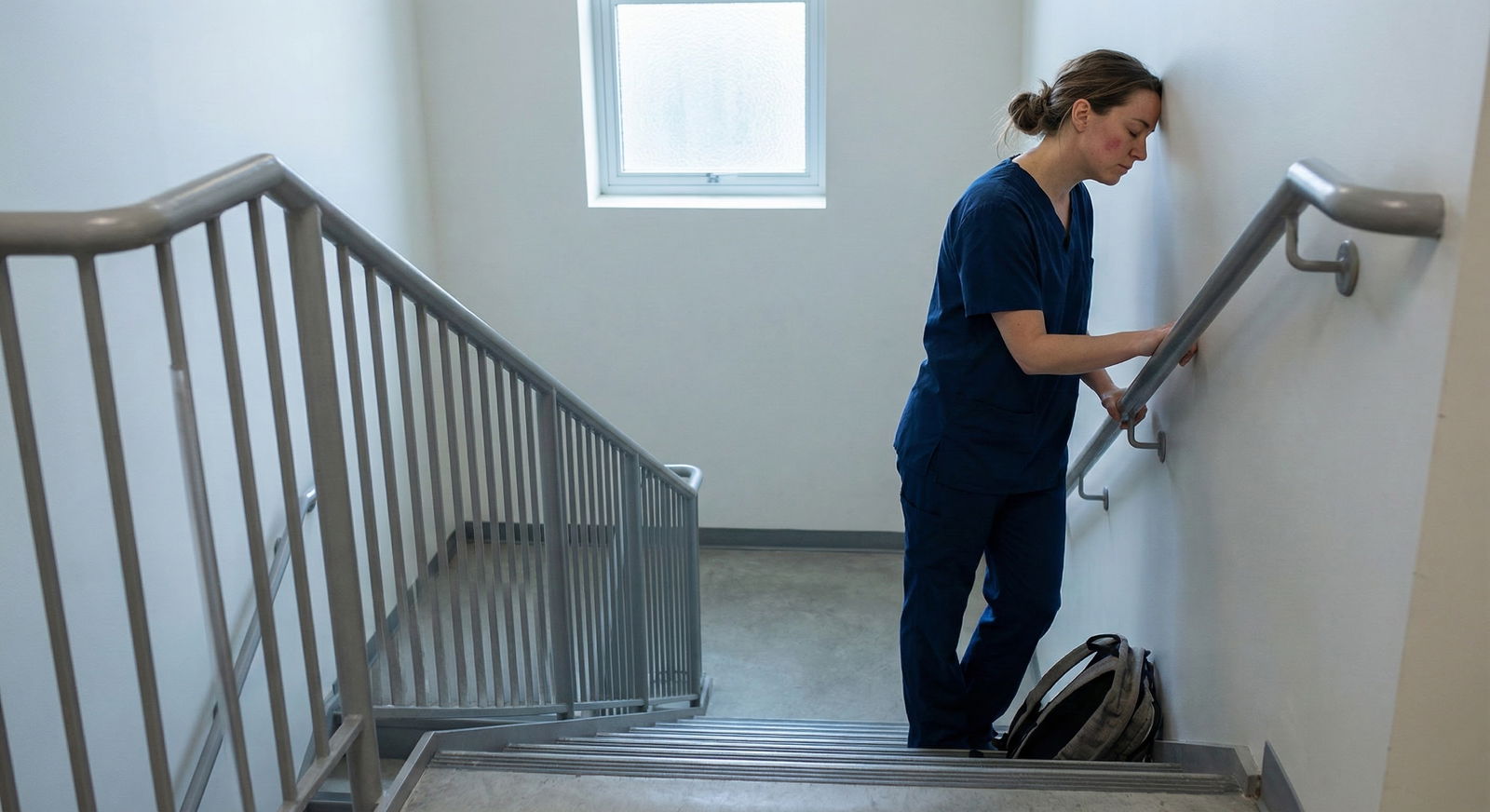
You’re in a cramped clinic workroom. You’ve got three charts open, you’re mid-note, and you’re already 25 minutes behind. A MA cracks the door: “Can you come look at this rash, room 4?” At the exact same moment your phone buzzes with a stat lab result and a patient message about chest pain that “has been going on for 3 weeks but now feels worse.”
Your brain spikes. You feel that familiar inner snap: irritation, pressure, a hint of panic. You notice your next thought: “I can’t do this. I need everyone to leave me alone for five minutes.” But no one is going to leave you alone.
This is the situation: constant interruptions in clinic, and no realistic way to get a quiet room, a yoga mat, or 20 peaceful minutes. You still have to be ethical, kind, and clinically sharp. You do not have the luxury of “ideal” mindfulness practice.
So you need something else: on‑the‑spot mindfulness that works in the chaos, not around it.
Let’s talk about exactly what to do in the real moment, with real people knocking on the door.
First: Redefine What “Mindfulness” Means in Clinic
Most clinicians have an image of mindfulness that’s totally incompatible with clinic reality: a quiet space, eyes closed, 10–20 uninterrupted minutes. That picture is why people say, “I don’t have time for mindfulness.”
In clinic, that version is dead on arrival.
Here’s the version that actually works in a busy outpatient day:
- 3–30 second micro-pauses, done dozens of times
- Often with eyes open, while walking or typing
- No special posture, cushion, or app
- Simple anchors: breath, body sensation, single phrase
- Directly tied to an action you’re already taking
You’re not trying to become Zen. You’re trying to move from “reactive and scattered” to “slightly more deliberate and less harmful” in the next 30 seconds.
That’s it. That’s success.
What Interruptions Really Do To You (And Your Patients)
Interruptions are not just annoying. They actively wreck your cognition and nudge you toward unethical behavior.
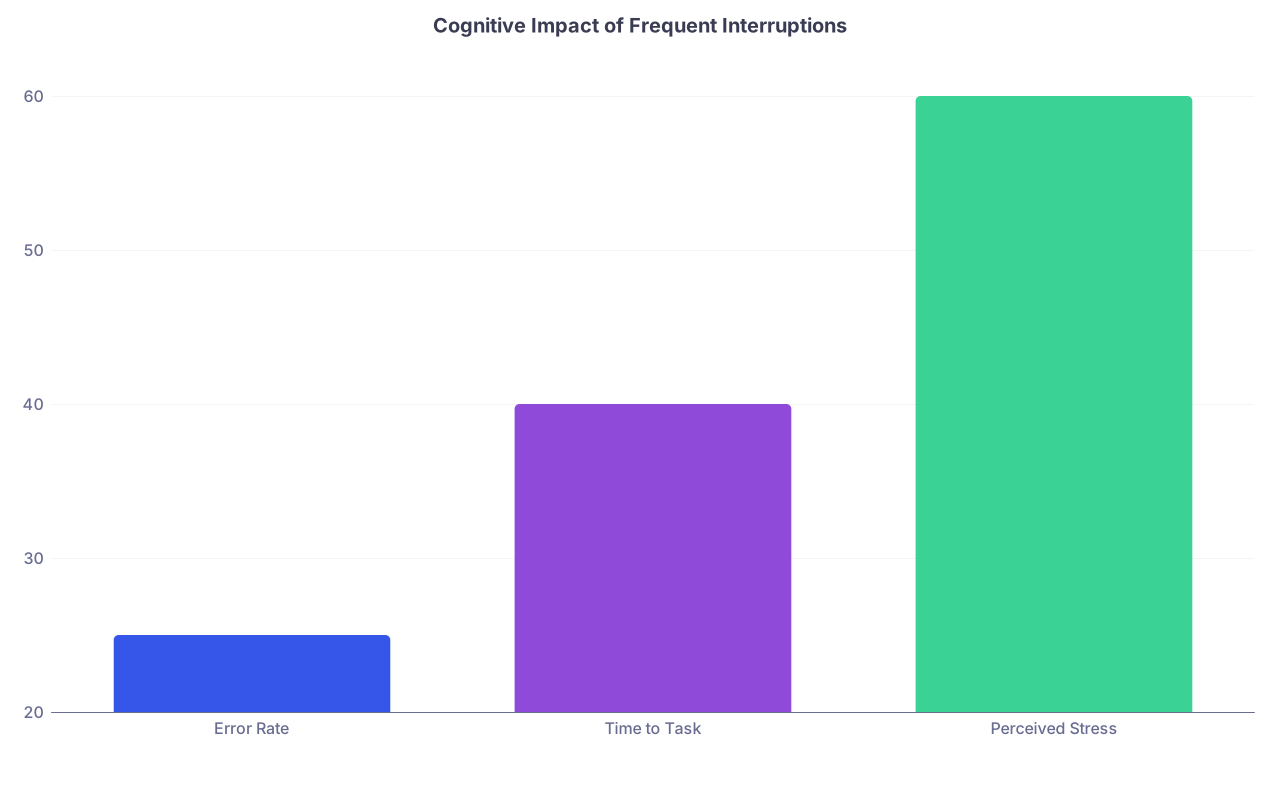
| Category | Value |
|---|---|
| Error Rate | 25 |
| Time to Task | 40 |
| Perceived Stress | 60 |
Numbers here are representative, not gospel, but the pattern is real: more interruptions → more errors, slower charting, more stress.
Here’s what I see in real clinics:
- You’re midway through reconciling meds when someone asks, “Quick question?” You switch tasks, then forget whether you renewed the ACE inhibitor. That’s a near-miss.
- You’re trying to counsel a patient on new diabetes meds when a nurse knocks: “Your 10:30 is angry and wants to leave.” Your attention fractures. Your tone gets clipped. The patient in front of you gets half a conversation.
- After the fifth interruption in 20 minutes, your empathy drops. You cut corners on explanations. You use more “we already talked about this” language than you’re proud of.
Clinically, it’s dangerous. Ethically, it’s corrosive.
On‑the‑spot mindfulness is not some wellness decoration. It’s a tool to:
- Reduce your reactivity when someone interrupts
- Protect attention for the patient in front of you
- Catch the “I don’t care anymore” drift before it shows up as harm
So let’s get tactical.
A 5-Second Protocol for the Exact Moment You’re Interrupted
You’re typing. Someone appears in the doorway. Here’s what you do, step-by-step.
Step 1: Micro-pause your hands (1 second)
Don’t immediately swivel, talk, or click. Freeze your hands on the keyboard or mouse for one full breath.
Literally: inhale, exhale.
This half-second pause is where you interrupt autopilot. You’re choosing to respond instead of react.
Step 2: Name your internal state (1–2 seconds)
In your head, quickly label what’s happening:
- “I feel irritated.”
- “I’m anxious and rushed.”
- “I’m overloaded right now.”
One word is enough: “irritated,” “tired,” “overwhelmed.”
Why bother? Because naming drags your experience out of the swirl and into awareness. “I’m angry” is very different from simply being anger.
Step 3: Ground in one physical sensation (2 seconds)
Pick one of these, fast:
- Feel your feet in your shoes
- Notice your sit bones in the chair
- Feel your hand touching the desk or mouse
- Notice one inhalation at your nostrils
Two seconds. Not 20.
You’re not escaping the situation; you’re dropping one anchor so you don’t get swept fully into reactivity.
Step 4: Ask for one clear piece of information (about 1 second)
Now actually turn to the interrupter and clarify:
- “What do you need help with?”
- “Is this urgent, or can it wait 5 minutes?”
- “One sentence — what’s going on?”
You say it calmly, not aggressively. This does two things:
- It slows the interaction enough for your brain to catch up.
- It models concise, respectful communication.
Here’s all four steps compact:
- Pause hands, inhale–exhale
- Name your state: “overwhelmed”
- Feel your feet on the floor
- “Is this urgent or can it wait 5 minutes?”
That entire sequence can be under 7 seconds. It is a mindfulness practice. In clinic clothes.
Using Boundaries Without Being a Jerk (and Staying Ethical)
Mindfulness in medicine isn’t just breathing. It’s also how you structure your responses so you do not harm patients through rushed, fragmented attention.
You absolutely need boundaries around interruptions. But most clinicians swing between:
- Overly porous: say yes to everything, drown
- Overly rigid: shut people down, damage team function
A mindful middle path looks like this: deliberate triage plus clear language.
Here are specific phrases you can use, immediately.
For non-urgent clinical questions
Scenario: MA at the door, “Can you come look at this foot wound sometime?”
Try:
- “I can’t leave this patient’s care plan right now. Put it on my list, I’ll come by in 20–30 minutes.”
- “Not urgent? Great. Write it on the whiteboard; I’ll batch these between patients.”
You’re explicitly prioritizing the patient in front of you. Ethically correct.
For borderline-urgent but not emergent issues
Scenario: Nurse, “Room 5’s BP is 170/100, no symptoms, worried.”
You do your 5-second protocol, then:
- “Ok, thank you. Please recheck in 5 minutes and message me the numbers. If still high, I’ll go in after I finish here.”
You’re not ignoring it. You’re sequencing it. There’s a difference.
For truly urgent or emergent situations
Scenario: “Doctor, room 3 is short of breath and looks gray.”
Your mindfulness move here is not to breathe for 30 seconds. It’s to cut everything else and move with clarity.
- Pause hands for one half-breath.
- Name it: “Urgent.”
- Stand intentionally, not frantically.
- Tell your current patient: “I’m sorry, a patient down the hall needs immediate help. I need to step out. I will come back and give you your full time.”
That one sentence to your current patient is ethical gold. It acknowledges them, explains, and implicitly values their time, even as you leave.
Micro-Practices You Can Embed in Your Clinic Day
If you only rely on the 5-second protocol during interruptions, it will help. But you can reinforce it by sprinkling other tiny practices into the structure of your day.
Think of them as “oxygen shots” between dives.
1. The Door Handle Reset
Every time your hand touches a patient room door handle:
- Feel the metal or plastic
- One slow breath in and out
- Mentally: “This is a new person.”
You’re closing the last visit, even if the note isn’t finished, and arriving for the next.
Ethically, this protects against emotional carryover: the difficult, demanding patient in room 2 doesn’t poison the kind, anxious patient in room 3.
2. The Hand Sanitizer Moment
You’re doing this dozens of times. Turn it into a built-in mindfulness cue:
While rubbing sanitizer:
- Notice the temperature and texture
- Feel your hands fully — fingers, palms, backs
- Let your shoulders drop 2 millimeters
You’re already “wasting” those 5–10 seconds drying your hands. Use them.
3. The Chair Exhale Before Notes
Before you start a note:
- Sit down
- Exhale fully through your mouth, like a slow sigh (quietly)
- Notice your back against the chair
Then type. That’s it.
I’ve seen this cut people’s end-of-day emotional fatigue because they’re not white-knuckling the entire documentation process.
Managing the Mental Aftershock of Interruptions
The interruption itself is bad enough. The mental aftershock is often worse:
- Ruminating: “Why can’t people think for themselves?”
- Self-criticism: “I’m so behind, I’m terrible at this.”
- Catastrophizing: “I’ll never get any of these notes done.”
That noise burns more energy than the actual work.
Here’s a simple, ethical way to handle the mental fallout.
The 3-Sentence Reset
Between tasks, or while walking down the hall, you silently say three sentences to yourself:
- “Right now I am [emotion].”
- “This is what it feels like when I’m under pressure.”
- “I can still choose my next small action.”
Example:
- “Right now I am frustrated.”
- “This is what it feels like when my day is out of control.”
- “I can still choose to listen fully in the next room.”
Is this cheesy? A little. Does it work? Yes, if you actually do it. It moves you from shame and rumination into agency.
When Interruptions Make You Rude (and How to Repair)
Let me be blunt: everyone reading this has snapped at a nurse, MA, or patient because they were overloaded.
You say something short or sharp. They back off. You feel like a jerk.
Mindfulness here is not about never snapping. You’re human. It’s about noticing faster and repairing faster. That’s both personal development and medical ethics.
Catching the Snap
Clues you’ve gone over the line:
- You see a flinch on their face
- Your volume or tone spikes
- You think, “That was harsher than necessary”
The impulse is to justify: “Well, they shouldn’t have interrupted me.” Drop that. That move will rot your relationships.
The 20-Second Repair
As soon as feasible — next time you see them or even 10 minutes later — say:
- “Hey, earlier when you came in, I was really short. I’m overloaded, but that’s not your fault. I’m sorry.”
Stop. Don’t add “but…” Anything after “but” erases the apology.
This is mindfulness applied to ethics: you noticed your impact, took responsibility, and cleaned it up. It also makes future interruptions smoother because staff trust you’re not perpetually angry.
Structural Changes That Make Mindfulness Actually Possible
You can be the most mindful person in the world and still get wrecked by a garbage clinic system. So part of on‑the‑spot mindfulness is noticing patterns and making small but concrete structural changes.
Here are changes that I’ve seen actually stick in real clinics.
1. Interruptions Triage Board
Tiny whiteboard in the workroom, divided into:
| Category | Meaning |
|---|---|
| Now | Truly urgent – interrupt immediately |
| Soon | Needs attention in 15–30 minutes |
| Later | Non-urgent questions, teaching points |
Teach your staff:
- “Now” = crashing, chest pain, anaphylaxis, stroke symptoms, suicidal, anything you’d feel guilty about delaying
- “Soon” = new worrisome symptom without distress, abnormal vitals but patient stable, medication questions that need your review
- “Later” = refills, forms, FYIs, minor administrative stuff
Then tell them: you only want door knocks for “Now” and some “Soon.” The rest goes on the board.
2. Batch Questions
Instead of five separate interruptions:
- “Any questions for me? Let’s batch them every 30–45 minutes.”
You can even set two “consult huddles”:
- Mid-session (e.g., 10:30)
- End of session (before lunch or end of day)
This is mindfulness at a systems level: you’re reducing the frequency of “mind flips” required of your brain.
A Walk-Through: One Chaotic Hour, Done Mindfully
Let’s stitch this together.
It’s 9:15. You’re already 10 minutes behind.
- 9:16 – You leave room 1, flustered. At the door: hand on handle, one breath: “New person.”
- 9:17 – While sanitizing hands before room 2, you notice the cool gel, drop your shoulders a touch.
- 9:25 – Mid-visit in room 2, MA knocks: “Dr. K, quick question?” You micro-pause, feel your feet, name “irritated.” “Is this urgent or can it wait 5?” She says it can wait. “Please write it on the ‘Soon’ section. I’ll check after this patient.” Back to patient: “I want to stay focused on you — where were we?”
- 9:32 – You sit to write the room 2 note. One exhale, feel your back on the chair, then type. You’re interrupted again: nurse, “BP 180/100, no symptoms.” Hands freeze for one breath. “Thank you. Recheck in 5, message me. If still high I’ll go after room 3.”
- 9:40 – You’re behind, frustrated. Walking to room 3 you do the 3-sentence reset: “Right now I am stressed. This is what pressure feels like. I can still choose to listen fully in this next room.” Hand on handle, breath, “New person.”
Same chaos. Slightly different you. That slight difference scales across weeks and years.
How This Ties Back to Medical Ethics (Not Just Wellness)
Let me tie this back explicitly, because this isn’t just about you “feeling better.”
On‑the‑spot mindfulness in the face of constant interruptions helps you uphold:
- Respect for persons – giving patients undivided attention, even in short bursts
- Nonmaleficence – reducing errors driven by distraction and cognitive overload
- Fidelity – being honest about delays, explaining when you have to leave, not pretending you can do 3 things at once with full attention
- Justice – not letting the loudest or most disruptive needs always override the quiet, respectful patient in front of you
Mindfulness, in this context, is a practical ethics tool. It lets you notice: “I am about to shorten this explanation just because I’m annoyed.” Then you choose differently.
That’s character. Built second by second.

| Step | Description |
|---|---|
| Step 1 | Interruption Happens |
| Step 2 | Pause Hands and Breathe |
| Step 3 | Name Emotion |
| Step 4 | Ground in Body Sensation |
| Step 5 | Address Immediately |
| Step 6 | Deflect to Later with Clear Plan |
| Step 7 | Explain Briefly to Current Patient |
| Step 8 | Return Focus to Current Task |
| Step 9 | Urgent or Not |

What to Do Tomorrow in Clinic
If you try to implement 12 new things at once, you’ll do none. Pick two or three from this list for your next clinic day:
- During every door handle touch, take one breath and think “New person.”
- Use the 5-second protocol for every interruption: pause hands, name state, feel feet, clarify urgency.
- Turn hand sanitizer time into a micro-practice: notice the sensation, drop your shoulders.
That’s it. Three things.
Do them for a week. You’ll start to notice that even when the system doesn’t change, your reactivity does. Slightly more space. Slightly fewer regretted snaps. Slightly more genuine presence.
And over time, those “slightlys” add up to a very different kind of clinician.
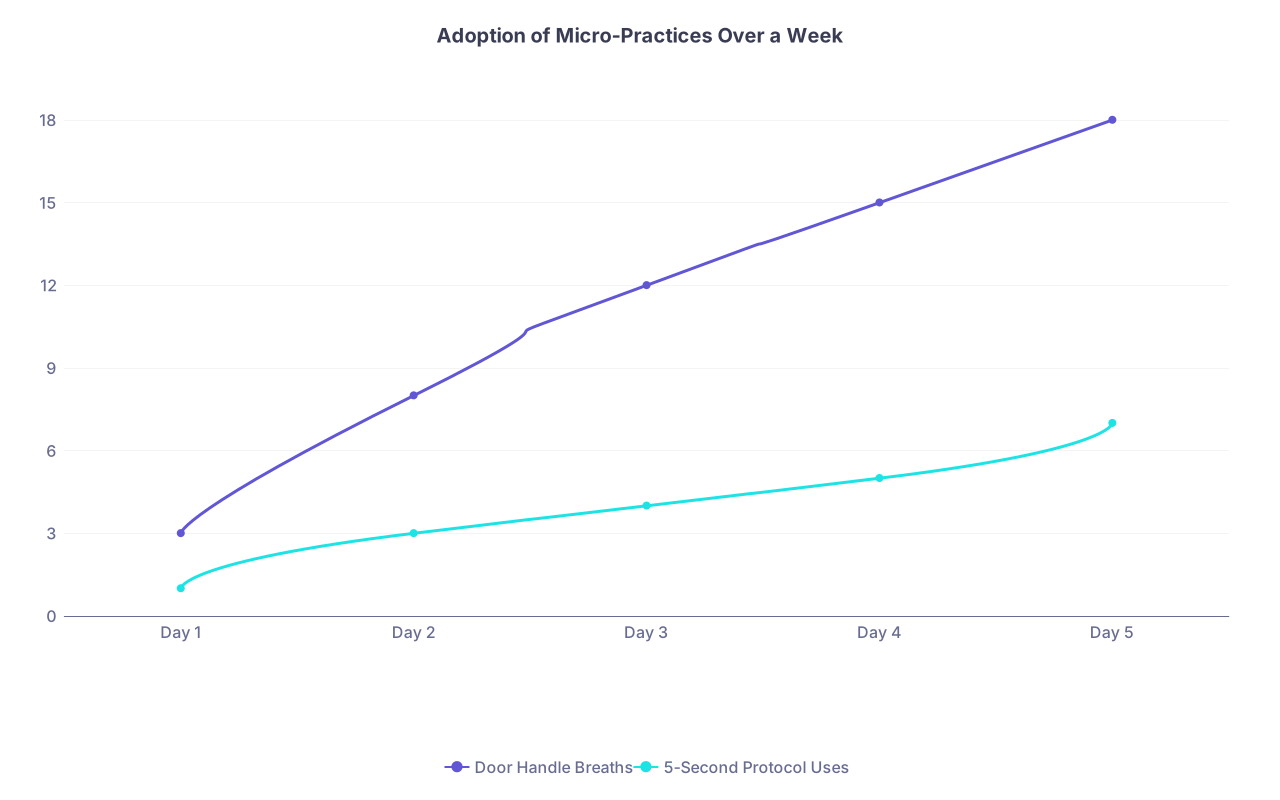
| Category | Door Handle Breaths | 5-Second Protocol Uses |
|---|---|---|
| Day 1 | 3 | 1 |
| Day 2 | 8 | 3 |
| Day 3 | 12 | 4 |
| Day 4 | 15 | 5 |
| Day 5 | 18 | 7 |

Bottom Line
Three key points:
- You will not get a quiet, perfect clinic day. So build 3–10 second mindfulness moves that fit inside the chaos, not outside it.
- Use the 5-second interruption protocol — pause, name, ground, clarify urgency — to turn constant knocks into deliberate choices instead of reflexive reactions.
- Treat mindfulness as an ethics tool: it protects your attention, your tone, and your clinical decisions when the system keeps trying to fracture them.


