

The way most clinicians “prepare” for high‑risk procedures is broken. We obsess over the checklist and ignore the mind that has to execute it.
If you’re about to do something that can kill or save a person in minutes—complex central line in a crashing patient, tricky airway, high‑stakes surgery—you do not just need knowledge and technical rehearsal. You need a deliberate mindfulness rehearsal plan so that when the pressure spikes, your brain does not betray your hands.
This is not yoga music and scented candles. This is mental skills training, like athletes and pilots use, adapted for medicine.
Below is a practical, step‑by‑step plan you can actually run before a high‑risk case. Use it the night before, the morning of, and in the 5 minutes before you scrub.
1. Get Clear: What “High‑Risk” Actually Means for You
Before you talk mindfulness, define the situation honestly. “High‑risk” is not only massive cardiac surgery.
It’s any procedure where:
- There’s real risk of death or permanent harm
- You know complications will be hard to reverse
- You feel your heart rate rise just thinking about it
Examples I’ve seen people spiral over:
- A PGY‑2 doing their first awake fiberoptic intubation on a distorted airway
- A senior resident leading their first trauma laparotomy at 3 a.m. with an attending “supervising from the corner”
- An ICU fellow placing a subclavian line on a coagulopathic patient with a history of pneumothorax
- A new attending doing a solo emergency C‑section under time pressure
You need to know:
- What’s at stake clinically
- What’s at stake for your identity (reputation, “am I good enough,” fear of looking incompetent)
Because those identity stakes are what hijack your attention mid‑procedure, not just the clinical ones.
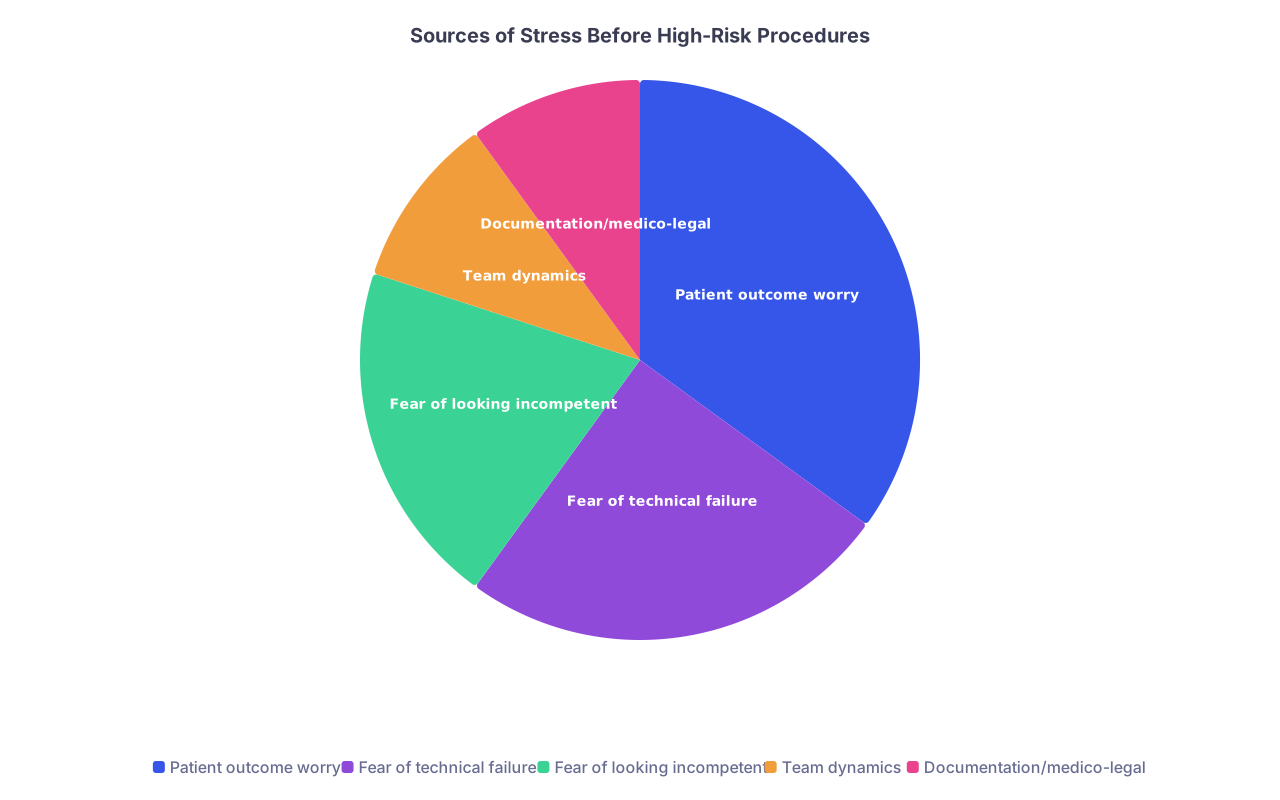
| Category | Value |
|---|---|
| Patient outcome worry | 35 |
| Fear of technical failure | 25 |
| Fear of looking incompetent | 20 |
| Team dynamics | 10 |
| Documentation/medico-legal | 10 |
Take two minutes and literally write on a scrap of paper or in your phone:
- “This procedure feels high risk because…”
- “What I’m most afraid of is…”
Name it. If you do not externalize it, it will run the show from the background.
2. Build a 3‑Layer Rehearsal Plan (Not Just “I’ll Try to Stay Calm”)
You need three layers:
- Before the day
- The day of, before you walk in
- During the procedure
Think of it like a checklist, but for your mind.

| Step | Description |
|---|---|
| Step 1 | Day Before |
| Step 2 | 15 min mental rehearsal |
| Step 3 | Sleep and boundaries |
| Step 4 | Day Of Prep |
| Step 5 | 5 min pre procedure routine |
| Step 6 | In procedure reset tools |
| Step 7 | Post case debrief |
Let’s break each layer down.
3. The Night Before: 15 Minutes That Change Tomorrow
You are not doom‑scrolling UpToDate at midnight. You are doing targeted mental prep.
Step 1: Anchored Breathing (3 minutes)
Sit down. Back supported. Feet on the floor. Phone on airplane mode.
Do a simple 4‑6 breathing pattern:
- Inhale through the nose for a slow count of 4
- Exhale gently through the mouth for a slow count of 6
Do that for 10 breaths.
While you breathe, give your mind a simple instruction: “Right now, my only job is this breath.”
Your goal is not to feel relaxed. Your goal is to practice noticing when your mind runs off to “what if I perforate” and calmly bringing it back. That exact skill is what you’ll use when the room gets tense.
Step 2: Clear, Neutral Intention (2 minutes)
Say (out loud if you can, quietly if you share walls):
- “My job tomorrow is to: [state it simply].”
- “Safely place a right IJ central line with ultrasound.”
- “Lead this trauma laparotomy using ATLS principles.”
Then add:
- “My priorities are: 1) Patient safety 2) Communication 3) Learning.”
No heroic language. No “I must be perfect.” You’re setting a clear frame. When things get messy, you’ll come back to these priorities.
Step 3: Brief Technical Visualization (5–7 minutes)
Now you run the procedure in your head, but not as a movie where everything is perfect. That’s useless.
You visualize:
- Normal flow
- 2–3 predictable complications
- Yourself using reset tools when stress spikes
Example for a central line:
- See yourself positioning the patient, doing the time out, visualizing anatomy on ultrasound.
- See the wire not threading. Notice the jolt of anxiety. You pause, feel your feet on the floor, take one breath, re‑confirm landmarks, adjust.
- See a brief arrhythmia on the monitor as you advance the wire. You stop. You breathe. You withdraw slightly. You communicate with the nurse.
The key detail: you include stress in the visualization and practice what you’ll do with it.
If you’re doing this right, you’ll feel your heart rate bump a bit. That is fine. You’re training under simulated pressure, but safe.
Step 4: Set Boundaries So Your Brain Can Sleep (3 minutes)
You’re not a hero for reading case reports at 1:30 a.m. with a 7 a.m. case.
Simple rule: Set a “cutoff time” the night before. For example:
- “After 10 p.m., I am not allowed to open clinical resources about this case. I can write down worries on paper, but I’m off duty.”
You can literally have a “parking page” in a notebook:
- Write “Tomorrow’s case worries:” and list them.
- Close the notebook. Put it in your bag.
Your brain relaxes more when it trusts you’ve captured the worries somewhere physical.
4. Morning Of: A 10‑Minute Mental Warm‑Up
Treat your brain like your hands. You would not go straight from bed to the OR without washing and gloving. Don’t go straight from email to a high‑risk case.
Step 1: 2‑Minute Check‑In (no app required)
Find a private-ish corner. Sit or stand.
Ask yourself, quickly:
- “On a scale of 1–10, how keyed up am I right now?”
- “Where do I feel it in my body?” (chest tight, jaw, shoulders, stomach)
Name it: “I feel about a 7, tight in my chest.”
No judgment. Just data.
Then do 6 slow breaths (4‑in, 6‑out) and check that number again. You’re just re‑calibrating the alarm system.
Step 2: Re‑State Your Intention (2 minutes)
Say quietly:
- “My job in this case is to be present, methodical, and safe.”
- “If I get overwhelmed, I will pause, breathe once, and refocus on the next step.”
You’re wiring in your plan for handling stress before stress hits.
Step 3: One Concrete Communication Plan (3–5 minutes)
A lot of procedure anxiety is actually team anxiety: “Will I look lost? Will the nurse think I’m incompetent?”
Solve that directly. Decide one sentence you’ll say to the room before you start:
Examples:
- “This is a high‑risk airway. My plan A is [x], plan B is [y]. If I say ‘pause,’ that means everyone stops talking so I can think.”
- “This central line will be ultrasound guided. I’ll verbalize each step. If anyone sees a break in sterility, please speak up.”
You are building a shared mental model and giving yourself permission to call a time‑out.
| Situation | Script Starter |
|---|---|
| High-risk airway | "This is a high-risk airway. Plan A is..." |
| Complex central line | "This line is higher risk because of..." |
| First time leading | "I will lead the flow, please flag concerns..." |
| Unfamiliar team | "Quickly, here is my plan and backup..." |
You’ll be surprised how much calmer you feel once you’ve rehearsed and spoken this out loud.
5. The 5‑Minute “Airlock” Before You Touch the Patient
This is the most important piece. The liminal space between the hallway and the procedure. Most people waste it.
You’re going to turn it into a micro‑ritual.

Here’s the sequence:
Minute 1: Physical Grounding
Feel your feet in your shoes. Literally. Wiggle your toes.
Drop your shoulders down and back. Unclench your jaw. Let your tongue rest on the floor of your mouth.
You might silently say, “Body here, now.”
Why? Because dissociation and tunnel vision are common in high stress. Grounding your attention in physical sensation widens your perceptual field.
Minute 2–3: Three‑Point Attention Drill
You’re training flexible attention: inside, outside, and the task.
Do this quickly:
- Inside: Notice 3 sensations in your body (pressure of shoes, air on face, movement of breath).
- Outside: Pick 3 sounds (monitor beeps, distant voices, air vent).
- Task: Visualize the first 3 steps you’ll do once you start (e.g., wash hands, confirm consent, time out).
You’ve just trained your brain to move attention on command. That’s exactly what you’ll need when something unexpected happens.
Minute 4: Pre‑Commit to a Reset Cue
Decide now: what will be your “reset cue” if you feel panic, anger, or overwhelm during the procedure?
Options:
- Feeling your feet in your shoes
- One deliberate breath (4‑in, 6‑out)
- Light touch of your thumb to middle finger inside your glove (a subtle, physical anchor)
Say quietly:
- “If I get overwhelmed, I will [reset cue] and then ask: ‘What is the next clear step?’”
You’re building a micro‑contract with yourself.
Minute 5: Ethical Anchor
This is where the “medical ethics” part is not theoretical.
Silently tell yourself one sentence:
- “This human being is not a test of my worth. They are a person I am here to help.”
And one more:
- “My obligation is to act in their best interest, even if that means asking for help or changing the plan.”
That sentence is what stops ego from causing harm when complications hit. I’ve watched residents push on with a failing plan because they were more afraid of looking weak than of hurting a patient. That is an ethical failure, not a technical one.
Let your last thought before you go in be: “Patient first, humility always.” Then walk in.
6. During the Procedure: Micro‑Skills for When Things Go Sideways
You cannot meditate for 20 minutes mid‑hemorrhage. You can use 3–10 second tools to keep your cortex online.
Tool 1: Name What’s Happening (Out Loud)
When the complication hits—arterial puncture, unexpected bleed, airway collapse—your brain wants to dunk you in panic.
Cut that cycle by naming reality in plain clinical language:
- “We have arterial blood.”
- “This is more bleeding than expected.”
- “I’m losing the view.”
This sounds trivial. It is not. Labeling moves activity from amygdala to frontal cortex. You also bring your team along instantly.
Tool 2: The One‑Breath Pause
Once you’ve named the problem, you are allowed exactly one breath before acting.
You say (in your head or softly):
- “Pause.” Inhale for 4, exhale for 6.
During that one breath, ask:
- “What is the NEXT safe step? Not the entire solution. Just next.”
Examples:
- “Next step is to tamponade and call for help.”
- “Next step is to withdraw the wire a bit and check position.”
- “Next step is to switch to video laryngoscope.”
You are not paralyzed. You are trading one second for less stupidity over the next five minutes.
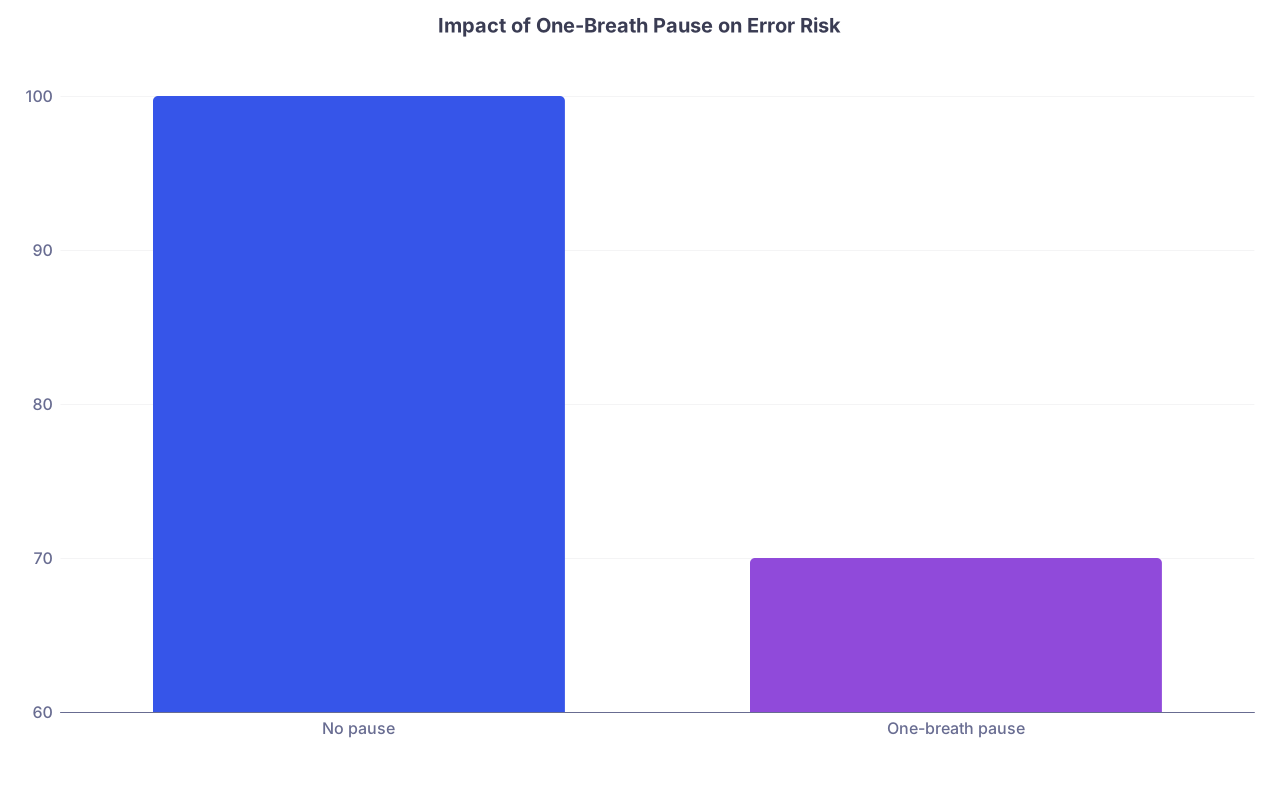
| Category | Value |
|---|---|
| No pause | 100 |
| One-breath pause | 70 |
(Approximate relative risk; the point is: errors drop when you interrupt panic with a structured micro‑pause. I’ve seen this repeatedly.)
Tool 3: Shrink the Task
Under stress, your brain tries to solve everything at once. That feels like drowning.
Instead, you deliberately shrink your horizon to the next one or two steps and say them out loud.
- “Suction, then pack. Suction, then pack.”
- “Landmark, then needle. Landmark, then needle.”
- “Call attending, then stabilize. Call attending, then stabilize.”
Your language becomes the track your action runs on. If your inner voice is “I can’t screw this up oh God oh God,” your hands will follow that script.
Tool 4: Use Your Pre‑Committed Reset Cue
The moment you notice:
- Hands shaking
- Tunnel vision
- Irritability (“everyone shut up”)
You trigger your cue:
- Feel your feet.
- Thumb to middle finger inside glove.
- One breath.
Then you must ask yourself or the room:
- “What is the safest next step?”
If you need help, the ethical move is:
- “This is more complex than expected. I want another set of eyes.”
Say it exactly like that if you have to. It’s clean and adult. Not “Uh, I don’t know, maybe someone else…?” You are still leading, you’re just expanding the team.

7. After the Case: Mindfulness as Ethical Debrief, Not Self‑Flagellation
What you do after a high‑risk procedure determines whether the next one will go better or worse.
Most clinicians choose shame, rumination, or complete avoidance. That’s how you burn out or entrench bad habits.
You’re going to do a 5–10 minute mindful debrief instead.
Step 1: Simple Decompression (2–3 minutes)
Somewhere private:
- Feel your feet on the floor.
- Take 5 slow breaths.
- Notice what’s there: “I feel keyed up / shaky / numb / relieved / angry.”
Name it. You’re not fixing it yet. Just refusing to pretend you’re a robot.
Step 2: Three Questions (5–7 minutes)
Grab paper or notes app. Answer briefly:
“What objectively happened?”
- Just facts: procedure, key events, complications, outcomes. No adjectives.
“What did I do well?”
Force yourself to write at least two things, even in a disaster.- “Recognized bleeding early.”
- “Called for help instead of pushing blindly.”
- “Communicated clearly with the nurse.”
“What will I do differently next time?”
One to three items. Concrete.- “Verbalize backup plan before starting.”
- “Ask for second set of hands earlier when my stress hits 8/10.”
- “Spend 5 minutes reviewing ultrasound anatomy right before the case, not the night before only.”
This is mindfulness: observing with clarity, not judgment, and choosing an intentional response. You’re wiring in learning, not self‑hatred.
Step 3: Ethical Check
Ask yourself bluntly:
- “Did fear of looking incompetent influence any of my decisions?”
If yes, you write what you’ll do differently:
- “Next time I will explicitly say, ‘I need help’ when my plan is failing, even if it’s embarrassing.”
That single habit is an ethical line in your career.

8. Turning This Into a Repeatable Protocol
If you only do this once, it’s a nice idea. You need it to be automatic, like tying knots.
Here’s a simple template you can adapt and stick in your locker or notes app.
Night Before (15 minutes)
- 10 breaths (4‑in, 6‑out)
- Write: “This feels high‑risk because…”
- Visualize: normal flow + 2–3 complications + you using reset cue
- Set cut‑off time for clinical reading
Morning Of (10 minutes)
- Rate anxiety 1–10; 6 breaths; rate again
- State intention: “My job is…”
- Decide and mentally rehearse pre‑procedure script to the team
5 Minutes Pre‑Procedure
- Physical grounding (feet, shoulders, jaw)
- Three‑point attention (inside, outside, first 3 steps)
- Pick reset cue and mentally rehearse using it
- Ethical anchor: “Patient first, humility always.”
During Procedure
- When stress spikes: name reality out loud
- One‑breath pause
- Shrink to next step; verbalize if needed
- Use reset cue; call for help if threshold crossed
After Procedure (10 minutes)
- 5 slow breaths alone
- Answer: what happened, what I did well, what I’ll change
- Ask: “Did ego influence care?” and document your answer
You can literally print that and keep it in your pocket.
9. Final Reality Check
Let me be very clear about two things.
First, mindfulness will not magically make you a brilliant operator. If you have poor technical skills, no amount of breathing will save you. You still need supervision, practice, and humility about your limits.
Second, though: high‑level performance under pressure is not just about skill. It’s about whether your mind collapses or stays usable when the stakes spike. That part is trainable. Most clinicians never train it. That’s the gap you’re closing.
If you’re prepping for a high‑risk procedure:
- Do not wing your mental state. Prepare it as deliberately as your sterile field.
- Use specific, tiny tools—one‑breath pause, reset cue, three‑point attention—rather than vague “try to stay calm.”
- Tie all of it back to ethics: patient first, ego second; asking for help is not weakness, it is part of your duty.
Run this plan for three tough cases in a row. You’ll feel the difference. And more importantly, your patients will get a steadier version of you when it matters most.


