

The way most people are told to “fight imposter syndrome” on a new service is useless in real life. You do not have time for a silent retreat between pages.
You’re walking onto a new service—maybe the MICU, maybe surgery nights, maybe a subspecialty you barely saw in med school. Your stomach is tight, your badge suddenly feels fraudulent, and everyone around you seems to know exactly what to do.
Here is how you manage that specific situation with targeted mindfulness. Not vague “be present” nonsense. Concrete stuff you can do on rounds, between pages, and in the call room—without anyone noticing.
1. Recognize the Exact Pattern You’re In
You are not “broken.” You are in a predictable cognitive pattern that gets triggered in high-stakes, low-familiarity settings.
On a new service, imposter syndrome usually sounds like this in your head:
- “Everyone can tell I have no idea what I’m doing.”
- “If I ask this question, they’ll know I’m incompetent.”
- “I only matched/got here because I got lucky.”
- “I’m one bad decision away from hurting someone and being exposed.”
On a brand-new service these thoughts spike during:
- Pre-rounding (especially before you’ve seen the attendings’ style)
- Presentations (new structure, new expectations)
- First procedures or new workflows (writing TPN orders, vent adjustments, chemo orders)
- Sign-out (you feel like you’re missing something critical)
Step one is not to “fix” the thoughts. Step one is to catch them in real time.
Use a two-word mental label: “Imposter story.”
You think: “I’m going to sound stupid presenting this.”
You immediately tag it: “Imposter story.”
That label does two things:
- It pulls you out of fusing with the thought (“this is absolutely true”) into observing the thought (“oh, my brain is running that script again”).
- It gives you just enough distance to choose your next behavior based on the situation, not the anxiety.
This is mindfulness stripped down to something you can use on rounds: noticing and labeling.
2. Build a 10-Second Reset You Can Use Anywhere
You don’t need a meditation cushion. You need something you can do:
- Standing at the Pyxis
- Waiting for labs to load in Epic
- Walking from the stairwell to the unit
Here’s a 10-second reset that actually works on a busy service.
The 4–3–2–1 Micro-Reset
- One full exhale, longer than the inhale. Aim 4 seconds out, 2–3 seconds in. Do not overcomplicate this.
- Feel three physical points of contact: feet in shoes, badge on chest, stethoscope on neck. Name them in your head.
- Notice two sounds: the monitor beeps, the hallway chatter, the printer. Just label: “beep,” “voices.”
- Commit to one single next action: “Read the K+ level.” “Open the sign-out note.” “Ask the nurse for the story.”
That’s it. Ten seconds. You come out slightly less hijacked by your thoughts and more anchored in the actual room.
Targeted mindfulness means you link this micro-reset to specific stress triggers:
- Before entering a patient room you’re anxious about
- Before speaking during rounds
- Before calling consults
You don’t wait until you’re spiraling. You pre-load the reset at predictable points.
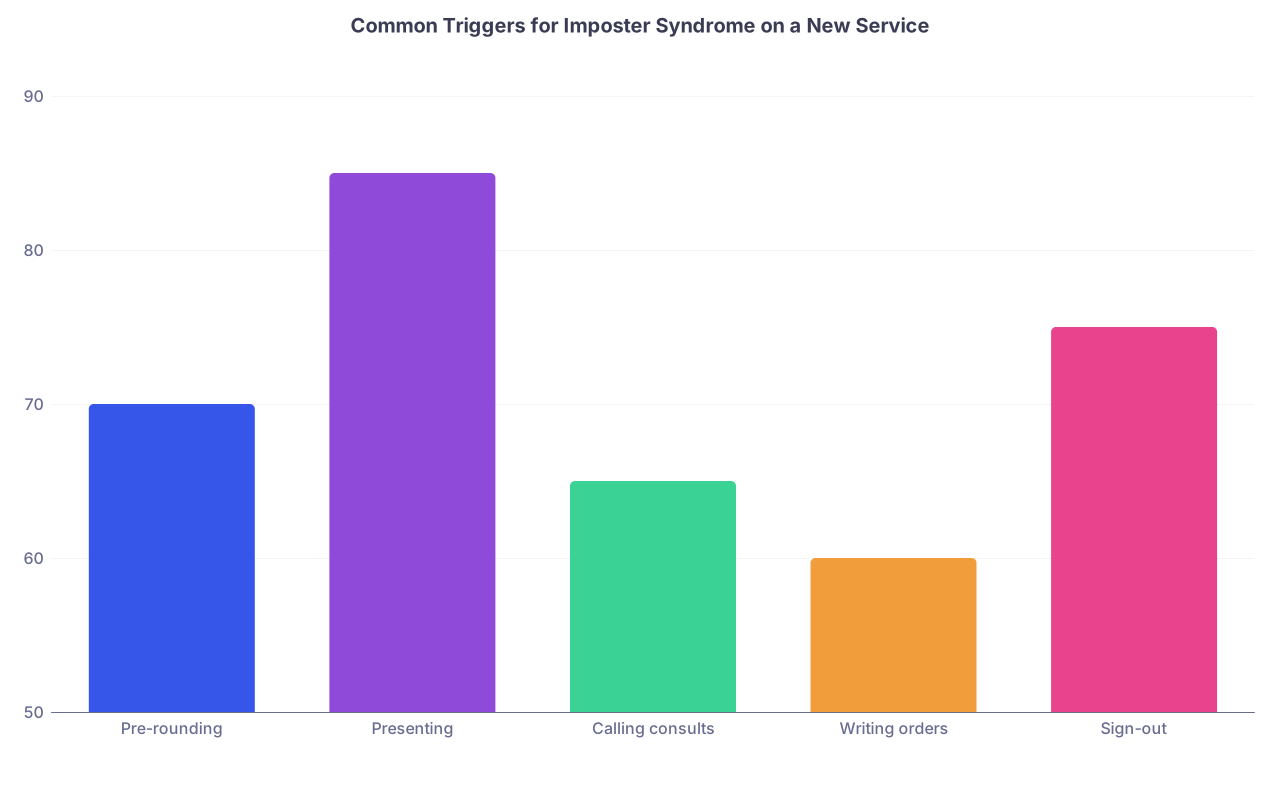
| Category | Value |
|---|---|
| Pre-rounding | 70 |
| Presenting | 85 |
| Calling consults | 65 |
| Writing orders | 60 |
| Sign-out | 75 |
(Percentages here are rough “how often people tell me this freaks them out” numbers, not a published study. But they’re accurate enough for our purposes.)
3. Use Mindfulness to Separate “Competence” from “Familiarity”
On a new service, your brain makes a lazy, harmful equation:
New + Unfamiliar = Incompetent + Fraud
Wrong. What you are is unfamiliar—not incompetent.
Mindfulness here is about seeing what’s actually happening instead of what your fear says is happening.
Try this quick mental audit when you feel that fraud spike:
Ask yourself three questions, fast:
What’s actually new here?
Example: “This specific EMR order set; this attending’s rounding style; this subspecialty jargon.”What is not new here that I actually know how to do?
Example: “Gather a coherent HPI; reconcile meds; recognize a crashing patient; communicate with nurses.”What matters most for patient safety right now?
Example: “Making sure the K is rechecked; that someone is watching the new pressor; that the consent is accurate.”
You’re forcing your attention out of “I suck” and into “what’s in front of me, and what part of this I already know how to do.”
That is mindfulness applied directly to clinical work: attending to reality instead of to your story about reality.
4. Create a Mindful Script for Rounds So You Don’t Freeze
Rounds on a new service are prime imposter territory. New expectations, new cadence, new “right” way to present. You’re in performance mode and your inner critic is screaming.
You don’t need to be calm. You just need to be functional.
Use this three-part script:
Before presenting (5–10 seconds)
- One 4–3–2–1 micro-reset.
- Then silently: “My job is to give a clear, honest snapshot—not to be perfect.”
During presenting
While you talk, anchor your attention slightly in your body:- Feel your feet in your shoes or your fingers on the tablet.
- When the “you sound stupid” thought pops up, just mentally: “Noted.” Then finish your sentence.
You are not fighting the thoughts. You’re letting them be background noise while you keep behavior on track.
When you do not know an answer
This is where people panic and start word salad. Do this instead:- One breath.
- Then a simple, honest line:
“I do not know the exact rationale. I can look that up after rounds and get back to you.”
or
“I’m not sure; my initial thought would be X, but I’d want to confirm.”
That sentence is mindfulness in practice: you’re staying with reality (you do not know) without letting shame run the show.

5. A Concrete Pre-Shift Mindfulness Routine That Takes 4 Minutes
You do not need a 30-minute guided meditation. You do need a repeatable warm-up you can run on every new (or intimidating) service day to keep your nervous system from starting at a 10.
Here’s one that fits in a call room chair or your parked car.
Minute 1: Body scan in chunks
- Sit, both feet on ground, hands resting.
- Notice: feet; legs; back against chair; jaw; shoulders.
- You’re not “relaxing” them. You’re just noticing. If something drops a little, great. If not, also fine.
Minute 2: Breath with counting
- Inhale quietly to a count of 4.
- Exhale to a count of 6.
- Do 6–8 cycles.
- Mind wanders? You notice, label “wandering,” and bring it back to the count. No drama.
Minute 3: Imposter script rehearsal
Say this exact script silently, or whisper if you’re alone. Not affirmations. Orientation.
- “New does not mean incompetent. It means new.”
- “My job is to notice, ask, and act, not to know everything.”
- “Patient safety comes from teamwork and honesty, not pretending.”
Minute 4: Intention for the shift
Pick one behavioral intention. Not five.
Examples:
- “Today I will ask at least one clarifying question on rounds even if I feel stupid.”
- “Today I will pause for one breath before signing any high-risk order.”
- “Today I will give myself the same tone I’d use with a good intern, not a hostile attending.”
Write it on a sticky note, on your progress note template, or type it in a tiny note on your phone.
This is targeted mindfulness: you’re priming awareness, then directing it toward one specific, meaningful behavior.
6. Ethical Angle: Mindfulness as a Safety Tool, Not Self-Care Fluff
Here is where this intersects with medical ethics. Imposter syndrome on a new service is not just a personal suffering problem. It is a safety risk.
Two dangerous patterns show up:
Overcompensation and silence
You feel like a fraud, so you stop asking questions. You nod along when you’re confused about an order set or a procedure. You mimic what others are doing without actually understanding it.Ethically, this is a problem. Because:
- You’re less likely to catch errors.
- You might carry out something you do not understand (chemo orders, anticoagulation plans) because you’re afraid of looking dumb.
Collapse and withdrawal
You’re so convinced you’re incompetent that you mentally check out. You become passive, wait to be told every move, and miss chances to advocate when something seems off.
Mindfulness aimed at imposter syndrome is not about “feeling good.” It’s about:
- Noticing when shame is about to make you unsafe (by hiding confusion or disengaging).
- Re-grounding in the present situation.
- Choosing the ethically correct behavior: asking, clarifying, escalating concern.
You can literally use a mindful checkpoint before any safety-critical action:
- “Am I about to click through this because I’m embarrassed to ask?”
- Breath.
- “What would I tell a med student to do here?”
- Then do that.
That last question is a hack. You’d tell a med student: “If you don’t understand, you ask.” So you follow your own ethical standard.
7. Targeted Mindfulness for Common New-Service Stressors
Let’s run through a few very specific situations.
Situation 1: First time calling a high-profile consult (Cards, Neuro, ID)
Your brain: “They’re going to know I’m clueless and tear me apart.”
Targeted mindfulness sequence:
- 4–3–2–1 micro-reset as you dial.
- Before they pick up, silently: “My job is to give a clear clinical picture, not impress them.”
- If you get flustered and lose your place:
- One breath. Then: “Let me back up and give you a quick, structured summary.”
- After hanging up, 10 seconds:
- Notice your heart pounding. Label: “Adrenaline.”
- One slow exhale. Move to the next task.
The goal is not to become a zen monk on the phone. The goal is to keep enough bandwidth online to be accurate.
Situation 2: Attending grills you on something you really do not know
Your brain: “They finally see I’m a mistake.”
Targeted mindfulness response:
- Notice the heat in your face, the squeeze in your chest. Label: “Embarrassment, not danger.”
- One short breath.
- Out loud: “I do not know. I’d guess X based on Y, but I’d need to look that up.”
- After rounds, write down the question, look it up, and tell them the next day:
- “You asked yesterday about ___; I read about it last night. The answer is ___.”
That last move rewires your brain: “I did not know → I learned → I closed the loop.” It fights the fixed “I’m a fraud” story with actual behavior.

| Step | Description |
|---|---|
| Step 1 | Trigger - New task or question |
| Step 2 | Notice body reaction |
| Step 3 | Label thought - Imposter story |
| Step 4 | 10 second micro reset |
| Step 5 | Clarify or ask for help |
| Step 6 | Do next safe step |
| Step 7 | Return to task |
| Step 8 | What is needed now |
Situation 3: You made a small but real mistake
Wrong dose caught by pharmacy. Missed a lab for a day. Not a catastrophe, but it hits your worst fear.
Your brain: “If I were competent, this would not happen.”
Targeted mindfulness repair:
Two slow breaths. Feel your feet. Name: “Shame. Fear.”
Out loud (to senior/attending if appropriate):
- “I missed X; it’s now corrected. I see how it happened: ___. Here’s what I’ll change to prevent it: ___.”
Alone, run this reflection, without self-attack:
- What in the system or workflow set this up?
- What in my behavior set this up?
- One small change I can implement tomorrow?
You’re using mindful curiosity over self-flagellation. That shifts you from “I’m a fraud” to “I’m a learning clinician in a fallible system.”
8. Protecting Yourself from the Toxic Version of “Mindfulness”
Let me be blunt: some institutions weaponize “mindfulness” as a way to say, “You’re burning out because you aren’t meditating enough,” while doing nothing about staffing or workload.
That’s garbage.
Here’s how to keep your practice clean:
- Use mindfulness to reclaim 5–10% more mental space. Not to make an inhumane workload feel okay.
- Use the clarity it gives you to accurately see when something is unsafe or unethical.
- Then use your voice—talk to chiefs, program leadership, union reps if you have them.
Mindfulness should make you more honest and more aligned with your ethical obligations, not more compliant.
9. Short Tools You Can Copy-Paste Into Your Real Life
You’re busy. So here’s a compact kit.
| Tool | When to Use | Time Needed |
|---|---|---|
| 4–3–2–1 micro-reset | Before rounds / consults | 10 seconds |
| 4-minute pre-shift | Start of day/night | 4 minutes |
| Imposter label | Any self-attack thought | 2 seconds |
| Ethical checkpoint | Before risky decisions | 5–15 seconds |
| Post-error review | After a mistake | 2–5 minutes |
Screenshot that into your phone notes. You’ll actually use it.

FAQ (exactly 4 questions)
1. What if my imposter syndrome is actually accurate and I really am behind my peers?
Sometimes you are behind in specific knowledge or skills. That still does not mean you’re a fraud; it means you have gaps. Use mindfulness to stop the global self-attack long enough to ask targeted questions: “What are my 1–2 biggest skill gaps on this service?” Then make a simple plan with a senior or attending: one topic a night, one procedure to observe, one algorithm to review. You can fix gaps; you cannot fix a made-up global identity of “fraud.”
2. I try to notice my thoughts but I get stuck analyzing them. How do I keep it practical?
You’re over-intellectualizing. Instead of “Why am I like this?” use concrete labels: “Imposter story,” “Catastrophizing,” “Mind wandering.” Then immediately redirect to a simple external target: the feeling of your feet, the next line in your note, the current vital signs. Mindfulness in the hospital is less about deep introspection and more about fast, gentle redirection to the task at hand.
3. Won’t admitting I don’t know something make people think less of me?
If you routinely shrug and say “no idea” with no follow-through, yes. That looks careless. But if you pair “I don’t know” with “Here’s my initial thought” and “I’ll look it up and report back,” you actually build trust. Seniors and attendings know when trainees are bluffing; it’s obvious. Mindfully owning your limits—and closing the loop the next day—signals maturity and protects patients.
4. How do I keep up any mindfulness practice when I’m on q4 call or brutal rotations?
You scale it down. Forget 20-minute sessions. Use:
- One 4–3–2–1 micro-reset before each new patient or major task.
- A 60-second breath/count practice when you sit to eat or chart.
- A 2-minute body scan in bed before you crash.
That’s it. You’re not trying to become a meditation expert during ICU month. You’re trying to reclaim just enough bandwidth that imposter syndrome doesn’t run your decisions—or your ethics.
Key points to walk away with:
- Imposter syndrome on a new service is a predictable brain script, not a personal defect. Label it, do not fuse with it.
- Targeted mindfulness is about ultra-brief, situation-specific resets linked to real tasks—rounds, consults, orders, errors.
- The ethical move is not to be fearless; it’s to be honest and present enough to ask, clarify, and act safely even while feeling like an imposter.


