

The code in a failed resuscitation is not what breaks most attendings. It’s the two minutes afterward.
You call the time. The room goes quiet in this weird, thick way. Someone starts pulling lines and turning off the monitor. The respiratory therapist is already half out the door. And you’re standing there—team looking at you, family waiting outside, your own heart still at 150—and you’re supposed to be the calm, ethical adult in the room.
Mindfulness is not a spa trick in that moment. It’s a survival tool and a professionalism tool. Used well, it keeps you from snapping at a nurse, from saying something robotic to the family, from carrying this one code into every patient you see for the rest of the night.
Here is how to actually use mindfulness when you’re the attending in a failed resuscitation. Not in theory. In the real, messy, fluorescent-lit version.
Step 1: The 15-Second Reset Before You Say Anything
The most dangerous moment for you as the attending is the 30 seconds after you call the code.
You’re full of adrenaline, possibly guilt, and a dozen “what if I had…” thoughts. That is not the mind you want speaking to your team or the family. So you buy yourself 15 seconds.
Here is a simple, concrete protocol that works in real resuscitation rooms:
- You call it: “Time of death, 19:42.”
- Then you say out loud to the room: “Let’s all pause for a moment.”
- While everyone is naturally freezing in that moment, you do this silently:
- Feel your feet in your shoes. Literally notice heel, toes, the pressure on the floor.
- Take one slow breath in through your nose. Count 4 in, hold 2, out for 6.
- On the exhale, consciously drop your shoulders an inch.
- Label your state in one or two words: “Overwhelmed.” “Sad.” “Angry.” “Numb.” No judgment. Just name it.
This is mindfulness under fire: awareness + non-judgmental acknowledgment.
You’re not trying to erase feelings. You’re just not letting them drive the bus for the next five minutes.
If you skip this and immediately start talking, you’ll say things on autopilot. That’s how you get the flat, cold-sounding death notifications or the snappy “Can someone please document correctly” when no one did anything wrong.
Step 2: Mindful Debrief With the Team (2–5 Minutes, Max)
After the pause, you have work to do: turn chaos into closure for the team. Mindfulness here looks like intentional presence, not a half-hearted “Any questions?” while you’re backing out of the room.
You do not need a 30-minute formal debrief every time. You do need a structured, humane 2–5 minutes.
Use something like this mini-script, and do it before you go talk to the family if you can:
Name what just happened (fact-based).
“We had a 62-year-old with septic shock and PEA arrest. We did 35 minutes of CPR, multiple rounds of epi, ultrasound showed no cardiac activity, and we called it.”Make space for reactions.
Ask: “How’s everyone doing right now—physically, mentally?”
Expect silence. Maybe one person says “That was rough.” That’s fine. The point is the invitation, not a group therapy session.Model non-judgmental reflection.
You: “I noticed I kept wanting to push longer, even when the ultrasound stayed flat. That was hard to call.”
You just demonstrated: I have emotions, I can notice them, and I can still act.Brief process check (not a blame hunt).
“Anything you saw that we should do differently next time? Or anything that worked well you want to call out?”
If someone says, “We lost a minute getting the IO,” don’t attack. You can say, “Good catch. Next time, let’s call out early who’s placing it.”
This is mindfulness in leadership: you’re observing the process without immediately judging everyone (including yourself) as good or bad.
And then you close it:
“Thank you all. That was a hard one. Document what you need to, take a minute if you need it. I’ll go talk to the family now.”
You just gave your team permission to be human, while keeping the train on the tracks.
Step 3: Walking to the Family – Transitional Mindfulness
The walk from the resuscitation bay to the family room is its own battlefield.
This is where catastrophizing and self-blame get loud. “Did I intubate too late? Should I have gone to ECMO? Did I miss a tamponade?” If you let that mental noise run unchecked, you will show up distracted, avoidant, or weirdly over-explanatory with the family.
Use the walk—30 seconds, maybe a minute—as a formal mindfulness transition.
Pick one of these and actually do it:
Box breath: 4-in, 4-hold, 4-out, 4-hold. Two cycles.
On each out-breath, find one tight muscle group and let it go: jaw, forehead, shoulders.Grounding scan: In your head:
“Feet on floor. Air on face. Badge against chest. Key card in pocket. Phone in hand.”
You’re reconnecting with your body and environment to pull yourself out of the mental spiral.Simple phrase anchor:
Quietly repeat: “Present, kind, clear.” Or “Just this family. Just this moment.”
Short mantra, not spiritual performance. It’s a cognitive steering wheel.
By the time you hit the family room door, your mind is still sad, still questioning, but less hijacked. That’s the goal.
Step 4: Mindful Presence in the Death Conversation
There’s no such thing as a “perfect” death notification, but there are clearly bad ones. The attending who talks non-stop. The one who won’t make eye contact. The one who robotically lists meds and downplays emotion.
Mindfulness here is about two things: attention and honesty.
Basic structure that actually works:
Sit or be at eye level.
If they’re seated, you sit. Period. Do not hover in the doorway.Simple, clear opener.
“I’m Dr. Patel, the attending physician who was leading the team. I’m very sorry to have to tell you this.”Direct statement.
“We were not able to get his heart beating again. He died a few minutes ago.”
Then you shut up. Let it land.
Here’s where mindfulness becomes a skill, not a slogan:
Notice the urge to fill the silence because you feel uncomfortable.
Instead: count three breaths in your head before saying anything else.Notice body sensations: your chest tight, your throat dry.
Label quietly: “Tight chest, dry throat, sadness.” That simple naming stops you from unconsciously armoring up—crossing your arms, checking your watch.Stay with the family’s reaction, not your script.
If they cry: just stay. If they ask immediately “What happened?” answer briefly. If they get angry, notice your own defensive surge—clench in the jaw, urge to explain—and choose one sentence of validation first:
“I hear how angry you are. This is not what anyone wanted.”
Being mindful doesn’t mean becoming soft or saying “I understand” when you really don’t. It means noticing your own reactions and choosing responses deliberately instead of reflexively.
If you feel yourself dissociating—sound going muffled, room feeling unreal—anchor again: feel your feet, feel your fingers, pick three physical objects in the room and silently name them: “Chair. Tissue box. Blue door.”
You owe the family clarity and presence. You can’t give that if you’re mentally back in the code replaying the last epi dose.
Step 5: Handling Guilt and “What If I Missed Something”
After the family conversation, you will eventually be alone. That’s when the “I failed” narrative usually ramps up.
Mindfulness here is not about convincing yourself you did everything correctly. It’s about relating to those thoughts in a way that doesn’t eat you alive or destroy your judgment.
Use a three-part structure later that shift, when you have even 5 minutes—on a bench in the hallway, in your office, in your car before driving home.
Name the story explicitly.
“This is the ‘I killed him by calling it too early’ story.”
You’re labeling it as a story your mind is telling, not a fact carved in stone.Notice the data vs. emotion.
Data: 35 minutes of CPR, asystole on multiple checks, no reversible cause identified despite ultrasound and labs.
Emotion: “I feel like I abandoned him.”
You don’t have to argue the emotion away. Just separate it from facts.Ask a simple, grounded question:
“If a resident on my team had done what I did and told me this case, what would I say to them?”
Almost always, you’d say something far more balanced and kind than what you’re telling yourself. That contrast is instructive.
You’re not offloading responsibility. If you truly suspect a missed diagnosis or delayed intervention, that deserves a clinical review. But it’s very different to think, “There’s something to learn here,” versus, “I’m a fraud and a danger to patients.”
Mindfulness is what keeps you in the first camp.
Step 6: Leading Ethically After the Code (Without Pretending You’re Fine)
Your behavior after a failed resuscitation sets the tone for your team’s culture.
Here’s what mindful, ethical leadership looks like in the hours after:
You keep showing up.
You do not vanish for an hour and leave the intern to fend off the next admission because you “need to process.” Take 2–5 minutes, sure. Then you come back. That’s part of the job.You’re honest but contained with trainees.
“That one hit me hard too.” is fine.
“I can’t stop thinking I killed him” dumped on a PGY-1 is not fine. They don’t have the scaffolding to hold that for you.You normalize that it’s okay to be affected.
“If you notice this one sticking with you tonight or this week, my door’s open. And if it feels heavy, no shame in using the employee assistance or talking to someone outside of work.”
Mindfulness intersects with ethics here: you’re modeling transparency without burdening your team, and you’re not pretending invulnerability. The “nothing bothers me” attendings are not more professional. They just teach everyone else to shut up and suffer quietly.
Step 7: A Simple 5–10 Minute Post-Shift Practice That Actually Helps
I don’t care how “not into meditation” you are. If you’re leading resuscitations, you need some way to regularly clear your nervous system. Otherwise, codes start stacking up in your body, and you get numb, irritable, or reckless.
Here’s a minimalistic practice that’s realistic on a call schedule:
Right after the shift (or when you get home, if you commute):
- Set a 5–10 minute timer.
- Sit somewhere you won’t be interrupted—car, couch, edge of bed.
- Close your eyes or lower your gaze.
- Breathe normally. No special technique required.
- For the first 2 minutes, just notice your body: where is there tension?
Neck, back, jaw, stomach. Just notice. - Pick one place and soften it a bit on each exhale. That’s it. Might be 10% looser. Good enough.
- When your mind brings back the code—images, sounds, the family’s face—you silently say, “Remembering. Thinking.” and come back to the sensation of breathing or of your feet on the floor.
You’re not trying to suppress memories. You’re training the skill of: “I can remember something awful without drowning in it every time.”
That’s the skill that prevents PTSD symptoms from quietly building. It also preserves your capacity to be fully present with the next critically ill patient.
Step 8: Turning One Bad Code Into Future Competence (Without Obsessing)
There is a productive way and a destructive way to “learn from a failed resuscitation.”
Destructive:
Replaying the code in your head 50 times alone at 3 a.m., always with the conclusion “I’m incompetent.”
Productive, mindful version looks like:
- Schedule a short, specific review: M&M, chart review, or a five-minute run-through with a trusted colleague.
- Before the review, write down 3 questions you honestly want answers to.
Example:- “Was there a reversible cause I didn’t address?”
- “Was the timing of calling the code reasonable?”
- “Did I miss an earlier opportunity for escalation (ICU, cath lab, etc.)?”
Then during the review, keep coming back to those questions like anchor points. When your brain starts chasing “They all think I’m an idiot,” notice that, mentally label it “self-judgment,” and redirect to: “What does the data say about my timing?”
You’re using mindfulness as guardrails to keep the review from turning into a self-flagellation festival.
If you discover a true error? You own it. You adjust your practice. Maybe you contribute the case to teaching. Mindful ethics means you don’t hide from mistakes, but you also don’t brand yourself with them.
Step 9: When You Realize This Is Piling Up
If you’re reading this because it’s your first hard code, you’re already ahead. You’ll build good habits now.
If you’re reading this after your tenth or fiftieth, and you’re noticing any of this:
- You feel nothing in codes anymore—just cold efficiency.
- You feel everything, all the time—can’t sleep, intrusive images, short fuse at home.
- You’re avoiding certain patients or procedures because they remind you of one bad case.
That’s your mind and body saying: “I need more than quick breaths between codes.”
Mindfulness here means you don’t gaslight yourself. You take your own state seriously.
Concrete moves:
- Talk to a colleague you trust and say the unvarnished version: “I think these deaths are getting to me more than I admit.”
- Use formal resources—employee assistance, a therapist who works with physicians, peer support groups. Not as a last resort when you’re about to quit medicine, but as maintenance.
The ethical part: your mental state affects patient care, teaching, and team climate. Taking care of it is not self-indulgent; it’s part of being a responsible attending.
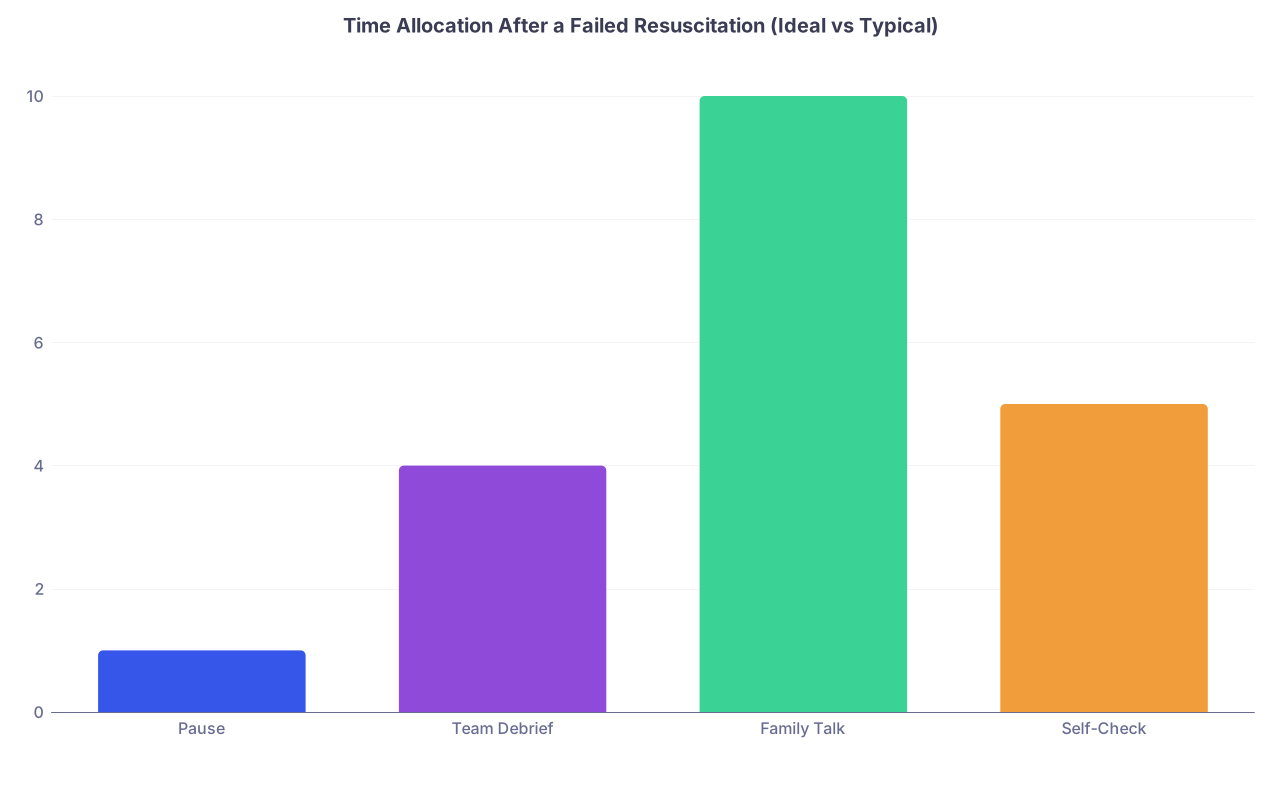
| Category | Value |
|---|---|
| Pause | 1 |
| Team Debrief | 4 |
| Family Talk | 10 |
| Self-Check | 5 |


| Step | Description |
|---|---|
| Step 1 | Call Time of Death |
| Step 2 | 15 Second Reset |
| Step 3 | Brief Team Debrief |
| Step 4 | Walk to Family Mindfully |
| Step 5 | Death Notification |
| Step 6 | Return to Clinical Duties |
| Step 7 | Post Shift 5 Min Practice |


Bottom Line
Three things to keep:
- Build in tiny, deliberate pauses: right after the code, on the walk to the family, and after the shift. Fifteen seconds used well can change everything.
- Use mindfulness to improve ethics, not escape emotion: it helps you be clearer with families, kinder but firmer with teams, and more honest with yourself.
- Treat your reactions as data, not defects. Notice them, name them, and if they’re piling up, take that seriously and get support before it starts leaking into your practice.


