

It’s 8:45 pm. You just got home from a brutal shift, you open your email “real quick” before bed, and there it is: a message from risk management, or your licensing board, or your group’s medical director.
Subject line: “Notice of Complaint” or “Potential Malpractice Claim.”
Your stomach drops. Heart rate spikes. You read the first two lines and your brain goes white-noise. You start replaying the encounter. Or worse – you are not even sure which patient this is. You feel exposed, ashamed, defensive, furious, terrified… all of it at once.
Here’s what you’re up against: the system will pull you immediately into legal, administrative, and documentation mode. Lots of instructions. Very little emotional support. And yet your brain and body are having a full-on threat response.
This is where mindfulness is not some soft, optional wellness thing. It’s a survival tool. A way to keep your mind from eating you alive while you deal with the process.
I’m going to walk you through what to do from the minute you see that notice, through the weeks and months that follow, using concrete mindfulness tools that actually work in this situation.
Step 1: The First 10 Minutes – Interrupt the Panic Spiral
You open the notice. Your body lights up like a fire alarm. Before you reply, call someone, or open the chart, you need to get out of “fight/flight/freeze” just enough to think clearly.
1. Ground your body first, not your thoughts
You will not think your way out of this initial panic. Your cortex is basically offline. Start with the body.
Use a simple 5–4–3–2–1 grounding sequence. I like this one because you can do it sitting on your couch, in your car, or in a call room and no one will know.
- Look around and silently note:
- 5 things you can see
- 4 things you can feel (clothes on your skin, feet on the floor, chair under you)
- 3 things you can hear (HVAC, traffic, fridge, your own breath)
- 2 things you can smell
- 1 thing you can taste
Do it slowly. Not as a checklist. Really notice each thing. Give it a full second or two.
This pulls your attention out of the mental catastrophe movie and back into the present moment, where you actually have some control.
2. Expand the breath, but don’t overdo it
You’ve heard “just take a deep breath” a million times. Most people do it wrong in a panic—they over-breathe, get lightheaded, and feel worse.
Use this instead: 4–6 breathing.
- Inhale through your nose for a count of 4
- Exhale through pursed lips for a count of 6
- Repeat 8–10 cycles
Longer exhale signals “not dying right now” to your nervous system. That’s what you need.
3. Name what’s happening in plain language
Your brain is screaming, “You’re a terrible doctor. Your career is over.”
Counter that with a simple, factual label. Not a pep talk. A label.
Examples:
- “This is a stress response.”
- “This is fear about my professional identity.”
- “This is shame showing up in my body.”
Out loud if you’re alone. Quietly if you’re not.
That act—called affect labeling—drops the amygdala activation a few notches. I’ve watched people go from 10/10 panic to 6/10 just by naming what’s happening.
Step 2: The First 24 Hours – Create a Mental Containment Zone
Once you’re not actively spiraling, the next danger is rumination: replaying the encounter, imagining worst-case scenarios, checking the email again, looking up horror stories online.
This is where mindfulness shifts from crisis management to structure.
1. Set a “worry container” for the complaint
Your brain will try to think about this all day. That will wreck your sleep, your work, and your relationships.
Instead, you create a boundary:
Pick a specific 15–20 minute window in your day that is dedicated “complaint time.” For example:
- 7:30–7:50 pm, after dinner, before starting notes
- Or 12:30–12:45 pm during lunch in a private space
During that window only, you’re allowed to:
- Read the notice carefully
- Review the chart (if appropriate and permitted)
- Write down questions for risk management or your attorney
- Journal your emotions and fears
- Make calls related to the complaint
Outside that window, when your mind drags you back to it, you say (internally), “Not now. I’ll give this my full attention at 7:30.”
You’re not denying it. You’re scheduling it. That distinction matters.
2. Use brief “anchor” practices during the workday
You still have to see patients. You do not get two weeks off to emotionally process this.
So you use micro-practices—30–60 seconds—to prevent the complaint from bleeding into every encounter.
Three good anchors:
- Doorway breaths – Before you enter each patient room, pause with your hand on the handle. One slow in-breath, one slow out-breath, mentally saying: “This patient. This moment.” Then walk in.
- Handwashing reset – While you scrub, feel the temperature of the water, the texture of the soap, the sensation on your skin. Let that be your full attention for those seconds.
- Chair check – Every time you sit down to chart, feel the chair under you, your feet on the floor, your back supported. Three breaths into your belly before typing.
Are these small? Yes. Do they keep you functional when your mind wants to live in the complaint? Absolutely.
3. Create a simple internal script
Your inner critic is about to go wild.
Write down a short phrase you’ll use every time the “I’m doomed” story starts. It should be:
- True
- Short
- Neutral-to-kind
Examples:
- “A complaint does not define my entire career.”
- “Many good physicians have gone through this.”
- “I will respond methodically. I don’t need to solve it tonight.”
You’re not trying to convince yourself everything is great. You’re trying to keep the mental story from going full apocalypse.
Step 3: Engaging With the Process Mindfully (Without Self-Destructing)
At some point soon, you’ll need to read the complaint carefully, talk to risk management or an attorney, and maybe write a formal statement. This is where unmindful behavior can really hurt you—either by being defensive and impulsive, or by melting into shame and paralysis.
1. Separate “facts review” from “self-judgment”
When you review the chart or recall the encounter, deliberately split your attention into two streams:
- Stream 1: What actually happened (timeline, actions, communications, decisions, documentation)
- Stream 2: What your mind is saying about what happened (“I’m incompetent,” “I knew I was going to mess up,” “I should quit”)
When self-judgment thoughts show up, don’t argue with them. Just tag them:
- “Judging mind.”
- “Catastrophic story.”
- “Shame narrative again.”
Then shift back to the factual stream: “What did I say? What did I chart? What was the clinical context?”
Precision helps here. Not because you’re trying to prove you’re perfect, but because you’re trying to stay in reality instead of in a horror movie written by your amygdala.
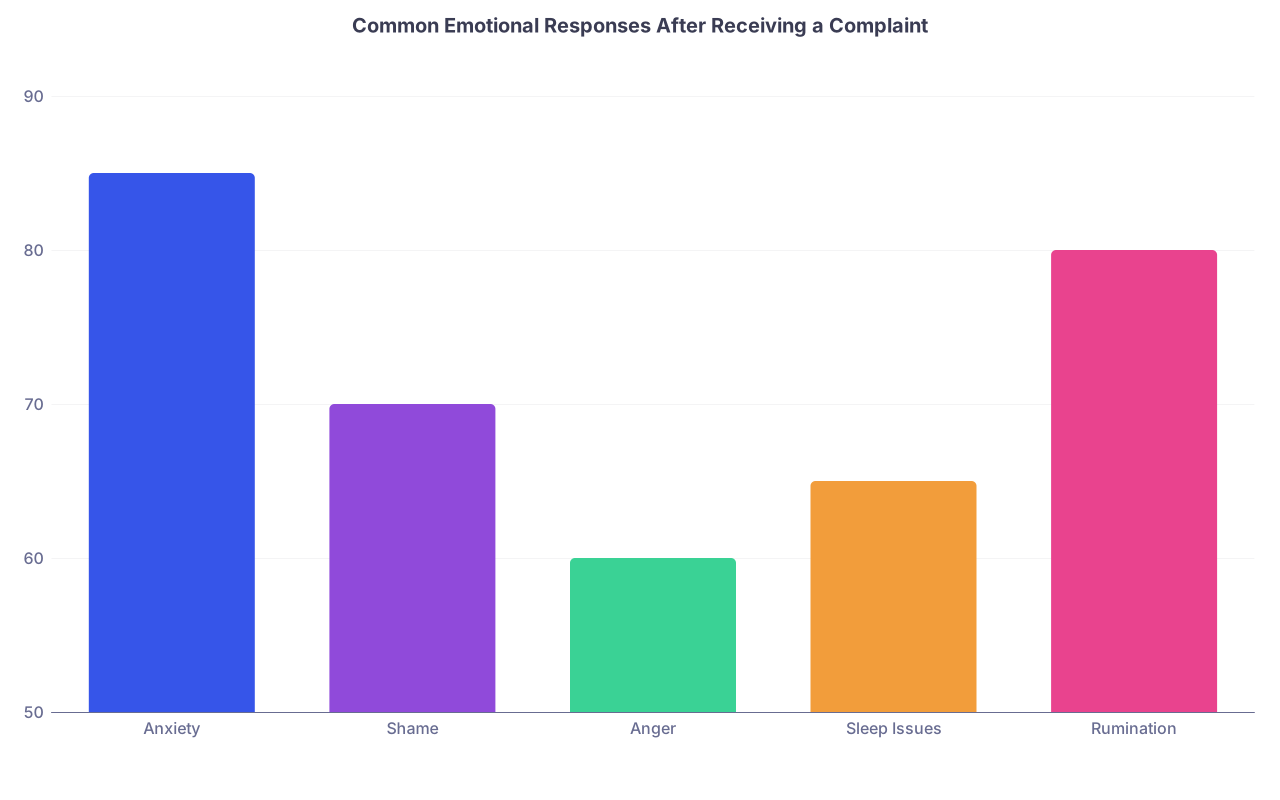
| Category | Value |
|---|---|
| Anxiety | 85 |
| Shame | 70 |
| Anger | 60 |
| Sleep Issues | 65 |
| Rumination | 80 |
2. Use “STOP” before sending any written response
I’ve seen people write emails or statements in the heat of anger or panic that made things worse.
Use a simple STOP protocol when drafting anything related to the complaint:
- S – Stop. Don’t hit send. Don’t finalize the statement.
- T – Take a breath. One full 4–6 breath.
- O – Observe. Notice: what am I feeling (angry, scared, ashamed)? What’s my impulse (defend, blame, apologize excessively, withdraw)?
- P – Proceed wisely. Ask: “If I read this a month from now, would I be glad I sent it?”
Concrete rule: No emotionally loaded email or statement gets sent the same hour it’s written. Sleep on it or at least give it half a day and re-read with a calmer mind.
3. Mindfulness around guilt vs. shame
Important distinction:
- Guilt: “I may have done something wrong or could have done better.” That can be constructive.
- Shame: “I am wrong. I am a bad doctor, bad person.” That is toxic and paralyzing.
When you notice “I am” language, that’s shame. Respond with something like:
- “I’m feeling shame right now. That’s a human response, not a verdict.”
- “Shame is here, but it doesn’t get to write my statement.”
If you identify specific mistakes or system gaps, write them down as learning points later, not as self-indictments right now. You will do reflective work—after the initial storm.
Step 4: Protecting Your Sleep and Relationships While Under Investigation
The process can last months. If you let it, it will colonize your entire life. Your job now is almost boringly simple: keep yourself operational.
1. Build a 10-minute pre-sleep decompression ritual
No one sleeps well with a complaint hanging over their head, but you can improve the odds.
Before bed (30–60 minutes before, ideally), do:
- Digital cutoff – No checking email, EHR, or complaint-related documents. Zero. Your brain needs a buffer.
- Download the worries – 5 minutes, pen and paper. Write: “Things my mind is worried about right now.” List them. No editing. When done, close the notebook. Represent to your brain: “Captured. I don’t have to rehearse these all night.”
- Body scan (5 minutes) – Lie down or sit. Move your attention slowly from toes to head. At each region, silently label: “toes… feet… ankles…” Not judging. Just noticing. When you find tension (jaw, chest, shoulders), breathe gently into that area for one exhale count or two.
If you wake in the night with racing thoughts, don’t fight them. Return to the body scan—this time maybe just feet, palms, and breath.
2. One honest sentence with a trusted person
The natural move is to withdraw and tell no one. Or overshare with the wrong people. Both can backfire.
You need at least one person (partner, close friend, therapist, coach) who hears the truth.
Guideline: One clear sentence that’s emotionally honest but not graphic:
- “I received a formal complaint and it’s really scaring me. I may be more distracted and irritable for a while.”
- “There’s a malpractice notice on a patient case. It’s bringing up a lot of shame and anxiety for me.”
You’re not asking them to fix it. You’re letting yourself be human in front of another human. That, by itself, is a mindfulness act—dropping the mask for a moment.
What you do not do: discuss clinical specifics with random colleagues, vent in hallway conversations, or post anything even vaguely related on social media. Use discretion and the legal guidance you receive.
3. Make one “non-complaint” micro-commitment per day
Under this kind of stress, everything contracts. Your world shrinks to: complaint / work / crash.
Pick one very small, enjoyable, non-medical action every day. Something you can actually sustain.
Examples:
- 10-minute walk without your phone
- One chapter of a non-medical book
- 5 minutes of music with your eyes closed
- Making a proper cup of tea or coffee and actually tasting it
And when your brain says, “You don’t deserve this, you should be working on the complaint,” answer: “This is how I make sure I am still a functioning person who can handle this.”
That’s not indulgence. It’s maintenance.
Step 5: Using Mindfulness to Learn From the Experience (Without Self-Destructing)
At some point, the process will end or at least stabilize. Maybe the complaint is dismissed. Maybe it settles. Maybe there are consequences. Whatever the outcome, there’s a second stage: integrating what happened.
This is where mindfulness prevents two equal and opposite mistakes: total defensiveness (“The patient was unreasonable, end of story”) and self-annihilation (“I should never have been a doctor”).
1. A structured reflection, not a self-flagellation session
Set aside 30–45 minutes once the dust settles a bit. Notebook, no distractions.
Use four questions:
- What actually happened? (brief, factual narrative)
- What was outside my control? (system factors, patient variables, staffing, timing)
- Where could my care or communication reasonably have been better?
- What one or two specific changes will I make in my practice or habits as a result?
Write in short, clear sentences. When “I’m terrible” shows up, tag it as “shame voice” and return to the questions.
This is ethical growth, not self-punishment.
| Aspect | Mindful Response | Unmindful Response |
|---|---|---|
| Initial reaction | Grounding, delayed response | Immediate defensive email |
| Thought patterns | Labeling, scheduling worry | Constant rumination |
| Self-talk | Specific, neutral phrases | Global self-condemnation |
| Learning afterward | Structured reflection and small changes | Either denial or total self-blame |
2. A short compassion practice targeted to this event
Yes, “self-compassion” can sound fluffy. In this context, it’s basic psychological first aid.
Try this 3–4 minute sequence:
- Recall the situation briefly. Notice what emotions arise.
- Put a hand lightly on your chest or abdomen (if that’s comfortable).
- Silently say three lines, adapted to this situation:
- “This is a painful part of being a physician.”
- “I’m not the only one. Many good clinicians have been here.”
- “May I treat myself with the same fairness I would offer a colleague in this situation.”
You’re not excusing real errors. You’re refusing to treat yourself worse than you would treat anyone else.
3. Boundaries with your “story”
After a complaint, many people start introducing themselves internally as “the doctor who got that complaint” or “the one who was sued.” Your mind likes identity hooks.
When that story comes up, use a very simple boundary phrase:
- “This is something that happened to me. It is not the definition of me.”
Repeat as often as needed. Boring, consistent repetition beats clever insights here.

| Step | Description |
|---|---|
| Step 1 | Receive Complaint Notice |
| Step 2 | Ground Body and Breath |
| Step 3 | Set Worry Container |
| Step 4 | Review Facts Separately from Judgments |
| Step 5 | Consult Risk Management or Attorney |
| Step 6 | Use STOP Before Responding in Writing |
| Step 7 | Protect Sleep and Daily Functioning |
| Step 8 | Structured Reflection After Initial Phase |
| Step 9 | Implement 1 to 2 Practice Changes |
Quick Reference: Practices You Can Start Today
Here’s the stripped-down toolkit you can actually remember:
- 5–4–3–2–1 grounding (first 10 minutes)
- 4–6 breathing (any time you feel the surge)
- Worry container (one 15–20 minute “complaint time” daily)
- Doorway breath before each patient
- STOP before hitting send on any email/statement
- 10-minute pre-sleep decompression (digital cutoff + worry download + body scan)
- 3-line compassion script
- One tiny non-medical pleasure per day
You do not need to do all of them every day. But pick two or three and commit.


