

It’s 10:47 p.m. You just got home. You’re still in your hospital socks because you did not even have the energy to change. Your brain keeps replaying one moment from your shift on loop.
The bed request you denied because “no capacity.”
The prior auth you didn’t fight because “it won’t go through anyway.”
The patient you discharged earlier than felt right because “we need the bed.”
You followed the policy. You did what everyone said was “the right call” for the system… and you feel like you betrayed something core in yourself.
That sick, buzzing feeling in your chest? The mix of anger, shame, and “I shouldn’t have let that happen”? That’s moral injury. And it hits hardest once you finally stop moving.
Tonight is about damage control. Not for the hospital. For you.
Here’s what to do between now and sleep so this doesn’t eat a hole in you.
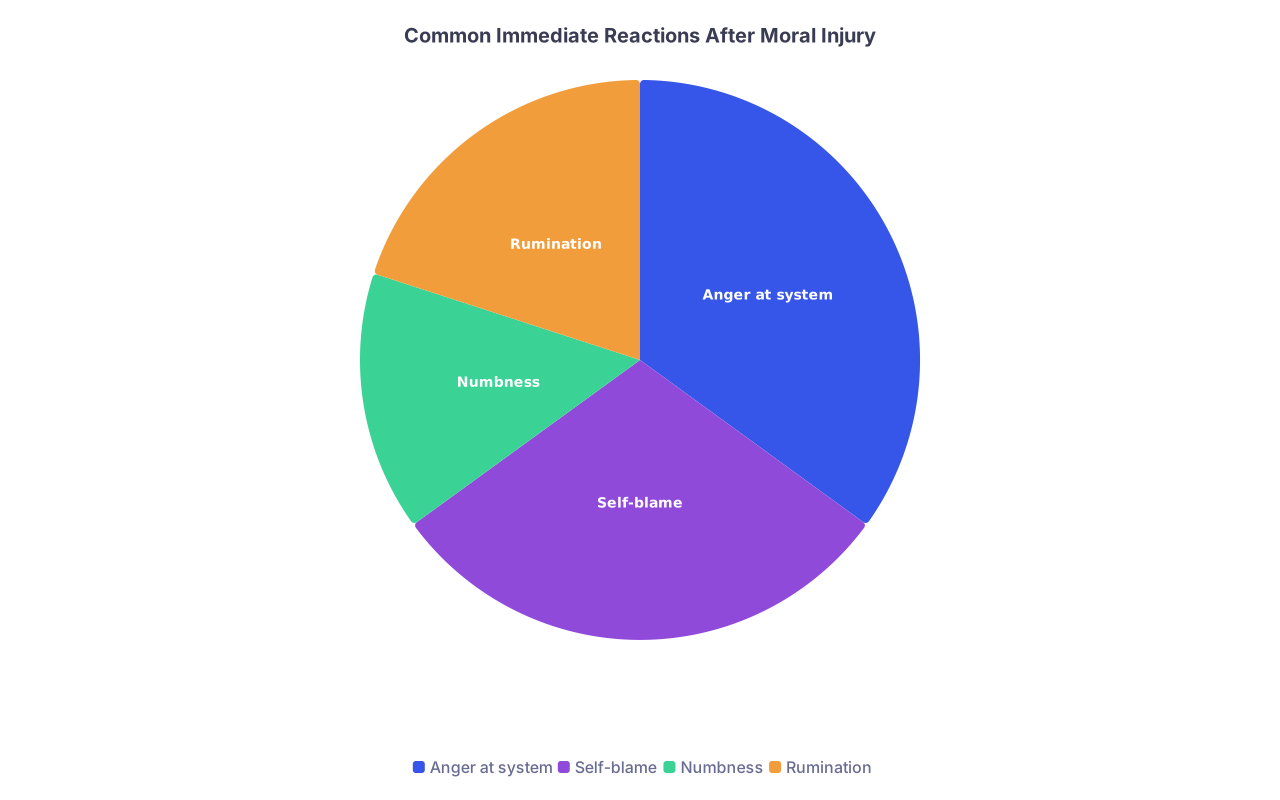
| Category | Value |
|---|---|
| Anger at system | 35 |
| Self-blame | 30 |
| Numbness | 15 |
| Rumination | 20 |
Step 1: Name What Actually Happened (Not Just How You Feel)
Right now your brain is probably spitting out vague accusations.
“I failed them.”
“I’m a bad doctor.”
“I shouldn’t be in medicine.”
Those are conclusions, not facts. Tonight, you need facts on paper.
Grab a pen and whatever scrap of paper is closest. Or open a note on your phone if that’s all you have.
Write three short sections. Literally label them:
- “The Situation”
- “What I Actually Did”
- “What I Wanted to Do”
Keep it brutally concrete.
“The Situation” example:
– 74-year-old with CHF, no insurance, borderline stable. ED full, no ICU beds. Administration pushing throughput. Team decided to discharge with home oxygen and close follow-up that we all know is fragile.
“What I Actually Did” example:
– Agreed with discharging although it felt too early. Documented that they were hemodynamically stable. Did not push hard for observation admit because charge nurse and bed coordinator were clear: no beds.
“What I Wanted to Do” example:
– Keep them at least 24 more hours. Optimize meds. Coordinate home visit. Make absolutely sure they were safe.
Why this matters: moral injury thrives in the fog. When you separate concrete events from your global self-judgment, you create some space. You’ll still feel awful, but now the “awful” has edges. You can work with edges.
If you’re too flooded to write full sentences, do bullet fragments. The rule is: real details, no adjectives.
Step 2: Call Moral Injury by Its Name (Not “I’m Just Weak”)
You’re not “too sensitive.” You’re not “not cut out for this.” You’re reacting to a values violation.
Moral injury = the wound that happens when you are part of (or feel complicit in) something that violates your core moral code, usually under pressure from hierarchy, policy, or resource constraints.
It’s not simple guilt (“I did something wrong”).
It’s not simple burnout (“I’m exhausted and detached”).
It’s “I was forced into, or felt trapped in, a decision that feels fundamentally wrong.”
Say this sentence out loud, even if you feel ridiculous doing it alone in your kitchen:
“Today I experienced moral injury. The system’s constraints pulled me away from the kind of clinician I want to be.”
Not “maybe.” Not “kind of.” Say it straight. The moral conflict isn’t a flaw in you; it’s information about who you actually are.
If you have a whiteboard, sticky note, whatever, write one anchor line for tonight:
“I can feel harmed by this and still be a good clinician.”
Stick it somewhere you’ll see it before bed.

Step 3: Do a 10-Minute “Values Decompression”
Right now your nervous system is revved. If you go straight to Netflix or doomscrolling, your brain will marinate in the story “I’m a terrible person” all night.
You need a short, structured decompression that realigns you, even slightly, with your values.
Set a 10-minute timer. Not 30. Not an hour. Ten. Then:
Sit down somewhere you can be mostly undisturbed.
Put one hand on your chest and one on your abdomen.
Take 6 slow breaths. 4 seconds in, 6 seconds out. Count it.
Then answer these questions in writing (short phrases are fine):
– In that situation, what value of mine felt violated? (Examples: safety, honesty, fairness, compassion, autonomy, nonabandonment.)
– In what tiny way did I still honor my values, even under pressure? (Examples: I explained honestly to the patient. I looked them in the eye. I documented my concerns. I talked with a colleague about it. I checked their med list carefully.)
– If I could replay that moment with the same system constraints, what is one slightly more aligned action I might try next time?
This is not fantasy-land “I’d just defy admin and magically create a bed.” Keep it realistic.
Examples of “slightly more aligned” actions:
– Saying clearly in the team huddle: “I’m uncomfortable with this discharge; here’s why.”
– Telling the patient: “The system is very constrained, and I’m worried about you. Here are specific red flags I want you to watch for.”
– Writing in your note: “Clinically borderline for discharge; capacity limitations and bed demand factored into disposition decision.”
You’re not rewriting the whole system tonight. You’re reclaiming a sliver of agency so tomorrow doesn’t feel like you’re walking back into a moral meat grinder with no options.
Step 4: Separate System Responsibility from Personal Blame
You might be thinking: “But I still signed the order. I still went along.”
Yes, you did. That’s the part that hurts the most. But collapsing “I participated” into “it’s 100% my fault” is how moral injury becomes permanent damage.
Quick exercise I use with residents:
Draw three circles on a page:
– Circle 1: “System Forces”
– Circle 2: “Team Dynamics”
– Circle 3: “My Actual Choices”
Now fill them in.
Circle 1 – System Forces (examples):
– No psych beds in the region
– Insurance denial
– Throughput metrics
– OR block scheduling
– Staffing ratios
Circle 2 – Team Dynamics:
– Attending made final call
– Charge nurse said “we literally have no space”
– Case management unavailable after 4 p.m.
– You’re the intern, lowest power in the room
Circle 3 – My Actual Choices:
– Didn’t speak up strongly
– Used language in note that downplayed my discomfort
– Didn’t ask, “What’s the least bad option here?”
You’re allowed to put items in more than one circle, but be honest about where the heavy weight actually sits. Usually, Circle 1 is enormous, Circle 2 is big, and Circle 3 has a handful of items.
This doesn’t absolve you. That’s not the point. It right-sizes your role. You’re standing in a river of pressure. You did not build the dam.
| Aspect | Mostly System / Context | Mostly You |
|---|---|---|
| Bed availability | ✔️ | |
| Insurance/prior auth | ✔️ | |
| How forcefully you spoke | ✔️ | |
| Whether policy exists | ✔️ | |
| Exact wording of your note | ✔️ |
When you see it laid out like this, the narrative shifts from “I’m a monster” to “I’m one person in a very compromised system who still has some choices to refine.”
That shift is crucial if you want to stay in medicine without going numb.
Step 5: Do One Tiny Repair Action Before Bed
Moral injury screams for a grand fix: resign, whistleblow, overturn the whole system. That’s not happening tonight. And fantasizing about it usually just deepens the helplessness.
Instead, do one small, concrete repair action that nudges the world 1mm closer to your values. Examples:
– Send a concise message:
“I’m still thinking about [patient Initials/bed #]. I felt uneasy about the decision given [short reason]. Next week, could we debrief cases like this as a team?”
– Draft (do not have to send yet) an email to your program director/chief:
“We had a situation where system capacity strongly drove a decision that felt morally compromising. I’d like to see if there is space for a structured discussion about cases like this.”
– Put in a follow-up call for the patient tomorrow (if appropriate and feasible):
“Call [patient] tomorrow afternoon to check on status / reinforce safety net.”
– Start a note for yourself titled “Cases that bother me.” Just list this one case. Maybe others later. This can be the seed for future advocacy, QI, or ethics consults.
The bar for tonight’s repair action:
– It must be doable in under 10 minutes.
– It must be something you actually control.
– It must lean toward your values, not toward self-flagellation.
Do it, then stop. No spiraling into email drafts until 1 a.m.

| Step | Description |
|---|---|
| Step 1 | Get Home |
| Step 2 | Write what happened |
| Step 3 | Name moral injury |
| Step 4 | Values decompression 10 min |
| Step 5 | Sort system vs self |
| Step 6 | Choose 1 tiny repair action |
| Step 7 | Protect sleep |
Step 6: Protect Sleep Like It’s Part of the Treatment (Because It Is)
You’re not going to “process” the entire event tonight. Your brain does a big chunk of that consolidating and cleaning work during sleep. If you sacrifice sleep to ruminate, you make tomorrow’s moral pain worse and your coping weaker.
Here’s a basic “moral injury night” sleep protocol that actually fits into a resident’s life:
Cut yourself off from work input.
No Epic logins. No inbox. No reading the policy that pissed you off. Boundary.8-minute body reset.
– Lay on the floor or your bed.
– Do a slow body scan from toes to head; at each region, clench for 3 seconds, then release.
– When your mind jumps back to the case, label it “the case” and return to the body part.Decide on one grounding sentence for the night.
Examples:
– “I did the best I could in a bad system today.”
– “This hurts because I care.”
– “I can revisit this with a clearer head tomorrow.”Give your brain a different story for 15–20 minutes before sleep.
A non-medical book, a silly show, a podcast that has zero to do with medicine. Not Twitter, not Reddit “medical horror stories.”
You’re not “ignoring the problem.” You’re doing wound care. Raw, exposed nerves don’t need more poking right now.

Step 7: Plan the First 5 Minutes of Tomorrow
Moral injury gets worse when it turns into isolation and secrecy. The longer you wait, the more your brain rewrites the story as “no one else would have done this; it’s just me.”
Before you sleep, decide one small thing you’ll do tomorrow in the first part of your day to avoid that isolation.
Options that don’t blow up your schedule:
– Send a message to a trusted colleague:
“Hey, I had a case yesterday that’s still weighing on me. Can we grab 10 minutes sometime this week to talk it through?”
– Look up your institution’s ethics consult or moral distress resources and bookmark them. Decide: If I feel the same way by [2 days from now], I’ll reach out.
– If you’re in training, plan to bring this to supervision or a check-in:
“I’d like to discuss a case where system constraints drove a decision that felt wrong to me.”
– If you’re an attending, set a calendar block labeled “Debrief hard case – 10 min” during a non-clinical slice. If you don’t protect the time, it won’t happen.
You don’t have to know what you’ll say yet. You just need a placeholder in your future where this doesn’t stay only inside your skull.
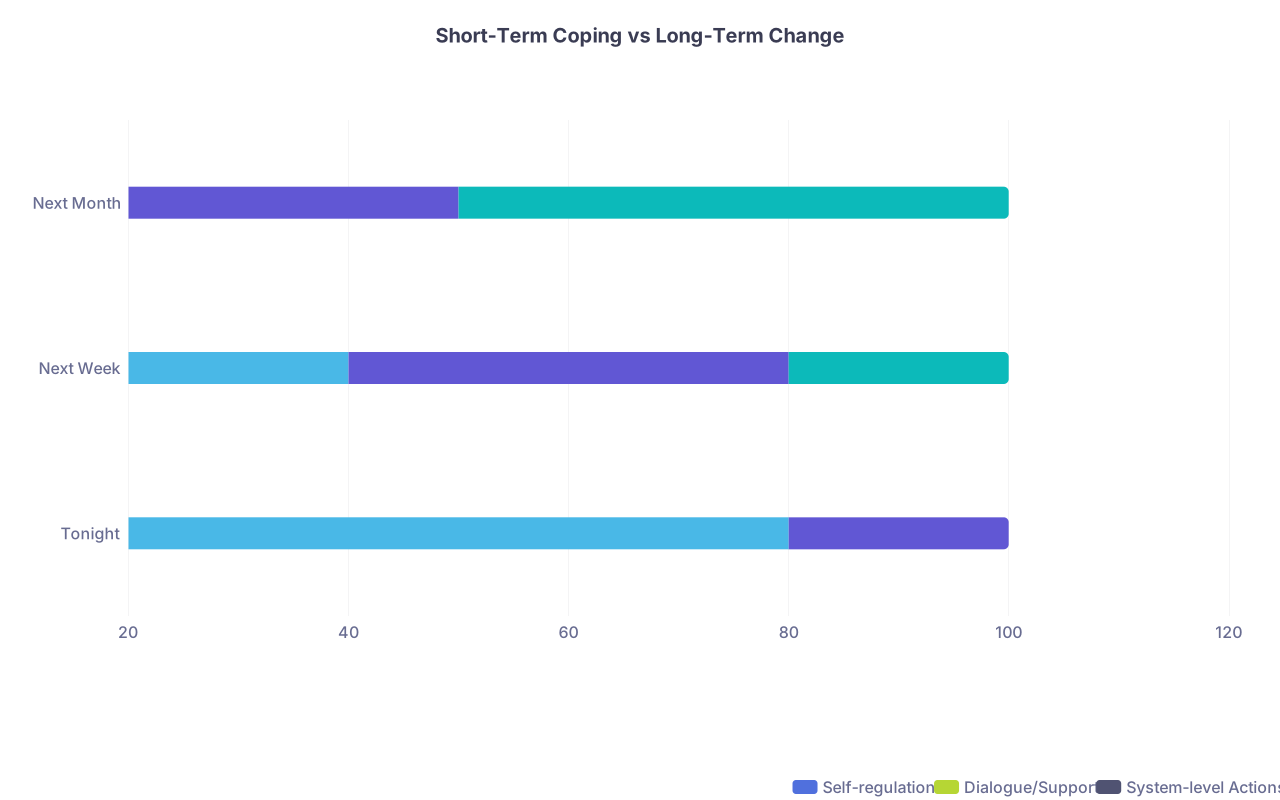
| Category | Self-regulation | Dialogue/Support | System-level Actions |
|---|---|---|---|
| Tonight | 80 | 20 | 0 |
| Next Week | 40 | 40 | 20 |
| Next Month | 20 | 30 | 50 |
Step 8: What Not to Do Tonight
A quick list, because I’ve watched too many good people make the same mistakes on nights like this:
Don’t write a scathing all-staff email at 1 a.m.
You’ll either regret the tone or they’ll ignore it. Either way, not helpful.
Don’t decide your entire career is a mistake based on this one shift.
Schedule a time to think about that when you’re rested, not while you’re flooded.
Don’t numb out with alcohol or benzos “just this once.”
You’re trying to repair your moral compass, not sedate it. If you already use substances, this is a high-risk moment to escalate. Be honest with yourself.
Don’t go hunting for internet stories of similar tragedies as validation.
You’ll find them. You’ll also layer other people’s trauma on top of yours.
Don’t turn this into a personal referendum:
“This proves I’m [weak / bad / not cut out for this].”
No. It proves you still have a functioning sense of right and wrong in a warped environment. That’s painful, but it’s not a defect.
When the Case Might Need More Than “Just” Self-Work
Sometimes the thing that happened is not just morally distressing. It’s also potentially unsafe, unethical, or illegal.
If any of these are true, you’re in “needs escalation” territory:
– The decision clearly placed a patient at high risk of serious harm solely because of financial or political reasons.
– You were explicitly told to misrepresent the chart or hide a safety concern.
– You’re seeing a pattern: this wasn’t a one-off; it’s “how we do things here.”
– You’re being retaliated against for raising concerns.
Not tonight, but over the next few days, you may need to:
– Document your recollection in a secure, time-stamped personal note.
– Talk to risk management or an ethics committee.
– Consult your union, GME office, or ombuds if in training.
– Get independent legal advice in extreme situations.
You’re not obliged to do all of that. But recognize when the weight of the problem exceeds “I just need to meditate more.”

FAQ (Exactly 4 Questions)
1. How do I know if this is moral injury or just normal guilt about a tough call?
Ask yourself: did I experience a clash between what I believe is right and what the system or hierarchy pushed me to do? If the answer is yes and you feel betrayed by forces bigger than you—not just regret about your own judgment—that’s moral injury territory. Guilt is “I did something wrong.” Moral injury is “I was part of something wrong that I could not fully stop.”
2. What if speaking up tomorrow makes me look incompetent or “not a team player”?
Then you pick your audience and your level of detail carefully. You don’t have to storm into the attending’s office. You can say to a trusted senior: “I’d like to understand how we think about cases where capacity drives decisions that feel borderline unsafe.” Curiosity is often safer than accusation, but silence is what cements the injury.
3. Is it ever okay to just say, ‘This is how it is,’ and move on?
You can accept that constraints exist without endorsing every outcome. “This is how it is” becomes toxic when it’s used to shut down your moral response. A healthier version is: “This is the current reality, and I will keep looking for small ways to practice closer to my values within it—and push for better when I can.” Resignation is different from realistic acceptance.
4. How many times can I go through this before I should seriously consider leaving my job or specialty?
If moral injury is becoming frequent—weekly or even daily—and you see no path to influence, escalation, or support, your system is injuring you chronically. That’s when exploring transfers, different practice settings, or even different roles is not “quitting”; it’s self-preservation. But you don’t have to decide that tonight. Tonight is about stabilizing yourself enough to make that decision with a clear head later.
Two things to carry into sleep:
- You’re not broken for hurting after a system-driven decision. That hurt is evidence your ethics are still alive.
- You can’t fix the whole system tonight, but you can reclaim a little agency: write the facts, name the injury, do one tiny repair, and protect your sleep.
That’s enough for one night.


