

You’re Here
It’s 7:40 p.m. You just signed out. You’re walking to your car (or collapsing on your couch), and your brain keeps jumping ahead to tomorrow at 10:30 a.m.
The family meeting.
You already know the players: the daughter who wants “everything done,” the son who keeps asking about rehab when his father is on escalating pressors, the aunt on FaceTime from another state, the attending who tends to talk in euphemisms, the social worker who is great but overrun. The patient is not going to get better in any meaningful way. You know that. You can feel it in your gut.
And you’re dreading it.
Not just “this will be hard.” More like a sense of heaviness. Maybe an urge to escape—call out sick, find some consult to hide behind, magically get pulled to another unit. You already feel your chest tighten just thinking about sitting at that conference table, trying to be present while everyone’s emotions explode in different directions.
You’re not burned out. Yet. But this is exactly the kind of thing that quietly eats away at people.
So here’s the situation: it’s the day before. You cannot cancel the meeting. You cannot magically fix the prognosis. But you can change how you walk into that room tomorrow. That’s what we’re going to handle.
This is not generic “practice self-care” fluff. I’m going to give you a set of mindfulness steps you can actually do in the 12–18 hours before the meeting. On call, post-call, clinic day, whatever. Some will take 3 minutes. One will take 30. All are aimed at one thing:
You walking into that room not as a stiff, numb automaton, and not as an emotional wreck. But as a regulated, grounded human being who can tolerate what is about to happen and still act according to your values.
Step 1: Call the Dread What It Is (10 Minutes)
You cannot work with dread if you pretend it is “just stress” or “busy brain.”
Sit down somewhere slightly private. This can literally be in your parked car, stairwell, or on your couch with the TV off. Set a timer for 10 minutes. That’s it.
Then do this:
Name it out loud, exactly:
“I am dreading tomorrow’s family meeting about Mr. Alvarez at 10:30.”Ask yourself three questions and write the answers down on any scrap of paper or note app:
- What exactly am I afraid will happen in that room?
- What am I afraid I will do or not do?
- What am I afraid I will feel?
Be specific. I’ve seen answers like:
- “They’ll demand things that are medically futile and I’ll feel trapped.”
- “I’ll tear up and my attending will think I’m unprofessional.”
- “The son will accuse us of ‘giving up’ and I’ll feel like a bad doctor.”
- “I will freeze and not know what to say and just stare at the table.”
Now look at what you wrote and separate out:
- Things about them (their reactions, words, decisions)
- Things about you (your actions, your emotional reactions)
Draw a quick line down the page if it helps.
Your mindfulness target tomorrow is not “have a perfect meeting.” It is:
“I will show up as the kind of clinician I want to be, regardless of how they react.”
That’s a massive reframe. You cannot control their grief. You can control what you embody.
Write one sentence at the bottom of your list:
“My job tomorrow is to be [pick 2–3 words: clear, honest, kind, steady, compassionate, real]. Not to make everyone feel okay.”
You’ll come back to that sentence.
Step 2: Regulate Your Body First (6 Minutes Total)
If your nervous system is already in fight-or-flight the night before, no amount of “mindful intention” is going to stick. Your body will steamroll it.
You need one short practice that you can repeat a few times before bed and once in the morning. Use this 6‑minute protocol:
2a. 3-Minute Exhale-Weighted Breathing
Sit or lie down. Set a 3‑minute timer.
Breathe like this:
- Inhale through nose for a count of 4
- Exhale through pursed lips for a count of 6
- Gentle, not forced. Let your belly move, not your shoulders.
Your goal is not Zen enlightenment. The goal is to signal to your vagus nerve, “We’re safe enough right now.” You may not feel calmer instantly. Fine. Do the reps anyway.
2b. 3-Minute Grounding Scan
Immediately after (same spot), do a quick body scan:
- Notice where your body touches the chair, floor, or bed.
- Move attention, slowly but deliberately:
- Feet
- Legs
- Hips
- Chest
- Shoulders
- Jaw
- Face
At each area, silently label: “Tense / neutral / relaxed.” Do not “fix” anything. Just notice and label.
If something is clearly tense (jaw, shoulders), on the exhale, allow a 5–10% softening. Not all the way. Just a little.
You are practicing being in your body without bolting. That is exactly the skill you need in the meeting: staying in your body while emotions are flying around the room.
Do this protocol:
- Once tonight before bed
- Once on waking (before you touch your phone)
- Once in the 15 minutes before the meeting if at all possible
Step 3: Do a 15-Minute Reality Check, Not a Script (15–20 Minutes)
Most clinicians either:
- Over-script (“If they say X, I’ll say Y, then Z…”) and then panic when reality doesn’t match; or
- Wing it and hope their training carries them, then feel sloppy or guilty afterward.
The middle path: a reality check that focuses on clarity and values, not memorized lines.

Here’s how to spend 15–20 minutes the day before:
- Clarify the medical reality in plain language.
On paper, answer:- What is the actual clinical situation in 2–3 sentences?
- Best case realistic outcome?
- Most likely outcome?
- What are we not going to offer because it’s non-beneficial?
Force yourself to write it like you’d explain it to a smart high-school student, not a colleague.
Write three anchor sentences you can return to.
Not a full script. Just three phrases you want to be able to say even if your heart rate is 120.Examples:
- “I wish I had better news.”
- “Given how sick he is and what we are seeing, more aggressive treatment would not help him get back to the life he valued.”
- “We cannot stop him from dying, but we can control how much he suffers as that happens.”
Circle them. These are your verbal “home base” tomorrow. When you get lost, you can come back to one of these and say it again in slightly different words.
Name your ethical stance in one sentence.
This ties directly into the “personal development and medical ethics” side, not just emotional survival.Something like:
- “My ethical responsibility is honesty without cruelty.”
- “My ethical responsibility is to not offer treatments that are non-beneficial, even if that’s hard to hear.”
- “My ethical responsibility is to respect this patient’s values more than my discomfort.”
Write it at the top of a sticky note or in your pocket notebook. Tomorrow, that is your internal compass.
Step 4: Run a 5-Minute Worst-Case Drill (Instead of Rumination)
Your brain is already spinning worst-case scenarios. Mindfulness is not pretending you’re not. It’s dragging them into the light and making a plan.
Set a 5‑minute timer. Rapid fire:
- Ask: “What is the worst realistic thing that might happen in that meeting?”
Realistic, not TV drama. Think:
- “A family member yells that we’re killing their mom.”
- “Someone storms out.”
- “My attending undermines what I just explained.”
- “I start crying.”
- For each one, write one concrete, simple response that meets two criteria:
- It’s something you’d actually be willing to do.
- It aligns with your earlier ethical stance.
Examples:
- If someone yells:
“I will keep my voice low and say, ‘I can see how painful this is. I promise we will not abandon her.’ Then I will stop talking for a full 5 seconds.” - If someone storms out:
“I will pause, let the social worker check if they want to come back, and not chase them verbally with explanations.” - If my attending contradicts me:
“I will not argue in front of the family. I’ll say, ‘Let me step out for a moment and clarify with the team so we can give you the clearest answer,’ then talk to my attending outside.” - If I cry:
“I will not apologize for basic human emotion. I’ll take one breath, maybe say, ‘I’m sorry, this is hard news to share,’ and continue.”
This is contingency planning, not catastrophizing. The difference is: you end with a behavior you can execute.
You go into tomorrow thinking, “If X happens, I’ll do Y.” That calms your nervous system more than vague hope that nothing will go wrong.
Step 5: Set a 24-Hour Boundary Around This Meeting (3 Minutes)
If you let it, this meeting will colonize your entire evening, night, and morning. That’s a straight line to insomnia and irritability. Mindfulness here means deliberate containment.
Decide exactly when you will “engage with” the meeting again before it happens.
For example:
- “I will think about and prep for the meeting from 8:00–8:20 a.m. tomorrow, and not outside that time.”
- “I will look at the chart and check any updates once at 7:45 a.m., then close it.”
Then do something concrete right now:
- If you’re off the clock, close the EHR. Fully. Sign out of the app.
- If colleagues text after hours with non-urgent meeting gossip, you do not need to respond. Tomorrow’s 20‑minute block is when you’ll handle it.
Say to yourself (out loud if you can):
“I am not at the family meeting right now. I will go there tomorrow. For the next [X] hours, I’m allowed to live the rest of my life.”
That sentence sounds corny. Use it anyway. I’ve watched it pull people out of obsessive replay at 11:30 p.m.
Step 6: A 10-Minute Evening Practice: Sit With One Emotion, Not All of Them
Before bed, do one more round. No apps. No guided audio. Just you, a chair, and 10 minutes.
- Sit down. Set a 10‑minute timer.
- Ask yourself: “What is the strongest emotion I feel about tomorrow’s meeting right now?”
Could be fear, anger, resentment, sadness, guilt, helplessness. Pick one. That does not mean the others aren’t there. You’re just choosing one to sit with.
- Where do you feel it in your body?
- Fear: often chest, throat, gut.
- Anger: jaw, fists, forehead.
- Sadness: eyes, throat, heavy shoulders.
Put your hand on that area if it helps. Then, for the rest of the 10 minutes, your only job is to:
- Silently name it on the in-breath: “Fear” (or “Sadness,” etc.)
- Notice the body sensation on the out-breath: “Tight chest,” “Heavy shoulders.”
That’s it. No story. No planning. When your brain tries to jump into “What if tomorrow…” you gently drag it back to, “Tight chest. Fear. Breath.”
You’re doing emotional exposure in microdose form. You’re teaching your brain: “We can feel this and not explode.” Which means tomorrow, when the room gets heavy, you’re less likely to dissociate or shut down.
If you end these 10 minutes still a bit uncomfortable, that’s normal. The win is you stayed with yourself instead of anesthetizing with doomscrolling.
Step 7: Morning-of Micro-Routine (12–15 Minutes Total)
You wake up, and your first thought is, “Ugh, the meeting.” Fine. Here’s what you do between waking and walking onto the unit.
You are not designing a wellness retreat. You’re running a tactical routine.
7a. 6 Minutes: Repeat the Breathing + Grounding
Same protocol from Step 2. Before your phone, before your inbox:
- 3 minutes of 4‑in / 6‑out breathing
- 3 minutes of quick body scan
That’s your nervous system check-in.
7b. 5 Minutes: Re-Read and Recommit
Pull out what you wrote yesterday:
- Your list of fears
- Your anchor sentences
- Your one-sentence ethical stance
- Your worst-case responses
Skim them. Then say, out loud if you can:
“My job today in this meeting is to be [your 2–3 words: clear, honest, kind, steady]. Not to erase anyone’s grief and not to fix the unfixable.”
If you’re religious or spiritual, this is where people sometimes add a one-sentence prayer. If you’re not, keep it as a values statement. Either way, you’re orienting to something larger than your own anxiety.
7c. 1–2 Minutes: Visualize Just the First 60 Seconds
Do not try to visualize the whole meeting. That’s where people go off the rails.
Close your eyes and see only this:
- You walking into the room.
- You taking your seat.
- You placing your hands somewhere (on the table, in your lap).
- You making eye contact with one family member.
- You saying your first sentence. One of your anchor lines, or:
“Thank you all for coming. I know this is a really difficult time.”
Then stop the mental movie. That’s enough. You’re priming your brain for a calm entry, not scripting every word.
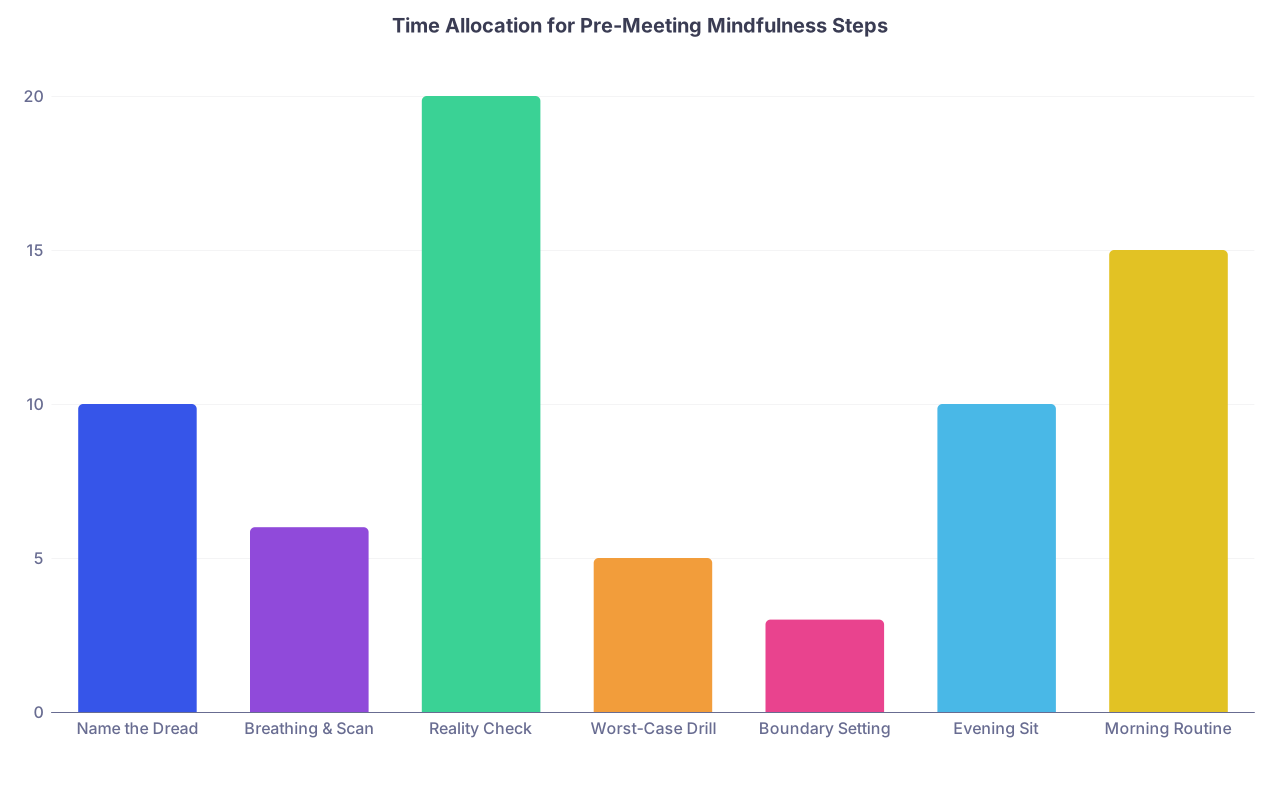
| Category | Value |
|---|---|
| Name the Dread | 10 |
| Breathing & Scan | 6 |
| Reality Check | 20 |
| Worst-Case Drill | 5 |
| Boundary Setting | 3 |
| Evening Sit | 10 |
| Morning Routine | 15 |
Step 8: Ethics in the Room — Using Mindfulness as a Compass
Let’s talk about the actual ethical tension you’re probably feeling, because pretending this is just “emotional regulation” is dishonest.
You’re stuck between:
- Respect for autonomy (family’s wishes, patient’s previously expressed values), and
- Non-maleficence/beneficence (not causing harm, not offering non-beneficial interventions)
When families say “do everything,” and you already know “everything” means more tubes, more pain, zero chance of meaningful recovery, every part of you is pulled in two directions.
Here’s how mindfulness ties into ethics instead of being a side hobby:
Mindfulness gives you a pause between stimulus and reaction.
In that micro-pause, you can ask: “What action here best honors the patient, not my comfort, not the family’s short-term denial?” That’s an ethical question, not just emotional.You notice your own agenda.
Are you pushing for comfort care because it’s truly right for this patient—or because you want this medically futile case off your service? You do not have to like the answer, but you should know it.In the pause, you can silently label:
- “Impatience”
- “Guilt”
- “Fear of conflict”
That simple labeling keeps those emotions from secretly steering the ship.
You stay present when families express moral distress.
When someone says, “So you’re just letting him die?” your own shame or defensiveness will spike. Mindfulness lets you recognize, “Shame in chest,” without immediately reflexing into over-explanation or angry debate.Instead, you might respond:
- “No one in this room is ‘letting’ him die. His illness is causing that. What we are talking about is how much suffering he goes through as that happens.”
That kind of clarity only comes if your brain isn’t hijacked.
You remember the patient as a person, not a problem.
A simple mindful move in the room: once, at some point, imagine this patient outside the hospital doing something they loved. Fishing. Playing with grandkids. Cooking.
Let that image exist in your mind for 3 seconds. Then speak.You will sound different. More human. Less algorithmic. Families hear that.
Step 9: A 2-Minute Exit Ritual (So This Doesn’t Linger All Day)
Fast forward. The meeting ends. Maybe it went fine. Maybe it was rough. Either way, if you just sprint to the next task, your nervous system drags that whole meeting into every patient encounter for the rest of the day.
You need a 2‑minute exit ritual. Yes, even if you’re slammed. Especially then.
Outside the room (stairwell, bathroom, empty hallway), do this:
Name three things you did that aligned with your values.
Examples:- “I was honest about prognosis.”
- “I didn’t raise my voice even when they were yelling.”
- “I made space for silence instead of filling it with jargon.”
Name one emotion you’re carrying now.
“Sadness.” “Anger.” “Relief.” “Numbness.” That’s all. Name it.Three breaths.
In for 4, out for 6, three times. On each exhale, imagine leaving 5–10% of that meeting behind you, in the room, where it belongs.
Not 100%. You will still think about it. But you won’t be dragging the whole weight into the next patient’s room.
| Timeframe | Key Action |
|---|---|
| After shift | Name dread + fears |
| Evening | Breathing + reality check |
| Before bed | 10-min emotion sit |
| Morning | Breathing + review notes |
| Just before | 60-second visualization |
Your Next Step — Do This in the Next 10 Minutes
Right now, before you scroll to something else, do one concrete thing:
Take out your phone or a piece of paper and answer these two sentences:
- “I am dreading tomorrow’s family meeting because __________.”
- “In that room, I want to be the kind of clinician who is __________, __________, and __________.”
Fill them in. No polishing. No overthinking. Then set a 10‑minute alarm block for tonight to run through:
- The 3‑minute breathing
- The 3‑minute body scan
- The 4‑minute “name one emotion and feel it” sit
That’s it. Ten minutes.
You cannot change that the meeting is coming. You can absolutely change which version of you walks through that door.


