

Last week on nights, I watched an intern take three slow breaths by the med room fridge while the code team rushed past. You could see the cardiology fellow glance over, raise an eyebrow, and half-smirk. The intern’s shoulders tightened. The breaths got shorter. She looked like she wanted to apologize for trying to calm herself down.
That’s what I’m afraid of. That if I admit I meditate, or that I step away for two minutes to actually feel my heart pounding, my co‑residents will decide I’m the “soft” one. The weak link. The one who “can’t handle real medicine.”
The fear behind “mindfulness makes me look weak”
Here’s what runs through my head, and probably yours too:
If I shut the door to the call room for five minutes and sit quietly, they’ll think I’m slacking.
If I say, “Give me ten seconds” before a tough phone call and close my eyes to ground myself, they’ll think I’m fragile.
If I admit in conference that I use mindfulness to manage anxiety, they’ll silently move me into the “not a future chief, not leadership material” box.
And then my brain escalates it: what if attendings think I can’t hack it? What if that comment makes it into my evals? What if, in a specialty that already worships toughness and speed, I get labeled as the resident who needs “too much support”?
Here’s the messed up part: you’re not imagining that culture. I’ve heard a senior tell an intern, “You don’t need a breathing exercise; you need to toughen up.” I’ve seen an attending roll their eyes at a wellness session and say, “We’re not paying you to color.”
So yeah. The fear isn’t irrational. But your conclusion probably is.
What “weak” actually looks like in residency (hint: it’s not what you think)
The people I’ve seen labeled as “weak” or “struggling” over and over? It wasn’t because they took a quiet minute at the workstation.
It was because of things like:
- Falling apart in crisis and staying scattered
- Snapping at nurses and blaming everyone else
- Making the same error three times and refusing to examine why
- Showing up chronically late, unprepared, or unreliable
- Shutting down feedback, or melting down with every minor critique
None of that is mindfulness. That’s untreated stress and ego flailing around.
The residents who actually get trusted, promoted, and quietly admired? They usually have some kind of internal practice. They may not call it “mindfulness,” because that word has become a little cringe and over-marketed. But they do something:
- One PGY‑3 in EM did a 2‑minute grounding routine before every shift, in the bathroom, behind a closed door. No one thought she was weak. They just noticed she could stay laser‑calm in multi‑trauma chaos.
- A surgery resident I knew did a body scan walking from the locker room to the OR. He never advertised it. What people said about him? “He doesn’t rattle. Ever.”
You know what actually looks weak to other residents? Losing your temper every time you’re stressed. Gossiping instead of owning your mistakes. Needing constant external reassurance because you have no internal system to regulate yourself.
Mindfulness is the opposite of that. It’s you quietly building that internal system.
Why medicine’s “toughness” script makes this feel so loaded
There’s a very specific, unspoken script in medicine:
- You stay late without complaining.
- You never say you’re tired.
- You shrug off trauma like it’s a boring TV episode.
- You act like nothing touches you. Ever.
Compassion fatigue? Burnout? Those are for other people. People who didn’t “really want it.”
So when you show up and say, “Actually my nervous system is not a brick wall, and I’d like to keep it from shattering,” it threatens that script. It makes the unspoken rule visible: we’re all human, but we’re pretending not to be.
Some people will resent that. Especially if they’ve built their identity on not needing help, not needing rest, not needing feelings.
And that’s the core fear, right? That their resentment is going to be your evaluation. Your reputation. Your career.
Let me be blunt: the people most threatened by your mindfulness or self-awareness are usually the least emotionally healthy in the room. Their judgment is not the one you should stake your entire professional identity on.
What co‑residents actually notice – and what they don’t
Here’s the pattern I’ve seen:
They don’t notice:
- That you put a 1‑minute breathing timer on your watch between patients
- That you stand outside the room and take three slow breaths before a difficult family meeting
- That you close your eyes at the workstation for 15 seconds before you call a consultant who always tears into you
They do notice:
- Whether you crumble or function in chaos
- Whether you apologize when you snap, or just keep snapping
- Whether you’re the resident they want on nights because “you keep your head straight when everything is on fire”
So the question isn’t actually “Will they think mindfulness is soft?”
The question is, “Does my mindfulness practice make me better on the floor? Or is it just theoretical?”
Because if it’s actually working, over time, people stop caring how you got there. They just know you’re solid.
Let me ground this a bit more with a quick reality snapshot:
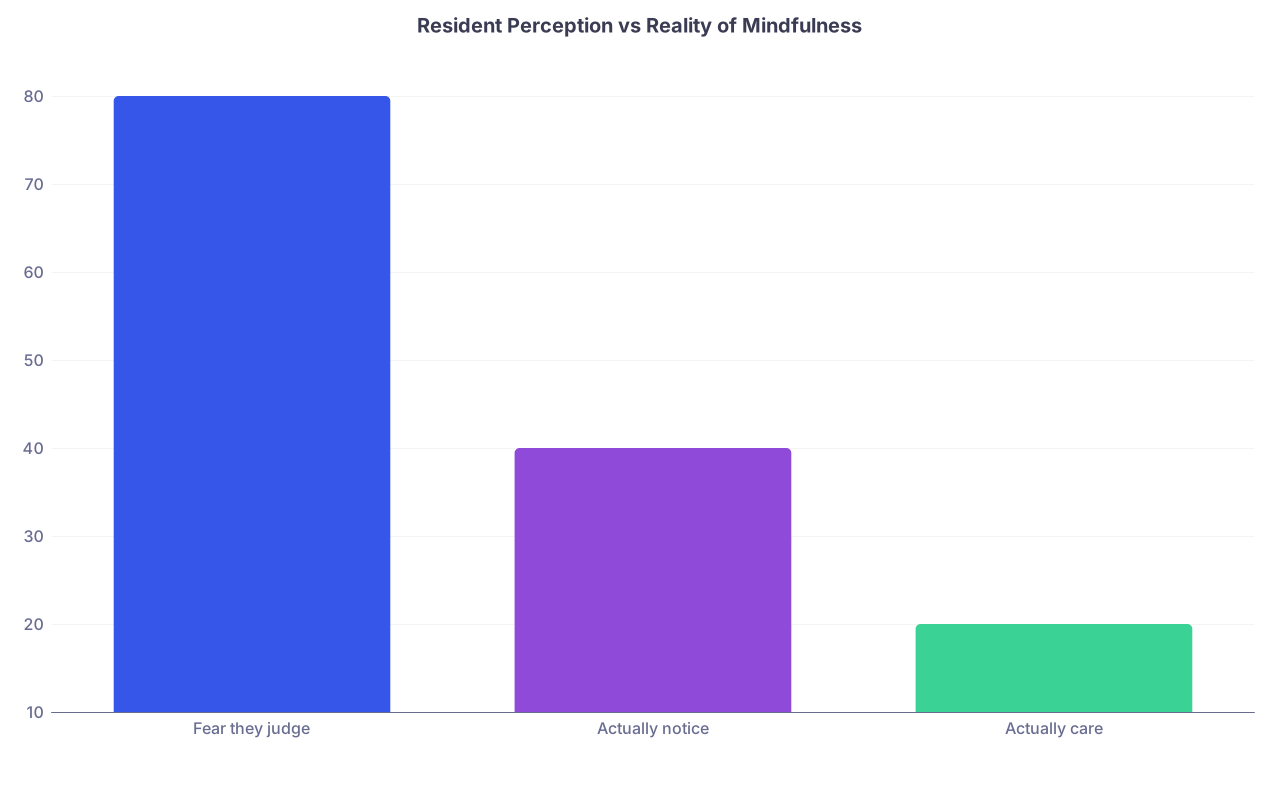
| Category | Value |
|---|---|
| Fear they judge | 80 |
| Actually notice | 40 |
| Actually care | 20 |
Your fear that “everyone is judging” is probably at an 8 out of 10. Their actual attention to your internal practices? Closer to a 4. Their actual care as long as you get the work done and don’t make their life harder? Maybe a 2.
They’re too busy worrying about their own performance.
How to practice mindfulness without looking like a caricature
There is a way to do this that doesn’t invite eye rolls. Some residents shoot themselves in the foot by turning mindfulness into a personality performance.
“I can’t see this patient yet, I need to ground myself.” Said loudly. At the nursing station. While everyone else is drowning.
Or lecturing the whole team: “You know, if you all meditated you wouldn’t be so stressed.”
That stuff? Yeah, people will call that soft. Or annoying. Or out of touch.
You don’t need to be the mindfulness spokesperson for your program. You just need your tools to work for you.
Think “stealth mode”:
- Walking meditation between patient rooms: feel your feet, feel your breath, name three things you see. No one knows you’re doing it.
- 3‑breath resets in the stairwell. You’re “checking a lab,” but you’re really letting your nervous system drop half a gear.
- Box breathing at the computer while you’re reading a chart. Looks like you’re just thinking.
- Quick body check at sign-out: “Jaw unclenched, shoulders down, belly soft.” That’s it.
If you want a rough sketch of what a “stealth mindful day” can look like:

| Step | Description |
|---|---|
| Step 1 | Pre-shift 2 min breathing |
| Step 2 | Walk to floor focus on steps |
| Step 3 | First signout brief body scan |
| Step 4 | Stairwell 3 breaths after tough page |
| Step 5 | Mindful drink of water at 3 am |
| Step 6 | Post-shift 5 min decompression |
Nobody needs to know that this is what you’re doing. They just see a colleague who isn’t constantly vibrating at a 10/10 stress level.
The line between healthy vulnerability and oversharing
Another big worry: what if I share that I’m anxious or that I use mindfulness, and suddenly I’m “the anxious resident”?
You don’t have to narrate your entire internal world to your co‑residents. Not everyone has earned that access.
There’s a middle space between total silence and tearful confessions to everyone.
Examples of that middle space:
- In a wellness session: “I’ve found a quick breathing thing that helps when my pager won’t shut up. Happy to share if anyone wants the app later.” Then drop it.
- With a trusted co‑resident privately: “I’ve been doing a 5‑minute meditation before nights and it actually helps. No pressure but if you ever want to try it with me, let me know.”
- On rounds, if appropriate: “Before we go in, I’m going to take one breath to get my head straight.” Then you do it. Once. No speech.
You’re not auditioning for “Mindfulness Influencer, PGY‑2.” You’re allowed to protect your image and your boundaries while still protecting your nervous system.
The ethical piece: is “pretending not to feel” actually good medicine?
This is the part I can’t shake, and maybe you can’t either. The ethics of this.
You’re taking care of suicidal patients, and you’re encouraged to joke about “another psych admission.”
You’re declaring time of death and then hustling to the next task with a casual, “Okay, what’s next?”
You’re watching your co‑resident cry in the stairwell after a bad outcome, then walk back onto the unit with a perfectly calm tone like nothing happened.
And some part of you knows: if you shut yourself off like that for years, it doesn’t just cost you. It starts to cost patients. Because numbness doesn’t stay neatly in one box.
Mindfulness, at its best, isn’t “I feel nothing.” It’s “I feel what I feel, and I don’t let it run the show.”
The alternative is either emotional flooding (you can’t function) or emotional shutdown (you function, but like a robot). Both of those are actually less ethical in the long run than you stepping aside for one minute to get re-centered so you don’t snap at a grieving family.
Burned-out, dissociated doctors make more mistakes and show less empathy. That’s not noble. It’s just untreated damage.
If anyone thinks that choosing not to wreck yourself is weak, they’re confusing self-harm with professionalism.
Building a practice that’s strong, not “soft”
If you’re worried your mindfulness is “soft,” ask yourself: is it actually trained? Or is it just a vague idea you like?
Real practice is a bit uncomfortable:
- You sit with your racing thoughts when you’d rather scroll.
- You notice how much you judge yourself and you keep sitting anyway.
- You watch your brain relive the code from last night and instead of pushing it away, you anchor in your body and let the wave pass.
That’s not softness. That’s reps. That’s training under load.
Think of it like this:
| Pattern | Mindfulness Version | Avoidant Version |
|---|---|---|
| After bad code | Sit 5 min, breathe, feel, maybe jot 3 lines | Immediately check out on your phone |
| Before shift | 3–5 min grounding or intention | Rush in late, slam coffee, hope for best |
| Tough feedback | Notice shame, breathe, get curious | Defend, joke it off, or spiral privately |
If you’re doing the left column most days, you’re training strength. Even if your co‑resident thinks it’s “soft,” that strength will start to show up in how you work and how you handle them.
And quietly, people respect that.
What to do when someone actually does mock it
Let’s not pretend this won’t happen. Someone will say something like:
“Oh my god, are you meditating again?”
“Need a safe space after that midnight trauma?”
“Guess your breathing exercises didn’t stop that bad outcome.”
You can’t control that. You can control your response.
A few options that don’t sell you out:
- Dry humor, then pivot: “Yup, radical act of survival over here. Anyway, what’s the plan for 3B?”
- Light boundary: “It just helps me not lose it. You handle it your way, I’ll handle it mine.”
- Matter-of-fact: “Takes 30 seconds and I make fewer dumb mistakes. Worth it.”
You’re not trying to convert them. You’re just signaling: “This is how I operate. I’m not ashamed of it. And I’m still doing my job.”
If they keep pushing, that’s not about you. That’s about their stuff leaking out. You do not need to step into their storm.
FAQ (exactly 4 questions)
1. What if attendings see my mindfulness practice as a sign I can’t handle the workload?
Most attendings don’t care how you stay functional; they care that you are reliable, safe, and not constantly melting down. If your practice is quiet, doesn’t disrupt workflow, and clearly helps you stay composed, they’ll either be neutral or quietly impressed. On the rare occasion someone equates self-regulation with weakness, that’s revealing more about their burnout than your capacity. Protect your evaluations by being prepared, thorough, and responsive. Protect your sanity with mindfulness. Those aren’t in conflict.
2. Should I talk about mindfulness explicitly on evaluations, in mentorship meetings, or fellowship interviews?
You don’t have to lead with it. Frame it in the language medicine already respects: performance, focus, and patient safety. For example: “I’ve found a brief pre‑shift routine that helps me stay present and avoid mistakes on nights.” If someone seems receptive, you can mention meditation or mindfulness by name. If they seem dismissive, stick to the outcomes, not the label. You’re not lying; you’re translating.
3. How much mindfulness is realistic during a brutal ICU or ED rotation?
You’re not going to sit for 30 minutes twice a day on a Q4 call schedule. That’s fine. Aim for micro‑practices folded into what you’re already doing: 3 breaths before calling a consultant, feeling your feet while walking to a code, a 2‑minute decompression in the bathroom after a rough family conversation, a 5‑minute reset in your car before driving home. Consistency beats duration. Tiny, repeated reps under real stress build more resilience than rare, long meditations on your one day off.
4. What if I’m not even sure mindfulness is helping, and I’m scared I’m just wasting time?
Totally reasonable fear. Don’t judge it by how “zen” you feel during the practice; judge it by how you behave on the floor. Are you snapping less? Recovering faster after hard cases? Ruminating a bit less at 3 am? If the answer is even slightly yes, it’s doing something. Give it 4–6 weeks of small, daily reps before deciding. And if a particular style does nothing for you (like a voice you hate on an app), switch the method, not the whole idea of training your mind.
Open your calendar or notes app right now and block off one concrete, tiny thing: a 3‑minute pre‑shift grounding ritual you’ll try for the next 7 shifts. Name exactly when and where you’ll do it. That’s your experiment. Let your co‑residents think whatever they want; give yourself actual data on what helps you stay standing.


