

Last month I watched a classmate dissociate halfway through a “mindful breathing” exercise at a wellness workshop. Lights dimmed, gentle bells chimed, the instructor told everyone to “go inside and notice your body.” Ten seconds later she was staring at the floor, completely gone, and when we stepped out she whispered, “I can’t do this, it feels like being back there.”
So when you tell me, “I feel detached and guilty after traumas… is mindfulness even safe for me?”—I don’t hear that as an abstract question. I hear it as someone bracing for impact, worried that one wrong wellness tool is going to make everything worse.
Let me be blunt up front:
Mindfulness can help trauma.
Mindfulness can also make trauma feel way worse—if it’s done the wrong way, at the wrong time, without the right support.
You’re not overreacting for asking this. You’re being smart.
What “Detached and Guilty” Actually Looks Like (You’re Not Broken)
You probably know the textbook words: dissociation, depersonalization, derealization, moral injury, PTSD.
But the lived reality in medicine is uglier and weirder:
- You’re in a code and moving on autopilot, and afterward everyone is shaken… except you feel nothing. Just… blank. Then the guilt lands: “What kind of person doesn’t feel anything when someone dies?”
- You’re driving home after a brutal shift, replaying a missed diagnosis, and you suddenly realize you don’t remember the last 10 minutes of the drive.
- You sit in meditation for a required “wellness session” and your heart rate spikes, your chest tightens, and instead of calm, you get slammed with images you’ve been trying not to see.
- You feel like a bad doctor / bad student / bad human because other people cry and talk about “processing,” and you feel like you’re watching your own life from behind glass.
That detached, “am I even here?” sensation isn’t a moral failing. It’s your nervous system doing something it thinks is protective:
- Numbing so you can function
- Disconnecting from your body so you don’t feel overwhelmed
- Shutting down emotions when they feel too dangerous or shameful
The guilt is the cruel side effect.
Trauma brains are great at adding: “And by the way, this is all your fault.”
Now add mindfulness to that mix and it gets scary. Because everyone keeps telling you: “Just be present with your body. Notice your breath. Sit with your feelings.”
And you’re like: “Being in my body is where the horror lives. Why would I go there on purpose?”
This is not you being “resistant to growth.” It’s your brain doing threat assessment and saying: “Hard pass.”
The Hard Truth: Mindfulness Isn’t Automatically Safe for Trauma
Medical culture has turned mindfulness into a kind of universal prescription: burnt out? meditate. overwhelmed? meditate. trauma? meditate.
That’s lazy and sometimes harmful.
Here’s the uncomfortable reality no one tells you when they hand you a meditation app code:
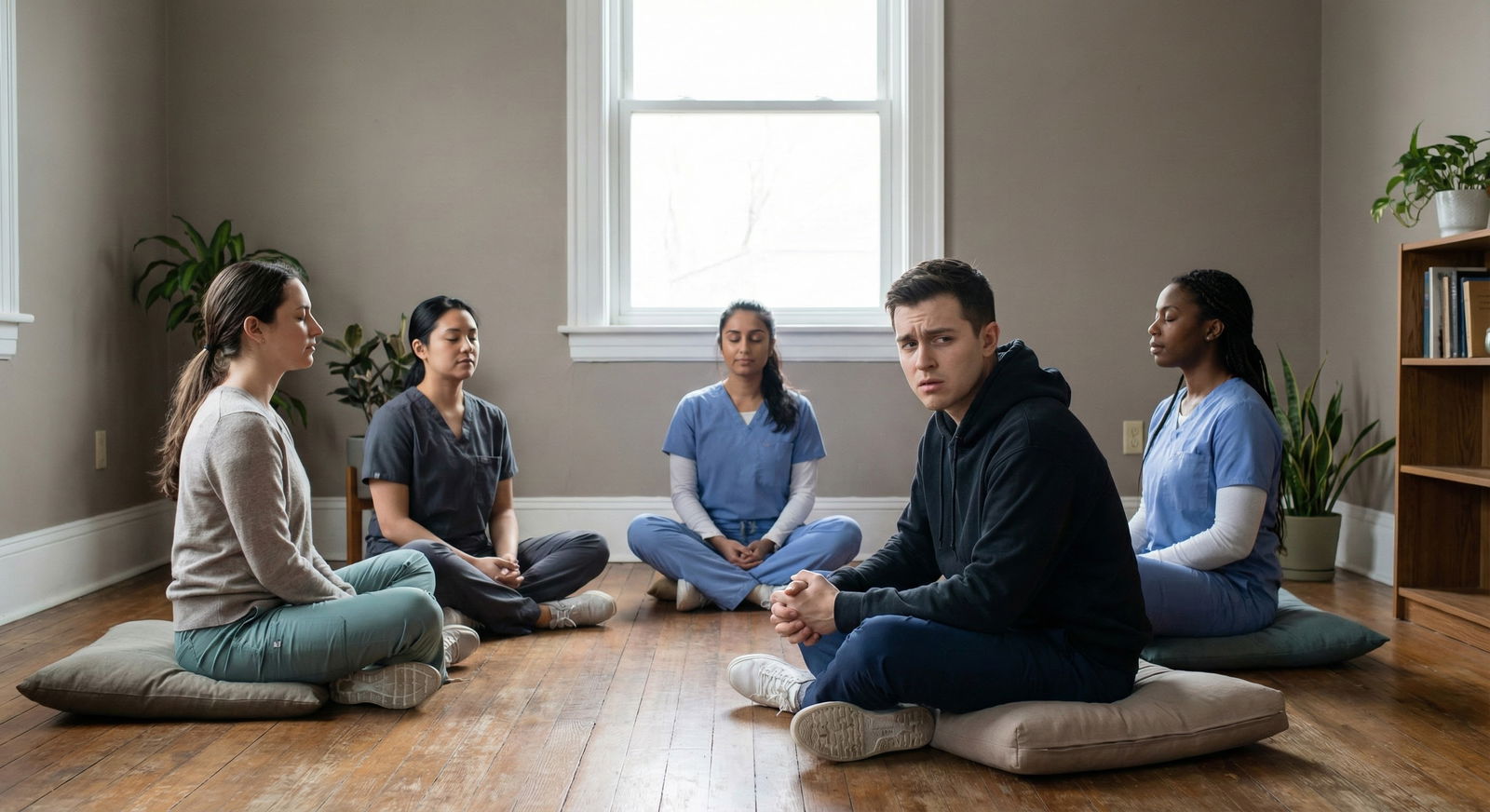
For trauma survivors, some common mindfulness practices can:
- Trigger flashbacks when you “go inside”
- Intensify shame when you’re asked to “just notice” thoughts that are actually self-hatred
- Increase dissociation when you focus on breath or body and your system decides to check out completely
- Reinforce guilt if you can’t stay present and you think, “I’m failing at mindfulness too”
Certain red-flag scenarios:
- Long, silent body scans where you’re asked to notice every area of your body
- Instructions like “just observe your thoughts and emotions without reacting” when your emotions are terror and your thoughts are violent self-blame
- Closed-eye meditations in dark rooms with no grounding or pacing
- Group sessions where you feel pressure to perform “calm” because everyone else looks serene
If you’ve had any of these happen and then thought, “Wow, I’m too damaged even for mindfulness,” I want you to hear this:
No. The intervention was wrong for your nervous system. That’s it.
The question isn’t “Is mindfulness safe?”
The question is “Which mindfulness, delivered how, with what safeguards, at what stage of my healing?”
That’s a very different conversation.
Types of Mindfulness: Some Are Safer Than Others After Trauma
Let’s dissect this a bit, because “mindfulness” is not one thing.
| Approach | Typical Example | Trauma Risk Level |
|---|---|---|
| Long body scan | 30–45 min lying down | Higher |
| Breath-focused sitting | 20 min on breath only | Moderate-Higher |
| Open awareness | “Notice all thoughts, feelings” | Moderate |
| Grounded, external focus | Sounds, sights, objects | Lower |
| Movement-based | Walking, yoga, tai chi | Lower |
The stuff that’s often rough for trauma survivors:
- Long body scans
- Breath-only focus
- “Sit with whatever arises” style meditations
Safer starting points (for many, not all):
External-focused mindfulness
Instead of going deep inside, you anchor to the outside world.- Noticing sounds in the room
- Feeling your feet on the floor while walking
- Naming 5 things you can see, 4 you can touch, 3 you can hear…
You’re still being present, but you’re not diving headfirst into the trauma vault.
Short, structured practices with clear exits
Two to five minutes. Timer visible. You know exactly when you can stop.
No “let’s just see how long we can sit.”Movement-based mindfulness
Walking, gentle stretching, yoga, tai chi.
Anything where your body is doing something concrete and simple, not lying still waiting for memories to ambush you.Mindfulness with a trained trauma therapist
Not a random hospital wellness leader reading from a script.
Someone who can see dissociation coming and stop the practice or shift it.
So yes, there are versions of mindfulness that are actually more stabilizing than destabilizing. But they’re rarely what gets handed out in mandatory workshops.
“Is It Safe For Me?” A More Honest Risk Check
Let me give you a practical risk filter instead of vague assurances.
Here are some things that make mindfulness more likely to be destabilizing:
- You’ve had flashbacks, panic attacks, or intense shutdown during past meditation attempts
- You’re currently having frequent intrusive memories, nightmares, or active self-harm thoughts
- You’re doing it because a program requires it and you feel trapped, not because you chose it
- The facilitator has zero idea how to talk about trauma or dissociation and just keeps saying “breathe through it”
Now, what tilts things toward safer:
- You have a therapist (ideally trauma-trained: EMDR, CPT, PE, somatic therapies) who knows you’re trying mindfulness
- You have permission (from yourself) to stop at the first sign of overwhelm without pushing through
- You stick to short, external, or movement-based practices at first
- You’re not in the middle of an acute crisis (like right after a major trauma, or during a safety meltdown)
This isn’t a hard algorithm. It’s more like: if you’re already white-knuckling through your days, adding deep internal practices unsupervised is risky.
You wouldn’t do your first central line on a crashing patient alone. Same idea.
What About the Guilt? “Good People Don’t Feel This Numb”
The guilt piece—this “I feel detached and that must mean I’m a monster”—is vicious.
Especially in medicine, where we worship the idea of the endlessly empathic, always-present healer.
A few ugly, honest truths:
- Many people in medicine dissociate or emotionally numb at some point. They just don’t talk about it.
- Some of the most “compassionate” attendings you know have admitted, in quiet side conversations, that they felt nothing at a terrible moment and then hated themselves for it.
- Guilt often hits after the trauma, when your nervous system is finally not flooded and starts doing forensic analysis on your reactions.
Mindfulness is often sold as the cure to this: “Be present so you’ll feel more.”
But if you leap straight into “feel everything” when your system has been surviving by feeling nothing? That can backfire, hard.
So here’s a different framing:
Mindfulness—for you, right now—might not be about “opening your heart” or “feeling more compassion.”
It might just be about building the tiniest, safest bridge back to yourself that doesn’t collapse under the weight of all that guilt.
That might look like:
- 60 seconds of noticing your feet on the floor between patients
- Mindfully washing your hands, feeling the water, naming the temperature
- Mindfully holding your coffee cup, noticing warmth, texture, smell
Not dramatic. Not Instagram-level “healing.” Just little moments that say: “I can be here, in this moment, without being eaten alive by what’s inside.”
That counts.
How to Protect Yourself in “Mandatory Mindfulness” Situations
Here’s where it gets messy. A lot of us are being forced into wellness sessions. No one asks about our trauma histories before dimming the lights.
So what do you do when opting out feels dangerous politically, but staying in feels dangerous emotionally?

| Step | Description |
|---|---|
| Step 1 | Mandatory mindfulness starts |
| Step 2 | Participate as guided |
| Step 3 | Modify practice quietly |
| Step 4 | Step out or keep eyes open |
| Step 5 | Continue modified version |
| Step 6 | Feels safe enough? |
| Step 7 | Still overwhelmed? |
Some concrete self-protection strategies:
Keep your eyes open
Look down softly or at a neutral spot. You don’t owe anyone closed eyes. Closed eyes can increase flashbacks and dissociation.Change the focus
If they say “notice your breath,” but focusing on breath makes you panic, switch it.
Focus on your feet on the floor. Feel your back against the chair. Count objects of a certain color in the room.No one needs to know you’re doing a different practice.
Anchor to the room
Quietly name (in your mind):
“Chair. Floor. Window. Door. Blue poster.”
This keeps you in the present when your brain wants to time-travel.Take micro-breaks
If it’s a long meditation, periodically move a finger, shift your weight, or gently stretch. Tiny movements can keep you from slipping into freeze/dissociation.Have an exit plan
If you start to feel overwhelmingly triggered:- Open your eyes fully
- Look around, find 3 solid objects
- Take a normal (not deep) breath and exhale slowly
- If needed, step out. Say you feel lightheaded or need air. You don’t have to give a trauma TED talk at the door.
If anyone pushes you—“Why weren’t your eyes closed?” or “Why did you leave?”—you are allowed to say:
“I wasn’t feeling well; I did what my body needed.”
End of explanation.
If You Want to Try Mindfulness Safely, Start Here
Assuming you’re not in immediate crisis and you want to experiment (not because someone’s forcing you), I’d start embarrassingly small.
Think: 30–90 seconds, not 20 minutes.
Example 1: Grounding with objects (1 minute)
Sit, look around, and silently name:
- 5 things you can see
- 4 things you can feel (sock on foot, chair under legs, etc.)
- 3 things you can hear
- 2 things you can smell
- 1 thing you can taste (even if it’s just “toothpaste from earlier”)
If at any point it’s too much, stop. Look around. You’re done.
Example 2: Mindful walking between rooms (30–60 seconds)
On the way from one room to another:
- Feel your feet making contact with the ground
- Notice the temperature of the air on your skin
- Pick a color (like “blue”) and find every blue thing you pass
That’s mindfulness. Zero inner excavation required.
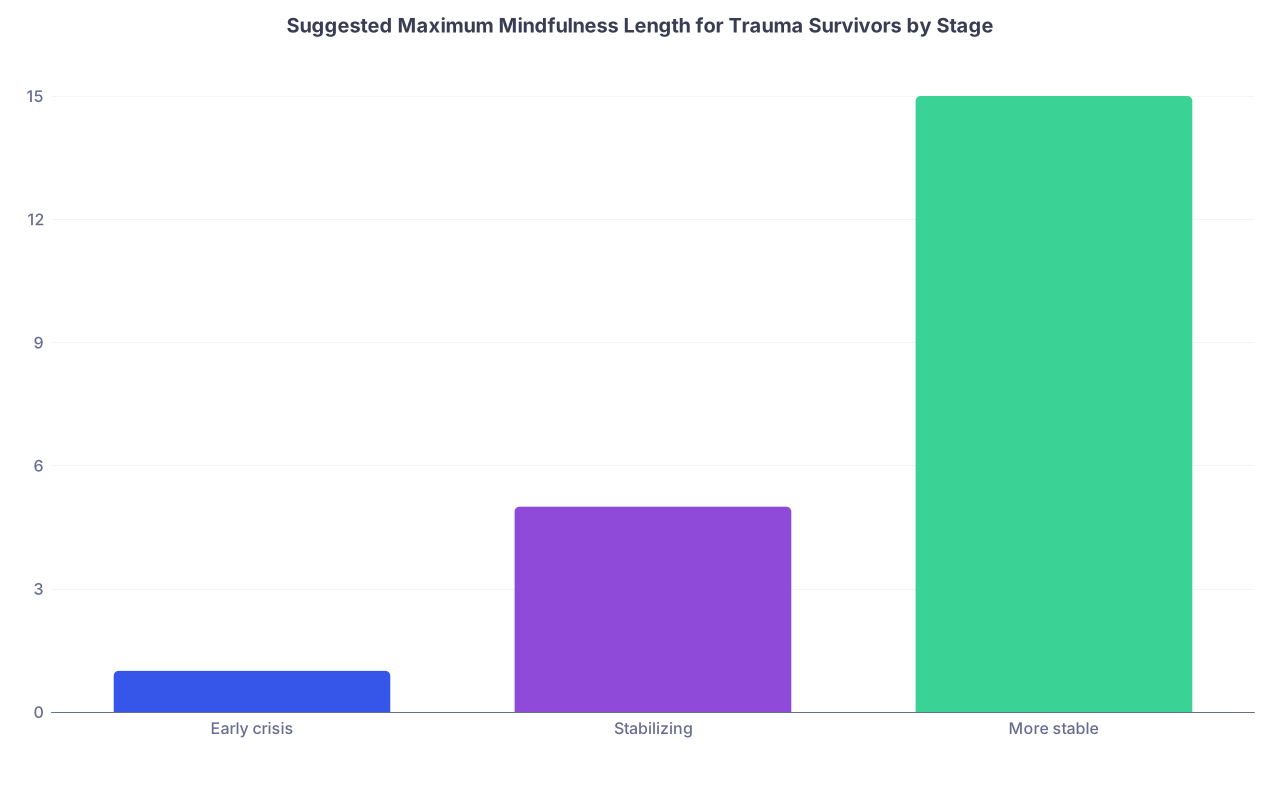
| Category | Value |
|---|---|
| Early crisis | 1 |
| Stabilizing | 5 |
| More stable | 15 |
And if you ever notice:
- Numbing out more
- Flashbacks increasing
- Sleep worsening specifically after practicing
- More self-blame because “I can’t even meditate right”
That’s your cue: pause mindfulness. Talk with a therapist. Reassess.
You are not failing. You’re collecting data on your nervous system.
How This Tangles With Medical Ethics (And Why Your Reaction Makes Sense)
This isn’t just personal wellness. There’s an ethical layer here that makes it heavier.
You’ve probably thought something like:
- “If I feel detached, am I unsafe for patients?”
- “If I avoid mindfulness because it’s triggering, am I neglecting my professional responsibility to grow?”
- “If my trauma came from a medical situation I was involved in… do I even deserve to feel better?”
I’m going to say this as clearly as I can:
Your nervous system reacting to trauma does not make you unethical.
It makes you human. If anything, pretending you’re fine and pushing yourself into practices that make you less stable is more dangerous for patients than tailoring your self-care.You are not obligated to use mindfulness specifically to be a good clinician.
Ethics ask that you seek appropriate support, not that you all use the same tool. If journaling, trauma therapy, or peer support circles help you more than meditation, that’s valid.Feeling detached doesn’t automatically mean you don’t care.
Numbness often coexists with deep, painful caring. I’ve seen residents cry in stairwells because they wish they could cry with the family at the bedside and can’t access it.
You’re allowed to prioritize safety in how you engage with your own mind. That’s not selfish. That’s you trying to stay intact enough to keep showing up.
When Mindfulness Might Need to Wait
There’s a line people don’t admit until they’re in therapy and exhausted:
“Trauma work is already ripping me apart. I can’t also be ‘mindful’ on top of it.”
If you’re:
- Just starting trauma therapy where stuff is surfacing
- In the middle of legal proceedings, investigations, or serious complaints related to the trauma
- Barely sleeping, barely eating, and white-knuckling through each shift
Then classic mindfulness practice may be… optional. Or even counterproductive right now.
Stabilization comes first:
- Basic safety
- Enough sleep to not be hallucinating from exhaustion
- A few coping tools that work (even if they’re imperfect and not what wellness handouts recommend)
Mindfulness can be the Phase 2 or Phase 3 tool. Not Phase 0.
You’re not falling behind some invisible moral or professional growth schedule if you’re not meditating daily while your world is on fire.
FAQ (Exactly 5 Questions)
1. What if my therapist keeps pushing mindfulness but it makes me worse?
Say that, directly. “When I try the meditations, I dissociate / get flashbacks / feel worse afterward.” A trauma-informed therapist should pivot—toward more grounding, stabilization, and maybe different modalities (like EMDR, somatic work, or cognitive approaches) before any inner-focused mindfulness. If they dismiss your experience—“you just need to stick with it”—that’s a red flag. You’re allowed to push back, request specific adjustments, or change therapists.
2. Does dissociating during meditation mean I’m beyond help?
No. It means your nervous system is doing what it’s learned to do in overwhelm. Many people who dissociate heavily during early practices later become able to tolerate gentle mindfulness once they’ve had more stabilization and trauma processing. Dissociation is a survival strategy, not a life sentence. The treatment plan needs to respect that, not bulldoze it.
3. Is it unethical to avoid mindfulness if my program strongly encourages it?
Ethically, your first duty is to your patients’ safety and your own basic functioning. If a specific practice undermines your stability, blindly following it is not virtuous; it’s risky. You can fulfill the spirit of “wellness” and professional growth using other tools—therapy, peer support, boundaries, sleep, exercise, spiritual practices—without forcing yourself into a method that harms you.
4. How do I tell faculty or wellness leaders that mindfulness is hard for me without disclosing my trauma details?
You can keep it vague and still set a boundary: “Extended meditations tend to make me feel unwell, so I’ll be keeping my eyes open / modifying / stepping out briefly if needed.” You don’t owe trauma narratives to get accommodation. If someone presses, you can repeat: “It’s a health-related need; I’m working on it with my own providers.”
5. Will I ever be able to use mindfulness the way everyone else seems to?
Maybe. Maybe not in the same way, and not on the same timeline. Some trauma survivors eventually do quite well with gentle, well-structured mindfulness; others stick with movement-based or external-focused practices long-term and never do 30-minute silent sits—and live full, grounded lives. The goal isn’t to fit the app’s idea of “mindful person.” The goal is a nervous system that feels safe enough for you to live and practice medicine without drowning. How you get there can be different. That’s allowed.
Years from now, you probably won’t remember which meditation you “failed” to complete in a forced wellness workshop. You will remember the moment you decided that your safety and sanity mattered more than matching some idealized image of the perfectly mindful clinician—and you protected yourself accordingly.


