

It’s 10:47 p.m. You’re staring at your self-evaluation form or your residency personal statement draft. There’s a question about “how you handle stress,” or “how you maintain professionalism under pressure,” or “an example of personal growth.”
And all you can think is:
“I meditate. I use mindfulness. It genuinely helped me not lose my mind on surgery.”
But then your next thought is:
“If I write that, are they going to think I’m some flaky wellness influencer who’s going to burn incense in the call room and refuse to answer pages because I’m ‘centering my energy’?”
You’re stuck between two bad-feeling options:
- Be honest and risk sounding soft/unstable/not serious.
- Hide it and feel like you’re cutting out a huge, real part of how you function as a decent human in medicine.
You’re not crazy for worrying about this. This is exactly the kind of thing that keeps anxious applicants and trainees up way too late.
Let’s walk through how to talk about mindfulness in evaluations, applications, or feedback conversations without sounding flaky, naïve, or unprofessional—and also without lying about what’s actually keeping you afloat.
The Core Problem: “Mindfulness” Sounds Soft, Medicine Worships Grit
Here’s the tension you’re feeling but maybe haven’t said out loud:
Medicine still quietly worships:
- Suffering
- Stoicism
- “Powering through”
- People who brag about never peeing during a 12‑hour shift
Mindfulness, on the other hand, gets lumped into:
- Corporate wellness emails nobody reads
- Instagram quotes over sunsets
- The “burnout seminar” your program scheduled on your only afternoon off
So when you think about putting “mindfulness” into something formal—MSPE input, end-of-rotation self-evals, residency apps, 360 evals—you’re imagining some old-school attending rolling their eyes and thinking:
“This person won’t last. Needs a yoga mat to do basic work.”
Is that possible? Yes. There are still dinosaurs in the system.
Is it guaranteed? No. And you have more control over how it comes across than you think.
The trick is this: most people don’t actually care that you use mindfulness. They care whether it leads to concrete, professional behaviors they value.
So you don’t sell “mindfulness” as a vibe. You sell outcomes.
Step One: Strip Out The Woo, Keep The Function
If you talk about mindfulness like this:
“I ground myself in my breath to reconnect with my inner self and release tension.”
Yeah. That might land weird.
But if you talk about it like this:
“I use brief, structured mindfulness techniques to reset when I’m overwhelmed, so I can stay focused, avoid snapping at people, and make fewer mistakes.”
Totally different energy.
Same reality. Different packaging.
Ask yourself: What does mindfulness actually do for me on the job? Not abstractly. Concrete behaviors. Think:
- Do you catch yourself before you say something snappy to a nurse?
- Do you notice when your frustration is rising and redirect?
- Do you maintain focus in a code because you’ve trained your attention?
- Do you recover faster after a bad outcome instead of spiraling during the shift?
Those are the things evaluators care about. They don’t care whether you call it “mindfulness,” “attention training,” or “mental reset techniques.”
Here’s one simple rewrite trick:
Instead of:
“I practice mindfulness.”
Try:
“I use brief attention and breathing techniques to stay calm and focused under stress.”
You can mention mindfulness once if you want, but anchor it to behavior:
“I practice mindfulness regularly, which for me means using short, evidence‑based attention and breathing exercises. On service, that shows up as being able to stay calm during unexpected events and reset quickly after difficult encounters.”
That doesn’t sound flaky. That sounds like someone who has done emotional skills training.
Where It Actually Fits in Evaluations and Applications
You don’t randomly drop “mindfulness” in the middle of “Describe a complex patient.” You tuck it into questions that are made for this.
Common spots where it fits well:
- “How do you handle stress or heavy workload?”
- “Describe a challenge and how you managed it.”
- “How do you maintain professionalism during conflict?”
- “What personal habits support your resilience/well‑being?”
- “Tell us about an instance of personal growth.”
Here’s how that can look without sounding like a TED talk.
Example 1: Handling stress
Weak / flaky-sounding:
“I rely on mindfulness to stay grounded and present in my day-to-day.”
Stronger / concrete:
“I’ve built a daily mindfulness habit—10 minutes before bed—and I use 30‑second breathing resets between tasks on busy days. That’s helped me show up more calmly with patients, think more clearly when things change rapidly, and avoid taking my stress out on the team.”
You’re not selling spirituality. You’re selling performance and professionalism.
Example 2: After a bad outcome or code
Weak:
“I used mindfulness to process the code.”
Stronger:
“After a difficult code where the patient didn’t survive, I noticed I was dissociating a bit and replaying every decision. I used a brief grounded breathing exercise to get present enough to finish my tasks safely, then later that night I did a guided mindfulness practice focused on observing my reactions rather than fighting them. That helped me not shut down, which meant I could meaningfully participate in the debrief the next day instead of avoiding it.”
You just described insight, emotional regulation, responsibility to the team, and self-awareness. No one sane is calling that flaky.
Example 3: Working on interpersonal stuff
Weak:
“Mindfulness helps me be more empathetic.”
Stronger:
“I’ve used mindfulness training to develop a habit of pausing before responding when I feel defensive or rushed. On my medicine rotation, there was a nurse who often paged me in a way that felt abrupt. Early on I would feel irritated and answer quickly. After reflecting, I started using a 2‑breath pause before calling back. That small shift helped me respond more calmly, and our communication improved a lot. She actually mentioned on my eval that I was ‘easy to approach’ by the end of the month.”
That’s not “mindfulness is pretty.” That’s: I used a skill, it changed my behavior, someone noticed.
How “Mindful” Is Too Mindful? Reading Your Audience
Here’s the paranoid thought:
“What if I say ‘mindfulness’ and the evaluator instantly writes me off?”
Some people will get it immediately, especially:
- Psych, palliative, primary care, heme/onc folks
- Programs that talk explicitly about wellness and burnout
- Younger faculty who’ve seen this stuff in workshops
Others will be neutral. A small minority may be quietly skeptical.
So, play the game strategically:
On formal written things that go everywhere (ERAS, personal statement, MSPE input):
Use the behavior-first, jargon-second rule. Talk about the skills (pausing, refocusing, self-regulation), then lightly label it as mindfulness if you want.On specialty-specific stuff:
- Applying to psychiatry, palliative, family med? You can be more explicit. They often appreciate it.
- Applying to ortho or neurosurg? I’d still mention it if it’s real, but I’d keep it extremely behavioral and performance-focused.
In face-to-face feedback conversations:
You can read the room. If your attending mentioned using “Headspace” or “therapy” once, you’re safe to say mindfulness outright. If they complain about “this new generation and their yoga,” maybe just say “brief attention and breathing exercises I’ve practiced.”
You’re not hiding. You’re translating.
Words That Make You Sound Serious (Not Flaky)
You don’t have to use all of these, but sprinkling some in changes the tone fast.
Instead of “mindfulness makes me feel more positive,” try:
- “attention training”
- “emotion regulation”
- “resetting between tasks”
- “staying present in difficult conversations”
- “reducing reactivity”
- “maintaining cognitive bandwidth under stress”
- “evidence‑based mindfulness tools” (if you want to flex a little)
| Flaky-Sounding Phrase | Stronger Alternative |
|---|---|
| I ground myself in my breath | I use brief breathing exercises to reset my focus |
| I try to stay in the moment | I practice maintaining attention on one task at a time |
| Mindfulness keeps me centered | Mindfulness helps me regulate my reactions under stress |
| I listen to my body | I notice early physical signs of stress and respond proactively |
| I protect my energy | I use structured habits to prevent emotional exhaustion |
You’re saying the same thing. You’re just speaking “attending.”
What If They Think It Means I’m Weak?
This is the nightmare scenario, right? You mention mindfulness, and they silently infer:
- “Can’t handle real workload.”
- “Needs too much emotional support.”
- “High maintenance.”
So you pre-empt that. You pair mindfulness with grit and responsibility, not with fragility.
For example:
“I started practicing mindfulness consistently during my third year when I realized my stress was showing up as impatience with patients. I didn’t want to lower my standards or care less, so I looked for a way to handle the intensity better. Over time, mindfulness has helped me increase my capacity—fewer emotional crashes, more ability to stay engaged on long days, and less carry-over of frustration from one patient to the next.”
You are not saying “I’m fragile and need mindfulness to survive.”
You’re saying “I care about doing this well, and I trained my mind like I train any other skill.”
If you frame it as skill-building instead of self-soothing, most reasonable people respect it.
Concrete Examples You Can Steal and Make Your Own
Here are a few plug-and-modify sentences you can adapt to your own situation.
Use them in self-evals, reflection sections, or apps.
“I’ve built a regular mindfulness practice (10–15 minutes most days), which has taught me to notice early signs of overwhelm and reset quickly. On rotation, that means I can stay calm when plans change abruptly and avoid taking my stress out on patients or staff.”
“During a particularly heavy ICU week, I realized I was carrying one difficult family meeting into the next. I used brief mindfulness exercises between encounters—literally three slow breaths at the computer—to mentally close one interaction before starting another. That helped me show up more present and less emotionally tangled.”
“Mindfulness for me isn’t abstract; it’s a concrete attention and emotion regulation tool. I’ve used it to pause before reacting when I feel criticized, which has made feedback conversations more productive and less defensive.”
“I’ve completed a short structured course in mindfulness-based stress reduction, and I continue to use those tools to maintain focus on long call shifts and recover more quickly after emotionally intense encounters.”
“I’m actively working on how I respond under pressure. One of the most helpful strategies has been mindfulness-based attention training—catching when my mind is racing, pausing for a breath, and then intentionally returning to the immediate clinical task.”
None of that is flaky. It sounds like someone doing deliberate mental training.
Yes, You Can Mention Research and Evidence Without Sounding Extra
If you’re worried they’ll assume you got this from TikTok, you can casually anchor it in evidence:
“I initially got interested in mindfulness after reading about its use in reducing burnout and improving attention in clinicians. I tried a short course myself and found it meaningfully changed how I handled stressful patient encounters, so I’ve kept it as a regular habit.”
You’re not writing a review article. One sentence is enough to signal:
“I didn’t make this up; I’m using tools that have actual data.”
The Line You Don’t Want to Cross
There is a way to make mindfulness sound flaky, and you’re right to be nervous about it.
Red flags:
- Talking about it like it replaces medical care or systems changes
- Sounding like you think mindfulness alone “fixes” burnout
- Centering vibes instead of behavior (“I feel aligned with my true self”)
- Making it sound like you check out of reality to “protect your peace”
For example, this is where evaluators start to worry:
“When situations get really overwhelming, I just detach and go into my own head with mindfulness so I don’t absorb the negativity.”
That sounds like avoidance, not skill.
Much better:
“When situations get really overwhelming, I use mindfulness tools to stay in contact with what I’m feeling without getting swept away by it, so I can still hear what patients and colleagues are saying and respond thoughtfully.”
See the difference? One sounds like checking out. The other sounds like training your nervous system to stay online.
Quick Reality Check: You’re Not The Only One Doing This
You might feel like you’re the weird outlier for using mindfulness. You’re absolutely not.
Programs are literally:
- Running mindfulness workshops
- Bringing in people to teach this stuff
- Publishing papers about MBSR for residents and students
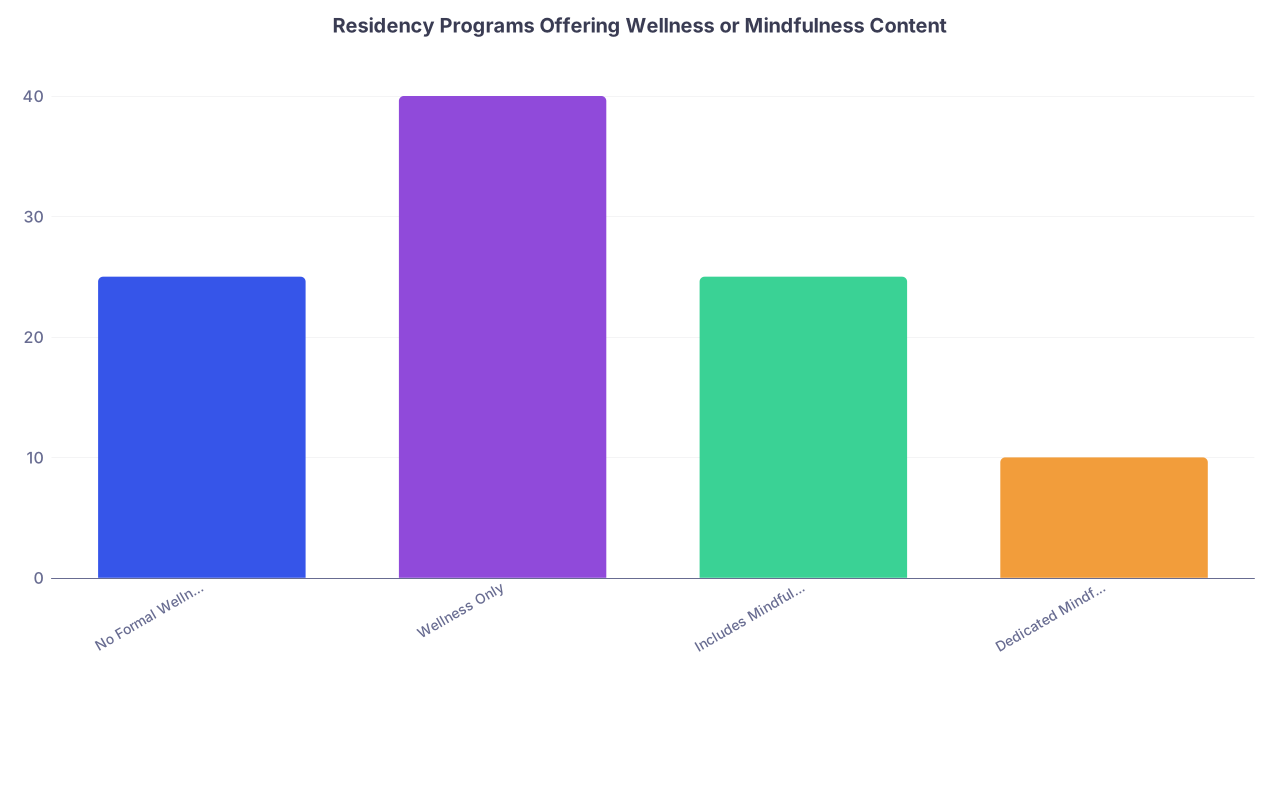
| Category | Value |
|---|---|
| No Formal Wellness | 25 |
| Wellness Only | 40 |
| Includes Mindfulness | 25 |
| Dedicated Mindfulness Program | 10 |
That’s made‑up distribution data for illustration, but the trend is real: this isn’t fringe anymore. The culture just moves slower than the data.
You are not wild for wanting to talk about mindfulness. You’re just early enough that you still have to translate it into a dialect old‑school medicine understands.
If You’re Still Anxious, Use This Simple Template
If your brain is spiraling and you just want something safe to plug in:
- Name the context (stressful thing).
- Name the problem (how you reacted before).
- Name the tool (mindfulness, briefly defined as attention/breathing/awareness training).
- Name the behavioral change (what you do differently now).
- Name the outcome (how it helps patients/team/you function).
Example:
“On busy inpatient rotations, I used to carry frustration from one interaction into the next, which sometimes made me less patient with staff and families. I started practicing mindfulness—short, structured attention and breathing exercises—which helped me notice when my stress was spiking. Now I intentionally reset before starting a new interaction, which has made my communication calmer and more consistent, even late in long call days.”
That’s it. That’s the whole move.

Final Takeaways (Before Your Brain Spirals Again)
Let me boil this down so you can close the tab and go to sleep:
- You absolutely can talk about mindfulness in evaluations and applications without sounding flaky—if you frame it in terms of concrete behaviors and outcomes, not vague “inner peace” language.
- Translate it into medicine-speak: attention training, emotion regulation, staying calm under pressure, communicating better, recovering after hard cases. That’s what evaluators actually care about.
- Pair mindfulness with competence and responsibility, not with fragility. You’re not saying “I can’t handle this.” You’re saying “I care enough to train my mind like any other clinical skill.”
If mindfulness is genuinely helping you be a better, safer, kinder clinician, you don’t need to hide it. You just need to speak about it in a way the people reading your evals can respect—and you’re fully capable of that.


