

It’s 4:37 p.m. You’re already running an hour behind. The last patient just yelled at you because “no one here cares,” and now you’re standing outside the next exam room door with your heart pounding, jaw clenched, and that hot shame creeping up your neck because…you kind of do want to yell back.
And the scary part? You’ve already snapped once this month. Or been visibly curt. Or rolled your eyes in a way the patient definitely saw. Now you’re in your car after clinic, replaying every second and thinking:
“Am I actually not cut out for this?
What if I turn into that burned-out, cynical doctor?
And does mindfulness really fix this or is that just a wellness buzzword people throw at us instead of giving us reasonable workloads?”
Yeah. I know that mental spiral.
Let me say the quiet part out loud: a lot of us are one bad shift away from saying something we can’t take back. And then we Google things like “mindfulness for doctors” while stress-eating cold takeout at midnight and wondering if we’re broken.
So. Can mindfulness really help with difficult patients—or is it just another thing you’re supposed to feel guilty for not doing perfectly?
I’ll be blunt: yes, mindfulness can help a lot with not losing your cool. But not in the magical, “I now love all angry patients” way. More in the, “I stopped pouring gasoline on the fire in my own nervous system” way.
Let’s break this down like actual humans, not wellness brochures.
What’s Actually Happening When You Lose Your Cool
You’re not “a bad person” for getting frustrated. You’re a human with a nervous system that’s been getting body-slammed by chronic stress.
Here’s the ugly chain that usually happens in real life:
- Patient says something hostile, unfair, or triggering.
- Your nervous system goes straight into threat mode: heart rate up, shoulders tight, tunnel vision.
- Your brain flips to survival scripts: defend, argue, shut down, get sarcastic.
- You react—tone, words, eye-roll, visible irritation.
- You leave the room and immediately feel guilt and shame.
- Cue late-night ruminations: “What is wrong with me?”
Mindfulness doesn’t magically make patients less rude, entitled, manipulative, non-adherent, or verbally abusive. It changes steps 2–4.
Instead of your stress reaction owning you, you start to see it as it happens. And that tiny moment of seeing——“Oh wow, my chest is tight, I want to snap right now”—creates a microscopic space for choice.
That microscopic space is basically the whole ballgame.
What Mindfulness Actually Is (And What It’s Not)
If your brain hears “mindfulness” and immediately pictures some influencer telling you to “just breathe” while you’re drowning in pages, yeah, I get the eye-roll.
So let’s define it in a way that isn’t useless.
Mindfulness, in this context, basically means:
Being aware of what’s happening inside you, right now, without immediately fighting it, fixing it, or acting on it.
That’s it. Moment-to-moment awareness with less auto-pilot reaction.
What mindfulness is not:
- It’s not forcing yourself to feel calm or kind.
- It’s not judging yourself for having ugly thoughts like “this patient is driving me insane.”
- It’s not agreeing with the patient or letting them walk all over you.
- It’s not a spiritual personality transplant.
It’s more like emotional triage. You notice:
“I’m angry. I feel cornered. My jaw is tight. I want to shut this patient down.”
And instead of fusing with that whole storm, you mentally step half a foot back and go, “Yup, that’s what’s happening.” Without instantly acting from that place.
That half-foot of mental distance can keep you from saying the thing you replay for the next six months.
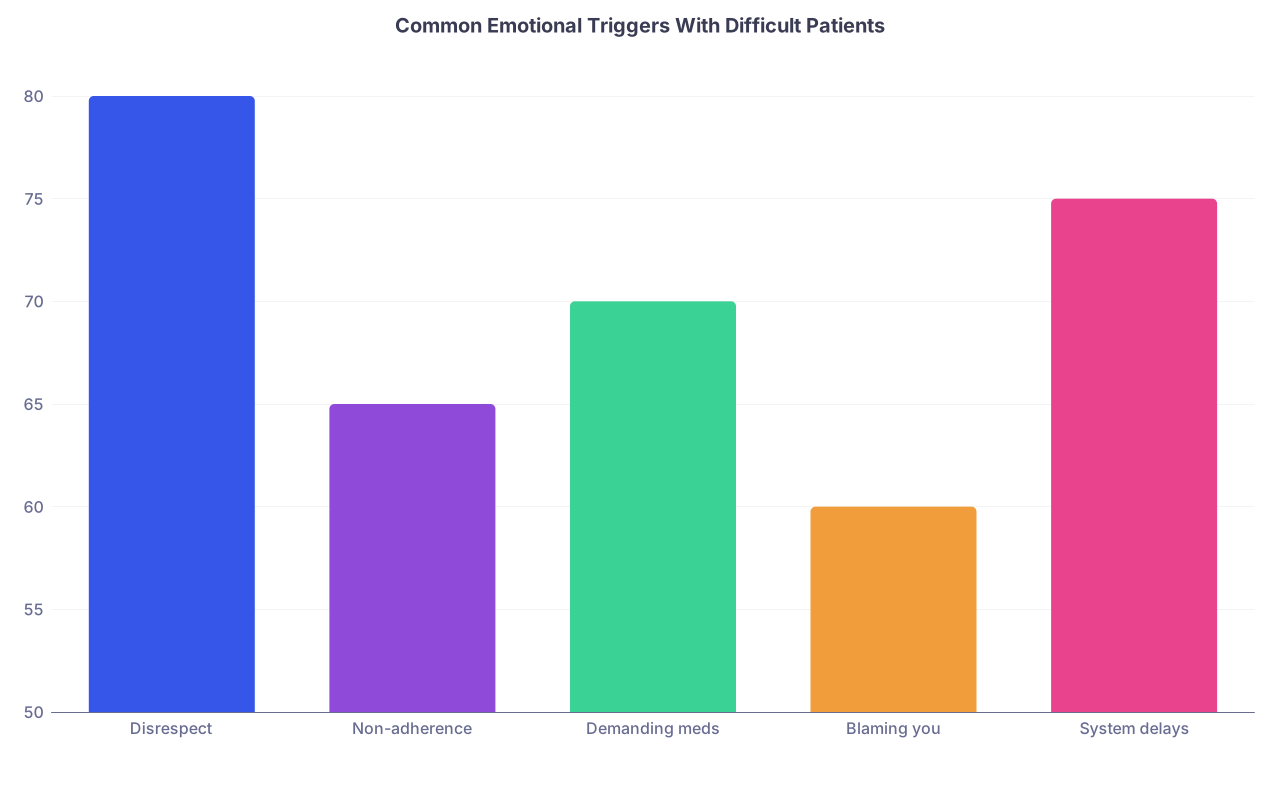
| Category | Value |
|---|---|
| Disrespect | 80 |
| Non-adherence | 65 |
| Demanding meds | 70 |
| Blaming you | 60 |
| System delays | 75 |
Why Difficult Patients Hit So Hard
Difficult patients don’t just make you annoyed. They usually poke old bruises.
There’s the patient who talks over you and says, “You don’t know what you’re doing.” If you already feel like an imposter? That’s a direct hit.
Or the patient who ignores every recommendation and then says, “You doctors never help.” If you’re already killing yourself trying to care? That feels like betrayal.
Or the chronic pain patient demanding narcotics who hints they’ll complain if you don’t prescribe what they want. If you’re terrified of complaints, evaluations, and getting in trouble? That’s panic in a lab coat.
Mindfulness helps because it slows the fusion between their behavior and your story. Instead of instantly falling into:
“They think I’m incompetent → that means I am incompetent → I have to defend myself right now.”
You build the ability to notice:
“Wow, I’m feeling really attacked. My chest is tight. My brain is screaming ‘prove yourself!’ Okay. That’s my reaction. I don’t have to let it drive.”
This doesn’t make it pleasant. It just makes it survivable—without collateral damage.
What Mindfulness Looks Like In The Room (Not On A Retreat Brochure)
The big question: can mindfulness work in a 15‑minute visit with a hostile patient, not just on a meditation app?
Yes. But it has to be bite-sized and ugly and real, not perfect.
Here’s how I’ve seen it play out in actual clinics:
1. The 5-second pause before opening the door
You’re outside a room with a note: “Very upset. Wants to speak to doctor now.” You feel your stomach drop.
A lot of people rush in just to get it over with. That’s how you walk in with your nervous system on fire.
- Literally stop. Hand on the door.
- Notice 3 sensations: feet on the floor, hand on the handle, air on your face.
- One slower exhale, just a little longer than your inhale.
- Silently name it: “Tension is here.” Or, “This is going to be hard. I don’t have to fix my feelings first.”
Total time: 5–10 seconds. It sounds ridiculously small. But it signals your brain: I’m responding, not just reacting.

2. Naming the storm in real time
Patient: “You people never listen, I’ve said this a thousand times. This place is a joke.”
Your body: instant adrenaline, heat, maybe anger, maybe fear.
Mindfulness move: mentally narrate it as it happens.
- “Anger is here.”
- “My shoulders are tensing.”
- “Part of me wants to argue.”
Notice: you’re not arguing with yourself about having those reactions. You’re just labeling. Like you’d chart: “Patient visibly distressed.”
That label already creates distance between you and the reaction. You’re observing, not drowning.
3. Using your body as an anchor
Your mind will want to fight them, convince them, or shut them down. You can’t out-cognitively-behave your sympathetic nervous system in the moment. But you can give your body something to hang onto.
A tiny practice:
While they talk, keep 5–10% of your attention on one physical anchor:
- Your feet pressing into the ground
- Your hand holding a pen
- The sensation of your breath in your nose
You’re still listening. You’re not ignoring them. You’re just not giving 100% of your attention to the verbal battle.
That sliver of attention on your body is like a safety line back to shore.
4. Letting the first reaction pass before you speak
When a patient says something unfair, your first internal response is almost always defensive. That’s fine. It’s also not the one that needs to come out of your mouth.
Mindfulness skill: let the first wave crest and fall before you respond.
Literally wait one extra heartbeat. Feel your tongue against your teeth, or your hands on your lap, while they finish their sentence.
Then answer from 2% less reactivity.
That 2% can be the difference between saying:
“Well, actually, we have been listening,”
versus,
“I can hear you’re really frustrated. Let’s slow down and walk through what’s been happening.”
One of those escalates. One de-escalates. Mindfulness doesn’t write the sentence for you. It just gives you the half-second to choose which one you want.

| Step | Description |
|---|---|
| Step 1 | Patient says something hostile |
| Step 2 | Body reacts fast |
| Step 3 | Immediate defensive response |
| Step 4 | Name feeling and sensation |
| Step 5 | Small grounding breath or body anchor |
| Step 6 | Choose response from calmer state |
| Step 7 | Notice reaction? |
But What If I’ve Already Snapped?
This is the part people don’t talk about. Everyone loves “prevent burnout” conversations. No one loves: “You already lost your cool and feel like trash.”
So, let’s say it’s too late. You got sharp. You cut someone off harshly. Your tone was icy. They noticed.
Now you’re flooded with shame.
Mindfulness here looks like:
Noticing the shame spiral
“I’m replaying that sentence over and over.”
“My stomach feels sick.”
“My brain is saying: ‘You’re a horrible doctor.’”Naming what your mind is doing, not just believing it
“Okay, this is my brain catastrophizing. It’s trying to protect me by making sure I never do this again. It’s harsh, but it’s a protection attempt.”Making a values-based choice about repair
That might be:- A simple, genuine apology: “I’m sorry, my tone was sharper than I meant. This is important, and I want to understand what’s going on for you.”
- Or, if that moment’s gone, learning from it: “Okay, that type of patient interaction triggers me hard. Next time, I want to catch it earlier.”
Mindfulness here is the difference between:
“I snapped → therefore I’m a bad physician → therefore I should quit,”
and
“I snapped → my stress is too high → I need skills and maybe system changes, not self-destruction.”
What Mindfulness Won’t Fix (And That’s Not Your Fault)
Let me be clear so you don’t weaponize this against yourself:
You can be the most mindful person on earth and still struggle with:
- Unsafe patient ratios
- 10-minute appointment slots for 10-year problems
- Abusive patients who cross lines (racism, sexism, harassment)
- An administration that cares more about Press Ganey than your well-being
Mindfulness doesn’t fix exploitation or bad policy. It just gives you tools so the system doesn’t eat you alive from the inside while you work on changing what you can—or, if needed, getting out.
If anyone implies that you wouldn’t be burned out if you “just meditated more,” that’s gaslighting. You’re not anxious because you lack moral fiber. You’re anxious because you’re a decent human trying to care in a system that often doesn’t.
| Situation | Micro-Practice |
|---|---|
| Before entering angry room | 1 slow exhale + name tension |
| During ranting monologue | Anchor attention to your feet |
| Feeling urge to argue | Silently label: "Defensiveness" |
| After snapping or being curt | Notice shame + plan one next step |
How To Start Without Adding Another Thing To Fail At
The last thing you need is “mindfulness” turning into another checkbox where you judge yourself: “I can’t even meditate right, I’m hopeless.”
So start insultingly small.
Examples that are actually doable during training or busy practice:
- One minute of attention while washing your hands before the next patient. Feel the water, the temperature, your breath. That’s it.
- Three breaths before you click into a new chart. Inhale, exhale slowly. Notice your shoulders. No app, no timer.
- After a brutal patient interaction, instead of immediately sprinting to the next task, give yourself literally 20 seconds sitting or standing, noticing your body. “That was rough. My heart’s still racing.”
If your brain says, “This is pointless,” fine. That’s just another thought to notice.
You’re not doing this to become Zen. You’re doing it so you stop getting yanked around by every surge of anger, fear, or shame.
The Ethical Piece: Are You A Bad Physician If You Lose It?
Here’s the ethical horror movie that runs in the background:
“I lost my cool with a patient → I caused harm → I’m failing my duty → I shouldn’t be a doctor.”
I’m not going to sugarcoat this: how we treat patients matters. Tone matters. Safety and trust matter. Chronic sarcasm, contempt, or cruelty have no place in medicine.
But having moments of losing your cool doesn’t make you irredeemable. It makes you in need of support, skills, and maybe therapy—not exile.
From an ethics standpoint, mindfulness helps you:
- Notice when your internal state could compromise care.
- Take micro-steps to protect patients from your worst reactions.
- Recognize patterns where you consistently struggle (certain personality types, certain complaints) and address them intentionally.
That’s not weakness. That’s actually moral seriousness. You care enough to be scared of the harm you might cause. I’d pick you as my doctor over someone who thinks they’re always calm and right.
If You’re Thinking “I’m Too Far Gone”
You might be reading this and thinking:
“I’m beyond breath-counting. I’m angry and numb and resentful. I don’t even like patients anymore.”
Honestly? That’s a huge red flag that what you need might be bigger than just mindfulness exercises: therapy, time off, schedule changes, boundaries, maybe a different environment.
Mindfulness can be part of the toolkit, but it’s not a magic exit from severe burnout.
The fact you’re even reading something like this means there’s a part of you that still cares. Don’t ignore that part. It’s asking for help, not punishment.
FAQs
1. What if I try mindfulness and I still feel just as angry?
Totally normal. The goal isn’t to erase anger. Anger is often appropriate. The goal is to see it sooner and not let it drive the bus. If you notice, “Wow, I’m furious right now,” that is mindfulness working—even if the feeling hasn’t changed yet. Over time, the intensity usually dials down a bit, but the first win is awareness, not serenity.
2. Won’t patients think I’m weird if I pause or breathe before answering?
Honestly? Most won’t notice. It’s a fraction of a second. If anything, a tiny pause often reads as “this person is actually thinking about what I said” instead of just reflex-answering. And if you ever need a longer pause, you can always cover it with a normal sentence: “Give me a second, I want to think about how to explain this clearly.”
3. Is mindfulness just avoiding conflict and letting patients walk all over me?
No. That’s people-pleasing, not mindfulness. Being mindful might actually help you set clearer boundaries because you’re responding from stability instead of panic. Mindfulness is what lets you calmly say, “I won’t tolerate being spoken to that way,” or, “I’m not comfortable prescribing that medication,” instead of yelling…or caving.
4. How long until I actually notice a difference?
If you’re doing tiny practices throughout the day, a lot of people notice moments of difference within a couple of weeks—like catching themselves right before they snap, or recovering faster after a hard interaction. It’s not some huge overnight transformation. It’s more: death by a thousand cuts, but in reverse. Healing by a thousand small reps where you choose awareness over autopilot.
Key points:
You’re not a monster for losing your cool with difficult patients—you’re a human under too much strain. Mindfulness won’t fix the healthcare system or make every patient easy, but it can give you just enough space between trigger and reaction to protect both you and them. And you don’t have to become a meditation guru; a few seconds of real, honest awareness in the hallway before a hard room is already you doing the work.


