
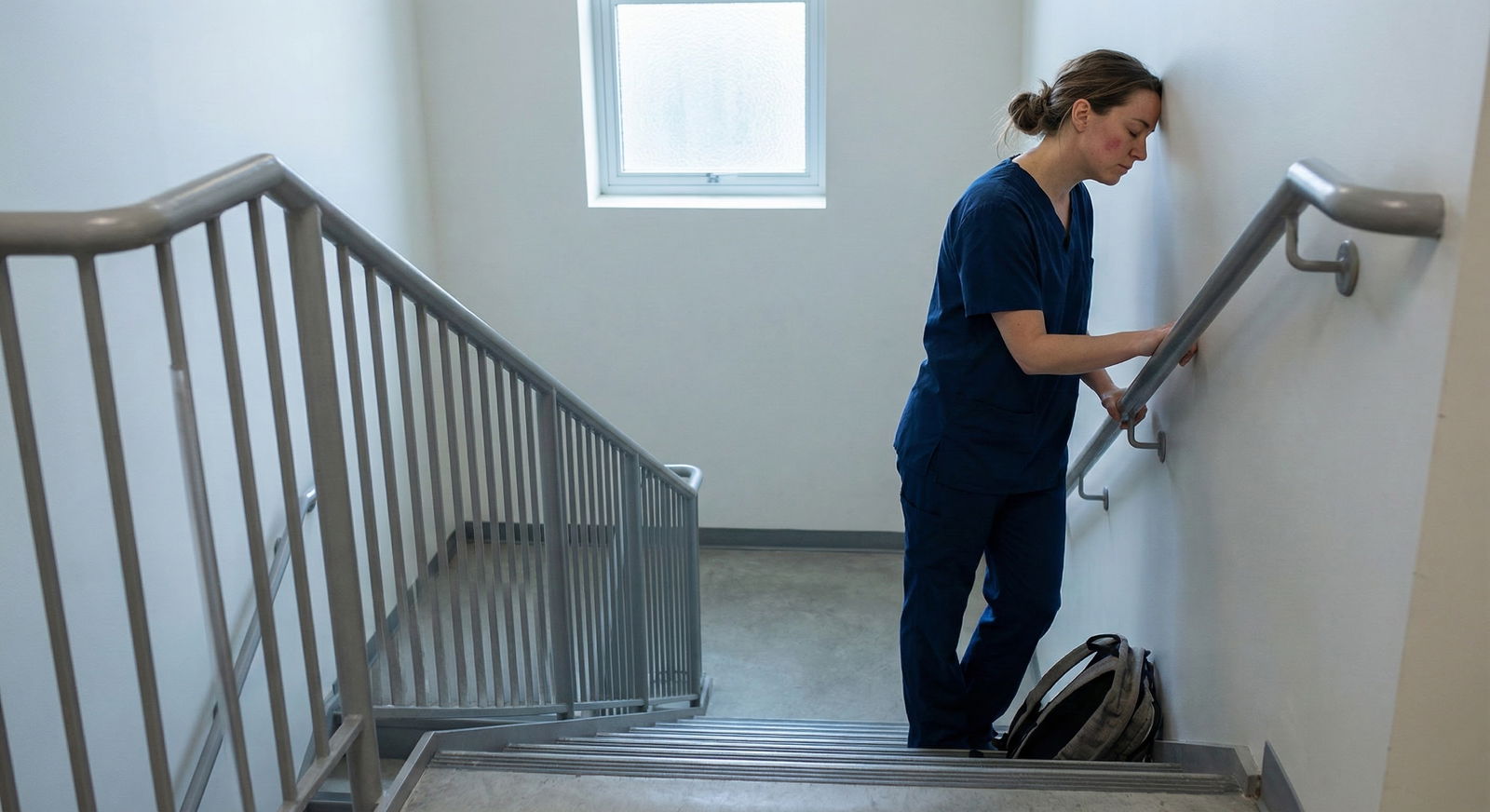
It’s 3:17 a.m. You’re post-call, technically “done,” but your brain didn’t get the memo. You’re home, showered, in bed. And still replaying that cross-cover page. The septic patient. The almost-missed lab. The way the attending’s eyebrows lifted when you fumbled that presentation.
Your body is wrecked, but your mind is sprinting a marathon.
You’re watching the hours until your next shift disappear, doing that mental math: “If I fall asleep right now, I can still get 3 hours.” Then it’s 2. Then 1. Then your alarm is going off and you feel hungover without drinking anything.
And underneath the exhaustion is this quiet, nasty whisper: “Real doctors handle this. Maybe I’m not cut out for this.”
Let me say it straight: you’re not broken. You’re not weak. You’re not the only one who can’t shut off their brain after call. Honestly, I’d be more worried about you if you saw the stuff we see and slept like a baby.
But I get the fear behind your question:
What if this never gets better?
What if I burn out before I even finish training?
What if my inability to shut my brain off makes me unsafe for patients?
Let’s talk about that. And let’s talk about mindfulness in a way that isn’t “just breathe and download Headspace” while your cortisol is doing parkour.
Why Your Brain Won’t Shut Up After Call (You’re Not Imagining It)
You know the physiology. You can recite the stress response pathway for an exam. But somehow it feels different when it’s happening to you at 3 a.m. and you’re lying there feeling like a failure for not being able to “just relax.”
Here’s the unromantic truth: call is basically a professionally sanctioned way to break your brain’s regulation systems.
You get:
- Sleep deprivation
- Constant interruptions (pages, alarms, overhead codes)
- High-stakes decision-making with incomplete information
- Chronic uncertainty: “Did I miss something? Did I document that? What if they crash after I leave?”
- Actual moral distress (you watch things that ethically bother you and you still have to function)
Your brain responds like it’s supposed to: it goes into survival mode. Hypervigilance. Rumination. Replaying threats to “keep you safe next time.”
So when you finally get home, your body is still primed for danger. Of course you can’t just flip a switch.
And here’s the part that really freaks people out: this state can start to feel normal. Coffee on top, work never fully “off,” your personal life becoming a side quest.
That’s exactly where mindfulness can help—not as a fluffy spa treatment, but as literal counter-programming for a nervous system that’s been jerked around for 28 hours straight.
What “Mindfulness” Actually Means When You’re A Doctor (Not a Monk)
Mindfulness gets thrown around like a scented-candle word. For you, it needs to be more like a clinical tool.
Realistically, for physicians, mindfulness is:
- Training your attention to come back from worst-case-scenario land
- Learning how to notice thoughts without automatically believing or acting on them
- Building a tiny gap between “trigger” and “reaction” so you don’t spiral at 2 a.m.
- Practicing staying with discomfort without letting it hijack your whole nervous system
It’s not “think positive.”
It’s not “don’t care so much.”
It’s not “turn off your emotions.”
(See also: How elite ICU teams use micro‑mindfulness between codes and rounds for quick practices.)
It’s closer to: “My brain is screaming, but I don’t have to let it run the show.”
And no, you don’t need to sit on a cushion for 45 minutes chanting in Sanskrit. You’re lucky if you get 10 minutes between pages to pee.
Post-Call: What You Can Actually Do in the First 60 Minutes
Let me be blunt: if you expect yourself to go from code blue adrenaline to peaceful lotus pose in 5 minutes, you’re setting yourself up to feel like a failure. Again.
Your first goal post-call is not “be enlightened.”
It’s: “Downshift from emergency mode enough that sleep becomes physically possible.”
Think of it like a decompression protocol, not a personality makeover.
Step 1: Micro-transition before you leave
Don’t roll your eyes. This matters.
Take literally 60–120 seconds before you walk out of the hospital:
- Sit down somewhere semi-quiet (stairwell, empty conference room, even a bathroom stall if you have to).
- Close your eyes or lower your gaze.
- Feel where your body is touching the chair or the wall.
- Take 5 slow breaths: in through your nose for 4–5 seconds, exhale for 6–8 seconds.
Your brain will say “this is pointless, I have to go home.” Do it anyway. This is you telling your nervous system: “We’re moving from action to release now.”
Step 2: A deliberate commute, not a black-out autopilot
Most of us drive home post-call like a zombie and then wonder why we walk into our apartment still buzzing.
Pick one focus for the ride home:
- If you’re driving: feel your hands on the steering wheel, notice the temperature, consciously relax your jaw and shoulders at every stoplight.
- If you’re on public transit: pick one sensory anchor—the feeling of your feet on the floor, the sound of the train, the colors around you. Keep bringing your attention back to that every time it runs off to the lab result you forgot to check.
You’re not trying to solve your thoughts. Just keep gently returning to something neutral and physical.

| Step | Description |
|---|---|
| Step 1 | End of shift |
| Step 2 | 60 sec breathing |
| Step 3 | Commute with sensory focus |
| Step 4 | Low-stimulation routine at home |
| Step 5 | Short mindfulness practice |
| Step 6 | Sleep |
Step 3: Strip down your home routine
Going from fluorescent chaos to phone, TV, laptop, bright kitchen lights, and scrolling? Your brain never gets the “we’re safe now” memo.
Post-call, your “routine” needs to be aggressively boring:
- Lights dim
- No email, no charting, no texts about work unless absolutely unavoidable
- No doomscrolling “just for a minute” (you know it’s not a minute)
If you can stand it, give yourself 5–10 minutes of a simple mindfulness practice right here before bed. That’s the moment where you can actually do some brain retraining.
Mindfulness Practices That Don’t Feel Fake at 3 A.M.
Let’s talk options. Some of these will sound cheesy at first. That’s fine. Try them like you’d try a new medication: not because you feel like it, but because there’s evidence and you’re experimenting.
1. “Dump and Park” Thought Download (5–10 minutes)
When your mind is racing:
- Grab a notebook or notes app.
- Set a timer for 5–10 minutes.
- Write down every single thing swirling around: “Did I sign that order? I think that family hates me. I sounded stupid on rounds. What if that patient decompensates.”
No editing. No fixing. Just a brain dump.
Then do this: tell yourself, literally out loud if you can stand it—
“I’m parking these thoughts here. I will come back to them after I sleep. My brain is not allowed to troubleshoot them right now.”
You’re giving your anxious brain what it wants: acknowledgment that these things matter. But you’re also drawing a boundary that 3 a.m. is not problem-solving time.
2. Box Breathing or 4-7-8 (2–5 minutes)
You already know this from teaching anxious patients. The difference is you actually do it.
Two simple patterns:
- Box breathing: inhale 4, hold 4, exhale 4, hold 4.
- 4-7-8: inhale 4, hold 7, exhale 8 (this one can actually make you sleepy if you do 4–8 rounds).
The key: longer exhale. That’s the parasympathetic signal.
Your mind will wander. Keep coming back to the counting. If you fail 100 times in 2 minutes, that’s not failure. That’s the workout.
3. Body Scan, But the Lazy Version (10 minutes, lying in bed)
Full-on 45-minute body scan from MBSR? Not happening. You’re horizontal and barely hanging on.
Try this stripped-down version:
Lying in bed, eyes closed:
- Bring your attention to your feet. Notice warmth, cold, tingling, pressure. No judging, just noting.
- Slowly move attention up: calves, knees, thighs, pelvis, abdomen, chest, shoulders, arms, hands, neck, face.
- At each area: notice tension, see if you can soften it 5–10%. Not 100%. Just a small release.
If you fall asleep halfway through, congratulations. That’s success.
4. “Name and Tame” for Guilt and Fear (2–3 minutes)
The worst part of post-call sometimes isn’t fatigue, it’s the guilt or fear:
“What if that patient codes tonight and it’s my fault?”
“I should’ve caught that earlier.”
“I didn’t do enough.”
You can’t thought-logic your way out of that at 3 a.m. But you can label the storm.
Try this sentence, internally or whispering:
- “This is anxiety.”
- “This is guilt.”
- “This is fear about being a bad doctor.”
Then add: “I don’t have to fix this right now. I can feel this and still rest.”
You’re not pretending you’re fine. You’re separating “what I’m feeling” from “what is objectively true about my competence as a physician.”
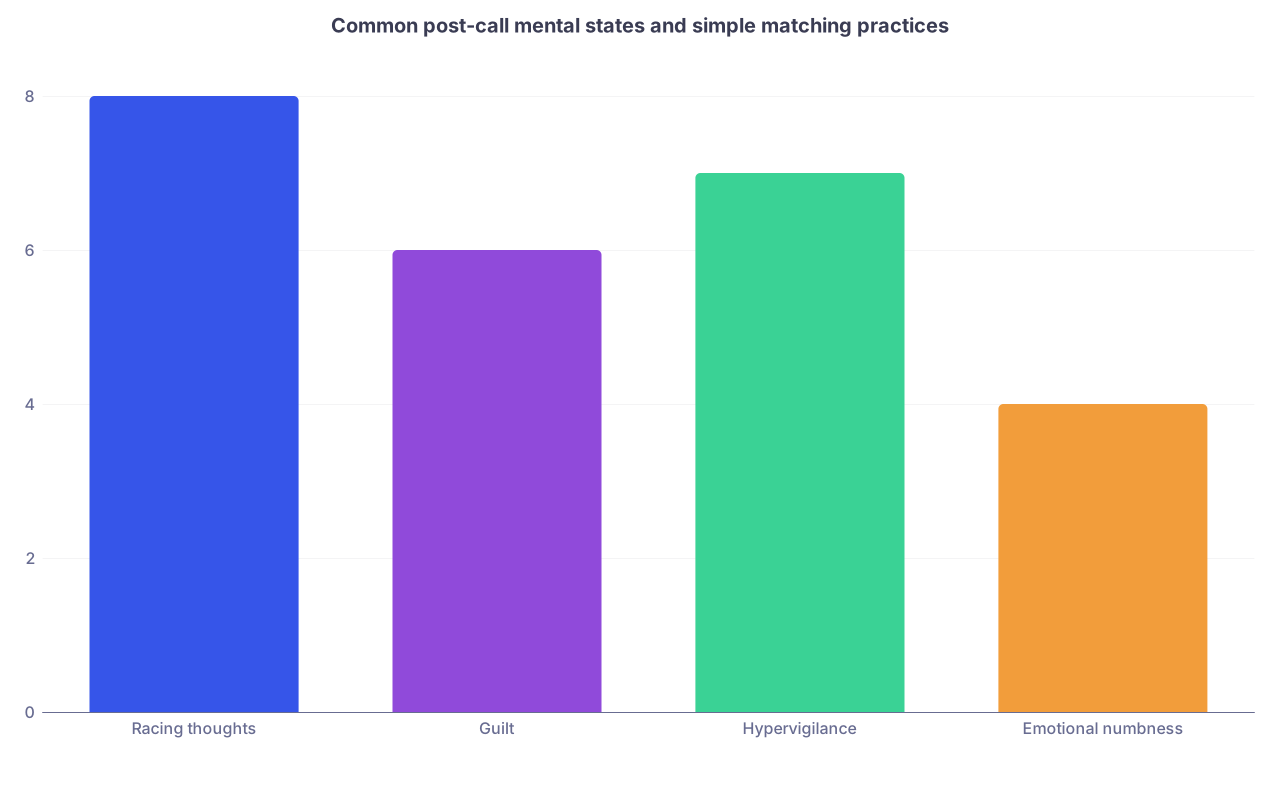
| Category | Value |
|---|---|
| Racing thoughts | 8 |
| Guilt | 6 |
| Hypervigilance | 7 |
| Emotional numbness | 4 |
The Fear Behind All of This: Ethics, Safety, and “Good Doctor” Anxiety
Here’s the part no one really says out loud in wellness talks: the reason you’re so scared you can’t turn your brain off isn’t just personal comfort. It’s ethics.
You’re thinking:
- “If I don’t sleep, I could miss something. That’s unsafe.”
- “If I can’t leave work at work, I’ll burn out and start cutting corners.”
- “If I’m always in fight-or-flight, I won’t be the kind, present doctor I want to be.”
And you’re not wrong to care about that. That’s actually your moral compass working.
So here’s the reframe: mindfulness isn’t some indulgent self-care thing. It’s part of professional ethics now. You can’t practice safely in a chronically dysregulated state forever.
But—and this matters—you are fighting a system that isn’t built for sane sleep or mental health. This is not a character flaw; it’s an occupational hazard.
So the ethical stance, in my opinion, is:
- You’re obligated to use whatever tools you can to keep yourself functional and present, including mindfulness.
- You’re not individually responsible for fixing a call structure that has people awake for 24–28 hours and then expects grace and perfection.
- You are allowed to say, “this system is harmful, and I’m doing damage control on my own nervous system so I can keep helping patients without losing myself.”
You can be both: deeply committed and deeply tired. Mindfulness is how you stop that from turning into deeply broken.
Long-Term: Building a Mindfulness Habit That Survives Residency
Here’s the part nobody wants to hear and everybody needs to: you can’t fix a year of chronic stress with a single post-call meditation.
You need small, boring, repeatable stuff.
Think of mindfulness like brushing your teeth. One heroic brush doesn’t save your mouth. Daily 2–5 minutes does.
Some realistic options for MDs:
- 5 minutes of breath practice before first patient or sign-out
- A 10-minute guided meditation on nights when you’re not on call
- One mindful walk per week (no phone, just noticing sights/sounds/your body)
- Short check-in after a rough patient encounter: “What am I feeling? Where in my body? Can I give it 30 seconds of attention instead of shoving it down?”
If you like structure, apps can actually help: Headspace, Calm, Ten Percent Happier, Insight Timer. But if guided voices annoy you, a simple timer and your breath work fine.
The point is repetition. Neuroplasticity. You’re training your brain that:
- Not every distressing thought is an emergency
- It’s safe to shift from doing mode to being mode
- You are allowed to shut down occasionally without the world ending
| Situation | Time Available | Practice to Try |
|---|---|---|
| Walking out post-call | 1–2 minutes | 5 slow breaths, grounding |
| On the commute home | 10–30 minutes | Sensory-focused commute |
| Lying in bed, wired | 5–15 minutes | Body scan or 4-7-8 |
| Before next shift | 3–5 minutes | Box breathing, “name and tame” |
| On a lighter day off | 10–20 minutes | Guided meditation or mindful walk |
When It’s Not Just “I Can’t Turn My Brain Off”
Here’s where the anxious part of your brain is probably already going:
“What if this is more than normal post-call stuff? What if this is depression? PTSD? Full-on burnout?”
Sometimes it is.
Red flags that this needs more than solo mindfulness:
- You can’t sleep even on nights when you’re not on call
- You’re starting to dread every shift, not just the tough ones
- You feel emotionally flat—no joy, no real sadness, just…nothing
- You’re having intrusive images or memories from cases that won’t leave you alone
- You’re thinking, even vaguely, that not existing would be easier
If you’re checking some of those boxes, mindfulness is still helpful, but it’s not enough alone. That’s where therapy (ideally with someone who gets medical culture) or your institution’s mental health services come in.
And no, going to therapy doesn’t mean you’re “that resident” or that you’ll be reported or lose your license by default. That fear is loud, but it’s not reality in most places. Plenty of excellent attendings I know see therapists. Quietly. During lunch. Between OR cases.
Your obligation to patients includes not silently decompensating while pretending you’re fine.

If You Try All This and Still Feel Like You’re Failing
I know the script that runs in your head:
“I should be able to handle this.”
“Everyone else seems fine.”
“I tried that breathing thing once; it didn’t work. I’m broken.”
Couple of things:
You’re seeing everyone else’s mask, not their 3 a.m. brain. I promise you’re not the only one whose mind replays patients on loop. I’ve watched absolute rockstar residents cry in their cars between shifts and then walk in smiling.
Mindfulness is a skill, not magic. The first few times, it might feel useless or even worse (“Now I’m just aware I’m suffering”). That doesn’t mean it’s not working; it means you’re building muscles in a part of your brain you haven’t trained before.
Your value as a doctor is not measured by how quickly you can emotionally detach after call. The fact that you care enough to be this affected? That’s part of what makes you good.
If all you can manage some days is: “I’m lying here, my brain is racing, and I’m just going to feel my breath for 5 cycles”…that counts. That’s a rep.
The Short Version
If you skimmed or your post-call brain is done, here’s what matters:
- You’re not weak or broken for not being able to shut your brain off after call. That’s your nervous system doing exactly what it was trained to do under stress.
- Mindfulness isn’t a cure-all, but tiny, repeatable practices—breath work, body scans, thought dumping, labeling emotions—can help you downshift enough to sleep and keep you from burning out ethically and emotionally.
- If the sleeplessness, guilt, or dread is constant and spilling beyond call nights, that’s your cue to bring in backup: therapy, peer support, maybe even schedule changes. That’s not failure; that’s responsible medicine.
You don’t have to become a Zen master to make this better. You just have to give yourself a few small tools and the permission to use them—even when the system around you acts like you’re supposed to be a machine.


