

Last month, a resident told me he’d started taking 60‑second breathing breaks between patients. The same week, an attending snapped at him in front of the team: “If you have time to stand still, you have time to see more patients.” He came to me later and whispered, “What if my ‘mindfulness’ makes me miss something and someone gets hurt? How do I live with that?”
I know that knot-in-the-stomach feeling way too well. You’re standing in the hallway, trying to do one grounded breath, but your brain is screaming, “What if the nurse is calling a Code Blue right now and I don’t hear? What if my intern needs me? What if the attending thinks I’m lazy? What if this one breath is the difference between catching sepsis and missing it?”
Let’s actually walk into that fear instead of dancing around it.
The Core Fear: “If I Slow Down, Someone Will Die”
This is the nightmare scenario, right? You step away to take 90 seconds to breathe, and in those 90 seconds:
- A patient decompensates.
- A nurse pages and you don’t see it.
- Your attending asks a question and you miss it.
- A subtle clue on exam is overlooked because your “mindful” self wasn’t rushing fast enough.
Underneath all of that is one brutal belief:
“If I’m not constantly hyper‑vigilant, I’m unsafe.”
Medicine trains this into you early. Third year of med school, someone says, “If you have time to sit, you have time to read.” Intern year, you’re praised for “hustle,” for “always being available,” for answering pages in under 30 seconds. Nobody pins a gold star on you for saying, “I took three mindful breaths before entering that room.”
So of course mindfulness feels dangerous. It feels like you’re taking your eye off the ball in a game where the “ball” is another human’s heart rate.
I’m not going to say, “Don’t worry, nothing bad will ever happen.” That’s a lie. Bad things happen in medicine whether you’re mindful, mindless, fast, slow, perfect, or exhausted. The question is different:
Is being constantly flooded and frantic actually making you safer? Or more likely to miss something?
What Constant Hyper‑Vigilance Really Does to You
Let’s be unpleasantly honest for a second. You know the version of you that’s 8 hours into a shift,:
- Your pager’s gone off 20 times in the last hour.
- You haven’t eaten.
- You’re replaying the attending’s criticism from this morning.
- You’re flipping from patient to patient, half‑remembering their labs as you walk.
That version of you feels like they’re “on.” But clinically? That version of you:
- Re‑opens Epic 3 times to look at the same potassium because you forgot it between rooms.
- Writes orders and then can’t remember if you actually placed them.
- Relies on pattern recognition instead of real thinking.
- Is way more likely to overlook the slightly mottled leg or the new confusion because you’re mentally somewhere else.
Hyper‑vigilance feels like safety. It’s actually cognitive overload dressed up as heroism.
There’s a reason airline pilots and military units build in micro‑pauses and checklists. Because at high stakes, the brain that’s too revved doesn’t see clearly.
Mindfulness, when done right, isn’t “tuning out.” It’s “turning toward what’s actually happening right now.” It’s snapping you out of the mental noise so you can actually see the patient in front of you.
So the real danger isn’t, “I took 4 slow breaths.” It’s, “I haven’t taken a real breath in 8 hours and my brain is fried.”
The Realistic Worst‑Case Scenarios (And What Actually Mitigates Them)
Let’s name the specific disasters you’re imagining and be clinical about them.
1. “I step away for a mindful break and miss a decompensation.”
You take 90 seconds in the stairwell. While you’re gone, a patient decompensates. Paging goes out. You’re not there.
Here’s the harsh truth: in almost every hospital system I’ve seen, you’re not the only safety net.
- Nurses are watching vitals.
- Monitors alarm.
- Rapid response teams exist.
- Codes are overhead paged.
- There’s usually at least one other resident/attending in the building.
If the patient is that unstable that 90 seconds of you not staring at their door is life‑or‑death, that’s not a “mindfulness” problem. That’s a triage/monitoring problem. You wouldn’t go hide in the stairwell if you knew someone was crashing. You’d be in the room. So we’re really talking about those “in between” moments when nothing seems actively on fire.
What actually reduces risk here is:
- Clear sign‑outs: “Room 14 looks borderline. Can someone keep an eye while I check labs on 18?”
- Using your “breaks” in sight of people/pagers: a couple of breaths at the workstation, in a conference room with your pager audible.
- Time‑boxing: “I’m going to pause for three breaths while this CBC loads, then reassess what needs me next.”
You’re not disappearing into the void. You’re pausing inside the system, still reachable.
2. “I miss a page or call because I’m doing a breathing exercise.”
Then the guilty loop starts: “If I had just not been doing that stupid mindfulness thing…”
Reality check: you miss pages all the time already. In the shower. In the bathroom. When your phone glitches. When you’re scrubbed in. When you’re literally in another patient’s room.
The question program leadership actually cares about is:
- Do you respond consistently and reasonably quickly most of the time?
- Do you close the loop and apologize when you miss one?
- Do you have coverage or backup on high‑risk services?
Doing a 30–60 second breath practice with your pager audible, checking it right after, doesn’t move the needle in some catastrophic way. But it might change how you respond when you call back: more present, less irritable, more able to think.
3. “I miss subtle clinical clues because I’m too inward‑focused”
This is one I hear a lot: “If I’m focusing on my breath, I’m not focusing on the patient.”
That’s not mindfulness. That’s zoning out.
The kind of mindfulness I’m defending is stuff like:
- Feeling your feet on the floor while you listen to the patient’s story.
- Taking one exhale before you start presenting so your brain un-clenches.
- Noticing your heart rate spike when someone asks you a pimp question, then choosing not to spiral.
You’re not closing your eyes and going to your “happy place” while you’re auscultating lungs. You’re using the body/ breath as an anchor so your mind is more in that room, not scattered across the last 10 rooms.
The residents I’ve seen who actually commit to tiny, in‑the‑moment mindfulness practices usually catch more subtle signs, because they’re less lost in catastrophizing and performance anxiety.
The Ethical Knot: “Am I Selfish if I Pause?”
This is where the guilt really bites. It’s not just fear. It’s moral distress.
You think:
- “I chose this field to serve patients, not myself.”
- “It feels wrong to prioritize my nervous system when someone is suffering down the hall.”
- “What if an attending sees me breathing and thinks I don’t care about the patients?”
You’ve absorbed an ethic that says good doctors = self‑sacrificing to the point of self‑erasure.
Here’s the problem: that ethic sounds noble and kills people slowly.
Burnout isn’t just about you being sad. It changes:
- How carefully you listen.
- How patient you are with questions.
- How likely you are to double‑check something that “seems fine.”
- Whether you actually like your patients or quietly resent them.
Taking 30 seconds to regulate your nervous system is not in conflict with the principle of beneficence. It serves it. Because the dysregulated, resentful, checked‑out version of you is not the one you want treating someone you love.
From a duty‑to‑care standpoint, I’d argue it’s ethically worse to run on fumes because you’re afraid of how it looks if you pause.
How to Take Mindfulness Breaks Without Freaking Yourself Out
You want safety rails. “Mindfulness, but with training wheels so I don’t spiral about it.” Fine. Let’s do that.
1. Shrink your idea of “a break”
You’re not meditating in lotus pose for 20 minutes during a code. You’re building micro‑pauses into things you already do.
Examples:
- While the EMR loads, feel your feet, unclench your jaw, three slow exhales.
- Before you knock on a door, one inhale/exhale, mentally say the patient’s name.
- Walking between rooms, notice one sensation: temperature of the hallway, sound of your shoes, feel of the badge on your chest.
That’s it. 5–15 seconds at a time. No sudden vanishing acts.
2. Pair it with checks, not absence
Mindfulness doesn’t have to be “away from” your work. Try:
- Mindful vital sign review: take one slow breath, then actually read the numbers, asking, “What changed in the last 6 hours?” instead of mechanically clicking.
- Mindful sign-out: before you start giving or receiving sign-out, one breath to remember: “This matters. I want this to be clear.”
You’re more in the work, not less.
3. Keep your pager in your field, not your pocket in a stairwell
If you’re already anxious, don’t make it worse by hiding.
- Do a 60-second breathing practice at the computer with your pager in front of you and the volume on.
- If you step into a side room, set a 1–2 minute timer so you know you won’t disappear for “too long.”
The goal is reducing your fear story: “What if I vanish and miss something huge?” You want your rational brain to look at your behavior and say, “No, I’m still in the loop.”
How to Talk About It Without Sounding Flaky
You’re also scared of optics. That if anyone sees you “being mindful,” you’ll get labeled as soft, fragile, or uncommitted.
So you don’t have to sell it as “mindfulness.”
You can say:
- “I’m just taking a second to organize my thoughts before we see the next patient.”
- “Give me 30 seconds to reset so I can think clearly about this plan.”
- “I’ve noticed if I rush, I miss details. I just need one breath.”
That’s all true. And it’s also mindfulness, whether you use the word or not.
If you ever do talk about it frankly with someone you trust, frame it in clinical language:
“I’ve realized when I’m in constant fight‑or‑flight, I’m more error‑prone. I’m experimenting with brief, in‑the‑moment resets to keep my thinking sharp. It’s like hitting a mental ‘clear’ button before big decisions.”
I’ve seen attendings, even skeptical ones, respect that way more than, “I’m doing a mindfulness practice.”
Where Mindfulness Actually Prevents Critical Misses
Mindfulness doesn’t just prevent burnout in some vague moralizing way. It helps you not screw up.
Concrete places I’ve watched it matter:
- Pre‑procedure pause: One breath before inserting a central line, then mentally running through: consent, allergies, side, equipment. Catches “Oh wait, this isn’t the side with the pneumothorax, right?”
- Order entry: Feeling yourself rush, pausing, then double‑checking weight‑based dosing instead of blindly copying from the last patient.
- Difficult family conversation: Pausing when a family member says something accusatory, noticing your urge to get defensive, choosing to stay calm and curious instead of snapping.
None of those examples involve you leaving the floor to “go be zen.” They’re about not letting your anxiety pilot the plane.
What If Something Bad Still Happens?
This is the part you’re probably bracing for.
What if you do take a brief mindful pause and something bad happens in its shadow? You will absolutely be tempted to build that into your personal story of guilt:
“If I hadn’t taken that stupid break…”
But here’s the sick truth: if you hadn’t taken that break and something bad happened, your brain would grab onto something else:
“If I had rounded faster…” “If I had checked the labs again…” “If I had stayed later yesterday…”
You’re good at guilt. You’ll always find raw material.
The more honest question is:
Did your behavior fit within reasonable, professional standards of care in a complex system? Were you reachable? Were you reasonably attentive? Were you acting in good faith?
If yes, then obsessively punishing yourself for one breath, one pause, isn’t moral seriousness. It’s self‑harm disguised as ethics.
You’re allowed to be a human body with a nervous system, even while you care for other humans. That’s not indulgent. It’s sustainable.
A Quick Reality Check From Systems, Not Just Feelings
Look at how other safety‑critical fields handle this.
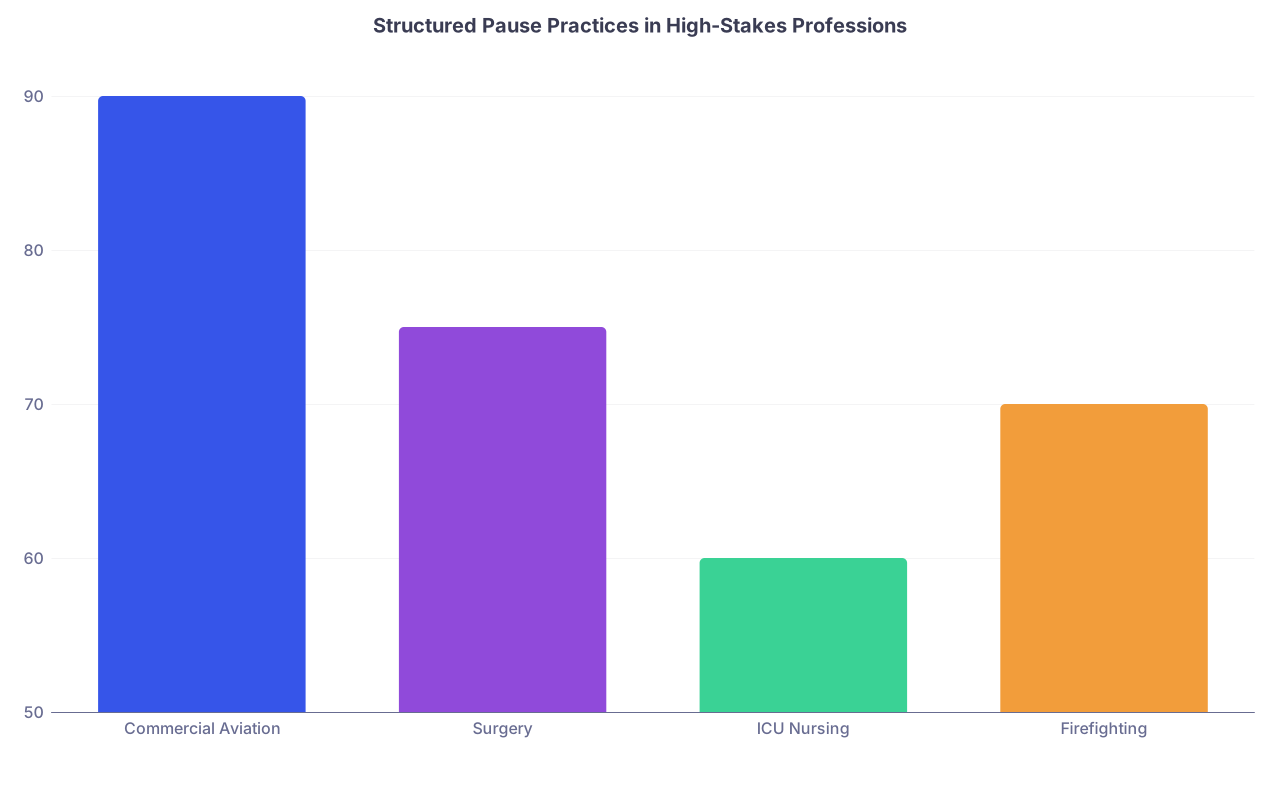
| Category | Value |
|---|---|
| Commercial Aviation | 90 |
| Surgery | 75 |
| ICU Nursing | 60 |
| Firefighting | 70 |
Roughly speaking (and yes, this is approximate), almost every high‑risk profession has:
- Built‑in structured pauses (checklists, time‑outs, huddles).
- Explicit permission to stop and think for a second.
- An understanding that rushing can kill.
Medicine says it knows this (surgical time‑outs, safety huddles), but the day‑to‑day culture still worships “go faster.” You’re not rebelling against safety when you take a breath. You’re aligning with how complex systems experts actually think about risk.
How to Start Without Freaking Yourself Out
Let’s make this so small that your anxiety can’t convincingly argue it’s dangerous.
Try this for the next shift:
- Pick one patient room per half‑day.
- Before you walk in, stop outside the door.
- Feel your feet in your shoes.
- One slow inhale, one slow exhale.
- Silently say: “One patient. One moment.”
Then go in as usual. No fanfare. No extended silent retreat in the supply closet. Just a 5–10 second pattern‑interrupt.
Do it again at the computer:
- Before you sign any order, notice your shoulders.
- Drop them.
- One slightly longer exhale.
- Then click.
Watch that version of you across a week vs the version that never stops.
You’re Allowed to Be Both Careful and Human
You’re scared that mindfulness will make you careless. That pausing means you’re not “all in.” That being anything less than constantly wired equals failing your patients.
The thing that probably needs to be said out loud:
You taking a 10‑second breath is not the weak link in modern healthcare.
Under‑staffing. Overbooking. Broken communication systems. EMR madness. Those are the things making patient care unsafe. You trying to be a slightly calmer, more present human inside of that chaos? That’s not the enemy.
You can still be obsessive about double‑checking meds, still hustle when things are crashing, still answer pages quickly. And also refuse to run your nervous system into the ground because you’re afraid pausing is immoral.
Today, don’t overhaul your life. Do this instead:
Before your next patient interaction—whether it’s on the floor, in clinic, or even simulated in your head—stop for one breath and ask yourself, “Am I actually here right now?” Then step in and see if anything feels even 1% different.


