Here's the mistake I keep watching residents make: they convert thousands to a Roth IRA because someone told them residency is the perfect "low tax bracket window," then their IDR payment triples and they're hemorrhaging money for 12 straight months. The advice was technically correct and financially catastrophic.
Don't do this. Not without reading every word below.
This article is for educational purposes only and is not financial advice, not legal advice, and not tax advice. Figures vary based on individual circumstances and tax law changes. Consult a qualified professional before making any conversion decisions.
The Hidden Danger: Why Roth Conversions During Residency Can Wreck Your Loan Repayment
You hear the pitch everywhere. "Convert while you're in a low bracket!" "Lock in tax-free growth now!" "Your residents are your cheapest years to pay the tax!"
For a detailed look at the broader transition, read about the big residency-to-attending tax trap no one warned you about.
None of these statements are wrong. They're just incomplete. And that incompleteness costs residents real money, often more than the supposed tax savings they were promised.
A Roth conversion adds taxable income to your return. That much is obvious. What's not obvious to most residents is how that added income ripples through the rest of their financial life. Specifically: it bumps your Adjusted Gross Income (AGI), and AGI is the single number that determines your income-driven repayment (IDR) payment under PAYE, REPAYE, and SAVE.
So you do a $10,000 conversion. Your tax bill goes up modestly. But your AGI jumps from $60,000 to $70,000, and suddenly your monthly student loan payment goes from $180 to $320. For the entire next 12 months. That's $1,680 in additional payments, plus whatever interest accrues because the SAVE interest subsidy no longer covers it.
The math doesn't lie. The math doesn't care about your bracket.
I've seen residents convince themselves they're being sophisticated by "tax planning" while their student loan servicer quietly locks in a payment tier that costs them thousands. Don't be that resident.
The Trap Explained: How AGI Inflation Hurts Your IDR Payments
Let's get into the mechanics, because this is where the trap snaps shut.
IDR plans calculate your payment as a percentage of your discretionary income, defined as AGI above 225% of the federal poverty line (for SAVE) or 150% (for PAYE/REPAYE, depending on plan specifics). The payment recalculates annually based on the AGI you report on your most recent tax return.
A Roth conversion shows up as ordinary income on your Form 1040. It doesn't matter that you didn't "earn" it in the traditional sense. To the IRS, and to your loan servicer, you earned it.
Here's the brutal sequence:
- You convert $15,000 from a Traditional IRA to a Roth IRA in February.
- Your tax return now shows $75,000 in AGI instead of $60,000.
- Your IDR plan recertification happens in November.
- The servicer uses your inflated AGI to calculate next year's payment.
- Your monthly payment locks in at the higher tier for 12 full months.
The chart above tells the story. Your income didn't change. Your lifestyle didn't change. But your payment jumped 78%. And this is for a single year of conversion activity.
The SAVE plan makes this worse. SAVE provides an interest subsidy when your calculated payment doesn't cover the accruing interest on your loans. Push your AGI high enough, and your payment covers the interest, but barely. Push it a little further, and you've lost the subsidy. Now interest compounds against you at 7-8%.
You may also want to read about common retirement contribution errors that waste physician tax space.
That's the trap. A move designed to save on taxes actively costs you more in interest than you ever saved in tax.
Common Scenarios Where Residents Get Burned
Pattern recognition matters. Here are the three situations I see most often:
Scenario 1: The Pre-Residency Rollover
You graduated medical school with $8,000 in a 401(k) from a gap-year job. You roll it into a Traditional IRA. Now someone tells you to convert it during residency because "the money isn't doing anything." So you do. And your AGI spikes. And your payment triples. All for an account that was generating maybe $400 in annual tax-deferred growth.
Scenario 2: The Married Filing Jointly Minefield
You're married. Your spouse works and makes $50,000. Together you make $110,000. You convert $10,000 thinking you're being smart. Your combined AGI is now $120,000, and your joint IDR payment, because spousal income is fully counted on SAVE when filing jointly, skyrockets. Meanwhile, you can't file separately without triggering other tax penalties that may exceed the conversion savings.
Scenario 3: The Death by a Thousand Cuts
You do four small conversions of $3,000 each throughout the year, thinking each one is "small enough to matter." But the IRS totals them up. Your AGI reflects $12,000 in additional income. You've blown past a payment threshold that you would have noticed if you'd done one $12,000 conversion, but missed because each individual event felt harmless.

Each scenario has a common thread: the resident wasn't modeling the loan payment impact. They were only modeling the tax impact. That's not enough.
The Forgotten Interaction: PSLF Eligibility and the Roth Conversion
Here's where it gets even more nuanced, and where I see residents panic unnecessarily.
Public Service Loan Forgiveness (PSLF) forgives your remaining federal student loan balance after 120 qualifying payments while working for a qualifying employer. The payments themselves still happen at whatever your IDR-calculation produces. A year with inflated AGI doesn't disqualify you from PSLF, the payments still count toward your 120.
But here's what residents miss: higher payments over the life of the loan reduce the amount eventually forgiven. If you stay in PSLF, that's not really your money, you were going to be forgiven anyway. So in a weird way, inflated payments during PSLF years are "less bad" than I sometimes suggest.
But, and this is critical, you might not stay in PSLF. You might switch to private practice. You might refinance. You might take a non-qualifying job for two years. And then those inflated payments you made? Real money. Gone. Not forgiven.
The other PSLF trap is timing. If you convert right before your IDR recertification, that inflated AGI gets locked in for 12 months. There's no mid-year correction. No appeal. You're stuck.
The flowchart shows the decision point. Most residents don't know which branch they'll be on 5 years from now. So you have to plan for both.
How to Avoid the Trap: A Safe Conversion Strategy for Residents
Now the part that actually helps.
Rule 1: Never convert until you've modeled the IDR impact.
I'm serious. Never. Run your numbers through the Federal Student Aid Loan Simulator. Plug in your current AGI. Add the conversion amount. See what your payment becomes. Then decide.
Rule 2: Identify "naturally low" income years.
A late-starting residency (July start) means your first calendar year has only six months of salary. That's a real, organic low-income window. You can convert in that year with less AGI damage. Similarly, gap years between fellowship and attending job can be low-income periods worth using.
Rule 3: Wait until after IDR-sensitive years end.
If you're pursuing PSLF and plan to finish it, your payments stop mattering after 120 months. You can convert aggressively afterward. Same if you refinance into a fixed-rate private loan, the payment becomes fixed and no longer AGI-sensitive.
Rule 4: Cap conversions to stay below payment thresholds.
If your AGI is $65,000 and the next SAVE payment tier kicks in at $72,000, you have $7,000 of "headroom." Convert $6,500. Leave a cushion. Don't round up.

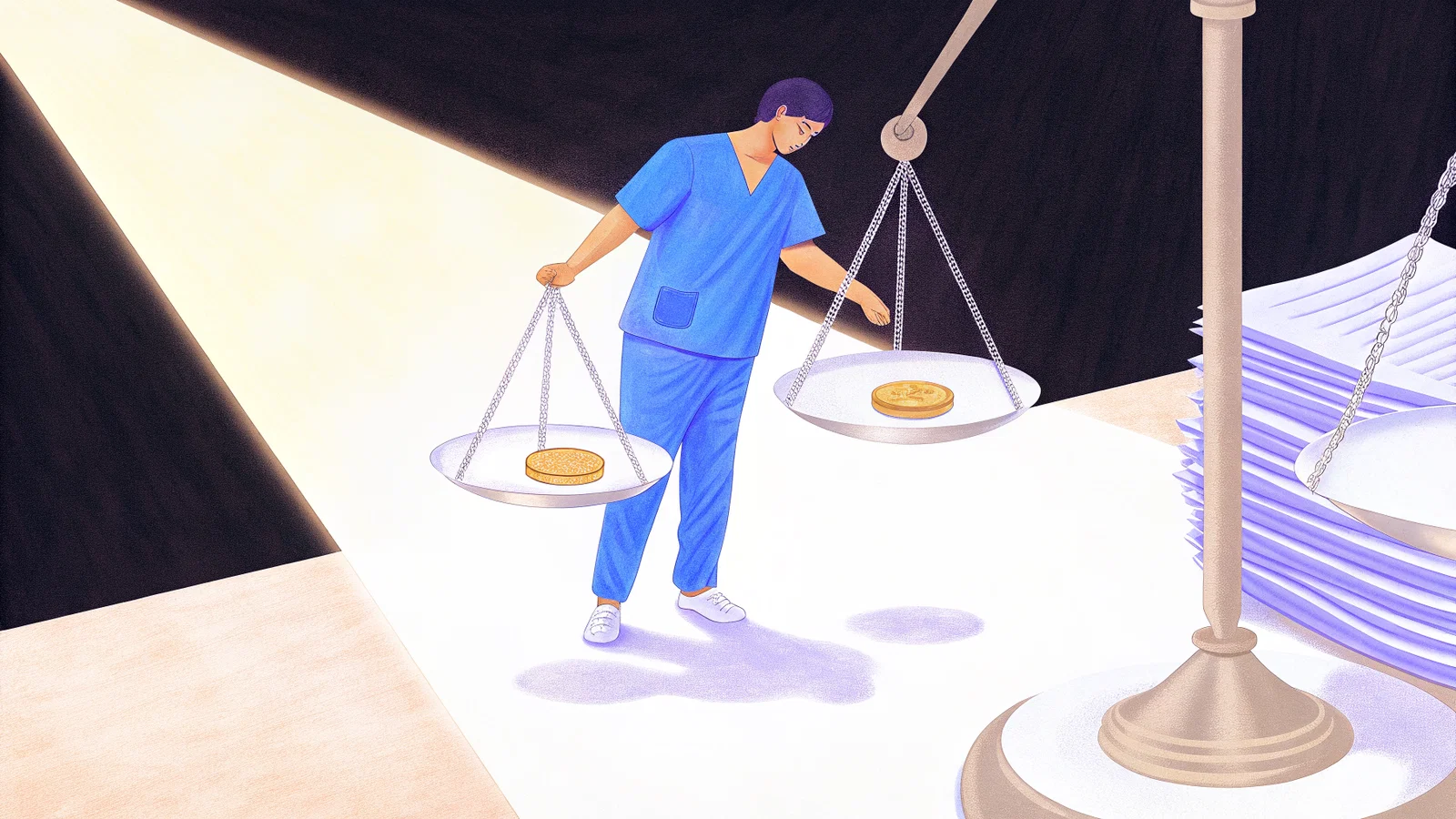
The image above is the goal. Perfectly balanced. The math has to work before you move money.
Your Action Steps: A Checklist Before Converting a Single Dollar
Run through this list before you sign anything. Print it out. Tape it to your laptop.
- Calculate your current AGI using the Federal Student Aid Loan Simulator or your most recent tax return.
- Project your post-conversion AGI. Add the conversion amount to your expected income. Include spousal income if filing jointly.
- Run the numbers for your specific IDR plan. SAVE, PAYE, and REPAYE all calculate differently. Know which one you're on.
- Compare tax savings vs. extra loan payments. A $15,000 conversion might save you $2,400 in taxes over 5 years of growth. But if it costs you $1,800 in extra loan payments for one year, you're losing money in real time.
- Decide based on the full picture. If the math doesn't work, skip the conversion. Limit it to an amount that keeps you comfortably below the next payment threshold.
This chart shows why so few conversions make sense during residency. The negative territory extends well beyond what most "convert now!" advice suggests.