
Doctors are not being “hunted” by the IRS. High‑income people with sloppy returns are.
That is the actual story once you strip away the fear‑based marketing from some “physician tax specialists” and look at the data. The white coat is not a red flag. Your income level, entity type, and how aggressive your return is—those are the flags.
Let me walk through what the IRS actually publishes, what’s changed over the last decade, and where physicians really sit in the audit risk pile.
Where the “Doctors Get Audited More” Myth Comes From
The myth has three roots:
- Doctors often have high W‑2 income.
- Many also have side practices, 1099 locums work, or partnerships.
- Accountants and financial marketers love fear because fear sells “specialized” services.
Put that together and you get the story you’ve heard at conferences or on podcasts: “The IRS targets physicians; you need a doctor‑only tax firm or you’ll get audited.”
Here’s the problem: the IRS does not publish “audit rate by occupation.” There is no official “physician audit” statistic. What they publish are audit rates by income and by return type (individual, small business, large corporation, etc.).
When you overlay where physicians tend to fall on those curves, the picture changes. You are not a special target. You’re just more likely than the average American to be in the income brackets that get more scrutiny.
What IRS Data Actually Shows About Audit Rates
Let’s talk numbers, not stories.
The IRS releases an annual Data Book and occasional deeper reports that show how many returns they audit out of each income band. They’ve also publicly admitted something important in the last few years: budget cuts gutted audit capacity for everyone except the very poor (thanks to cheap automated audits) and the very rich (strategic focus).
So where do high‑earning W‑2 professionals like doctors sit?
Broad strokes, based on the most recent sets of IRS enforcement data (exact percentages shift slightly year to year, but the pattern is very consistent):
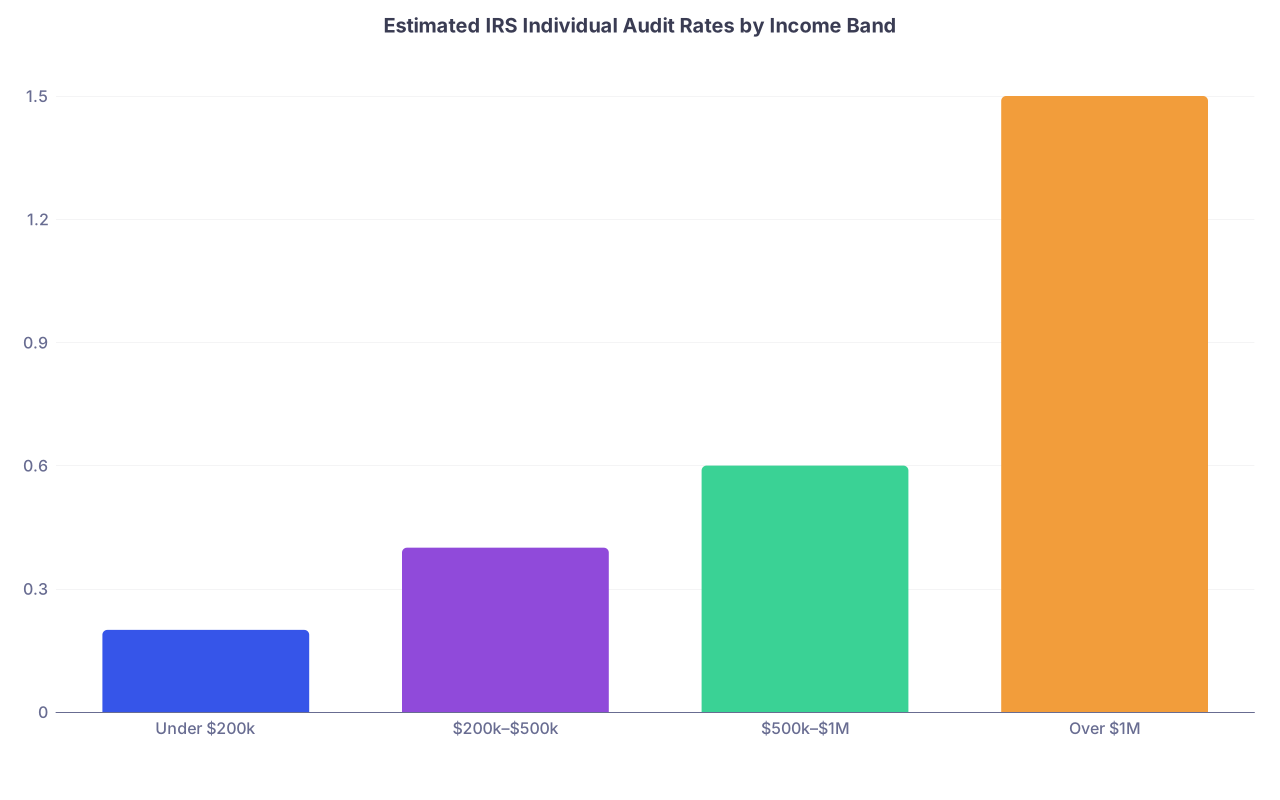
| Category | Value |
|---|---|
| Under $200k | 0.2 |
| $200k–$500k | 0.4 |
| $500k–$1M | 0.6 |
| Over $1M | 1.5 |
Those percentages are approximate but directionally right and consistent with recent IRS Data Books and Treasury analyses:
- Under $200k: extremely low audit rate, around 0.2% or less
- $200k–$500k: somewhat higher, around 0.3–0.5%
- $500k–$1M: higher still, roughly 0.5–0.7%
- Over $1M: jumps meaningfully, roughly 1–2% and climbing with new funding
So yes, the audit rate rises as income rises. But two things matter here:
First, even “higher” is still a small number. If you make $400k, your odds in a given year are something in the neighborhood of 1 in 200–300. Not 1 in 5.
Second, those are all high earners, not doctors specifically. Venture capitalists, BigLaw partners, tech executives, hedge fund managers—they’re all in the same bucket.
You’re not more likely to be audited because you write prescriptions. You’re more likely to be audited because you make several times the median U.S. income.
The Real Risk Factor: Type of Income, Not the White Coat
This is where physicians do start to look “riskier” than a typical W‑2 engineer or teacher: the complexity of your tax return.
A pediatrician making $230k as pure W‑2, no side jobs, no rental properties, standard 401(k), standard backdoor Roth properly documented? Very low audit risk.
An orthopedist making $600k W‑2 plus $200k from a 1099 locums side gig, with a new S corp, several K‑1s from surgery center ownership, and large “consulting” deductions? Higher risk. But again, that’s because the return is complex, not because CMS pays you.
The IRS has been very clear—both in public statements and by how they allocate their scarce enforcement resources—that they focus on:
- Self‑employment income with large deductions
- Pass‑through entities (partnerships, S corps)
- High‑income returns with lots of schedules: Schedule C, E, K‑1s, etc.
Sound familiar for a lot of mid‑career docs?
Locums, telemedicine side hustles, medical‑legal consulting, private practice with multiple entities—these are all normal in medicine now. Each extra schedule and entity is an extra place for the IRS’s data‑matching algorithms to find discrepancies.
Again: this is not physician‑specific. It is “any high‑income professional with side businesses and pass‑throughs.”
How Physicians Typically Compare to the Average Taxpayer
Let’s be concrete. Think about three simplified profiles:
| Profile | Income Type | Relative Audit Risk |
|---|---|---|
| Staff pediatrician, $230k | Single W‑2, standard deductions | Low |
| Hospitalist, $350k + $80k locums | W‑2 + 1099 Schedule C, some business expenses | Moderate |
| Private practice surgeon, $700k + ASC K‑1 | W‑2/guarantee, S corp, partnership K‑1, large deductions | Higher |
None of these are guaranteed audits. Not even close. But if you ask who the IRS is more likely to look at:
The complex, multi‑entity, high‑income return gets more attention than the simple W‑2 return. Every time.
In practice, I’ve seen:
- Young hospitalists freak out over “audit risk” when their return is one W‑2, one 1098‑E for student loan interest, and a 1099 from a brokerage account. The IRS has zero incentive to waste time on them.
- Multi‑entity private practice groups where partners are running cars, home offices, and borderline “consulting” out of the business, then shocked when they get a correspondence audit asking for substantiation. The income and structure, not the MD credential, drew the spotlight.
What Has Changed With IRS Funding (and What Hasn’t)
You’ve probably seen headlines about the IRS getting billions in new funding and “87,000 new agents coming for you.” Most of that discourse is nonsense, but some of it matters for you.
Here’s the short version:
- The IRS has publicly committed to not increasing audit rates for households under $400k from historical levels. Whether you trust that promise is your call, but it’s been stated repeatedly by Treasury and IRS leadership.
- They have said outright they intend to increase audits on returns over $1M and on complex business structures.
- They are spending heavily on data analytics and technology to better detect under‑reporting and abusive schemes.
So if you are a primary care doc making $220k with one W‑2? You’re not the focus.
If you are a subspecialist pulling $900k+ with multiple partnerships and aggressive planning structures pushed by a glossy “physician tax strategy” sales deck? You are closer to the zone they explicitly care about.
Here’s the nuance: the IRS does not want to audit everyone who makes $1M. They cannot. Even with more funding, they don’t have remotely enough bodies. But they absolutely want to raise the audit intensity on that group relative to the last decade of austerity.
Physician‑Specific Red Flags That Do Matter
The myth is “doctors are targeted.” That’s wrong. But physicians do fall into certain patterns the IRS does look at more closely, because they’re common failure points.
These are not illegal, but they’re abused often enough that they attract attention:
Schedule C “doctor side hustle” with big losses
A part‑time consulting gig that always loses money while you deduct a vehicle, large home‑office, expensive gadgets, and lots of “meals and travel”? The hobby‑loss rules exist for a reason. Repeated losses against high W‑2 income get scrutinized.Misused S‑corps for locums / 1099 income
S‑corps are fine. Underpaying yourself on W‑2 wages to dodge payroll taxes, while draining everything else as distributions, is not. The IRS has hammered this in court. Doctors get sold this gimmick a lot.Large “business” use of personal vehicles
The classic: “My accountant told me I can deduct 80% of my SUV because I drive to the hospital.” Commuting is not deductible. If your mileage logs are fictional, you are exposed.Questionable “medical management” or “consulting” entities
Some schemes create multiple shells—“IP holding company,” “management company,” etc.—with income intentionally shuffled to lower‑tax buckets without real business substance. The IRS has gotten more aggressive about substance over form.Poor documentation for CME, conferences, and travel
A legitimate CME conference in another state is fine. Turning it into a family vacation and expensing most of the trip under “education” without careful documentation is where it falls apart.
These are about behavior, not your job title. Engineers, attorneys, dentists, and consultants do the same things and get the same problems.
What an Audit Actually Looks Like for Most Physicians
Another part of the myth: people imagine agents showing up at the clinic, grilling you in a back room, combing through every Starbucks receipt.
That’s rare. For high‑income W‑2 professionals, most “audits” are:
- Correspondence audits – A letter from the IRS asking you to verify something: 1099 income, charitable deductions, the basis of a Schedule C deduction. You respond by mail or electronically with documents. Annoying, but manageable.
- Office audits – Less common, usually when there’s a bigger mismatch or pattern. You or your CPA meet with an IRS agent (in person or via phone/zoom) with your records.
Field audits, where agents come to your office, are usually reserved for larger businesses or clear signs of substantive non‑compliance.
The reason I’m spelling this out is simple: a lot of physicians make worse decisions because they’re terrified of an audit that’s wildly unlikely and, even if it happens, usually boring and document‑driven.
They avoid obviously legitimate deductions (“I’m scared to deduct my CME, what if it triggers an audit?”) but then accept some exotic captive insurance scheme shoved at them by a salesperson because it’s packaged as “bulletproof” and “physician‑specific.”
You want the opposite mindset: calm about reasonable, documented deductions; deeply skeptical of anything marketed as secret or special.
How to Actually Minimize Audit Risk Without Paranoia
You cannot drive your audit odds to zero. The IRS chooses some returns at random, and complex taxpayers naturally have a baseline risk. But you can stay out of the obvious danger zones.
Here’s the short list that actually matters for a physician:
- Keep your information reporting clean. Your W‑2s, 1099s, K‑1s, brokerage forms—those all get matched to your SSN. If the IRS sees mismatches or missing income, the computer spits out notices.
- Don’t run fake businesses. If your “consulting” or “coaching” never shows a profit and exists primarily as a write‑off machine, either fix it or stop calling it a business.
- Use reasonable numbers. Home office, vehicle, meals, and travel are not evil. They’re just abused. If your physician S‑corp shows a $40k salary and $260k of “distributions,” or if you claim 90% business use of a luxury SUV, you’re begging for questions.
- Work with a competent, not flashy, CPA. You do not need a “doctor‑only” specialist. You need someone comfortable with high‑income professionals, S‑corps and partnerships, and who is willing to tell you “no” when your idea is dumb.
- Document as if you’d be asked next year. Because you might. Mileage logs, receipts for larger business expenses, clear files for CME, licensure, board fees. Not a binder for everything, but proof for anything meaningful.
None of this is exotic. It’s boring, which is exactly the point. Boring returns with clean documentation are not the ones that get agents excited.
The Marketing Machine Around “Physician Audit Risk”
One last uncomfortable truth. A lot of the “doctors are under IRS attack” messaging isn’t coming from the IRS. It’s coming from people trying to sell you:
- High‑fee “doctor‑exclusive” tax prep
- Complex entity structures with big ongoing fees
- Aggressive schemes like micro‑captives, “income relocation” entities, abusive conservation easements, or offshore setups they barely understand themselves
Fear is the grease that makes those sales calls go down easier.
I’ve sat in on those “free dinner” talks targeted at physicians. The pattern is always the same:
- Start with a scary slide: “Doctors audited at X times the rate of average Americans!” (with a footnote that actually references income, not occupation)
- Show a few cherry‑picked IRS cases of doctors who got hammered (usually for outright fraud).
- Promise a magic bullet structure that “big corporations use” but “most CPAs don’t know about.”
You are not a naive intern anymore. Treat this like you’d treat a drug rep pushing a brand‑name pill that’s barely better than generic.
Ask for actual citations. Ask how the scheme is disclosed. Ask where the idea sits on IRS “dirty dozen” or “listed transaction” warnings. If the pitch leans heavily on fear of audits instead of clearly explaining real tax law, walk.
The Bottom Line
Three things you should remember:
- Doctors are not uniquely targeted by the IRS; high income and complex returns are. You happen to fall into that group more often than the average person.
- Your real audit risk drivers are income level, business structures, and how aggressive your deductions are—not your specialty or the MD after your name.
- You do not need to be scared of legitimate planning. You need to be wary of marketing that weaponizes “audit fear” to sell you complexity you do not understand and probably do not need.