

The blanket advice that “every physician should be an S‑Corp” is lazy, often wrong, and sometimes expensive.
I’ve watched countless doctors get shoved into S‑corps by accountants who use the same template for a radiologist with $900k of 1099 income and a pediatrician making $210k employed by a hospital “with a side LLC.” One of those might benefit. The other is probably lighting money on fire.
Let’s dismantle this myth properly.
What An S‑Corp Actually Does (And Does Not Do)
Start with the core misconception: “S‑corp saves tons of taxes.” In reality, it does one specific thing:
It can reduce self‑employment / payroll taxes by splitting your income into:
- “Reasonable salary” (subject to payroll taxes)
- “Distributions” (not subject to Social Security and Medicare taxes)
That’s it. No magic 37% tax reduction. No automatic write‑off bonanza. No special doctor loophole.
LLCs, sole proprietorships, S‑corps, and partnerships all:
- Deduct the same business expenses (CME, staff, rent, malpractice, equipment, etc.)
- Pay income tax at the same federal rates on net profit
The S‑corp difference is purely how that profit is categorized for payroll tax purposes.
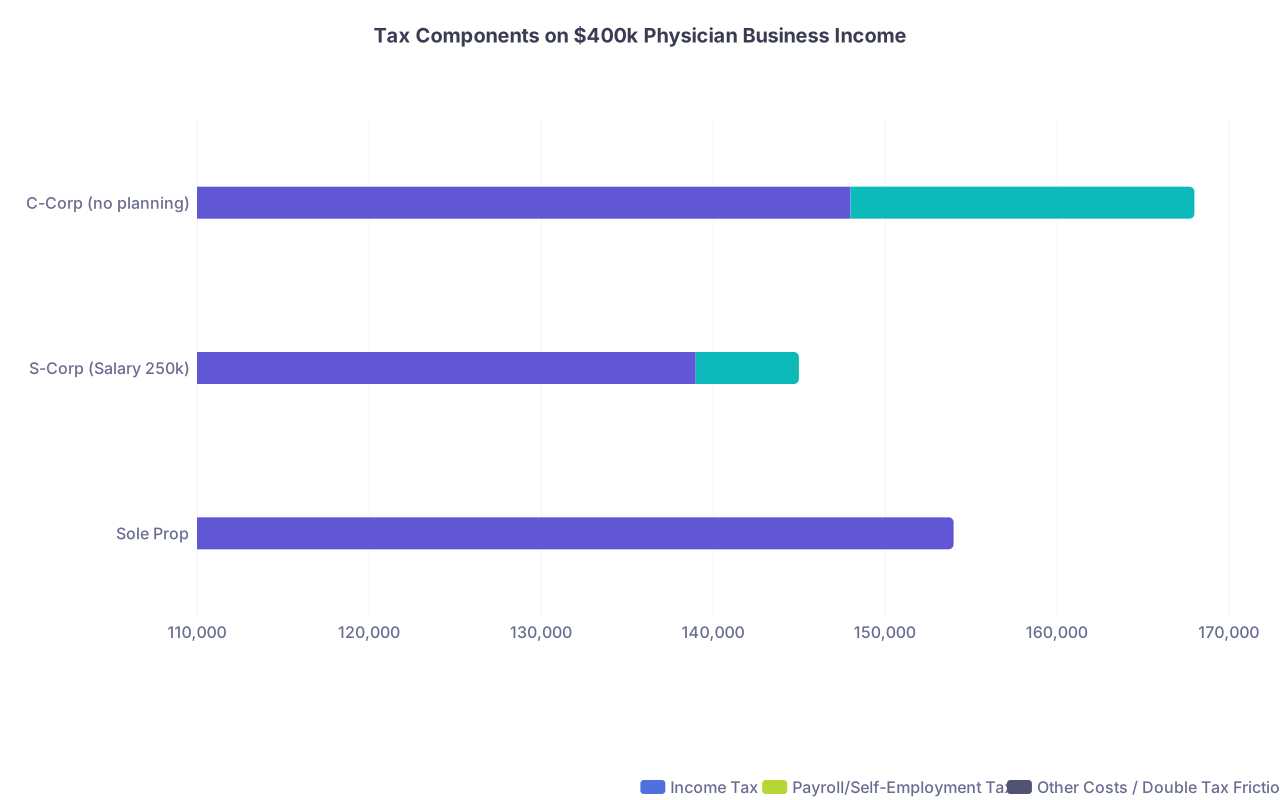
| Category | Income Tax | Payroll/Self-Employment Tax | Other Costs / Double Tax Friction |
|---|---|---|---|
| Sole Prop | 110000 | 44000 | 0 |
| S-Corp (Salary 250k) | 110000 | 29000 | 6000 |
| C-Corp (no planning) | 110000 | 38000 | 20000 |
Are those payroll tax savings real? Yes—if you structure it correctly and if your income level and state rules cooperate.
But you pay for that flexibility with:
- Complexity (payroll, corporate formalities, separate tax returns)
- Risk (IRS scrutiny on “reasonable compensation”)
- Loss of some benefits (e.g., sometimes reduced QBI deduction, state tax quirks)
The universal S‑corp pitch completely ignores this tradeoff.
Situations Where S‑Corps Backfire For Physicians
I’ll be blunt: there are plenty of doctors who should not be an S‑corp. Let’s walk through the most common “this was a mistake” scenarios I’ve actually seen.
1. The Low‑to‑Moderate Income Independent Contractor
Example: Hospitalist in a mid‑cost state, 1099 income of $230k, minimal business expenses.
An aggressive CPA sets them up as an S‑corp, pays them a $160k salary and takes $70k as distributions.
Estimated Medicare tax savings (ignoring the Social Security cap): roughly 2.9% of $70k = about $2k, maybe a bit more when you include the 0.9% additional Medicare tax depending on thresholds.
What do they now have to deal with?
- Separate corporate tax return (Form 1120‑S)
- Payroll processing, W‑2 filings, state unemployment, workers’ comp nuances
- Higher CPA fees (I routinely see $1,500–$3,000 / year just for the entity + payroll support)
- Time, admin, and the very real risk of screwing up payroll or state filings
I’ve seen situations where the doctor saved maybe $2,500 in payroll taxes and spent $3,000+ in extra professional fees and hidden admin costs. That’s not “tax planning.” That’s just moving money from you to your accountant and payroll provider.
For 1099 physician income under roughly the mid‑200s—and especially if you’re in a state with high entity and payroll friction—the S‑corp often isn’t worth the hassle.
2. The Full‑Time W‑2 Physician With a Small Side Gig
Classic story:
- You’re a W‑2 cardiologist making $450k at a hospital
- You do $30k–$60k of consulting, expert witness work, telemed, or moonlighting on a 1099
- Someone tells you, “Incorporate as an S‑corp, you’ll save so much self‑employment tax”
Reality:
- Social Security tax is already maxed out from your W‑2
- Only Medicare and the 0.9% additional Medicare are even relevant
- On $40k of side‑gig profit, maybe you can save a thousand bucks max in Medicare taxes, usually less after you pay yourself a small salary
Then you layer:
- Annual state LLC/corp fees
- S‑corp return prep
- Bookkeeping + payroll
Net effect? The S‑corp often becomes a rounding error at best, a net loss at worst.
For small side income, a single‑member LLC taxed as a sole proprietorship is frequently cleaner, cheaper, and “good enough.”
Where The S‑Corp Can Shine For Physicians
Now, I’m not anti–S‑corp. I’m anti–“everyone should be an S‑corp.” Those are different things.
When the stars line up, S‑corps can meaningfully improve after‑tax income and reduce exposure to certain taxes.
Here’s where they tend to make sense.
1. High 1099 Clinical Income, No W‑2, Clean Setup
Think: Anesthesiologist with $600k of 1099 compensation from a group, works via their own entity, minimal employed W‑2 income elsewhere.
You might reasonably set:
- Salary at $250k–$300k (must be defensible as “reasonable” for the work performed)
- Remaining $300k–$350k as distributions
On that $300k+ of distributions, you’re not paying the 2.9% Medicare tax or the additional 0.9% on high earners. That’s several thousand dollars—every year.
If:
- Your CPA fees are controlled
- Your payroll is handled efficiently
- Your state isn’t abusive with corporate taxes
Then an S‑corp can easily be a 5‑figure annual win.
| Scenario | 1099 Income Level | S-Corp Often Worth It? |
|---|---|---|
| Side gig only (consulting, small) | <$75k | Usually no |
| Mixed W-2 and 1099 (~50/50) | $200k–$400k total | Case-specific |
| Full 1099, high income specialist | >$300k 1099 | Often yes |
| W-2 only (no 1099) | Any | No (no role) |
I’ve seen interventional radiologists, anesthesiologists, EM docs, and high‑end locums physicians gain real value here—once you factor in all the moving parts.
2. Multi‑Physician Group Wanting Flexibility
Another place S‑corps can work: multi‑owner groups that want:
- Different pay structures
- Some control over retirement plan design
- The ability to run fringe benefits and accountable plans cleanly
In some setups, having individual physicians own their own S‑corps that contract with a central entity can give tax and liability advantages—if designed well and coordinated with ERISA/retirement plan rules.
I’ve also seen this done badly, with haphazard comp, QBI deduction lost due to bad aggregation, and partners getting different treatment in ways that blow up under scrutiny.
The point: S‑corps can be a powerful tool. But tools work when competent people use them, not because you “checked the S‑corp box” on LegalZoom.
The “Reasonable Compensation” Trap
This is the part most generic S‑corp cheerleaders conveniently forget when pitching doctors.
The IRS expects S‑corp shareholder‑employees to take “reasonable compensation” before taking distributions. If you lowball your salary—on purpose—to avoid payroll tax, you’re exactly the kind of case that gets flagged.
I’ve heard the terrible advice:
- “Just pay yourself $60k, the rest as distributions”
- “You’re an owner; IRS doesn’t really check”
- “If you get audited, we’ll just say it was a bonus”
If you’re making $500k as a practicing orthopedic surgeon and paying yourself a $90k W‑2 salary out of your S‑corp, good luck explaining that.
Reasonable comp for physicians is not guesswork. The IRS and litigators look at:
- Specialty and geographic market data
- MGMA and similar benchmarks
- Hours worked, responsibilities, RVUs, call burden
- Comparable employed docs in your hospital or group
If you earn $500k of clinical income, a salary of $250k–$350k is usually defensible, depending on specialty. A salary of $80k is not.
Undervaluing your comp too aggressively:
- Destroys your audit defensibility
- Increases penalties and back taxes if you get caught
- Can undermine other areas (retirement contributions, disability insurance calculations, etc.)
You do not run an S‑corp correctly by “making your salary as low as possible.” You run it correctly by making your salary defensible and knowing the tax savings will be meaningful but not magical.
The QBI (Section 199A) Curveball For Doctors
Here’s another place the S‑corp myth gets messy: the 20% Qualified Business Income (QBI) deduction.
Physicians are in a “specified service trade or business” (SSTB). Translation: the QBI 20% deduction:
- Phases out for high‑income physicians
- Depends on taxable income thresholds, not just business structure
- Plays differently with S‑corp vs sole prop based on what you call “wages”
I’ve seen advisors move physicians into S‑corps and accidentally reduce their QBI benefit because they jacked up “wages” and lowered QBI, sometimes for small or illusory payroll tax savings.
Reality check: QBI for physicians is a high‑income puzzle. Whether you use an S‑corp, partnership, or sole prop can affect the numbers—but not always in the way TikTok CPAs claim.
You need someone who will:
- Run projections both ways
- Show you QBI impact with and without S‑corp
- Consider your spouse’s income, deductions, retirement contributions, and filing status
If your advisor can’t show you this in a spreadsheet, they’re guessing.
State Taxes, Fees, and Legal Risks
Another quiet problem: state‑level headaches.
Some states:
- Impose minimum franchise taxes on corporations (including S‑corps)
- Require separate state S‑elections
- Don’t recognize S‑corp status at all
- Have high annual report and entity fees
On top of that, a corporate entity:
- Must maintain corporate formalities (minutes, separate accounts, no commingling)
- Adds legal complexity in malpractice and contract scenarios
- Interacts with your malpractice coverage in specific ways (are you covered personally, via the entity, both?)
If you’re saving $2k–$3k on payroll taxes and paying:
- $800 California franchise tax
- Extra $1,000+ in professional fees
- And adding legal friction in exchange
That’s a bad trade.
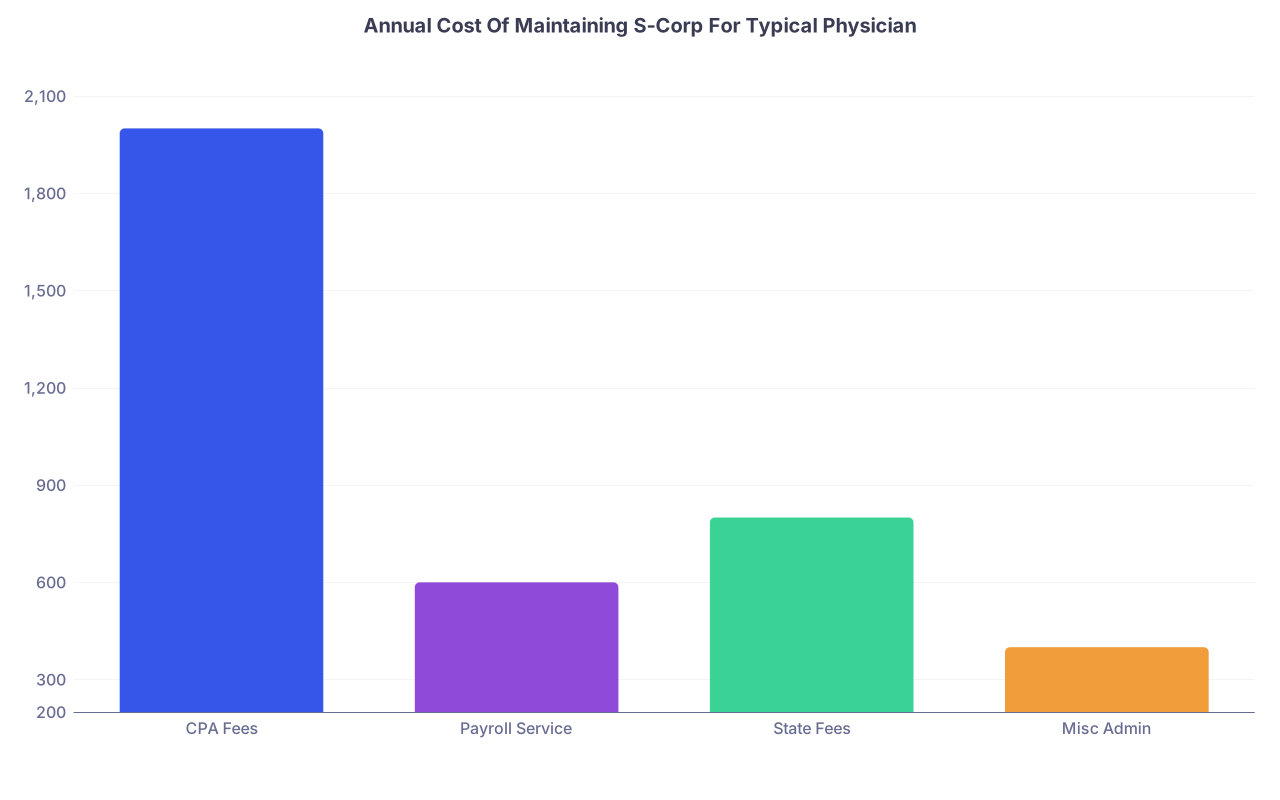
| Category | Value |
|---|---|
| CPA Fees | 2000 |
| Payroll Service | 600 |
| State Fees | 800 |
| Misc Admin | 400 |
You don’t judge the S‑corp alone by its tax rate. You judge the net effect after all the real‑world frictions.
Why So Many Accountants Push S‑Corps At Physicians
Let’s be candid.
Why do so many physicians end up in unnecessary or poorly designed S‑corp structures?
Three reasons I see all the time:
Cookie‑cutter practice models.
Some CPA firms build their entire physician offering on “turn everyone into an S‑corp and charge for it.” It’s simple to sell and looks impressive.Misaligned incentives.
S‑corps mean more:- Entity formation revenue
- Extra tax returns
- Year‑round payroll and compliance work
That’s recurring billable work, not a one‑time consult.
Outdated mental models.
A lot of older guidance was built pre‑QBI, pre‑ACA taxes, pre‑current state rules. They’re still running the old “S‑corp always good; C‑corp always bad” script without doing fresh math.
Good advisors don’t have one favorite entity. They have a process:
- Understand your income mix (W‑2 vs 1099, spouse, other businesses)
- Map state‑level rules
- Run side‑by‑side projections (sole prop vs S‑corp vs partnership, occasionally C‑corp)
- Compare tax and cost and complexity
If you don’t see numbers, you’re not getting planning. You’re getting a sales pitch.
A Simple Decision Framework (Not A Rule)
Let me give you a mental model. Not legal or tax advice—just how I’d think as a skeptical physician.
S‑corp is more likely to make sense if:
- You have ≥ ~$250k–$300k of 1099 income from physician services
- You’re not already maxing out Social Security with a high W‑2
- Your state isn’t brutal on corporations
- You’re willing to respect corporate formalities and keep real books
- You have (or can get) a competent CPA who actually understands physician compensation and QBI
S‑corp is more likely to be a distraction if:
- Your 1099 income is < $150k, especially as a side gig
- Most of your compensation is already W‑2 from an employer
- You live in a high‑friction state (e.g., big franchise fees)
- You do not want the complexity and ongoing overhead
- Your only explanation from your accountant was “trust me, everyone does it”
If you’re already in an S‑corp and suspect it’s not helping, ask for:
- A comparison return as if you were a sole proprietor / LLC
- A clear, written calculation: “Here’s your actual annual tax savings from S‑corp after fees”
If that number is tiny or negative, you have your answer.

| Step | Description |
|---|---|
| Step 1 | Physician income |
| Step 2 | W-2 only - No S-corp |
| Step 3 | Likely stay sole prop/LLC |
| Step 4 | Run detailed comparison |
| Step 5 | Model S-corp vs sole prop |
| Step 6 | Consider S-corp with solid CPA |
| Step 7 | Mostly 1099? |
| Step 8 | 1099 > 250k? |
| Step 9 | High-fee or complex state? |
| Step 10 | Net savings after fees? |
FAQ (Exactly 3 Questions)
1. I’m already an S‑corp. Should I undo it?
Not automatically. First, get your CPA (or a new one) to run a side‑by‑side comparison: your last year’s return as an S‑corp vs as a sole proprietorship/LLC. Include:
- Payroll/self‑employment taxes
- Extra CPA fees
- State franchise/entity costs
- Payroll service costs
If the net tax savings are small or negative, then you talk about whether transitioning back makes sense. But decide based on numbers, not vibes.
2. Can I be W‑2 for my main job and 1099 via my S‑corp for the same employer?
Usually no, and when it’s done, it’s often wrong. The IRS is very skeptical when an employee suddenly becomes a “contractor” through their own entity while doing essentially the same job. You can have W‑2 income from one entity (e.g., hospital) and 1099 income from a genuinely separate business (consulting, expert witness, etc.), but trying to “turn your W‑2 job into a 1099 S‑corp” is a red flag both for employment law and tax. If your group is pushing that without solid legal and tax backing, be cautious.
3. Is a C‑corp ever better than an S‑corp for physicians?
Sometimes, but it’s rare and nuanced. C‑corps have:
- Lower entity‑level tax rates
- But double taxation on distributions
- Different rules for retained earnings and benefits
They can make sense if you’re building a multi‑physician business, planning to retain and reinvest profits, or designing very specific benefit structures. For a typical independent contractor doc taking most of the profit out each year, an S‑corp or pass‑through setup usually wins. Again: you decide this only after running actual numbers, not because “C‑corps are bad” or “S‑corps are always better.”
Key takeaways:
- “All physicians should be S‑corps” is lazy advice; entity choice should be driven by real math on your specific income, state, and goals.
- S‑corps can save meaningful payroll tax for high 1099 earners, but the savings often vanish—or turn negative—once you include fees, complexity, and state costs.
- If your advisor can’t show you a clear, quantitative comparison of S‑corp vs alternatives, you’re not getting tax planning; you’re being sold a structure.


