

You are 10–15 years into practice, making good money, and your tax bill is still punching you in the face every April.
You scroll your prior returns and see the same pattern: big W‑2 income, maybe some 1099 income on the side, a small 401(k) contribution, no defined benefit plan, no real use of HSAs or backdoor Roths. You have a seven‑figure income and a four‑figure tax strategy.
You are not alone. I see this constantly with physicians in their 40s and early 50s. High income. Weak structure. Years of missed deductions and growth. The good news: you can fix a lot of it. Not all of it. But enough to materially change your after‑tax wealth over the next decade.
This is about using retirement accounts intentionally to patch the damage from years of poor tax planning.
Let’s get specific.
Step 1: Diagnose the Damage (Last 3–5 Years)
Do not start by opening a new account. Start by figuring out what you left on the table and what can still be salvaged. You need a quick forensic review.
Pull your last 3–5 years of:
- 1040s
- W‑2s
- 1099s
- Schedule C (if applicable)
- Business returns (1120S, 1065) if you own any practice/entity
- Retirement plan statements
Now answer, in writing, for each year:
What retirement plans existed?
- Employer 401(k)/403(b)?
- 457(b)?
- Separate solo 401(k) or SEP for side 1099 income?
- Defined benefit/cash balance plan?
- HSA?
What were your contributions vs. allowed limits?
For a recent year (2024 numbers as reference; older years will be similar but not identical):- Employee 401(k)/403(b) deferral: up to $23,000 (<50), $30,500 (50+).
- Employer + employee total to 401(k)/profit‑sharing/solo 401(k): $69,000 (<50), $76,500 (50+).
- SEP‑IRA: up to 20–25% of net self‑employment income (depending on calculation) up to that same $69,000 cap.
- HSA: $4,150 individual / $8,300 family, plus $1,000 catch‑up at 55+.
Did your employer have a match that you missed? I still see $400k‑income physicians not even hitting the full match. That is just lighting money on fire.
Did you ever do a backdoor Roth IRA?
Or was it “I heard about that once at grand rounds” and then nothing.
You do not need to build a perfect spreadsheet going back 15 years. Just:
- What could you have contributed?
- What did you actually contribute?
- What accounts were not used at all?
From this, define your “tax planning gap” in two numbers:
- Annual contribution gap (e.g., “I could have put ~$80k/year pre‑tax across various plans and only did $19,500.”)
- Years with no/low planning (e.g., “10 years underused, last 3 were the worst.”)
That tells you how aggressive you need to be now.
Step 2: Stop the Bleeding This Year
Before talking about retroactive fixes, plug the current leak. Otherwise you are bailing water out of a sinking boat.
Here is the order of operations for most physicians:
Max your current employer retirement plan(s)
- Hit the full employee deferral. Every year. No excuses.
- If you are 50+, turn on catch‑up contributions.
- Make sure your payroll elections actually get you to the limit (people underestimate how often HR screws this up).
If you have 1099 income, set up a solo 401(k) immediately
Do not default to a SEP‑IRA unless you have a very specific reason. Solo 401(k) is almost always better for a high‑income doc with side income:- Allows employee deferral (if not already maxed via W‑2).
- Allows Roth and mega backdoor Roth options in some custodians.
- Keeps the door open for backdoor Roth IRAs by avoiding the pro‑rata IRA mess.
Turn on HSA contributions if eligible
If you are on a high‑deductible plan and not maximizing an HSA, fix that this week. The HSA is a stealth retirement account. Triple tax benefit: pre‑tax in, tax‑free growth, tax‑free out for qualified medical expenses.Re‑calibrate your estimates and withholdings
Once you know your new higher contribution levels, adjust your withholding or quarterly estimates to avoid penalties. A lot of physicians overpay taxes simply because they never re‑ran projections after increasing deductions.
This “stop the bleeding” step alone can shift tens of thousands of dollars per year from the IRS to your future self.
Step 3: Choose the Right Structures for Catch‑Up
Now we get into the real patchwork: using multiple retirement account buckets to accelerate tax‑advantaged savings.
1. Solo 401(k) vs SEP‑IRA for 1099 Income
If you have missed years of planning on side income, this choice matters.
General rule: solo 401(k) beats SEP‑IRA for physicians, unless:
- You already have a big pre‑tax IRA balance and no interest in backdoor Roths.
- Your 1099 income is tiny and opening a solo 401(k) is more hassle than benefit (think $5–10k total).
Key advantages of a solo 401(k):
- Employee deferral (if you still have room under the annual employee limit).
- Roth employee deferral option at many custodians.
- Potential for mega backdoor Roth via after‑tax contributions and in‑plan conversions (depending on plan design).
- Avoids pre‑tax IRA balance that messes up backdoor Roth IRA with pro‑rata rules.
If you have been lazily throwing SEP contributions into a brokerage because “my CPA said so,” you can fix that:
- Open a solo 401(k).
- Roll the SEP‑IRA into the solo 401(k) if your plan allows inbound rollovers.
- Clear the IRA balance so backdoor Roth becomes clean in future years.
2. Group Practice or S‑Corp: Add a Cash Balance Plan
This is where real catch‑up happens.
If:
- You are late‑career or mid‑career (late 40s–60s).
- You have stable high income.
- You are a partner/shareholder or have control over your entity.
Then a cash balance / defined benefit plan layered on top of a 401(k)/profit‑sharing plan can allow $150k–$300k+ per year of additional tax‑deferred contributions per partner, depending on age and income.
I have seen 52‑year‑old surgeons jump from:
- $69k/year into a 401(k)/profit sharing, to
- $69k + $220k into a cash balance plan, every year for 10 years.
That is how you patch a decade of under‑saving. You buy time with high contribution limits.
Is it more complex? Yes. There are actuaries, required minimum funding, and implications for non‑physician staff that need to be handled. But for a high‑income group practice, not exploring this is just leaving money on the sidewalk.
3. The Often‑Ignored 457(b)
If you work for:
- A hospital system
- Academic center
- Large non‑profit
You may have a 457(b) in addition to your 403(b) or 401(k).
For many physicians, this is:
- An extra $23k/year (2024) on top of 401(k)/403(b) limits.
- Either tax‑deferred (governmental 457(b)) or, in some cases, taxable on distribution with some employer risk (non‑governmental 457(b)).
Governmental 457(b) = generally a no‑brainer if the investments are reasonable.
Non‑governmental 457(b) = more nuanced. You are technically an unsecured creditor of the institution. If the plan’s solvency or your employer’s financial health makes you nervous, you might intentionally underuse this, and “patch” elsewhere (backdoor/mega backdoor Roth, taxable accounts, etc.).
Step 4: Use Roth Strategically, Not Emotionally
Many physicians internalize “high income = Roth is bad; always do pre‑tax.” That is simplistic and often wrong, especially if you are catching up.
You need a mix:
- Pre‑tax accounts to drop current liability and reduce marginal rates now.
- Roth accounts for future flexibility, RMD control, and estate planning.
Core Roth tools for catch‑up
-
- Each spouse: $7,000/year (<50) or $8,000/year (50+).
- Non‑negotiable for most high‑income docs. You should be doing it every year unless there is a very specific reason not to.
To clean this up if you have large pre‑tax IRAs:
- Set up a solo 401(k) or use your group 401(k) if it accepts rollovers.
- Roll pre‑tax IRA balances into the 401(k).
- Kill the pro‑rata issue and start annual backdoor Roths going forward.
Roth 401(k)/403(b) deferrals
Use these more sparingly at high incomes, but they have a place, especially for younger physicians who:- Already have some pre‑tax accumulation.
- Expect even higher income (and tax rates) later.
- Value future tax‑free income / RMD control.
Mega Backdoor Roth
If your 401(k)/403(b) plan allows:- After‑tax contributions above the normal $23k employee deferral, up to the total $69k plan limit.
- In‑plan Roth conversions or in‑service rollovers of the after‑tax portion.
You can potentially shove tens of thousands per year into Roth. This is powerful for patching years of doing nothing, especially if you also have a cash balance plan taking care of pre‑tax needs.
Step 5: Combine Accounts in a Coherent Strategy
Here’s where people blow it. They open 5 different accounts, each with different providers, and no integrated plan. You want a stacked, coordinated structure.
Example Profiles
Let me walk you through how I would structure things for a few typical scenarios.
| Scenario | Employer Plan | Side Income Plan | Extra Layers |
|---|---|---|---|
| Hospitalist W-2 only | Max 403(b)/401(k), 457(b) if gov | None | Backdoor Roth, HSA |
| Academic specialist with 1099 consulting | Max 403(b), 457(b) | Solo 401(k) for 1099 | Backdoor Roth, HSA |
| Private practice partner (S-corp) | 401(k)/profit sharing | Same entity | Cash balance plan, backdoor Roth |
| Employed surgeon with large moonlighting | 401(k) at hospital | Solo 401(k) for moonlighting | Backdoor Roth, HSA, mega backdoor if plan allows |
Step 6: Exploit Time Windows You Still Have
You cannot go back 10 years and “retroactively” contribute to a 401(k). But there are a few timing plays that create breathing room.
1. Prior‑Year Contributions for SEP and Solo 401(k)
- SEP‑IRA: Can often be opened and funded up to the tax filing deadline (including extension) for that year.
- Solo 401(k):
- The plan usually must be established by 12/31 of the tax year.
- Employer contributions may be made up until the tax filing deadline (with extension).
- Employee deferrals must be elected by year‑end payroll.
So if you are reading this in, say, March, and your CPA has not filed last year’s return yet, you may still:
- Open/fund a SEP for last year, or
- If you had a solo 401(k) in place by year‑end, add employer contributions before filing.
This is often the first “patch” I implement when a doc comes in with a big 1099 and zero retirement contributions for that year.
2. Bunching High Contribution Years Before Retirement
If you are 5–10 years from retirement and behind, your strategy is not “save an even amount each year.” It is “go heavy in the last high‑income years.”
For example, a 58‑year‑old orthopedist planning to retire at 65 can:
- Max 401(k) + catch‑up: $30,500/year.
- Max profit‑sharing: up to total $76,500.
- Add cash balance contributions: easily $200k+ depending on actuarial design.
- Backdoor Roth: $8,000/year per spouse.
- HSA if eligible.
Total: You can be at $250k–$350k/year of tax‑advantaged savings for 7 years. That is how you compress 20 years of decent planning into 7 years of aggressive planning.
Step 7: Fix Common Structural Mistakes Hurting Your Tax Planning
Sometimes the real problem is not just “low contributions” but bad structures that block you from using the right accounts.
Mistake 1: Operating as a Sole Prop When an S‑Corp Would Help
If you have significant 1099 income and no entity:
- You are paying full self‑employment tax on every dollar.
- Solo 401(k) is still available, but an S‑Corp can sometimes balance:
- Reasonable salary.
- S‑Corp distributions not subject to payroll tax.
- Employer retirement contributions based on W‑2 salary.
You do not form an S‑Corp just for retirement, but if you are already there for liability and tax reasons, you design salary levels to:
- Optimize 401(k)/cash balance contributions.
- Avoid silly extremes (like $400k of W‑2 salary you did not need to pay yourself).
Mistake 2: Big Pre‑Tax IRA Balances Killing Roth Options
This is the classic: rolled an old 401(k) into a traditional IRA years ago, now want to do backdoor Roths, and pro‑rata rules blow it up.
Fix:
- Open a 401(k) (solo or employer) that accepts rollovers.
- Roll the pre‑tax IRA into the 401(k).
- Zero out traditional IRA before December 31 of the year you do a backdoor Roth.
- Do the backdoor Roth cleanly going forward.
Yes, the investment options in the 401(k) may be slightly worse than your favorite brokerage. The tax benefit of unlocking decades of backdoor Roth contributions usually outweighs that.
Mistake 3: Overfunding Taxable Accounts While Underfunding Retirement
I see physicians boasting about $1M in a brokerage and only $150k total in retirement accounts. They “did not like the restrictions” of retirement plans.
Reality: your taxable account has less legal and tax protection and is often invested less aggressively due to perceived liquidity needs.
You fix this by:
- Determining a real cash and liquidity need (short‑term goals, upcoming purchases).
- Pushing everything else through retirement accounts first (401(k), solo 401(k), cash balance, 457(b), HSA, Roth).
- Then and only then funding taxable.
You want the opposite ratio: big retirement buckets, then a comfortable—but not bloated—taxable bucket.
Step 8: Align Investment Strategy Across All Accounts
You can patch the tax structure and still wreck the plan if your investing is a mess.
You do not need a PhD in portfolio theory. You do need consistency.
Basic rules:
- Treat all accounts (401(k), Roth, HSA, taxable) as one combined portfolio.
- Put tax‑inefficient assets (bonds, REITs, actively managed funds) preferably in pre‑tax or Roth accounts.
- Use broad low‑cost index funds as your core holdings across all accounts.
- Avoid speculative one‑off bets as your “catch‑up” strategy. You are catching up through contributions and tax efficiency, not lottery tickets.
If you are 50 and behind, chasing 15%+ annual returns with concentrated risk is how you blow up the patch job. Stay boring. Get rich.
Step 9: Build a 10‑Year “Patch Plan” in Writing
If you have 10+ years to go, you need a written, numeric plan, not vague intentions.
Here is what that looks like in practice.
Define target annual tax‑advantaged contributions
Example for a 45‑year‑old private practice anesthesiologist, partner in a group with a cash balance plan:- 401(k)/profit sharing: $69,000
- Cash balance plan: $150,000
- Backdoor Roth (self + spouse): $14,000
- HSA: $8,300
Total: ~$241,300/year.
Project for 10 years at a reasonable return (use something like 5–7% real, not fantasy numbers).
Cross‑check with desired retirement age and spending
If the numbers are short, either:- Extend working years,
- Increase contribution levels, or
- Change retirement expectations.
Integrate into tax planning
Run multi‑year tax projections with your CPA or planner:- Map how these contributions affect AGI and marginal rates.
- Plan timing of Roth conversions in early retirement (before RMDs and Social Security).
Here is a quick visual of how contribution size and years remaining interact:
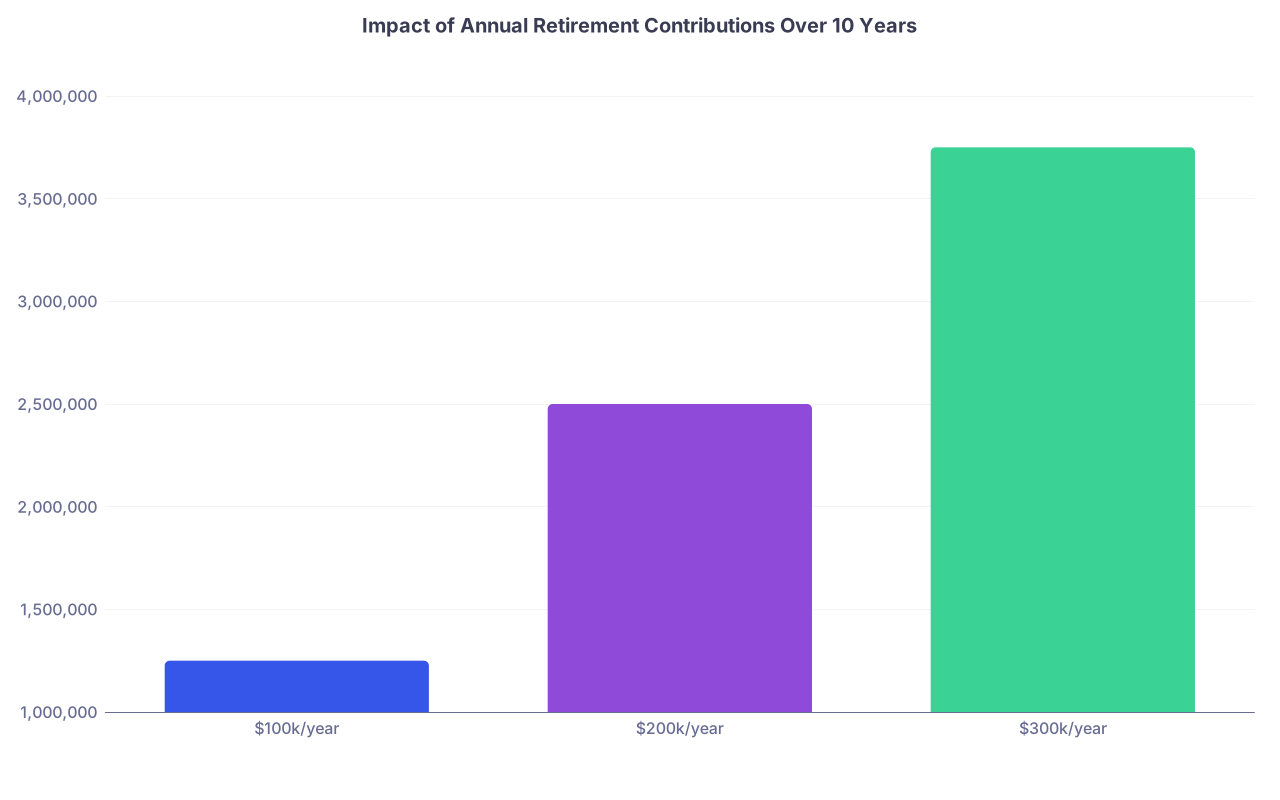
| Category | Value |
|---|---|
| $100k/year | 1250000 |
| $200k/year | 2500000 |
| $300k/year | 3750000 |
(Assumes ~7% annual growth, 10 years. Ballpark only, but you get the idea.)
Step 10: Know What You Cannot Fix (And Move On)
You cannot retroactively go back and insert 401(k) contributions into 2012. It is done.
Instead of obsessing over the sunk years, be clear about what is not fixable:
- Missed employer matches 5 years ago. Gone.
- Not using Roth when you were a resident/fellow. Gone.
- Money that should have gone into retirement but was burned on lifestyle. Definitely gone.
You acknowledge it and you pivot to maximum intensity on the years you do have left.
Short, Direct Summary
Stack the right accounts aggressively: Max your employer plan, build a solo 401(k) for 1099 income, layer in cash balance and 457(b) when appropriate, and never skip the backdoor Roth or HSA again.
Fix structural roadblocks: Clean up pre‑tax IRAs, use the right entity structure, and stop overfunding taxable accounts while starving your retirement buckets.
Run a written 10‑year catch‑up plan: Define explicit annual contribution targets and coordinate them with your tax strategy and investment plan. Then execute relentlessly.
That is how you patch a decade of weak planning. Not by magic. By using the retirement system as it was actually designed to be used—fully, and on purpose.


