

It’s March. You’re post-call, half-asleep on the couch, and you open your email to a delightful surprise: a W-2 from your home institution, another W-2 from the community hospital you moonlighted at across the border, and a random 1099 from that telemedicine platform you barely remember signing up for.
Different states. Different forms. And you already know HR is zero help because every answer starts with “we can’t give tax advice.”
You’re not trying to become a tax expert. You just don’t want to screw this up, get a surprise bill in October, or miss legit deductions. Here’s what to do if you’re a fellow moonlighting across state lines and want to file correctly without losing your mind.
Step 1: Map Out Exactly Where You Worked and Lived
Before anything else, you need a clean picture of your situation. Not vibes. Facts.
You care about three things:
- Where you lived (your state of residency for tax purposes)
- Where you worked as a W-2 employee
- Where you earned 1099 / independent contractor income
Pull out a notebook or spreadsheet and build something like this:
| Role / Site | State | Type | Estimated 2024 Income |
|---|---|---|---|
| Main fellowship hospital | NY | W-2 | $78,000 |
| Moonlighting community ER | NJ | W-2 | $24,000 |
| Telemedicine shifts (remote) | NY | 1099 | $8,000 |
Now answer, clearly and in writing:
- I lived in: [State] all year
- I physically worked in: [State A, State B, maybe State C]
- My W-2 income came from: [list states]
- My 1099 income came from work physically done in: [list states]
If you did telemedicine from your couch in Pennsylvania for a company in Texas seeing patients in Ohio, the state that usually cares is where you were physically sitting (PA), not the company’s HQ or the patient.
Do not skip this step. Every downstream decision depends on it.
Step 2: Figure Out Which State Returns You Actually Owe
You’re a fellow, not a traveling nurse with eight contracts. You probably have a manageable number of states involved, usually 1–3.
Here’s the basic rule set:
Your home state (where you lived)
- Almost always requires a resident tax return.
- They tax your worldwide income, including all moonlighting from other states.
- Then they’ll give you credits for taxes paid to other states, in most cases.
States where you physically worked as W-2
- Usually require a nonresident return if you earned income there.
- Exception: states with reciprocity agreements.
States where you did 1099/locums work
- If you physically traveled there: likely need a nonresident return.
- If you worked from home (e.g., telemed from your apartment): your home state claims it.
So your high-level pattern will often look like this:
- One resident return (where you live).
- One or more nonresident returns (where you moonlighted in person).
- Possibly no return in states with no income tax (e.g., Texas, Florida) unless local rules say otherwise.
To avoid total guesswork, use a simple decision flow:

| Step | Description |
|---|---|
| Step 1 | Where did you live most of the year |
| Step 2 | File resident return there |
| Step 3 | Only resident return needed |
| Step 4 | File nonresident return for that state |
| Step 5 | Only home state taxes that income |
| Step 6 | Did you work in another state |
| Step 7 | Physical work in that state |
If you’re in a weird situation (moved mid-year, two fellowships, etc.), you might have partial-year residency in two states. Still workable, just more annoying.
Step 3: W‑2 Moonlighting vs 1099 Moonlighting – Treat Them Differently
This is where many fellows screw it up. W-2 and 1099 are entirely different animals for tax purposes.
W‑2 Moonlighting
If you’re on payroll as an “employee”:
- You get a W-2.
- Income is reported by employer state on the W-2.
- That usually dictates where you owe nonresident tax (if different from your home state).
Example:
You live in Pennsylvania. Your main fellowship is in PA (W-2). You moonlight weekends at a New Jersey hospital (W-2).
You’ll typically:
- File PA resident return (all income, including NJ)
- File NJ nonresident return (only NJ moonlighting income)
- Claim credit on PA for taxes you paid to NJ
1099 / Independent Contractor Moonlighting
If you’re treated as an independent contractor:
- You get a 1099-NEC (or sometimes 1099-MISC).
- You’re running a tiny “business” in the eyes of the IRS.
- Income is tied to where you physically performed the work.
Common setups:
- Telemedicine from home: taxed by your home state.
- Locums shifts in another state: taxed as nonresident there + again by your home state with a credit.
And for 1099:
- You’ll file Schedule C (or sometimes Schedule E) on your federal return.
- You’ll pay self-employment tax (Social Security + Medicare) on that income.
- You can and should deduct legitimate business expenses.
The mix may look like this:
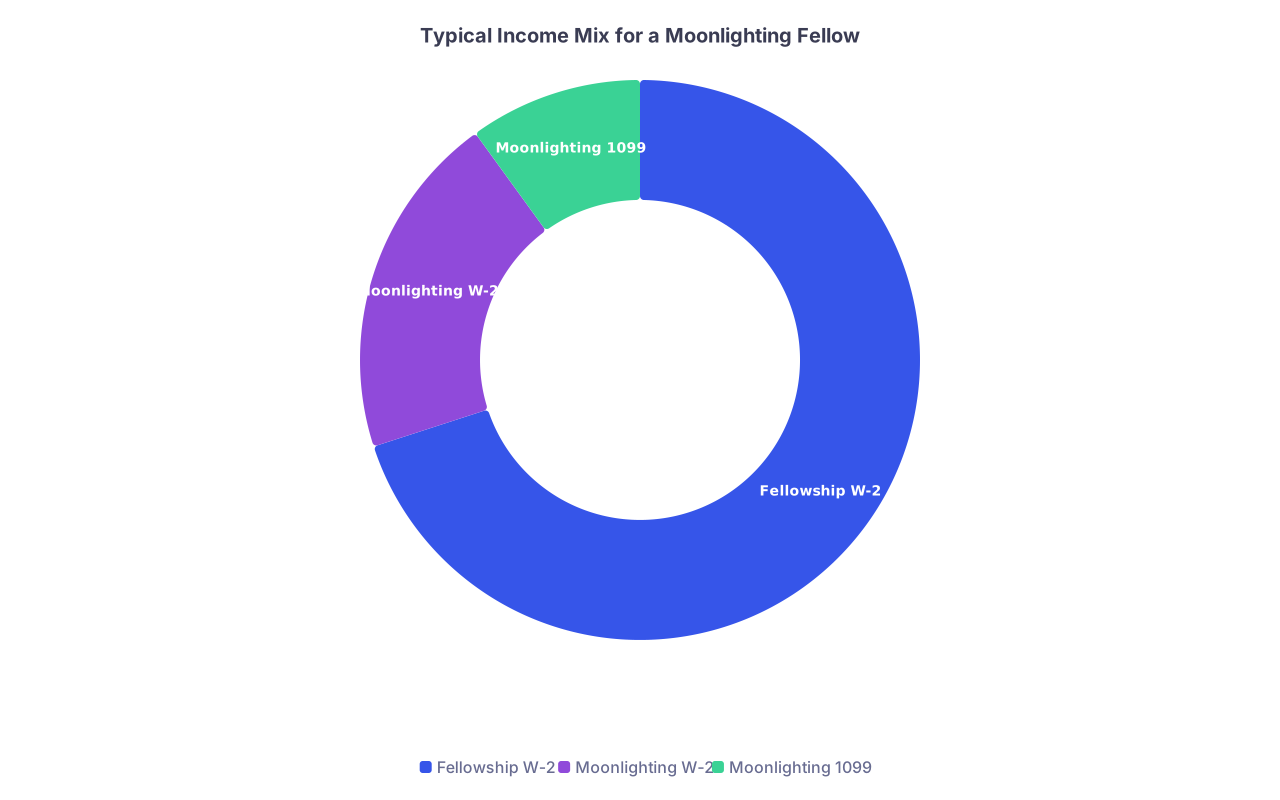
| Category | Value |
|---|---|
| Fellowship W-2 | 70 |
| Moonlighting W-2 | 20 |
| Moonlighting 1099 | 10 |
If any of your 1099 moonlighting is across state lines and you physically traveled, assume you probably owe that state a nonresident return until proven otherwise.
Step 4: Watch Out for Reciprocity Agreements (They Can Save You a Lot of Pain)
Some states have reciprocity agreements so people who live in one state and work in another only pay income tax to their home state. This matters a lot for fellows in border cities.
Classic example:
- You live in Pennsylvania, work in New Jersey. Many states in the Mid-Atlantic and Midwest have some form of reciprocity.
If reciprocity applies AND you filed the proper withholding form with your employer:
- You typically do not file a nonresident return in the work state.
- All your W‑2 wages are taxed only by your home state.
BUT:
- This almost never applies to 1099 income.
- Telemed/locums rules are not “standard employee” rules.
Don’t assume you have reciprocity. Look it up:
- Search: “[Your state] [moonlighting state] tax reciprocity”.
- Then actually read the state tax site, not a random blog.
If there’s no reciprocity, you’re back in the regular world:
- Nonresident return in work state.
- Resident return at home.
- Home state gives credit for taxes paid to the work state (usually).
Step 5: Your Filing Order: Nonresident First, Resident Last
You want the math to flow cleanly. Here’s the order that makes life easier:
Do your federal return first.
- Get your AGI, Schedule C, self-employment tax, etc. set.
- You need these numbers locked.
Then each nonresident state return.
- For each state where you moonlighted in person:
- Report only income sourced to that state.
- Allocate correctly (this is where pay stubs help).
- For each state where you moonlighted in person:
Do your home state resident return last.
- Enter all income (W‑2 + 1099 + other).
- Claim credits for taxes paid to other states.
Most decent tax software lets you set this up cleanly. But if you do it in the wrong order, your credits get messy and you end up paying more than you should.
Visualizing the flow helps:

| Step | Description |
|---|---|
| Step 1 | Federal return |
| Step 2 | Nonresident State 1 |
| Step 3 | Nonresident State 2 |
| Step 4 | Nonresident State 3 |
| Step 5 | Resident State return with credits |
Step 6: Allocate Income by State Without Guessing
The question every nonresident state will ask in some form:
“How much of your total income was earned in our state?”
For W‑2:
- Some employers break out state wages separately in Box 16/17.
- Some don’t. That’s when you need to reconstruct it.
Use:
- Pay stubs (most EHR/HR portals have them).
- A simple calculation: “I made $300/hour, worked 8 shifts x 10 hours = $24,000 in State X.”
For 1099:
- If you only did locums in one out-of-state hospital, easy: all that 1099 goes there.
- If you did both in-state and out-of-state 1099 for the same company, you have to split by where you physically were for each shift.
Document your logic somewhere in case you ever get a letter. A simple spreadsheet with date, site, state, hours, and pay is enough.
Step 7: Don’t Forget Self-Employment Tax and Deductions for 1099 Work
If any of your moonlighting is 1099, you’re playing by a different set of rules:
You owe:
- Federal income tax.
- Self-employment tax (~15.3% on net profit).
- State income tax (in home state, plus nonresident if you traveled).
But you can deduct reasonable business expenses connected to that moonlighting:
- Licensing fees (in the states where you actually used the license for 1099).
- DEA fees (prorated if you also needed it for your main job).
- Malpractice tail or extra coverage.
- Telemedicine equipment you actually bought (webcam, headset, etc.).
- CME that was required or used to keep credentials for that moonlighting.
- Mileage or travel if you’re a contractor traveling between sites (careful, this gets nuanced).
What you cannot do:
Try to shove half your life into “business expenses” because “I’m a doctor, everything I do is for work.” That’s how you end up on the wrong side of an audit.
A simple view of how the 1099 tax stack works:
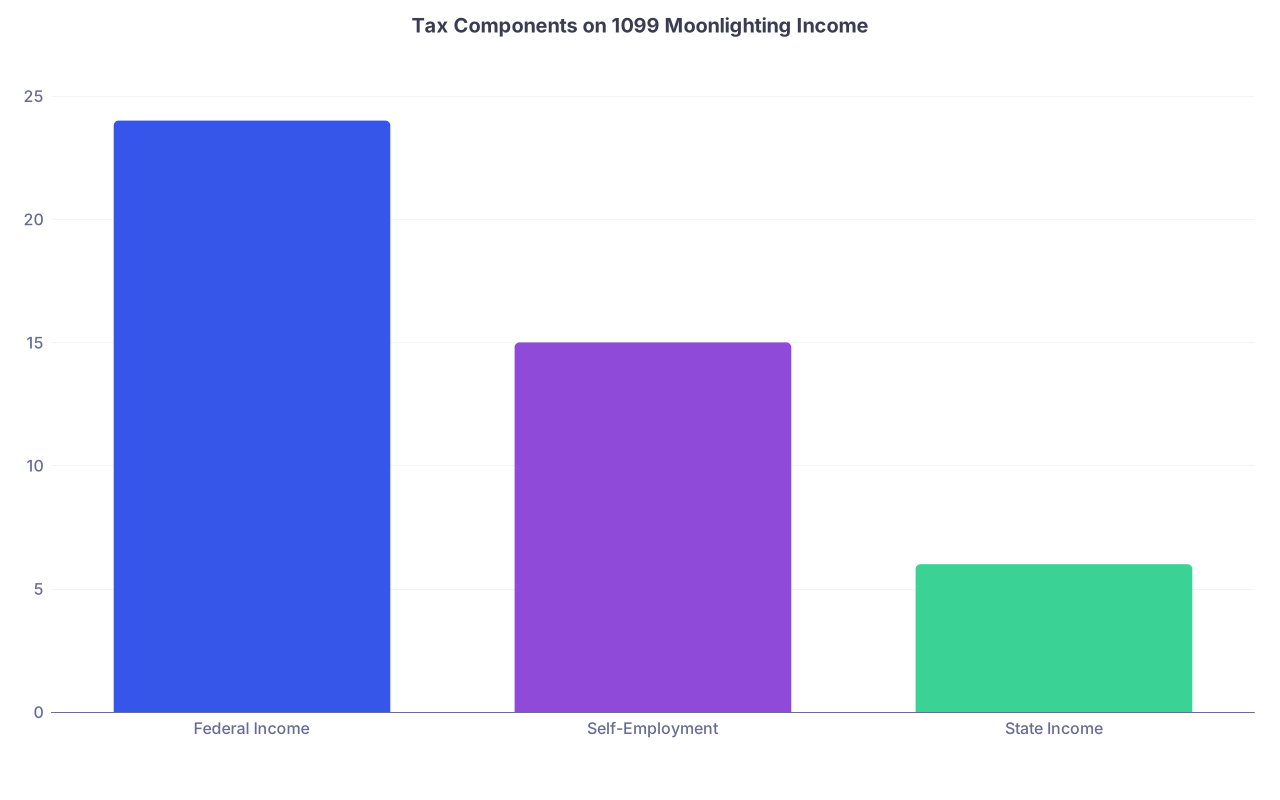
| Category | Value |
|---|---|
| Federal Income | 24 |
| Self-Employment | 15 |
| State Income | 6 |
(Those percentages are illustrative; your actual numbers vary. Point is: self-employment tax is not trivial.)
Step 8: Decide When DIY Is Fine and When to Bring in a Pro
You can absolutely do this yourself if:
- You lived in one state all year.
- You worked in at most two states, total.
- Most of your income is W‑2.
- You have straightforward 1099 (one or two 1099s, clear locations).
You probably should hire a CPA (ideally one who actually works with physicians) if:
- You moved states mid-year or did two fellowships.
- You worked in 3+ states.
- You have a heavy 1099 load (> $20–30k).
- You’re starting an S-corp/PLLC or setting up a solo practice on the side.
- Your state rules are famously gnarly (California, New York, New Jersey, etc.).
A good physician-focused CPA will:
- Set this up correctly once.
- Show you a system for tracking income by state.
- Make sure you’re not leaving credits or deductions on the table.
Then, if you really want, you can keep following the same pattern yourself in future years.
Step 9: Set Yourself Up for Next Year So This Isn’t a Yearly Panic
Most fellows repeat this cycle for 2–3 years. No reason to re-suffer every April.
Do this now, not next March:
Create a simple “moonlighting” folder:
- Subfolders by year:
2024,2025, etc. - Drop every contract, 1099, and W‑2 in there.
- Subfolders by year:
Keep a bare-bones log:
- Date, site, state, type (W‑2 vs 1099), rate, hours.
- You can do this in a 10-row spreadsheet. It doesn’t need to be pretty.
Fix your withholding:
- If you owed a big bill this year, adjust W‑4 at your main job or make quarterly payments for 1099.
- Underpayment penalties are stupid taxes you can avoid.
Decide: This year, am I DIY or using a pro?
- Make that call early, not on April 10th.
Quick Example: What This Looks Like in Real Life
Let’s say:
- You live in Maryland.
- You’re a cardiology fellow at a major academic center in Baltimore (W‑2, MD).
- You moonlight at a Delaware community hospital (W‑2, DE).
- You also pick up 1099 telemedicine shifts from home in Maryland.
Here’s your playbook:
- Federal: All income, W‑2 MD, W‑2 DE, 1099 telemed, Schedule C for telemed.
- Delaware nonresident:
- Report only DE W‑2 wages from that hospital.
- Pay DE tax on that slice.
- Maryland resident:
- Report all income (MD W‑2, DE W‑2, telemed 1099).
- Claim credit on MD return for tax paid to DE on the DE wages.
- No other state returns:
- Telemed done from MD is MD-sourced.
If instead you were driving to Virginia to do 1099 locums, then:
- You’d file a VA nonresident return for that 1099 income.
- Still report that income in MD.
- Credit in MD for VA taxes paid on that piece.
Same pattern, different labels.
FAQs
1. If my moonlighting W‑2 shows only my home state in Box 15, but I worked in another state, do I still need to file there?
Maybe. The W‑2 state info is often wrong or incomplete for multi-state work. The real question is: were you physically working in that other state and earning wages there? If yes, that state can absolutely claim taxing rights, even if your employer didn’t withhold correctly. In that situation, I’d at least talk to a CPA or call the state’s taxpayer assistance line before deciding to ignore it.
2. I did just a few shifts in another state for $2–3k total. Do I really have to file a return there?
Depends on that state’s filing thresholds, not your feelings. Some states will require a return for even a small amount of nonresident income; others have minimums (for example, no filing required under a certain dollar amount). Look up “[State] nonresident filing threshold.” If you’re over their limit, you’re supposed to file, even if it feels trivial. That said, if you’re in a gray area, this is where a 30-minute consult with a CPA can save you from either over-filing or under-filing.
3. Can I just use TurboTax or similar software for all of this?
You can, and many fellows do. The software will handle multiple states. The problem is not the software; it’s your inputs and assumptions. If you tell it the wrong state-source amounts or skip nonresident returns, it will happily produce a wrong answer in a very official-looking PDF. If your situation is 1–2 states and relatively clean, DIY with software is fine. If you have 3+ states or a lot of 1099, I’d use software plus a human who actually understands physician moonlighting to review at least once.
Key points to walk away with:
- Start by mapping where you lived, where you physically worked, and which income was W‑2 vs 1099. Everything flows from that.
- File federal first, then nonresident states, then home-state resident with proper credits so you do not pay tax twice on the same income.
- If your situation involves multiple states and decent 1099 income, get a physician-savvy CPA to set this up correctly once. It’s cheaper than fixing a mess three years from now.


