

The worst thing you can do with moonlighting income is treat it like “extra cash.” Savvy attendings treat it like a tax weapon.
You’re not just picking up an ED shift for fun money. You’re creating a separate income stream with its own rules, its own opportunities, and its own traps. The doctors who quietly build seven‑figure net worths off “side shifts” are the ones who understand that.
Let me show you how they actually use moonlighting income behind the scenes—not the vanilla advice you hear on physician Facebook groups.
First: The IRS Does Not See Your Moonlighting Like Your W‑2 Job
Your main attending job is usually W‑2. Taxes withheld. Payroll handled. You get a W‑2, plug it in, move on.
Moonlighting? That’s a different beast.
Most moonlighting setups fall into one of three buckets:
| Structure Type | What You Receive | Typical Tax Treatment |
|---|---|---|
| W‑2 Per‑Diem | W‑2 | Employee, limited deductions |
| 1099 Independent | 1099‑NEC | Self‑employment income |
| Locums via Agency | 1099 or W‑2 | Depends on contract |
| Direct Contracting | 1099 to LLC/PC | Business income |
| Hospital PRN Pool | W‑2 | Employee |
The tax games start once you’re in the 1099 / independent contractor world. That’s where the “extra” money can be turned into:
- A deduction engine
- A retirement contribution machine
- A way to legally shift income and benefits around your life
W‑2 moonlighting is better than nothing, but it’s the least interesting from a tax standpoint. The real optimization sits in 1099 land.
And yes, plenty of hospital “per diem” setups will happily pay you as 1099 if you ask and structure it correctly. I’ve seen it happen at community hospitals, small ED groups, and anesthesia groups that are desperate for coverage.
The Core Play: Turn Moonlighting Into a Real Business
Here’s the truth faculty won’t say out loud at noon conference: the smartest attendings treat their moonlighting like a practice, not a side gig.
They set up a proper business entity and then run all the associated tax levers through that.
Step 1: Get out of “paid personally” mode
You can absolutely get a 1099 in your own name and report it on a Schedule C. Many do. But the savvy ones usually:
- Form an LLC or professional corporation (PC/PLLC, depending on state)
- Get an EIN
- Have the moonlighting or locums contracts pay the entity, not them personally
Does an LLC magically save tax on its own? No. That’s nonsense.
What it does give you is:
- Separation of business and personal expenses
- Clean books for deductions and retirement planning
- The ability (once income is high enough) to elect S‑corp and play with salary vs distributions
Most hospitals and locums agencies are used to paying entities. This is not exotic.
Step 2: S‑Corp – not the magic bullet, but the right kind of weapon
Here’s the insider nuance most docs miss. Your W‑2 job kills a lot of the “S‑corp salary games” you hear online.
If your W‑2 attending salary is already, say, $350–$450k, you’re already maxing Social Security wage base, and you’re probably paying the 0.9% additional Medicare tax. The usual “huge payroll tax savings” from S‑corp are muted.
But S‑corps can still matter, especially if:
- Your 1099 moonlighting income is >$80–100k/year
- You have substantial business expenses and health insurance options
- You’re in a high‑tax state where every deductible dollar counts
Let me make it concrete.
Dr. P, hospitalist, $320k W‑2. Picks up locums shifts and nets $150k 1099.
She forms an LLC → elects S‑corp → pays herself a “reasonable salary” of $80k and takes $70k as S‑corp distributions.
On that $70k, she avoids the 2.9% Medicare self‑employment portion. She still pays income tax, but saves roughly $2,000 a year in Medicare tax. Not life‑changing, but real.
But the bigger advantage? The S‑corp gives her cleaner control over:
- Which benefits run through the entity
- How she times expenses and distributions
- How she sets up retirement contributions on top of her hospital plan
And that’s where the real leverage lives.
How Savvy Attendings Use Moonlighting as a Deduction Engine
Here’s where I’ve seen the quiet, very intentional moves.
They don’t just log miles and CME. They build a structure that turns inevitable professional and financial life costs into business deductions.
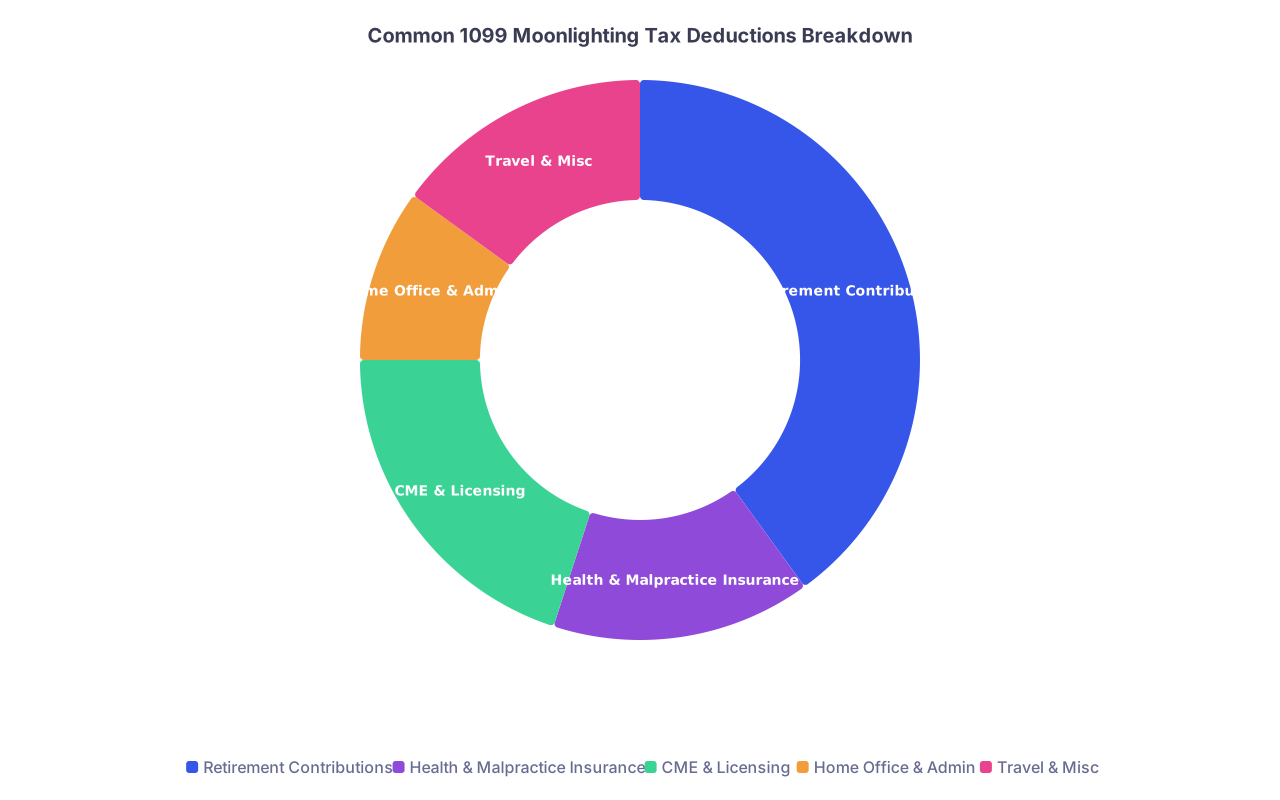
| Category | Value |
|---|---|
| Retirement Contributions | 40 |
| Health & Malpractice Insurance | 15 |
| CME & Licensing | 20 |
| Home Office & Admin | 10 |
| Travel & Misc | 15 |
Retirement contributions: the big gun
If you only remember one thing, remember this: moonlighting income can buy you another retirement account.
Most employed attendings think, “I have a 403(b)/401(k) at my main job, I’m tapped out.” Wrong.
As a 1099 doc, you’re both the employee and the employer. That means:
- You can use a Solo 401(k) or SEP‑IRA off your moonlighting income
- You have separate employer contribution limits that stack on top of your W‑2 plan, up to the overall IRS limits per plan
The cleanest way to think about it:
- Employee deferral limit (the $23k–ish number) is shared across all plans
- Employer contributions (profit‑sharing) are per plan, capped as a percent of that business’s compensation
Savvy attendings often do this:
- Max employee deferral at W‑2 job (to get the match and convenience)
- Use moonlighting entity to make employer contributions (20% of net self‑employment income in a Solo 401(k) or SEP)
I’ve seen pulmonary/critical care attendings pushing $40–50k EXTRA per year into a Solo 401(k) purely from moonlighting ICU shifts. That’s not theoretical. That’s from copies of tax returns they brought to meetings.
Health insurance and HSA moves
This is where it gets interesting for those not perfectly happy with their employment benefits.
A not‑so‑obvious play:
- Some attendings decline or downgrade the hospital family plan
- Get a high deductible plan through their moonlighting entity (if it makes financial sense)
- Pay for premiums and HSA contributions through the 1099 business
Not everyone can or should do this. But in certain high‑income, high‑deductible scenarios, using the 1099 business to house insurance + HSA contributions can be cleaner and more deductible than shoehorning everything through the W‑2 job.
And yes, an HSA is still one of the best triple‑tax‑advantaged tools you get.
CME, licensing, and that “CME vacation” everyone pretends is purely educational
This one’s simple but abused.
Responsible, savvy attendings:
- Allocate a CME budget through their moonlighting entity
- Deduct exams, board review, conferences directly tied to clinical work
- Deduct licensing and DEA fees, medical staff dues, specialty society memberships tied to that practice
What they do not do (or at least what their CPAs do not sign off on) is write off the entire cost of a Paris family vacation because they went to one half‑day session at an “international symposium.”
You can absolutely combine some travel with CME. But if you’re audited, you need a straight‑faced story with receipts and documentation. The attendings who are playing long‑term wealth games are not trying to steal $800 of hotel deductions and risk a multi‑year headache with the IRS.
The Real Insider Game: Using Moonlighting to Re‑Shape Your Whole Financial Picture
The biggest mistake is thinking, “How do I pay less tax on this moonlighting check?”
Wrong question.
The right question is: “How do I use this 1099 stream to restructure my entire financial and legal setup?”
That’s what the quiet wealth builders are doing.
Strategy 1: Funding multiple “buckets” with different tax treatments
I see this pattern over and over:
Main job (W‑2):
- Max pre‑tax 401(k)/403(b)
- Maybe a backdoor Roth IRA if allowed
Moonlighting entity:
- Solo 401(k) employer contributions (pre‑tax)
- HSA via high deductible plan
- Taxable brokerage funded with AFTER‑tax distributions from the S‑corp
Why that mix matters: in retirement, you have choices. Pre‑tax, Roth (if you convert later), and taxable. That gives you control over future tax brackets instead of being cornered into RMD hell with only pre‑tax accounts.
Strategy 2: Time‑shifting income and deductions
Here’s something senior faculty almost never confess at grand rounds, but they absolutely discuss with their accountants.
If they know a high‑income year is coming (partnership buy‑out, sale of a surgery center interest, big bonus), they may:
- Pull some moonlighting income into the prior year (bill earlier, invoice earlier)
- Or push it into the next year (delay invoicing if cash‑basis)
- Move deductible expenses (equipment, CME, malpractice tail, EHR subscriptions) into the higher‑income year
Is this sophisticated? Not really. It’s just thinking one tax year ahead instead of blindly cashing every check as soon as possible.
But when you’re in the top federal bracket plus state tax, a $20–30k timing shift in deductions is real money.
Strategy 3: Intentionally funding “non‑sexy” but powerful legal protections
The really savvy attendings use moonlighting cash to quietly build legal and asset‑protection infrastructure:
- Paying for robust personal umbrella policies
- Funding adequate malpractice tail without panic
- Paying attorneys to structure their entity properly (operating agreements, buy‑sell clauses if multiple docs share an entity)
- Getting proper estate planning (trusts, LLCs to hold rentals, etc.)
I’ve watched multiple physicians use three years of heavy moonlighting to:
- Wipe out student loans
- Fully fund a Solo 401(k)
- Build a six‑figure emergency fund
- Pay for a rock‑solid estate plan and asset‑protection structure
After that? They taper back their shifts. Because the heavy lifting is done.
The Legal Side: Where People Quietly Get Burned
Let me be blunt. Hauled‑in‑front‑of‑HR and audited‑by‑the‑IRS stories almost always share the same root cause: trying to act like a business without doing the boring setup work.
Non‑competes and your primary employer
This is where a lot of attendings pretend not to read their contracts.
Your hospital contract very often has:
- Non‑compete or restrictive covenant language
- “No outside clinical work without written permission” clauses
- Rules about moonlighting within the same system or catchment area
Here’s what actually happens behind the scenes:
- Some chairs look the other way if your moonlighting doesn’t affect call coverage or quality metrics
- Others are aggressively territorial and will absolutely use “unauthorized outside work” as leverage in promotions, scheduling, or discipline
The smart attendings:
- Disclose moonlighting in writing, in a controlled way
- Frame it as skill‑building, academic outreach, or underserved coverage when possible
- Get specific carve‑outs approved (e.g., locums >100 miles away, telemedicine outside the system)
No, you don’t tell your chair “I’m trying to hit FI by 45.” You talk about service, experience, and maintaining procedural volume.
Malpractice coverage gaps that nobody bothers to warn you about
If your moonlighting shifts aren’t fully covered, you are playing with fire.
Typical patterns:
- Main hospital job: claims‑made policy with tail paid by employer (or not)
- Moonlighting ED or ICU: separate malpractice, sometimes occurrence, sometimes claims‑made
The dangerous scenarios:
- Locums agencies with barebones coverage or sky‑high deductibles
- Overlapping coverage where each carrier tries to kick the claim to the other
- Telemedicine gigs that rely on you misunderstanding where jurisdiction and coverage actually apply
Savvy attendings:
- Get the actual policy documents, not just an email that says “you’re covered”
- Verify tail responsibility for each moonlighting relationship
- Make sure policy limits align with local norms (you do not want to be the only person in town with $250k/$750k limits when everyone else is 1M/3M)
And yes, some pay for their own individual malpractice coverage that follows them across gigs. Not cheap. But if you’re doing a lot of fragmented moonlighting, it can be cleaner.
A Realistic Case Study: How One Attending Turned Shifts Into Strategy
Let me walk through a composite of several physicians I’ve worked with. We’ll call him Dr. R.
- Age: 38
- Specialty: EM
- W‑2 job: $310k at a busy community hospital
- Moonlighting: 4–5 shifts/month at a small rural ED, $3,000/shift → ~$150k 1099
What he did initially (like most):
- Took checks personally
- Threw everything on Schedule C
- Paid a massive self‑employment tax bill
- Whined that “the government takes half my money”
What he changed over three years:
- Formed an LLC, elected S‑corp once net 1099 hit ~120k
- Set up a Solo 401(k) through a low‑cost custodian
- Paid himself an $80k salary from the S‑corp, took ~$60–70k as distributions
- Made employer contributions up to the Solo 401(k) cap from S‑corp profits
- Shifted CME, licensing, and some legitimate travel associated with rural coverage into the entity
- Worked with a CPA who actually understands physicians, not a generic strip‑mall tax preparer
Concrete outcomes:
- $40–45k/year additional retirement contributions purely from moonlighting income
- Slight reduction in Medicare taxes via S‑corp structure
- Cleaner audit‑defensible deduction structure
- Built a $250k+ Solo 401(k) balance in about five years, separate from his main 401(k) at work
Did he “pay no tax”? Of course not. That’s fantasy.
But he turned what felt like punishing side income into something that materially moved his net worth and long‑term security.
Simple Guardrails So Your “Tax Play” Doesn’t Turn Into a Legal Problem
Quick reality check. The attendings who do this well all follow a few boring, non‑negotiable rules:
They keep clean books.
Separate business bank account.
Separate business credit card.
Every 1099 goes through the entity, every business expense gets logged.
They do not DIY their taxes once 1099 income goes past ~50–75k.
They hire a CPA who:
- Has multiple physician or healthcare clients
- Understands retirement plans and S‑corp nuance
- Is willing to say “No, you cannot deduct that”
They do not play games with obviously personal expenses.
Family vacations, primary home renovation, personal cars with zero business use. That TikTok CPA telling you to “write off your whole life”? They will not be sitting with you in an audit.
They read (or have counsel review) their employment and moonlighting contracts.
Non‑competes, exclusivity, and IP clauses can blow up your side income faster than the IRS ever will.

| Step | Description |
|---|---|
| Step 1 | Pick Up Moonlighting |
| Step 2 | Limited Tax Levers |
| Step 3 | Form Entity |
| Step 4 | Open Business Accounts |
| Step 5 | Set Up Solo 401k or SEP |
| Step 6 | Route Deductions Through Entity |
| Step 7 | Coordinate With W2 Benefits |
| Step 8 | Review With CPA And Attorney |
| Step 9 | Refine Shifts And Strategy |
| Step 10 | W2 or 1099 |
FAQ: Physician Moonlighting & Tax Strategy
1. Is it ever not worth forming an LLC/S‑corp for moonlighting?
Yes. If you’re making, say, $15–30k a year from occasional 1099 shifts, the complexity and CPA fees can wipe out most structural savings. In that range, a simple Schedule C with good documentation and maybe a SEP‑IRA is usually fine. Once your moonlighting crosses roughly $60–80k/year and looks durable, that’s when the entity / Solo 401(k) / S‑corp conversation gets serious.
2. Can I have a 401(k) at work and a Solo 401(k) for moonlighting and fully max both?
You can max employer contributions in both, subject to each plan’s rules and overall IRS limits per plan, but the employee deferral limit is shared. In practice, most attendings shove all employee deferrals into the W‑2 plan (for the match) and use the Solo 401(k) purely for employer/profit‑sharing contributions from 1099 income. This is where a good CPA or retirement advisor earns their fee by aligning the math with your specific incomes.
3. What are the red flags that get moonlighting physicians audited?
The patterns I’ve seen: huge Schedule C losses year after year while you’re clearly a high‑income attending, excessive “CME travel” that looks like international vacations, claiming a massive home office deduction without a plausible admin workload, and sloppy or conflicting 1099 reporting. The IRS doesn’t care that you’re a doctor; they care that your numbers tell a believable story. If your return screams “I’m trying to zero out all my income,” you’re asking for attention.
4. How do I find a CPA who actually understands physician moonlighting?
You do not pick one based on the first Google ad. Ask senior residents, fellows, and attendings who are already doing 1099 work who they use. Ask specific questions when you interview a CPA: “How many clients do you have with W‑2 plus moonlighting 1099 income?” “How often do you set up Solo 401(k)s for physicians?” “How do you handle S‑corp planning when there’s a large W‑2 base salary?” If they give vague, generic answers or try to sell you on aggressive schemes, move on.
Bottom line:
- Treat moonlighting as a business, not a bonus.
- Use the 1099 stream to build retirement, deductions, and legal structure—not just more lifestyle.
- Get competent professional help once the numbers are real; that’s when moonlighting shifts stop being “extra” and start being a serious wealth lever.


