

It’s 11:45 p.m. You just finished a brutal moonlighting shift, cleared $1,200, and you’re thinking, “This is how I’m finally going to get ahead on my loans.”
Fast‑forward 10 months. Your accountant (or TurboTax) spits out a number: you owe $9,000. No refund. No sympathy. Just a nasty, unexpected bill.
That “extra” moonlighting money? Suddenly feels like a financial ambush.
I’ve watched residents and early attendings do this over and over. The same tax mistakes. The same “how is this possible?” conversations in March. The pattern is so predictable it’s almost boring—except it’s wrecking your cash flow and your sanity.
Let me walk you through the big landmines so you do not become that story.
1. Treating Moonlighting Like W‑2 Income (When It’s Almost Always Not)
Here’s the first big misunderstanding: your main job as a resident or attending is W‑2 income. Your employer withholds taxes, Social Security, Medicare, maybe retirement contributions.
Moonlighting? Different beast.
Usually it’s 1099 independent contractor income. No one withholds anything for you. The hospital or locums company just reports what they paid you and leaves you alone—until they send that 1099 to the IRS too.
The mistake:
You see checks hitting your account and mentally treat it like “normal” income. You spend it like it’s already-taxed money.
Reality:
A large chunk of that money was never yours. The IRS has just been quietly waiting.
If you’re 1099, you’re on the hook for:
- Federal income tax
- State income tax (unless you live in a no‑income‑tax state)
- Self‑employment tax (this is the one people forget—and it hurts)
Self‑employment tax is roughly 15.3% on your net earnings (before the income tax layer even starts).
So that “extra” $1,200 moonlighting shift?
After all taxes, you might really keep closer to $600–$750, depending on your bracket and state.
Red Flag Checklist
If any of this describes you, you’re at risk:
- You’re moonlighting and have not changed your withholding or made estimated payments.
- You assume your residency W‑2 withholdings will “cover everything.”
- You’ve never heard of self‑employment tax.
- You’re getting 1099‑NEC forms in January and just shrugging.
Do not wait until tax season to discover you’ve been pocketing the IRS’s share all year.
2. Ignoring Quarterly Estimated Taxes (And Getting Smacked With Penalties)
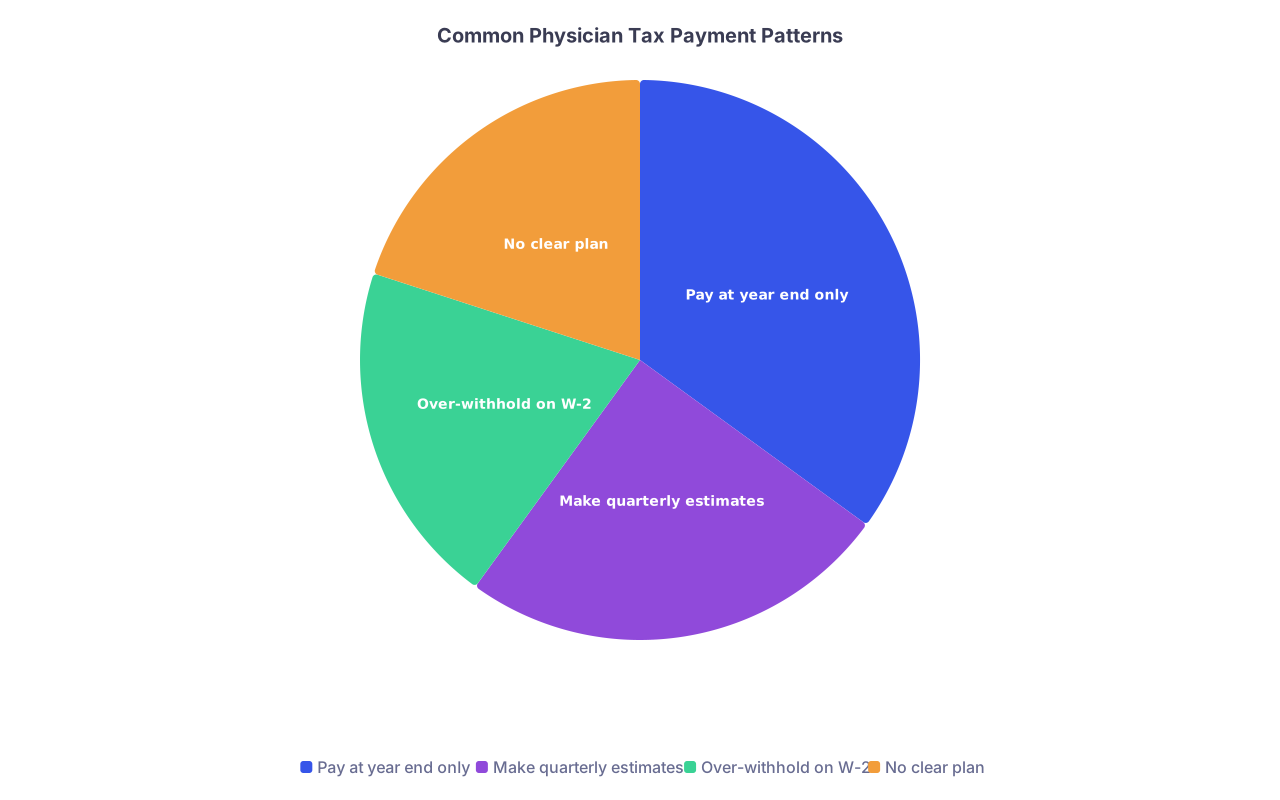
| Category | Value |
|---|---|
| Pay at year end only | 35 |
| Make quarterly estimates | 25 |
| Over-withhold on W-2 | 20 |
| No clear plan | 20 |
Here’s how the IRS thinks: taxes are “pay as you go.”
Here’s how most moonlighting residents behave: “I’ll deal with it in April.”
That mismatch is why so many get hit with underpayment penalties.
The rule of thumb (simplified):
If you owe more than $1,000 at tax time and you haven’t paid in enough throughout the year via withholding or quarterly estimates, you can get slapped with penalties.
Moonlighting 1099 + no estimates + minimal withholding = penalty magnet.
The classic mistake pattern
- You moonlight all year. No estimated payments.
- Your W‑2 job withholds based on that salary alone.
- You file your return.
- Surprise: Big tax bill + penalty for underpaying during the year.
The penalty isn’t usually life‑ruining. But the psychological punch of “You owe $8,000 plus a few hundred in penalties” is brutal when you thought you might get a refund.
How to avoid this (without overcomplicating your life)
Pick one of these and commit:
Clean method: Make quarterly estimated payments on moonlighting income.
- Take 25–30% of every moonlighting check.
- Transfer it immediately to a separate “tax” savings account.
- Pay the IRS quarterly (April 15, June 15, Sept 15, Jan 15).
Hacky method: Over‑withhold at your W‑2 job instead.
- Increase withholding on your residency or main employment W‑4.
- This can cover your moonlighting taxes if you over‑withhold enough.
- Easier to automate but requires actually doing the math and monitoring.
The dumbest strategy?
Doing neither.
3. Forgetting About Self‑Employment Tax (The “Extra 15.3%” Surprise)
This one stings every time.
Employees pay 7.65% for Social Security and Medicare; your employer pays the other 7.65%.
When you’re 1099, you are both employer and employee. That means you pay the full 15.3% on your net self‑employment income.
Common myth:
“I’m already paying Social Security and Medicare through my residency job. So I don’t owe it again, right?”
Partly wrong.
- Social Security portion (12.4%) stops once your total income (W‑2 + 1099) hits the annual wage base (over $160K+ and indexed each year).
- Medicare portion (2.9% + possibly an extra 0.9% for high earners) does not stop.
If you’re a resident making $65K and moonlighting another $30K? You’re paying full Social Security and Medicare on that moonlighting income. That’s before income tax.
Do not make the mistake of calculating “just” your marginal income tax bracket and ignoring this second tax layer. That’s how physicians miss by thousands.
4. Keeping Garbage Records (And Losing Legit Deductions)

You would not accept a patient saying, “Yeah, I think I took some kind of blood pressure pill a while ago” as an adequate medication history.
Yet I see physicians treat their business expenses exactly like that.
As a 1099 moonlighter, you’re technically self‑employed for that work. That means:
- You can deduct legitimate business expenses.
- You need halfway decent records to back them up.
Common mistakes that cost real money:
- No tracking of mileage to moonlighting sites.
- Mixing personal and moonlighting expenses on the same card with no log.
- Zero documentation for CME, licenses, or board exam fees related to that income.
- Not separating W‑2 job expenses (often non‑deductible now) from self‑employment‑related ones (often deductible).
What records you actually need (no, it’s not a full‑time job)
Do not overcomplicate this. But do not wing it either.
- Use one credit card (or at least one dedicated category) for moonlighting‑related expenses.
- Keep a running note or simple spreadsheet with:
- Date
- Vendor
- Amount
- Purpose/which moonlighting job
- For mileage:
- Use a mileage app, or
- Keep a basic log: dates, start/end location, purpose, miles.
If you get audited and your answer is, “I kind of remember driving a lot,” you’re going to lose that deduction. Quickly.
5. Commingling Everything: No Separation Between You and the “Side Business”
You do not have to create an LLC or S‑Corp to moonlight. For most residents and early attendings, a simple sole proprietorship (you, personally) is perfectly fine.
But here’s where people screw it up: they treat their moonlighting like scattered pocket cash.
- Checks into random personal accounts
- Expenses sprinkled across four credit cards
- No idea what the net profit actually was
Result: sloppy records, missed deductions, and wasted time.
Minimum separation you should have
You don’t need a corporation. You do need structure.
Bare minimum:
- One checking account where all moonlighting income lands
- One card (or clear digital category) where you put all moonlighting expenses
- One simple spreadsheet or tool that tracks:
- Income by source
- Expenses by category
- Net income per year
That’s it. But skipping this is how people end up guessing at tax time, which is a fast way to overpay or raise audit risk.
6. Choosing the Wrong State Strategy (Or Ignoring State Taxes Entirely)
Physicians are weirdly good at ignoring state tax rules. Until they get letters.
Common mess‑ups:
- Moonlighting across state lines and not realizing you might owe tax in that other state.
- Assuming your “home” state magically credits everything correctly without planning.
- Working in a no‑income‑tax state for moonlighting (Texas, Florida) but living in a high‑tax state and being surprised when your home state still takes a bite.
Example:
You live in New York, moonlight in New Jersey, get a 1099 from a NJ hospital.
You may owe NJ nonresident taxes on that income and NY resident tax too, with a credit. That’s not something you want to DIY casually the night before the filing deadline.
If you’re moonlighting in multiple states, do not pretend this is simple. It’s not. That being said, it’s solvable—as long as you don’t ignore it for three years and wait for back‑tax notices.
7. Playing Amateur Tax Pro With Complex Setups (LLCs, S‑Corps, “Write Off Everything”)

| Step | Description |
|---|---|
| Step 1 | Start Moonlighting |
| Step 2 | Ignore tax planning |
| Step 3 | Get big surprise bill |
| Step 4 | Search online hacks |
| Step 5 | Consider LLC or S Corp |
| Step 6 | Overcomplicate structure |
| Step 7 | Try extreme deductions |
| Step 8 | High audit risk |
Here’s the lifecycle I’ve seen over and over:
- Resident starts moonlighting.
- Gets crushed by taxes one year.
- Goes down an internet rabbit hole: “How doctors can pay zero tax.”
- Ends up forming an LLC or S‑Corp with no real strategy and terrible bookkeeping.
- Tries to deduct half their life as a “business expense.”
This is how ordinary, honest physicians end up looking suspicious on an IRS return.
Things I see that are overkill or just plain bad:
- S‑Corp for $15K of moonlighting income.
The compliance cost and complexity usually outweigh the benefit at that level. - Trying to write off your personal car lease 90% because “I drive to shifts.”
- Deducting vacations as “CME” with a flimsy 1‑hour conference slapped on.
- Treating every meal with another doctor as a “business meeting.”
Could some of these be legitimate in specific circumstances? Sure. That’s not the point.
The point is: physicians picking strategies off Reddit or TikTok and implementing them without professional advice is how you drift from “aggressive but defensible” into “this is nonsense and will get shredded in an audit.”
If you’re going beyond:
- Mileage
- CME
- Licensing/credentialing fees
- Simple equipment (scrubs, stethoscope, relevant tech/EMR tools)
- Professional dues and insurance
…you should have a real tax professional reviewing your approach. Period.
8. Under‑Insuring Yourself: Ignoring Malpractice and Legal Exposure

This one isn’t strictly “tax,” but it’s absolutely part of financial and legal planning around moonlighting—and it’s a common, dangerous blind spot.
Mistakes I’ve seen:
- Assuming your residency or main employer malpractice automatically covers your side work. Often it does not.
- Signing moonlighting contracts where the coverage is claims‑made, not occurrence, and you never address tail coverage.
- Not realizing that as a 1099 contractor, you may need your own malpractice policy, which is a business expense and tax‑deductible—but only if you actually buy it.
Do not let the search for extra income allow sloppy legal exposure. A single uncovered claim can make your tax planning jokes irrelevant.
If you’re 1099 moonlighting:
- Read the contract.
- Confirm in writing who provides malpractice, what type, and who pays for tail.
- If it’s on you, get quotes, get covered, and yes—deduct that premium as a business expense.
9. Not Using Retirement and HSA Options Connected to 1099 Income
Here’s a quiet mistake: missing the upside.
Everyone focuses on the tax hit from moonlighting. Fewer people realize that 1099 income often opens extra retirement and tax‑advantaged space.
The mistake:
You grind extra shifts, pay extra tax, and never use the unique tools that self‑employment unlocks.
You might be able to:
- Open a solo 401(k) or SEP‑IRA for your moonlighting business.
- Contribute pre‑tax dollars there in addition to your hospital 403(b)/401(k) (subject to limits and coordination rules).
- Deduct those contributions against your moonlighting income, cutting the tax hit meaningfully.
But most physicians ignore this because:
- No one tells them.
- They think it’s “too advanced.”
- They’re in survival mode and just trying not to owe more.
Skipping this is a long‑term wealth mistake, not just a tax one.
If you’re making substantial 1099 income (think $20K+ per year), and especially if you’re post‑training, not exploring a solo 401(k) is leaving money on the table.
10. Doing Taxes Completely Alone Once Things Get Complicated
| Situation | DIY Might Be OK | Get a Pro Involved |
|---|---|---|
| Single state, small 1099 (<$10K) | Maybe | Optional |
| Multiple 1099s, multiple states | No | Yes |
| Considering LLC or S-Corp | No | Yes |
| Using solo 401(k) or SEP | Risky | Strongly advised |
| Prior year underpayment or audit | No | Definitely |
Here’s where pride and frugality become expensive.
If you:
- Moonlight in more than one state,
- Have more than one 1099,
- Are thinking about any kind of entity structure,
- Or are trying to optimize retirement around 1099 income…
…trying to wing this with cheap software and free online articles is gambling.
I’ve reviewed situations where:
- The doctor “saved” $400 on tax prep.
- Then overpaid $5,000 in unnecessary taxes.
- Or mis‑filed and triggered letters and penalties.
If your moonlighting is a few thousand dollars in one state and you’re just getting started, fine—DIY with care.
But when you start stacking shifts and pulling in five figures as a contractor? Get a CPA or EA who has actually worked with physicians and self‑employment before.
Hiring the wrong kind of accountant is another mistake, by the way. Ask directly:
- How many physician clients do you have?
- How many 1099/self‑employed clients do you handle?
- Do you advise on estimated payments and retirement options, or just file returns?
If they stare blankly when you mention solo 401(k) or state non‑resident filings, keep walking.
11. Moonlighting Without a Simple System (And Hoping It Works Out)
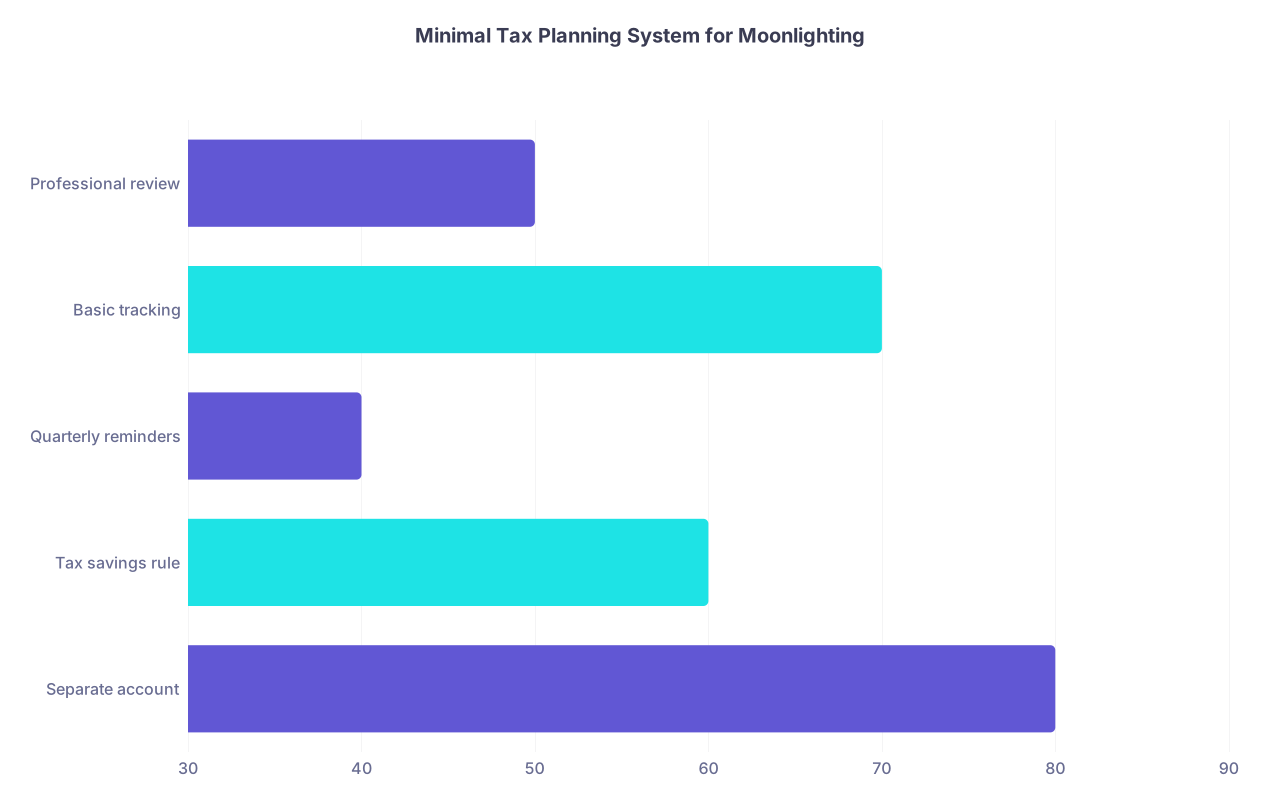
| Category | Value |
|---|---|
| Separate account | 80 |
| Tax savings rule | 60 |
| Quarterly reminders | 40 |
| Basic tracking | 70 |
| Professional review | 50 |
The biggest meta‑mistake is thinking you need some elaborate system. You do not.
You need a basic, boring, repeatable structure that keeps you out of trouble.
Here’s a simple low‑drama setup that works for most:
- Separate bank account for moonlighting income.
- Automatic rule: move 25–30% of every deposit to a “tax” sub‑savings.
- Calendar reminders for estimated tax due dates.
- Simple spreadsheet or app to track:
- Income by date and source
- Deductible expenses (CME, licensure, mileage, malpractice, equipment)
- Annual check‑in with a tax pro once your moonlighting >$10K–$15K.
The mistake is not complexity. It’s chaos. No plan, no tracking, no adjustments until the IRS bill shows up.
12. The Emotional Trap: Letting Tax Surprises Kill Your Motivation

One last point people underestimate: the psychological damage.
I’ve seen moonlighting go from “this is my path out of debt” to “I’m never doing this again; it’s not worth it” after one ugly April.
The frustration is real.
But often it’s not that moonlighting “doesn’t pay.” It’s that the tax handling is terrible.
When you:
- Know your after‑tax take‑home in advance,
- Automate the tax set‑aside,
- Use the right structures and deductions,
…then you can evaluate moonlighting logically: is $X per shift worth it for my time and fatigue? That’s a clean decision.
Don’t let sloppy tax handling poison the whole concept.
FAQs
1. How much of my moonlighting income should I set aside for taxes?
If you want to avoid underpayment surprises, a conservative rule for most residents and early attendings is:
- 25–30% of gross moonlighting income into a separate “tax” bucket.
If you’re in a high‑tax state or in a higher federal bracket, lean closer to 30–35%. A good CPA can refine this, but starting high and getting a refund beats being short by thousands.
2. Do I really need to pay quarterly estimated taxes as a resident?
If your moonlighting income is small (a few thousand annually) and your W‑2 withholding is high enough, you might get away without formal estimates by increasing your withholding instead.
But if you’re making 10K+ in 1099 income, especially with minimal W‑2 withholding, ignoring quarterly estimates is how you collect penalties. The IRS doesn’t care that you’re “just a resident.”
3. What expenses can I safely deduct for moonlighting?
Common legitimate deductions for 1099 moonlighting physicians include:
- Licensing and credentialing fees tied to that work
- CME directly related to your moonlighting practice
- Malpractice premiums if you pay them yourself
- Professional dues (e.g., specialty societies) tied to your practice
- Mileage to and from non‑primary work locations (with proper records)
- Reasonable equipment and tools (stethoscope, reference apps, etc.)
If an expense is mostly personal with a weak link to your 1099 work, be very cautious about deducting it without professional advice.
4. Do I need an LLC or S‑Corp to moonlight?
No. For the vast majority of residents and early attendings, you do not need an LLC or S‑Corp to moonlight safely and efficiently. A simple sole proprietorship (you reporting on Schedule C) is fine.
An LLC can help with liability structuring in some situations, and an S‑Corp may make sense once your recurring 1099 income is large and stable. But setting these up prematurely “for tax savings” often adds complexity and cost without benefit.
5. What’s one thing I can do this week to avoid moonlighting tax pain?
Today, set up one separate bank account for your moonlighting income and create a rule: every time money hits that account, immediately move 25–30% into a linked savings sub‑account labeled “TAX – DO NOT TOUCH.”
Then, open your calendar and add reminders one week before each quarterly tax due date (April 15, June 15, Sept 15, Jan 15). That tiny bit of structure prevents most of the big, ugly surprises.
Open your banking app right now and create that separate moonlighting account. The next time a shift pays out, move 25–30% to a tax bucket before you spend a dime. That single habit is the line between “extra pay” and “extra pain.”


