

The biggest tax threat to traveling physicians isn’t the IRS. It’s the states you forgot you “lived” in.
If you’re a locums, travel hospitalist, telemed doc, or you bounce between contracts, state tax residency is where people get burned. Repeatedly. Same patterns. Same letters. Same audits. Same “how on earth do I owe that much?” moment.
Let me walk you through the mistakes I see physicians keep repeating so you don’t have to learn this the expensive way.
1. Thinking “Where I Sleep Most” = My Tax Home
This is the first and most expensive misunderstanding.
Most traveling physicians assume their “tax home” is simply where they spend the most nights or where their main long-term contract is. That’s not how this works.
For federal tax purposes, your “tax home” is where you regularly work, not necessarily where you live. For state tax residency, it’s even messier: states care about where you’re domiciled (your true permanent home) and possibly where you are a statutory resident (you triggered day-count and housing rules).
The mistake:
You say, “I’m a traveling physician, I don’t really have a home, I’m just nomadic.” Then you:
- Keep your old apartment or house “just in case”
- Use that state on your driver’s license
- Keep voter registration there
- Leave your stuff in storage or your parents’ basement in that state
- Fly “home” there between contracts
Guess what that state calls you? A resident. Full-year, taxable on everything, not just what you earned there.
That “I’m a nomad” story doesn’t impress state revenue departments. It just makes you an easy target, because you haven’t planned anything.
The fix:
Pick one state as your domicile on purpose — ideally a no‑income-tax state (TX, FL, NV, WA, TN, SD, WY). Then:
- Actually move there (not a PO box fantasy)
- Establish real connections: lease or home, utilities, local bank, doctors, etc.
- Change your driver’s license, car registration, mailing address, voter registration
- Document the move: keep the lease, closing docs, moving receipts
Don’t drift. Choose. Or your old state will choose for you.
2. Ignoring Statutory Residency Traps
States don’t just ask, “Where is your permanent home?” Some have a backup weapon: statutory residency.
Typical pattern (varies by state):
- You maintain a “permanent place of abode” in the state (house, apartment, or sometimes even a room you can access year-round)
- You spend more than a threshold number of days there (commonly 183)
Do those two things and boom — you’re a resident again, even if you insist your “real” home is elsewhere.
Traveling physicians are uniquely vulnerable here.
Here’s the recurring train wreck:
- You say you moved your domicile to Florida or Texas to avoid state tax
- But you kept your condo in New York, Massachusetts, or California “because the market’s good” or “my kids might go back”
- You come back frequently to see family, do PRN shifts, or attend conferences
- Your days creep over 183 without you tracking them properly
Then 2–3 years later, you get a nice letter: “We believe you were a New York resident for tax years X, Y, Z…”
The audit is not fun. They’ll ask for:
- Flight records
- Credit card statements
- EZ-Pass / toll data
- Cell phone location records (yes, this happens)
- Airbnb/hotel bookings
- Calendar logs
And no, your “I think I was mostly in Texas” memory won’t cut it.
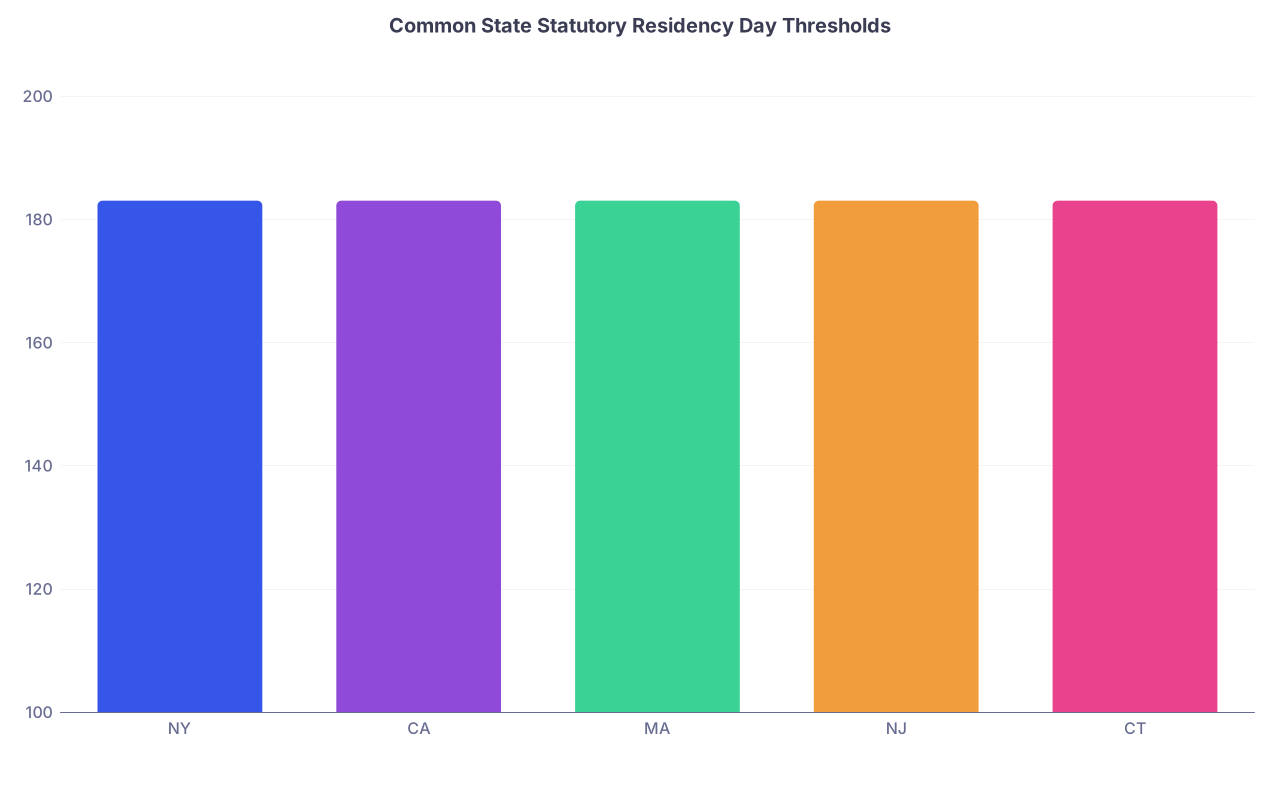
| Category | Value |
|---|---|
| NY | 183 |
| CA | 183 |
| MA | 183 |
| NJ | 183 |
| CT | 183 |
The fix:
- If you want out of a high-tax state, stop maintaining an accessible year-round residence there, or
- Track your days like your refund depends on it (because it might)
- Don’t casually crash at your own apartment/house in that state “whenever you’re in town”
If you keep a place in a high-tax state, treat it like radioactive material: count every day, know the rules, and do not drift past the threshold.
3. Believing “I Only Pay Where I Work” (Wrong in Two Directions)
Here’s a classic line I hear:
“I only work in State A, so I only pay tax there.”
Or the flip side:
“I live in State X, I pay there, so I don’t owe other states.”
Both are wrong in many situations.
The reality:
- Your domicile state (where you’re a resident) can tax your worldwide income.
- Nonresident states can tax you on income earned within their borders (W‑2, 1099, telemed, call shifts, etc.).
If you’re domiciled in, say, California, and you do locums in Arizona and Oregon, those states can tax your wages earned there. California then taxes your worldwide income but may give you credits for tax paid to other states.
The mistake people repeat:
- Ignoring nonresident filings in states where they worked (“I was only there 5 weeks, it doesn’t matter”)
- Assuming their home-state return somehow “covers everything”
- Forgetting telemedicine: you saw patients located in a different state → that state can claim taxation rights even if your body never crossed the border
Then what happens?
The state where you worked sees W‑2s or 1099s reporting income, with your name and SSN. They notice no corresponding return. They send a proposed assessment (with penalties and interest). Sometimes years later.
The fix:
- List every state where you physically worked or where your patients were located for telemed
- Check if those states have income tax and whether there’s a filing requirement for your income level
- File nonresident returns where required
- Coordinate credits with your resident state so you don’t get double-taxed
And stop assuming your payroll department or agency is handling this. They usually aren’t. Their responsibility is withholding, not optimizing your multi-state tax reality.
4. Treating High-Tax States Casually When You Leave
Exiting a high-tax state is not a casual event. If you think you “just moved” the day you started your first assignment elsewhere, you’re setting yourself up for a fight.
States like California, New York, New Jersey, and Massachusetts aggressively challenge residency changes, especially for high earners. Physicians are walking targets.
The repeated mistake:
- You accept an out-of-state contract
- You leave your old apartment as-is for a few months “while I test this out”
- You don’t change your driver’s license for a year because “DMV is a nightmare”
- Your mailing address is still your old state for bank accounts, credit cards, licensing boards
- You keep voting in your old state “because it’s easier”
On paper, you never left.
Then when you file as a nonresident or part-year resident, the state looks at your file and says, “Nope. Still ours.” You owe full-year resident tax.

The fix is boring but necessary:
- Plan your exit like a legal project, not a vibe shift
- Pick your new domicile state and document the move date:
- New lease or home closing
- Utility bills in your name
- Moving company invoice
- New driver’s license and voter registration shortly after arrival
- Close or convert the old residence (sell, end lease, or seriously limit access/use)
- Change addresses on:
- Medical license(s)
- DEA registration
- Bank, credit cards, loans
- Professional memberships
- Insurance (malpractice and personal)
If you want your residency change to survive scrutiny, it needs to look like an actual life move, not a six-month adventure.
5. Playing Games With “Mailing Address” vs. Actual Residency
Using your parents’ house as a “mailing address” in a no-tax state doesn’t magically move your residency there. States have seen that trick a thousand times.
The mistake:
- You list your parents’ home in Texas or Florida as your address
- But:
- You actually live and work mostly in California, New York, or Massachusetts
- Your apartment, friends, gym, doctors, and life are in the high-tax state
- You fly to the no-tax state maybe 2–3 times a year
Then when questioned, you wave your driver’s license and say, “But it says Texas.”
They won’t care. Residency is about facts, not paper. Economic and social ties matter more than whatever address you typed on a form.
What states look at (simplified):
| Category | Examples |
|---|---|
| Housing | Where you own/rent and for how long |
| Family Ties | Spouse/kids’ primary location, schools |
| Licenses/IDs | Driver’s license, vehicle registration |
| Financial | Bank/credit card addresses, local banks |
| Community | Church, clubs, physicians, social ties |
If those line up in the high-tax state, a Texas or Florida mailing address is just noise.
The fix:
- Align your life with your chosen domicile state in a way that actually looks like you live there
- If you truly are nomadic, accept that your last “real” state may still claim you and plan accordingly
- Stop using “my parents live in a no-tax state” as your only residency strategy
6. Forgetting That Telemedicine Leaves a Tax Trail
Telemedicine looks harmless. You sit in one state, see patients in another, maybe your company’s HQ is somewhere else entirely. People assume taxes follow where they are physically sitting.
States disagree.
Most states tax medical services where the patient is located, not the doctor. If you’re on a video call in Nevada and treating a patient in California, California often claims taxing rights.
Repeated problems I see:
- Telemed docs working for national platforms seeing patients from 10+ states
- No tracking of which states patients are in
- No idea where income was sourced
- Tax preparer just throws it all on one state return, or worse, only on federal
Then a state sees 1099s or W‑2s for companies that clearly operate there and asks, “Where’s your nonresident return?”
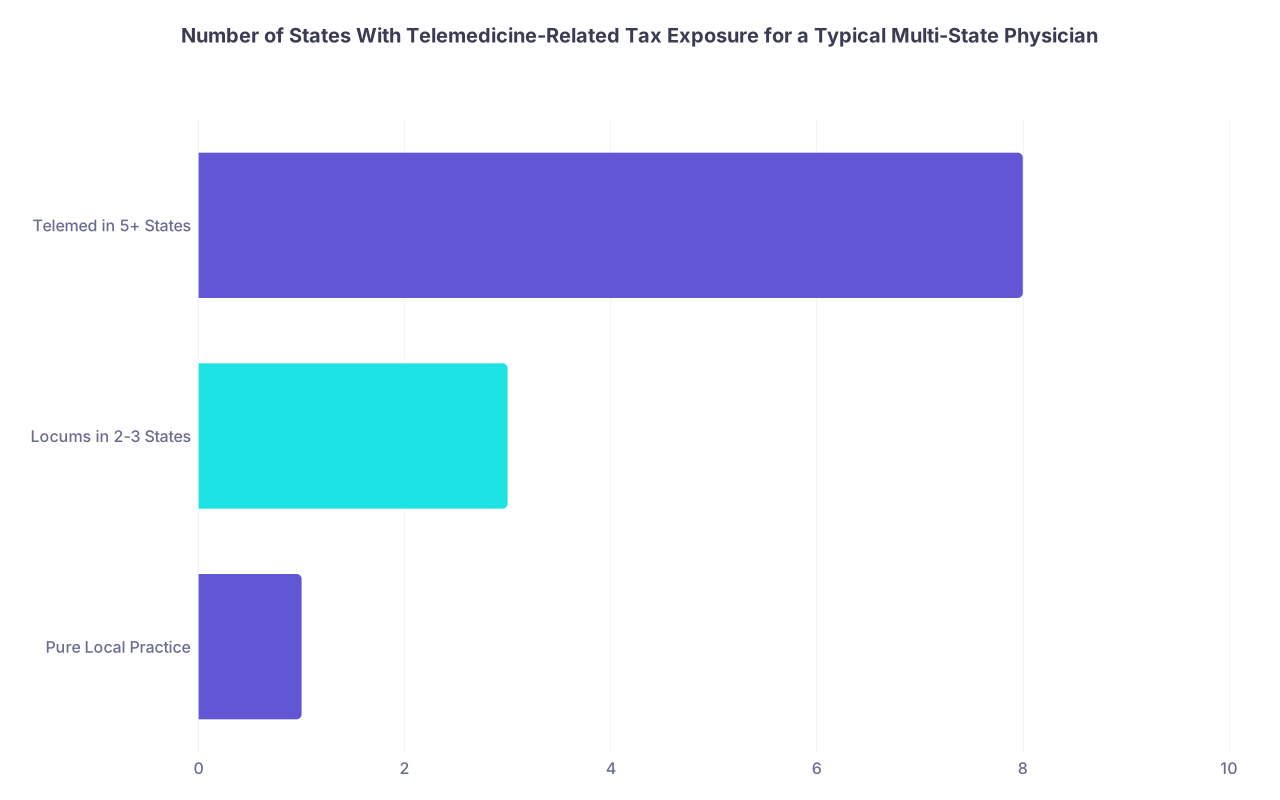
| Category | Value |
|---|---|
| Pure Local Practice | 1 |
| Locums in 2-3 States | 3 |
| Telemed in 5+ States | 8 |
The fix:
- Get clarity from your telemed employer or platform: where are patients located, and do they track it?
- If they can’t or won’t tell you, understand that you’re flying blind into multi-state tax exposure
- Work with a tax professional who understands telemedicine sourcing rules
- If multi-state complexity becomes unmanageable, intentionally limit which states you see patients from
Don’t assume that because the work feels digital, the tax world treats it that way. It doesn’t.
7. Blowing Off Day Counting and Documentation
This is not glamorous. But nothing will save you in a residency audit faster than solid day logs and documentation.
The recurring screw-up:
- You vaguely remember being “mostly in X state” during the year
- You have no calendar with locations
- You didn’t keep boarding passes or hotel receipts
- You can’t explain discrepancies between credit card activity and your memory
- You’re guessing under oath about how many days you spent in State Y
Revenue agents love this. Because once they decide your record-keeping is unreliable, they estimate aggressively in their favor.
The fix is simple, and no one does it consistently:
- Keep a location calendar — even a basic spreadsheet or calendar app
- Each day: which state you slept in
- Note travel days clearly
- Save:
- Flight confirmations
- Rental car receipts
- Hotel/Airbnb invoices
- Agency assignment letters with location and dates
- Sync with:
- Your EMR log-ins location
- Hospital credentialing records
If you’re ever challenged, you can reconstruct your year instead of winging it.
8. Mixing 1099 and W‑2 Income Without a Plan
Locums and traveling physicians often have a blend of:
- W‑2 hospital employment in one state
- 1099 locums in another state
- Telemed in multiple states
The repeated mistake:
- Treating all income as if it’s tied to a single state
- Not tracking where 1099 work was physically performed
- Letting agencies assign random “work location” addresses that don’t match reality
- Failing to adjust estimated tax payments for multi-state exposure
Then:
- One state under-withholds or doesn’t withhold at all
- No estimated payments are made for that state
- You end up with a big lump-sum bill plus underpayment penalties
The fix:
- For each 1099 gig, document:
- Where you physically were when doing the work
- Where the patient was (for telemed)
- Make state-specific estimated tax payments if withholding doesn’t cover it
- Don’t let the agency’s idea of “location” drive your tax reality — use the actual facts
9. Assuming Your CPA “Will Just Handle It”
I see this one constantly. A physician works in 4–5 states, their life looks complicated, and their tax return has… one state. Because the CPA “did what they always do.”
Most CPAs are not multi-state specialists. Many are fine with a simple move from State A to B. They are often not fine with:
- Simultaneous W‑2s in multiple states
- Telemed income sourced to several jurisdictions
- Partial-year moves out of aggressive states
- Dual-residency disputes
The mistake:
You don’t aggressively tell your CPA: “I worked in these exact states, for these periods, in these ways. How are we addressing each of them?”
You just upload your W‑2s/1099s and hope.

The fix:
- In January, make a list:
- Where you lived (domicile and any moves)
- Every state you worked in
- Any telemed activity and patient states if known
- Send that list explicitly to your preparer and ask:
- Which state returns are we filing?
- Where are we claiming resident vs. nonresident?
- Where are we claiming credits for taxes paid to other states?
- If they brush it off or seem confused, that’s a red flag. Get someone who actually understands multi-state physician tax issues.
10. Ignoring Licensing and Credentialing Clues
States look at where you’re licensed and where you maintain hospital privileges as additional evidence of your ties.
Common oversight:
- You move your claimed domicile but:
- Keep your original state medical license active and renew it as your “primary”
- Maintain multiple long-term hospital privileges in a high-tax state
- Let your DEA registration sit in the old state for years
- Meanwhile, your new “no-tax domicile” has minimal real activity beyond a mailing address and short stays
In an audit, this pattern screams “your real professional base is still the high-tax state.”
The fix:
- Realign your professional paperwork with your domicile story:
- Move DEA registration when reasonably possible
- Let some old-state licenses lapse if you’re not truly practicing there
- Build real, ongoing work and presence in your claimed domicile state (or at least not exclusively in your old one)
Your career footprint should match your residency narrative.
11. The Fantasy of Zero-State-Tax While Still Behaving Like a Resident
This is the hard truth: you can’t have a true, lived-in life in California, New York, or Massachusetts and magically be a resident of Texas or Florida just because you say so.
Yet physicians keep trying to pull off the “I live in a no-tax state” storyline while:
- Renting or owning long-term housing in the high-tax state
- Working the majority of the year there
- Keeping family there
- Participating in community, schools, clubs there
- Visiting the no-tax “home” a few scattered weeks per year
Auditors are not idiots. They look at patterns, not slogans.

| Step | Description |
|---|---|
| Step 1 | Claim No Tax State Residency |
| Step 2 | Lower audit risk |
| Step 3 | High risk statutory resident |
| Step 4 | High risk domicile claim rejected |
| Step 5 | Medium risk - need strong documentation |
| Step 6 | Do you keep a home in high tax state |
| Step 7 | Over 183 days there |
| Step 8 | Family and life mostly there |
If you want the no-tax benefits, you need to actually live the no-tax life. That means:
- Making the no-tax state the anchor of your personal and professional life
- Treating high-tax states as truly temporary for limited, counted periods
- Accepting that there may be a transition period where you still owe substantial tax to your old state before the move is fully recognized
When physicians ignore this, they end up with multi-year back-tax bills that wipe out the gains they thought they were capturing.
FAQs
1. If I move to a no-income-tax state but still do lots of locums in my old high-tax state, will I owe tax there?
Yes. Your old state can still tax the income you earn within its borders as a nonresident. Moving your domicile only stops that state from taxing income you earn elsewhere. It does not exempt the income you earn while physically working there.
2. I’m truly nomadic and don’t feel like I live anywhere. Can I just say I have no state residency and avoid state taxes?
That’s a fantasy. If you had a prior state of domicile and never clearly established a new one, your old state will usually still treat you as a resident. If you actually break all ties, states will still look for where you have the strongest connections. “Nowhere” is not a tax category they accept.
3. Do I really need to worry about day counts if I don’t keep an apartment or house in a state?
Day counts matter most for statutory residency when you have a permanent place of abode there. If you truly have no permanent home in a state (only hotels, short-term stays), the 183-day rule often doesn’t apply the same way. But you still trigger nonresident filing requirements once you work there, regardless of housing.
4. My agency withholds state income tax for the state where I’m doing locums. Doesn’t that mean I don’t need to file there?
No. Withholding and filing are separate. Withholding just means money was sent to that state in your name. You usually still have to file a nonresident return to reconcile the actual tax owed. In many cases you’ll owe more, and in some cases you might get a refund — but skipping the return is how you get notices and penalties.
5. What’s the single most protective step I can take this year to avoid a state residency mess?
Decide — in writing, for yourself — what your true domicile state is and then make your life match that choice: housing, licenses, bank addresses, voting, family location, and work pattern. Combine that with a simple day-tracking system and you’ll avoid 80% of the disasters I see traveling physicians repeat year after year.
Key points to walk away with:
- Residency is about facts, not where you wish you lived; your housing, family, work, and paperwork must tell the same story.
- Multi-state work (locums, travel, telemed) creates real nonresident filing obligations — ignoring them is how back-tax nightmares start.
- If you want no-tax-state benefits, commit fully and document everything; half-measures and vague “I’m kind of based there” stories are exactly what aggressive states tear apart.


