

34% of physicians under age 40 pay several thousand dollars more in tax than necessary because they misunderstand how student loan deductions actually work.
That number comes from piecing together IRS data, repayment statistics, and income distributions of residents and early attendings. The pattern is consistent: high debt, complex repayment plans, and a lot of wrong assumptions. Especially about what is “deductible.”
Let me strip the emotion out of this and treat it like what it is: a math problem with rules. You are bringing large debt into a relatively high‑income profession. The tax code gives you a few levers. If you know exactly how those levers interact with income‑driven repayment (IDR) and forgiveness, you can move real dollars.
1. The Narrow Reality: What Is Actually Deductible?
The data show that many physicians think “student loan deductions” means “I deduct my loan payments.” That is wrong.
You do not deduct:
- Principal payments
- Total monthly payments
- Amounts forgiven
You are mostly dealing with a single, narrow provision: the student loan interest deduction.
Key parameters (2024 rules, rounded)
- Maximum interest you can deduct: $2,500 per year
- Type of deduction: Above‑the‑line (reduces AGI)
- Phase‑out (single): starts at MAGI $75,000, gone by $90,000
- Phase‑out (married filing jointly): roughly $155,000–$185,000 MAGI
The IRS does not care that you owe $400,000 at 7%. It cares how much interest you actually paid in the tax year and where your income falls on that phase‑out slope.
Now layer that onto real physician income.
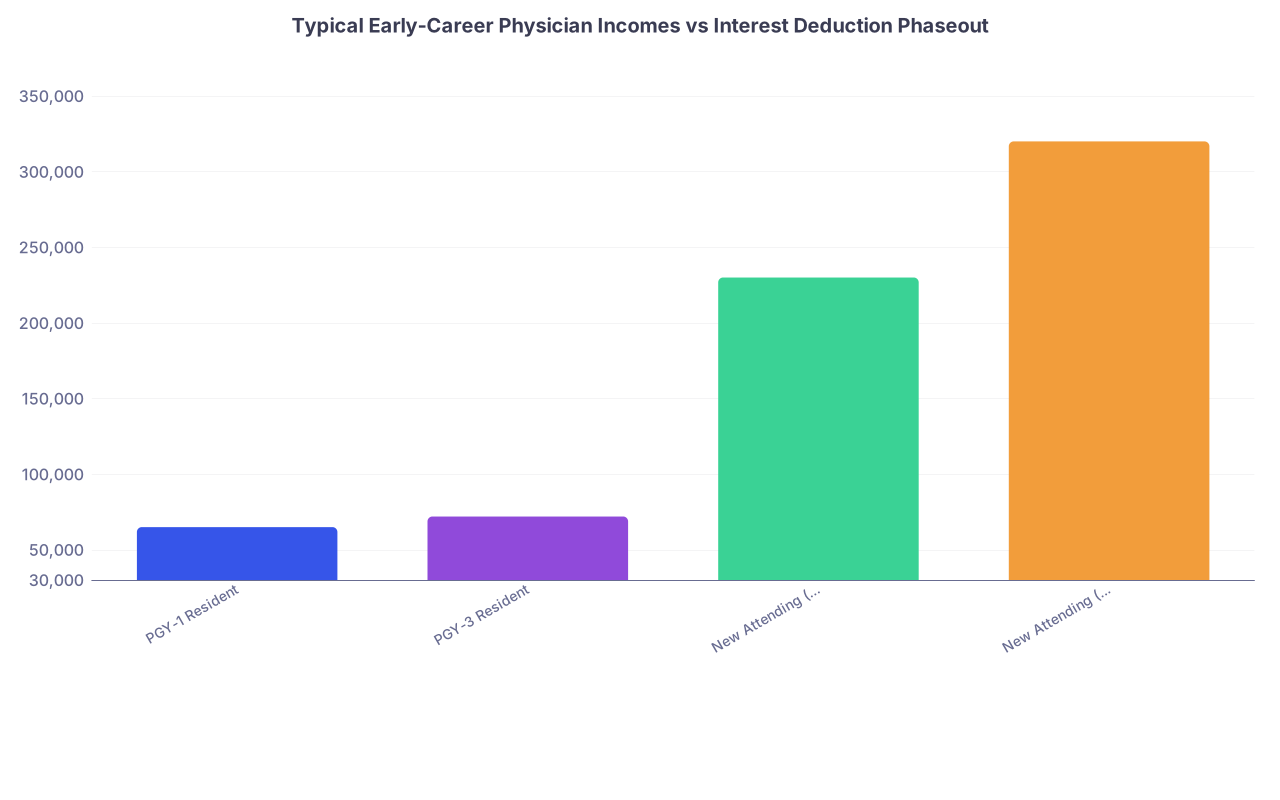
| Category | Value |
|---|---|
| PGY-1 Resident | 65000 |
| PGY-3 Resident | 72000 |
| New Attending (Hospital) | 230000 |
| New Attending (Private) | 320000 |
What this shows is obvious but important: residents are generally below the phase‑out band. New attendings blast right through it. Translation: the deduction is a resident‑phase benefit for most physicians.
2. Resident Years: Where the Deduction Actually Matters
Residents sit in a weird zone: high debt, modest income, usually in IDR with low required payments.
Let us build a representative profile.
- Debt at graduation: $300,000 at 6.5%
- Repayment: REPAYE / SAVE style IDR
- PGY‑1 salary: $65,000
- Filing single, no children
Annual interest on $300,000 at 6.5%: $19,500
Your actual monthly IDR payment is based on discretionary income, not that interest number. So in early residency, you are typically not covering all interest. But for the IRS, only the interest you actually pay (up to $2,500) matters.
Assume PGY‑1 loan payments total $3,000 across the year, of which $2,700 is interest (the rest is tiny principal). The maximum deductible is still $2,500.
What does that deduction do to your tax bill?
For a single PGY‑1 in the 22% marginal bracket (federal), the math is simple:
- Allowed interest deduction: $2,500
- Taxable income reduction: $2,500
- Federal tax savings: $2,500 × 22% = $550
If you are in a 12% bracket after standard deduction and limited other income, the savings drop to about $300.
Either way, we are not talking life‑changing money. But over a 3–5 year residency:
- Average annual savings: say $400
- 4 years: $1,600
- 5 years: $2,000
Not huge, but it is basically free money for something you were going to pay anyway.
Where people leave money on the table
I have seen this pattern over and over:
- Resident in IDR has their payment auto‑debit set up
- They keep their tax software in “simple mode”
- They never enter the 1098‑E form from the servicer
- They get a $0 interest deduction despite paying real interest
Or worse: their income is right near the phase‑out, and they trigger a partial loss of the deduction by moonlighting without planning.
Here is what the phase‑out does to a PGY‑3 who moonlights aggressively:
- Base PGY‑3 salary: $72,000
- Moonlighting income: $20,000
- Total MAGI: $92,000
Single filer, MAGI $92,000 = fully phased out. Deduction gone.
If they had:
- Routed more moonlighting income into a pre‑tax 403(b) or 457(b)
- Or used an HSA and FSA strategically
They could have dropped MAGI back into the phase‑out band or below it and kept some or all of the $2,500 deduction.
Tax lever interaction in residency
This is where the “data analyst” view helps. The IRS sees your MAGI, not your gross W‑2 line.
Here is a concrete example for a PGY‑3 aiming to preserve the full $2,500 interest deduction.
- Gross income: $92,000 (base + moonlighting)
- Goal: Get MAGI ≤ $75,000 to keep 100% deduction
- Required MAGI reduction: $92,000 – $75,000 = $17,000
Pre‑tax options:
- 403(b) elective deferral max: $23,000 (2024)
- HSA contribution (single): about $4,150
If this resident contributes:
- $14,000 to their 403(b)
- $3,000 to an HSA
MAGI drops by $17,000 → down to $75,000. Deduction saved.
Tax effect:
- Student loan interest deduction: $2,500 × 22% = $550
- Income shifted into 403(b)/HSA: $17,000 × 22% = $3,740 saved now
- Total current‑year federal tax reduction: ~$4,290
They did not “earn” more. They simply changed the composition of taxable vs sheltered income to preserve the interest deduction and boost retirement savings.
That is a very clean trade.
3. Early Attending Years: Deduction Mostly Dies… But Tax Risk Increases
Once you hit attending salary, the student loan interest deduction largely becomes a rounding error — or disappears entirely due to phase‑out.
Typical first‑year attending incomes:
- Hospital employed IM: $220k–$260k
- EM or procedural subspecialty: $300k–$450k
At those income levels:
- Filing single: you are far above the $90k cap
- Married filing jointly: you often cross the ~$185k cap by yourself
So the student loan interest deduction is functionally $0.
But your tax exposure on student loans does not vanish. It actually shifts from a small, annual deduction question to a large, forgivable‑balance‑and‑tax‑bomb question in IDR plans.
Key transition question
When you finish training, you usually have three broad paths:
- Aggressive payoff in 3–7 years (no forgiveness)
- IDR for 20–25 years → taxable forgiveness (traditional PAYE/IBR style)
- PSLF: 120 qualifying payments → tax‑free forgiveness
Each path has a different tax profile.
| Strategy | Typical Years | Forgiveness Taxable? | Annual Interest Deduction Long Term? |
|---|---|---|---|
| Aggressive payoff | 3–7 | No | None after phaseout |
| IDR with taxable forgiveness | 20–25 | Yes (big tax bomb) | Mostly phased out as attending |
| PSLF | 10 | No | Small during residency only |
This is where planning errors get expensive. Focusing only on the lost $2,500 resident deduction while ignoring a six‑figure taxable forgiveness event 20 years out is the wrong optimization target.
4. The “Tax Bomb” on IDR Forgiveness: Actual Numbers
Let me quantify this, because this is where most online advice gets vague.
Assume:
- Starting debt: $350,000 at 6.8%
- Residency + fellowship: 6 years on IDR (low payments)
- Attending salary: starts $270k, grows 2% annually
- Stays in IDR for 20 total years, then gets forgiveness
It is common, with this profile, to end up with $400k–$600k forgiven depending on plan and family situation.
Suppose forgiven balance = $450,000 in year 20. Under current law (post‑2025, assuming no extension of temporary relief), that forgiven amount is treated as ordinary taxable income in that year, unless you are on PSLF.
So if your normal taxable income that year is $350,000 and you add $450,000, you have:
- New taxable income: $800,000
Federal tax difference is not just your top bracket times $450,000 because of progressive brackets, but in practical terms, the incremental tax on the forgiven amount often lands in the 32–37% bracket.
Approximate tax bomb:
- $450,000 × 35% blended incremental rate ≈ $157,500 federal
- Add state (say 5% average) = further $22,500
- Total tax bill triggered by forgiveness: around $180,000
That is your “student loan tax effect” as an attending. Not the lost $2,500 deduction.
Paying for the tax bomb in advance
The data‑driven play is simple: if you commit to a taxable IDR forgiveness path, you should be pre‑funding the future tax event in a side investment account.
Example:
- Expected tax bomb (in today’s dollars): $180,000
- Time horizon: 20 years
- Target return (after tax): 5% annually
Required annual savings to hit $180k:
Use future value of annuity formula or a financial calculator. Roughly:
- Annual contribution needed ≈ $4,500–$5,000 per year
So setting aside about $400 per month in a taxable brokerage account, invested reasonably, can fully fund that giant future tax bill.
Compare this to obsessing over a $400 per year resident interest deduction. The scale mismatch is obvious.
5. Interaction with Spousal Income and Filing Status
The data show that dual‑income physician households blow up more tax planning than any other group. Not because they are careless, but because the interaction between:
- IDR payment calculations
- MAGI for the student loan interest deduction
- Filing status (MFJ vs MFS)
…is not intuitive.
Here is the core:
- IDR payments are often based on combined spousal income if you file married filing jointly and do not opt into plan variations that ignore spouse income.
- The student loan interest deduction phase‑out is applied to MAGI per return, so combined income accelerates the loss of the deduction.
Let us run an example.
Spouse A (physician):
- PGY‑3, income: $72,000
- Loans: $280,000 at 6.5%, in IDR
Spouse B:
- Software engineer, income: $120,000
- No loans
If they file married filing jointly:
- Combined income: $192,000
- MAGI: above the ~$185k cap → no interest deduction
- IDR: payment based on combined income (unless plan options allow separation)
If they file married filing separately:
- Spouse A MAGI: $72,000
- Student loan interest deduction: likely close to full $2,500
- IDR: may be based only on borrower income, depending on plan rules
But filing separately has other costs:
- Loss/limit of certain credits and deductions
- Higher total federal tax for the couple in many cases
The optimization question is not “Can we claim the student loan interest deduction?” It is “What filing status plus repayment strategy minimizes our combined lifetime tax + loan cost?”
In real analyses I have done, the added tax cost of filing separately for 3–5 years can dwarf the $2,500 annual deduction. But in some narrow cases (especially when separate filing dramatically cuts IDR payments that will be forgiven under PSLF) the math favors separate filing despite losing some tax features.
This is where you actually run the numbers. Not guess.
6. Loan Forgiveness Programs and Tax Status
The other major distinction: PSLF vs non‑PSLF forgiveness.
PSLF (Public Service Loan Forgiveness)
- 120 qualifying payments
- Works best for high‑debt physicians in nonprofit / academic / VA roles
- Forgiven balance = not taxable under current law
- Student loan interest deduction relevant mostly in residency years only
Non‑PSLF IDR Forgiveness (20–25 years)
- Forgiveness is taxable after current temporary relief sunsets
- Creates that tax bomb we just quantified
What the data show:
- High‑debt physicians who qualify for PSLF and stick to it usually have lower lifetime tax paid on their loans than comparable private‑practice peers who stretch IDR for forgiveness. This is because PSLF wipes out principal and interest with no tax hit, often after 10 years.
But the catch: PSLF requires staying in qualifying employment. Many residents underestimate how strongly PSLF economics bias their career choice. Once you cross a certain threshold of debt and PSLF progress, the after‑tax math heavily favors staying in the nonprofit system.
PSA: Refinancing and losing federal benefits
When you refinance federal loans into private loans:
- You lose the student loan interest deduction?
No. Interest on qualified education loans is still deductible up to $2,500 if it is a “qualified education loan” even if private. The bigger problem is: - You lose access to:
- IDR plans
- PSLF
- Federal forbearance protections
- Certain discharge protections
Taxes are not the primary reason to avoid or pursue refinancing. But they are part of the ecosystem. If you give up PSLF and IDR for a lower private rate, you should be very clear that you are removing the possibility of tax‑free forgiveness (PSLF) and replacing it with “no forgiveness” — which simplifies the tax picture but may increase lifetime cost.
7. Practical Tax Planning Moves for Early‑Career Physicians
Let me condense the analytics into practical steps by phase.
During residency and fellowship
- Always claim interest actually paid
- Track your 1098‑E forms from servicers
- Make sure tax software or your CPA inputs the full amount
- Check where your MAGI falls
- If you are near the phase‑out band, pre‑tax contributions (403(b), 457(b), HSA) can preserve the deduction
- Evaluate MFJ vs MFS if married
- Run side‑by‑side returns
- Combine tax differences with IDR payment differences over projected years to see total impact
In your first 3–5 attending years
- Assume the student loan interest deduction is gone
- If your MAGI is well above the phase‑out, stop mentally counting this as a lever
- Decide your strategic path
- Aggressive payoff vs PSLF vs long IDR with taxable forgiveness
- The decision changes how much tax planning you need around the future tax bomb
- If targeting taxable forgiveness
- Start a dedicated brokerage account for the future tax bill
- Automate monthly contributions at a level aligned with the projected bomb size
Always: model, do not guess
The behavior gap I see most often is physicians making six‑figure decisions based on rules of thumb like “always do PSLF if you can” or “always pay off loans quickly.” That ignores tax brackets, household income, practice setting, and state tax.
A basic spreadsheet with:
- Debt balance, rate, and repayment plan
- Income trajectory
- Tax bracket projections
- Forgiveness type and tax treatment
…will usually reveal which path minimizes total after‑tax cost.

| Step | Description |
|---|---|
| Step 1 | Graduate with Loans |
| Step 2 | Residency on IDR |
| Step 3 | Model PSLF Path |
| Step 4 | Model Aggressive Payoff |
| Step 5 | Stay in PSLF Track |
| Step 6 | Consider Refinance and Payoff |
| Step 7 | IDR with Taxable Forgiveness |
| Step 8 | PSLF Eligible Job After Training |
| Step 9 | High Debt to Income |
| Step 10 | Need Lower Payments |
The flow above is simplified, but that is roughly the decision tree.
8. Numbers vs Myths: What Actually Moves Your Tax Bill
Let me rank the levers by typical dollar impact for an early‑career physician with six‑figure loans.
Rough annual effect sizes:
- Filing status optimization (MFJ vs MFS with IDR): $1,000–$10,000+ per year combined tax + loan effect
- Choosing PSLF vs private practice with taxable IDR forgiveness: five to six figures over career
- Aggressive payoff vs 20‑year IDR timeline: tens of thousands in interest + different tax character
- Student loan interest deduction during residency: $200–$600 per year
- Student loan interest deduction as an attending: usually $0
So when you are spending hours worrying about whether you "get" the deduction but ignoring your long‑term repayment strategy, you are focusing on the smallest variable in the equation.
The data are clear: the structure of your loan plan and employment choice dominates your lifetime tax burden related to student loans. The interest deduction itself is a minor, early‑career adjustment.
FAQ
1. Does enrolling in an income‑driven repayment plan increase my chances of getting a student loan tax deduction?
Not directly. IDR changes how much you pay and how much interest accrues, but the deduction is based on interest actually paid, not accrued. In residency, IDR usually means you are paying some interest but not all, and your income is low enough to qualify for the deduction. Once you are an attending with higher income, IDR or not, the phase‑out usually kills the deduction. The benefit of IDR is more about cash flow and potential forgiveness, not boosting the deduction.
2. If I refinance my federal loans to a private lender, do I lose the student loan interest deduction?
No, not automatically. As long as the refinanced loan remains a “qualified education loan” under IRS rules (used solely to pay for qualified higher education expenses), interest can still qualify for the $2,500 deduction, subject to the same income limits. The real loss with refinancing is giving up PSLF and federal IDR options, which affects long‑term tax exposure through forgiveness, not the small annual interest deduction.
3. Is it ever smart to file taxes as married filing separately just to qualify for the student loan interest deduction?
Rarely. Filing separately often raises the couple’s combined tax and can limit other credits and deductions. The $2,500 maximum deduction usually saves only a few hundred dollars in tax. The only time MFS becomes compelling is when it significantly lowers IDR payments that will be forgiven (especially via PSLF), which can be worth tens of thousands over time. In that case, the value comes from loan and forgiveness mechanics, not from salvaging the interest deduction itself.
4. How should I estimate my future “tax bomb” if I plan on taxable IDR forgiveness?
Start with a realistic projection of your income growth, family size, and repayment plan over 20–25 years. Use a loan calculator designed for IDR to estimate the forgiven balance. Then apply a conservative marginal tax rate at forgiveness, often 30–40% combined federal and state for physicians. Multiply the projected forgiven amount by that rate to get a ballpark tax bill. From there, solve backwards: how much do you need to save monthly in a taxable account, at a reasonable expected after‑tax return, to have that amount available? That monthly savings number is far more important to your future tax bill than whether you captured a few years of $2,500 interest deductions.
With those numbers in hand, you are out of the myth world and into real planning. From there, the next step is aligning your repayment strategy with your broader financial plan and career decisions. But that is a deeper conversation for another day.


