

The default instinct many high‑income physicians have about Roth IRAs is wrong: they assume the account is “too small to matter” compared with a taxable brokerage. The data says otherwise. Over 30–40 years, even a modest annual Backdoor Roth can rival or beat a much larger taxable account for after‑tax wealth.
You do not need opinions here. You need projections, assumptions, and math.
Below I am comparing Backdoor Roth IRA contributions against investing the same after‑tax dollars in a taxable brokerage account, specifically for physicians in the typical 32–37% federal bracket with long careers and substantial investment horizons.
1. Core Setup: What Exactly Are We Comparing?
Strip away the jargon.
You have two choices with the same $6,500–$7,000 of after‑tax cash each year (ignoring exact IRS limits by year for simplicity):
Use it for a Backdoor Roth IRA
- Step 1: Contribute to a nondeductible traditional IRA
- Step 2: Convert to Roth IRA, ideally with no or minimal gains in between
- Result: Money grows tax‑free; withdrawals in retirement are tax‑free.
Put the same cash into a taxable brokerage
- Buy a broadly diversified stock index fund.
- Pay annual taxes on dividends.
- Realize capital gains when you sell.
Assumptions I will use (you can adjust mentally, but the relationship will not change much):
- Investment horizon: 30 years (we will also look at 20 and 40).
- Nominal pre‑tax return: 7% per year (approximately 2% dividends, 5% price growth).
- Qualified dividend and long‑term capital gains tax rate: 20% federal.
- Ordinary income tax rate in attending years: 35% (roughly 32–37% bracket).
- State tax: ignored for simplicity, but it usually strengthens the Roth advantage.
- You hold a tax‑efficient index fund, not a high‑turnover active fund.
The key friction in the taxable account:
- Dividends are taxed annually.
- Realized capital gains are taxed when you sell.
At a 2% dividend yield and 20% tax rate, your annual “tax drag” on dividends is:
- 2% × 20% = 0.4% per year reduction in effective return.
So a 7% pre‑tax return becomes roughly 6.6% after you pay dividend taxes each year, before considering future capital gains taxes.
2. One‑Year Cash Flow: Backdoor Roth vs Taxable
You earn income, get taxed, then invest. For this analysis, hold the after‑tax dollars equal:
- Backdoor Roth: $6,500 goes into nondeductible traditional IRA → converted to Roth.
- Taxable: $6,500 goes straight into a brokerage account.
In the ideal Backdoor Roth (no other pre‑tax IRA balances, and you convert immediately):
- The contribution is already after‑tax.
- There is essentially no tax cost on the conversion.
- Basis = $6,500; conversion amount $6,500; no embedded gain → no tax.
So $6,500 ends up inside the Roth IRA, fully able to grow tax‑free.
Taxable account: $6,500 is simply invested. No upfront tax advantage or penalty beyond the ordinary income tax you already paid on the earning itself.
Year 1 growth comparison at 7%:
- Roth: grows to $6,955 (7% growth, no tax).
- Taxable:
- Dividends: 2% × $6,500 = $130; tax at 20% = $26.
- Price appreciation: 5% × $6,500 = $325 (unrealized, no current tax).
- Ending value: $6,500 + $130 + $325 − $26 = $6,929.
Already, the Roth is ahead: $6,955 vs $6,929. Tiny. But that small edge compounds every year and scales heavily when you repeat this for decades.
3. Long‑Term Compounding: The Numbers Over 20–40 Years
Now the real question: what does this look like over 20, 30, 40 years if you repeat the same contribution every year?
I will first show the growth of a single $6,500 contribution and then the impact of 30 years of contributions. You care more about the series, but the single contribution example shows the mechanism clearly.
3.1 Single $6,500 Contribution: No Additional Contributions
Roth IRA at 7% for 30 years:
- Future value = 6,500 × (1.07)³⁰
- (1.07)³⁰ ≈ 7.612
- Roth future value ≈ $6,500 × 7.612 ≈ $49,478
- Tax on withdrawal: $0 (assuming qualified).
Taxable at 6.6% after drag (ignoring capital gains at the end for a moment):
- Future value ≈ 6,500 × (1.066)³⁰
- (1.066)³⁰ ≈ 6.56
- Approx. value ≈ $6,500 × 6.56 ≈ $42,640
That is already ~14% less than the Roth before we even tax the final capital gains.
Now include capital gains tax at liquidation:
- Original basis: $6,500
- Appreciation: 42,640 − 6,500 = 36,140
- Tax on gains: 20% × 36,140 ≈ 7,228
- After‑tax value: 42,640 − 7,228 ≈ $35,412
Compare after 30 years:
- Roth: $49,478 (no tax)
- Taxable: $35,412 (after all taxes)
Same $6,500. Same market. Different tax wrapper. The taxable account delivers ~28% less spendable money from that one contribution.
3.2 Series of Contributions: 30 Years, $6,500 per Year
Now assume you contribute every year for 30 years at the same return rates.
For the Roth (7% return, 30 annual contributions of $6,500):
- Use future value of an annuity formula:
FV = P × [((1 + r)ⁿ − 1) / r]
P = 6,500; r = 0.07; n = 30
Factor = ((1.07)³⁰ − 1) / 0.07 ≈ (7.612 − 1) / 0.07 ≈ 6.612 / 0.07 ≈ 94.46
Roth FV ≈ 6,500 × 94.46 ≈ $614,000 (rounded)
All of that $614k is tax‑free in retirement.
For the taxable account, there are two layers:
- Lower effective annual growth due to dividend tax drag (~6.6% instead of 7%).
- Capital gains tax on the final liquidation.
Step 1: approximate value before liquidating:
- FV ≈ 6,500 × [((1.066)³⁰ − 1) / 0.066]
- (1.066)³⁰ ≈ 6.56
- Factor ≈ (6.56 − 1) / 0.066 ≈ 5.56 / 0.066 ≈ 84.24
- Pretax taxable FV ≈ 6,500 × 84.24 ≈ $547,560
Total contributions: 6,500 × 30 = 195,000
Approximate gain: 547,560 − 195,000 = 352,560
Tax on gains at 20%: ≈ 70,512
After‑tax value: 547,560 − 70,512 ≈ $477,048
So with 30 years of contributions:
- Backdoor Roth: ≈ $614,000 after tax.
- Taxable: ≈ $477,000 after tax.
Delta: ~$137,000 more for the Roth. Same dollars in. Same market returns. Just wrapper differences.
To see the pattern over different horizons:
| Horizon | Backdoor Roth (7%) | Taxable (6.6%, then 20% on gains) |
|---|---|---|
| 20 yrs | ≈ $266,000 | ≈ $214,000 |
| 30 yrs | ≈ $614,000 | ≈ $477,000 |
| 40 yrs | ≈ $1,256,000 | ≈ $947,000 |
At 40 years, the Roth advantage creeps toward $300,000.
To visualize that growth gap:
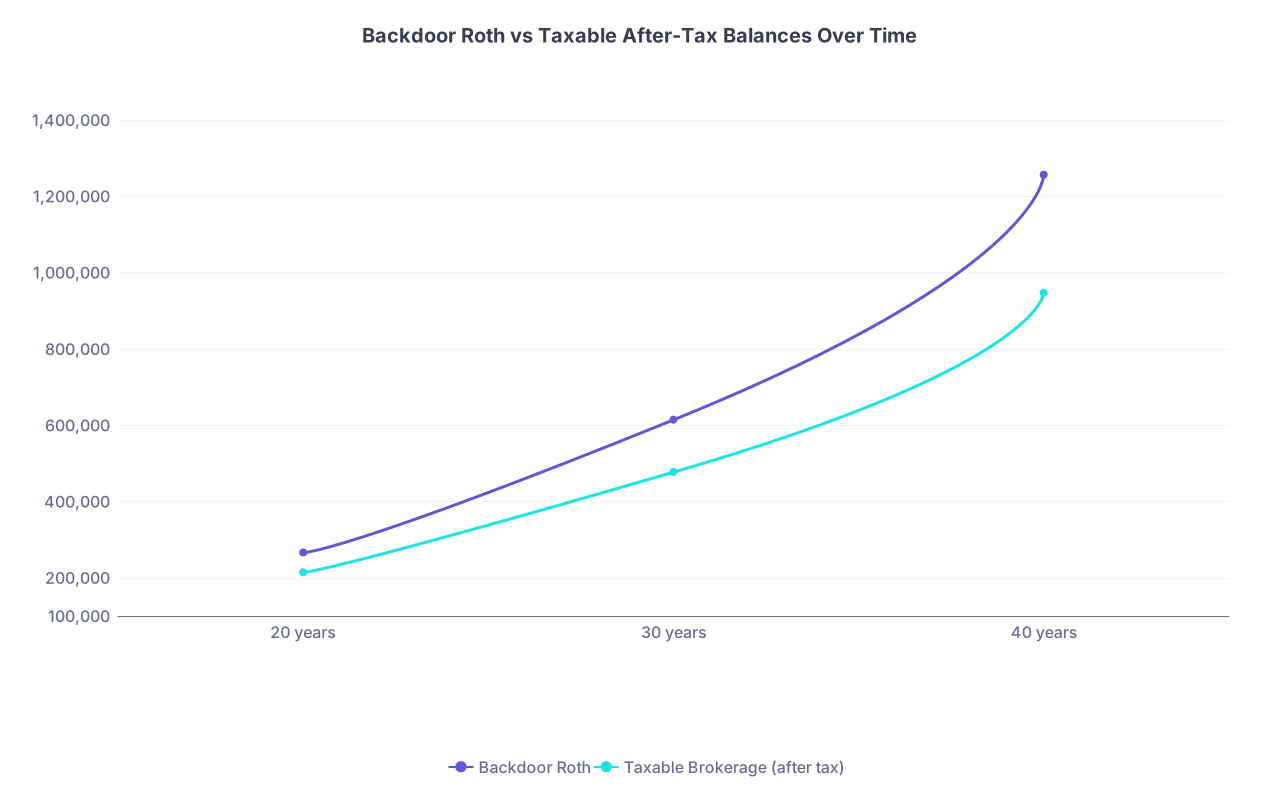
| Category | Backdoor Roth | Taxable Brokerage (after tax) |
|---|---|---|
| 20 years | 266000 | 214000 |
| 30 years | 614000 | 477000 |
| 40 years | 1256000 | 947000 |
If you are a 30‑year‑old attending planning to work until 60–65, this is your reality pattern.
4. Impact of Higher Income and Higher Tax Drag
Most attendings do not hold just one fund in taxable. They own some combination of:
- Broad index funds (good).
- Sector funds, active funds, or individual stocks with turnover (bad for tax drag).
- Possibly bond funds (worse from a tax perspective in taxable).
The data shows that once you move from a pure, low‑turnover index fund to something with more distributions, the effective annual “tax drag” can easily jump from 0.4% to 1%+ per year.
Let me model a slightly sloppier, but realistic, taxable behavior:
- Average dividend + distributed gains yield = 3%
- Tax rate on those = 20% (some part may be non‑qualified, so this is charitable)
- Annual tax drag: 3% × 20% = 0.6%
- Effective return: 7% − 0.6% = 6.4%
Redo the 30‑year series with 6.4% return in taxable:
- FV ≈ 6,500 × [((1.064)³⁰ − 1) / 0.064]
- (1.064)³⁰ ≈ 6.16
- Factor ≈ (6.16 − 1) / 0.064 ≈ 5.16 / 0.064 ≈ 80.6
- Pretax taxable FV ≈ 6,500 × 80.6 ≈ $523,900
Subtract tax on gains (assuming basis still $195,000):
- Gain: 523,900 − 195,000 = 328,900
- Tax at 20% ≈ 65,780
- After‑tax ≈ $458,000
Now the Roth advantage at 30 years is ≈ $614k − $458k = $156,000 difference.
The worse you are at tax‑efficient investing in your brokerage account, the stronger the Backdoor Roth wins.
5. So Why Use Taxable At All?
If the Roth wrapper is this good, why not just put everything there?
Because you cannot.
Legally, you are constrained:
- Roth IRA contribution limit: around $6,500–$7,000 per year (depending on current IRS rules and your age).
- Income phase‑outs on direct Roth contributions as a high earner. Backdoor circumvents this, but the amount is still capped.
- Many attendings are investing $50,000–$200,000+ per year once loans are under control and lifestyle is stabilized.
Your Roth pipeline is small. Your 401(k)/403(b)/457(b) spaces are larger, but Roth IRA via Backdoor is still a very tax‑efficient slice.
Taxable brokerage becomes necessary for:
- Extra savings beyond all tax‑advantaged space.
- Flexibility (early retirement, pre‑59.5 access).
- Certain specialized strategies (tax‑loss harvesting, concentrated bets, etc.).
So the real question for a physician is not “Roth or taxable?” It is:
- “Am I fully exploiting my limited Roth capacity each year?”
- “How should I allocate between Roth, pre‑tax, and taxable given my current and expected future tax brackets?”
But if the specific choice is:
“Backdoor Roth or just skip it and put that $6,500 in taxable?”
The numbers from Sections 3–4 show that skipping the Backdoor Roth is leaving six figures on the table over a long career.
6. Physician‑Specific Twist: Current vs Future Tax Rates
The other common argument you will hear in physician circles:
“Roth is only good if your tax rate in retirement is higher than now. I’ll retire in a lower bracket, so I should avoid Roth.”
That logic applies to pre‑tax vs Roth 401(k) decisions much more than to a Backdoor Roth.
With a Backdoor Roth IRA:
- Your contribution is not deductible now.
- You are contributing with after‑tax dollars either way (Roth or taxable).
- The relevant comparison is not “25% now vs 15% later” but “ongoing tax drag and capital gains vs none.”
The growth inside a Roth IRA is never taxed again if rules are followed. Period.
A taxable brokerage:
- Faces dividend taxes annually at your current bracket.
- Faces capital gains taxation when sold, at whatever your future bracket is.
Run through a simple retirement bracket scenario.
Assume:
- You retire with combined income that puts you in the 15% capital gains bracket.
- So rather than 20% on gains, you pay 15% in retirement.
- Dividend tax drag during working years is still at your current 20% rate on qualified dividends.
Recalculate the 30‑year taxable series with:
- 0.4% annual drag (as before, 2% yield, 20% during working years);
- 15% capital gains tax at liquidation.
The change is only in the liquidation tax:
- Prior gain: ≈ $352,560
- Tax at 15%: ≈ 52,884
- After‑tax value ≈ 547,560 − 52,884 ≈ $494,676
Still significantly lower than the Roth’s ≈ $614,000. You narrowed the gap, but it is still roughly $119,000 behind.
So even if your future capital gains rate is lower than now, the ongoing annual drag during your high‑income years still makes the Roth very hard to beat.
7. Risk, Liquidity, and Behavioral Realities
The math above assumes:
- You contribute the full Backdoor Roth every year.
- You invest it the same way in both accounts.
- You do not raid the account early.
- No legislative changes.
But physicians are humans, not spreadsheets.
Here is how behavior typically diverges:
Taxable money is “available” and therefore more likely to be spent.
I have seen more attendings dip into taxable for home down payments, cars, even private school tuition than I can count.
Roth IRAs are psychologically “retirement only.” That forced discipline compounds.Roth accounts are often invested more aggressively.
Many investors mentally earmark Roth as “longest‑horizon, last to touch money,” so they hold 90–100% equities there.
Taxable often ends up with a mix that is more conservative or more complex (e.g., adding bonds or “fun money” positions).Asset location optimization tilts strongly in Roth’s favor.
From a tax‑efficiency standpoint, the highest expected return assets belong in Roth.
Lower returning, more tax‑inefficient assets (like bonds) fit better in pre‑tax or sometimes taxable.
So the real‑world differential between Backdoor Roth and taxable is often larger than the clean theoretical models show.
8. Where the Backdoor Roth Loses or Becomes Marginal
There are scenarios where the Backdoor Roth is less compelling:
Very short time horizon
If you are 60 starting attending work, plan to retire at 65, and your Roth will only compound for 5–10 years, the tax‑free compounding edge is small.Extremely tax‑efficient taxable plus low future tax rate
If you:- Only hold total market index funds,
- Have very low dividend yields,
- Perform perfect tax‑loss harvesting,
- Retire with essentially zero taxable income so that capital gains are realized in the 0% bracket,
then the advantage narrows enormously.
Very few high‑income physicians execute that perfectly.
Pro‑rata rule issues with big existing pre‑tax IRAs
If you already have a large traditional IRA, SEP IRA, or SIMPLE IRA, a Backdoor Roth conversion becomes entangled with the pro‑rata rule, triggering tax on a large portion of any conversion.
In that case, you either:- Roll those IRAs into an employer’s 401(k)/403(b) to “clear the deck,” or
- Accept that the Backdoor Roth is not clean, and taxable might be simpler.
Ultra‑high savings where liquidity trumps everything
If you are already maximizing every pre‑tax and Roth space, and your taxable account is huge, then the marginal benefit of fighting for the Backdoor Roth paperwork each year could be trivial relative to the rest of your assets.
But that is rare in the first 10–15 years out of training.
9. Implementation Details That Physicians Commonly Botch
The Backdoor Roth is not complex, but physicians routinely mess it up in predictable ways:
Holding money in the traditional IRA for months before converting.
Result: you create taxable gains that complicate Form 8606. Convert quickly.Having existing pre‑tax IRA balances at year‑end.
Result: pro‑rata rule applies; your conversion is partly taxable; you lose much of the advantage.Forgetting to file Form 8606.
Result: IRS thinks the conversion is fully taxable; you effectively pay tax twice.
The clean pattern looks like this:

| Step | Description |
|---|---|
| Step 1 | After tax cash ready |
| Step 2 | Confirm no pre tax IRA at year end |
| Step 3 | Contribute to nondeductible traditional IRA |
| Step 4 | Wait minimal time |
| Step 5 | Convert full balance to Roth IRA |
| Step 6 | Invest in chosen allocation |
| Step 7 | File Form 8606 with tax return |
Once you have that pipeline set, it is a yearly ritual.
Taxable brokerage, by contrast, is operationally simpler but tax‑tracking is not free:
- 1099‑DIVs, 1099‑B, tracking basis, harvesting losses, etc. Over decades, that complexity accumulates.
10. Putting It Together: Strategic Allocation for Physicians
From a data perspective, your long‑term, after‑tax wealth as a physician is maximized when:
You max out all tax‑advantaged accounts:
- Employer 401(k)/403(b)/457(b) (pre‑tax vs Roth as a separate decision).
- HSA if available.
- Backdoor Roth IRA (for you and spouse if applicable).
You then channel all remaining investable cash into a tax‑efficient taxable brokerage.
The Backdoor Roth is a fixed, high‑yield tax arbitrage.
Taxable brokerage is the flexible overflow valve.
To visualize how a combined Roth + taxable strategy might build over time for a typical attending saving aggressively, assume:
- $6,500/year Backdoor Roth.
- $40,000/year taxable contributions.
- Same 7%/6.6% return assumptions.
- 30‑year horizon.
Rough math:
- Backdoor Roth after 30 years: ≈ $614,000 (as computed).
- Taxable after 30 years: scale up the earlier result by 40,000/6,500 ≈ 6.15×.
- 477,000 × 6.15 ≈ $2.93 million after taxes.
You end up with approximately:
- ~$614k tax‑free
- ~$2.9M taxable (with future planning opportunities)
Show it visually:
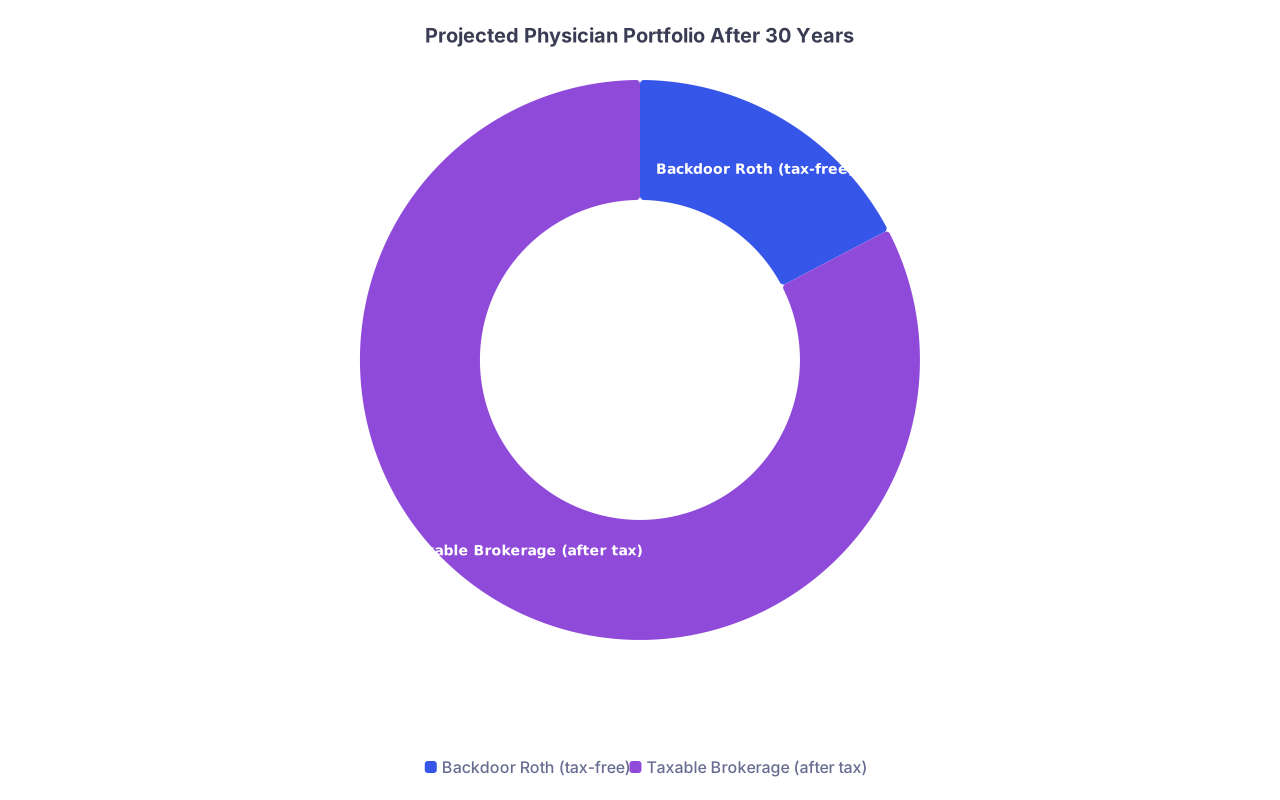
| Category | Value |
|---|---|
| Backdoor Roth (tax-free) | 614000 |
| Taxable Brokerage (after tax) | 2930000 |
Despite the smaller contribution, the Backdoor Roth is a non‑trivial slice of your eventual retirement pie—about 17% in this example—with higher quality dollars (fully tax‑free).
Skipping it would cut your tax‑free bucket by more than half, leaving you overly dependent on taxable account maneuvers in retirement.
11. Key Takeaways for Physicians
Over 30–40 years, Backdoor Roth vs taxable brokerage is not a close race on after‑tax results. The Roth wrapper typically produces six‑figure additional wealth for the same contributions in a typical physician tax profile.
The Backdoor Roth does not compete with taxable. It complements it. You should generally:
- Maximize every tax‑advantaged account you can, including the Backdoor Roth,
- Then pour excess savings into a carefully managed taxable brokerage.
The supposed “Roth only makes sense if my tax rate is higher later” line misses the point. For Backdoor Roth vs taxable, the real driver is ongoing tax drag and eventual capital gains, not only your marginal bracket at retirement.
If you are a high‑earning physician ignoring the Backdoor Roth and just investing in taxable, the data shows you are choosing a guaranteed long‑term haircut on your wealth.


