

It is October 1. You are between cases, scrolling your inbox, and you see the reminder from your CPA: “We should talk before year‑end—big income year.” You know you are on track for $600k+ in W‑2 or 1099 income. You also know that if you do nothing, the IRS will get a giant, unnecessary bonus from you on April 15.
This is the 90‑day window where high‑income physicians either tighten up their tax strategy or light money on fire.
You have three months. Here is exactly what you do, and when.
Big Picture: Your Last‑90‑Days Game Plan
At this point in the year, the goal is not to redesign your entire financial life. It is:
- Lock in every legal deduction still available.
- Pull income or deductions into the most favorable year.
- Clean up your entity, payroll, and retirement plan moves while there is still time on the calendar.
Think in three blocks:
- Days 1–30 (Early October): Diagnosis and decisions.
- Days 31–60 (November): Execute structural changes and big moves.
- Days 61–90 (December): Final tuning, deadlines, and documentation.
I will walk you through each period like a checklist.
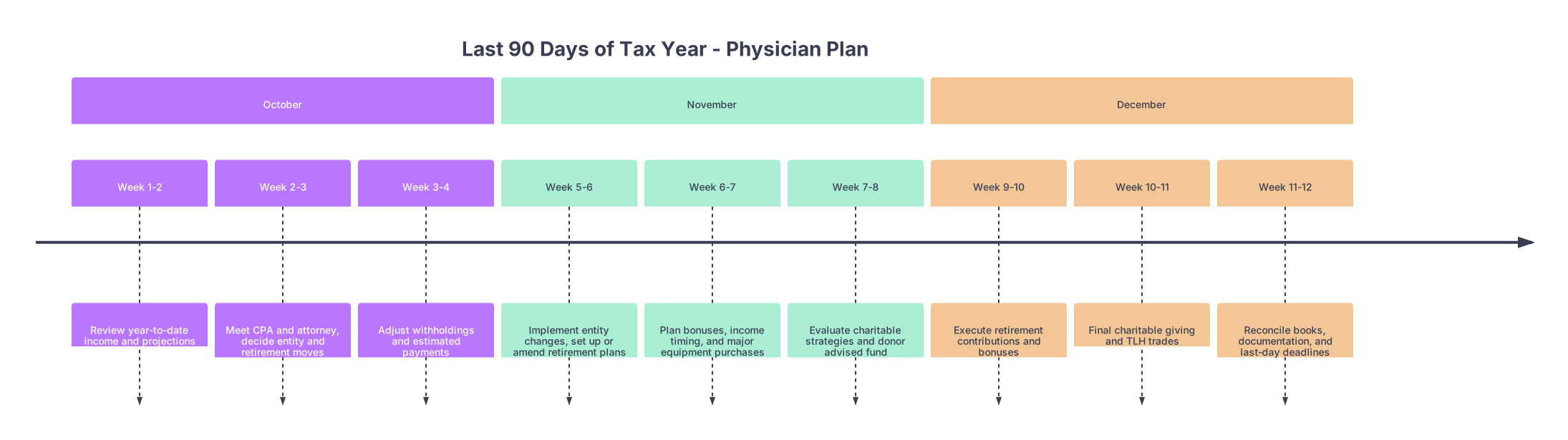
| Period | Event |
|---|---|
| October - Week 1-2 | Review year-to-date income and projections |
| October - Week 2-3 | Meet CPA and attorney, decide entity and retirement moves |
| October - Week 3-4 | Adjust withholdings and estimated payments |
| November - Week 5-6 | Implement entity changes, set up or amend retirement plans |
| November - Week 6-7 | Plan bonuses, income timing, and major equipment purchases |
| November - Week 7-8 | Evaluate charitable strategies and donor advised fund |
| December - Week 9-10 | Execute retirement contributions and bonuses |
| December - Week 10-11 | Final charitable giving and TLH trades |
| December - Week 11-12 | Reconcile books, documentation, and last‑day deadlines |
Days 1–30 (October): Diagnose, Decide, and Lock the Framework
At this point you should be brutally clear on your numbers. No guesses.
Week 1–2: Get Your Real‑Time Tax Picture
Sit down (30–60 minutes) and gather:
- Last pay stub(s)
- Year‑to‑date production or 1099 reports
- Brokerage statements (taxable accounts)
- Retirement account contribution records
- K‑1s or YTD reports from any side entities
Send this to your CPA with one simple question:
“Assume nothing else changes. What is my projected 2024 tax bill and marginal rate?”
You want a basic projection that shows:
- Estimated taxable income
- Marginal federal bracket (likely 35% or 37% if you are reading this)
- State bracket
- AMT exposure (if relevant)
- NIIT (3.8% Net Investment Income Tax) exposure
- Estimated underpayment or overpayment for the year
If your CPA cannot turn this around in a week in October, you have a different problem: the wrong CPA for a high‑income physician.
Week 2–3: Strategy Meeting – CPA + Attorney (If Needed)
Once you have the projection, you meet (video or phone is fine). At this point you should decide on the big structural issues that still matter this year:
Entity and compensation structure
- Employed W‑2 only? Focus will be retirement, HSA, charitable, investment tax planning.
- 1099 independent contractor? Then we are talking S‑corp vs sole prop, retirement plan limits, and timing of income.
- Practice owner (partnership or S‑corp)? We layer on entity‑level planning, equipment, bonuses, and fringe benefits.
Typical October conversations I see:
- “Your 1099 anesthesia side gig is now $200k+. You should not still be a sole prop with no retirement plan.”
- “Your S‑corp salary is way too high; you are bleeding payroll tax for no reason.”
- “Your group never implemented a defined benefit plan and your partners are leaving $50k+/yr each on the table.”
Retirement plan framework
By the end of this month, you want decisions on:
- 401(k) only vs 401(k) + cash balance/defined benefit
- Solo 401(k) vs SEP if you are 1099
- Whether a backdoor Roth IRA makes sense this year (pro‑rata rule, existing pre‑tax IRAs, etc.)
Charitable strategy
Especially if you had an unusually high‑income year, ask:
- Should you front‑load giving using a Donor‑Advised Fund (DAF) this year?
- Appreciated stock vs cash gifts?
- Bunching multiple years of giving into this tax year?
Tax‑loss harvesting and investment cleanup
You and your advisor should identify:
- Any funds with large unrealized losses for harvesting
- Any legacy, expensive, or tax‑inefficient funds to dump
- Whether you are about to get hammered by capital gains distributions in active mutual funds
At this point, you are not pushing buttons yet. You are deciding which buttons to push.

Week 3–4: Adjust Withholding, Estimates, and Cash Flow
Now that you know where you stand, you fix the underpayment problem before it becomes penalties.
For W‑2 physicians:
- If you are underwithheld, increase withholding on your largest paycheck source for the rest of the year.
- Use the “extra withholding” box, not the allowances games.
- Target: Enough extra to cover the projected shortfall by December 31. Withholding is treated as evenly paid throughout the year, which can save you from penalties.
For 1099 / practice owners:
- Look at your Q3 estimates (due September 15) and upcoming Q4 estimate (January 15).
- If your income ran higher than projected, you may need a catch‑up estimated payment in October or November.
- Discuss with your CPA whether to:
- Make a big estimate now, or
- Increase compensation/withholding through your S‑corp payroll, or
- Accept a small penalty if the numbers are too lumpy to fix perfectly.
At this point you should also:
- Park enough cash to fund:
- Year‑end retirement contributions
- Planned charitable giving
- Any major equipment purchases or practice investments
If you do not free up liquidity now, you will miss moves in December because you cannot write the check.
Days 31–60 (November): Implement the Big Levers
Now you build what you decided in October.
Week 5–6: Entity and Retirement Plan Implementation
This is the part everyone procrastinates. Do not.
For 1099 and practice owners:
Entity clean‑up
- If you are switching to or cleaning up an S‑corp, get:
- Articles filed (if new entity)
- S‑election in place (timing and late election options = CPA job)
- Payroll set up or corrected if salary level needs adjustment
You are probably not going to fully “fix” 2024 with an S‑corp if you are starting in October, but you can get part of the benefit and be ready on January 1.
- If you are switching to or cleaning up an S‑corp, get:
Retirement plan setup or amendment
Deadlines differ:
Key Physician Retirement Plan Deadlines (Typical) Plan Type Common Use Case Key Year-End Consideration W-2 401(k) Employed physicians Deferral election before last pay Solo 401(k) 1099 IC / single-owner practice Plan must be opened by 12/31 SEP IRA Small 1099 with late setup need Can open and fund by tax filing Cash Balance / DB Plan High-profit groups / partners Must be adopted by 12/31 (usually) Backdoor Roth IRA High income, no pre-tax IRAs Contribute by 4/15, but plan now Translation:
- Solo 401(k) – If you are a 1099 doc and want a solo 401(k) for this tax year, you get it opened by December 31, not “by tax filing.” Huge difference.
- Cash balance / defined benefit – For groups and partners, the plan almost always must be formally adopted by year‑end for the current year to count, even if fully funded later. If your group wants to implement for this year, these weeks are your last real shot.
For employed physicians with W‑2 401(k):
- Check your year‑to‑date deferrals:
- 2024 employee deferral limit: $23,000 (plus $7,500 catch‑up if age 50+).
- If you are behind, increase contribution percentage so that:
- You hit the limit by your last paycheck.
- You avoid missing employer matching by front‑loading too early (varies by plan).
Week 6–7: Income Timing, Bonuses, and Practice Investments
At this point you should be making decisions about whether to accelerate deductions or defer income into next year, based on your projected bracket this year vs next.
Typical scenarios:
This year is higher income than next year (e.g., final attending year before going part‑time, or huge bonus year)
You usually want to:
- Pull as many deductions into this year as reasonably possible.
- Consider front‑loading:
- Charitable giving
- Practice expenses (within reason, not junk)
- Retirement plan contributions (if flexible)
Next year will be higher income (promotion, partnership, new side gig)
You may want to:
- Defer some income into next year where legally possible.
- Avoid unnecessary deduction acceleration if the deduction is more valuable in a 37%+ bracket next year.
For practice owners and 1099s, this can include:
- Scheduling patient billing or collections slightly earlier or later (within reason; fraud and abuse rules still apply).
- Timing equipment purchases that qualify for Section 179 or bonus depreciation.
- Adjusting owner bonuses from S‑corps or partnerships, with an eye on payroll tax vs. distribution split.
This is also when you and your CPA decide:
- “Are we pushing a larger employer contribution into the 401(k) this year, or are we conserving cash and taking it next year?”
| Category | Value |
|---|---|
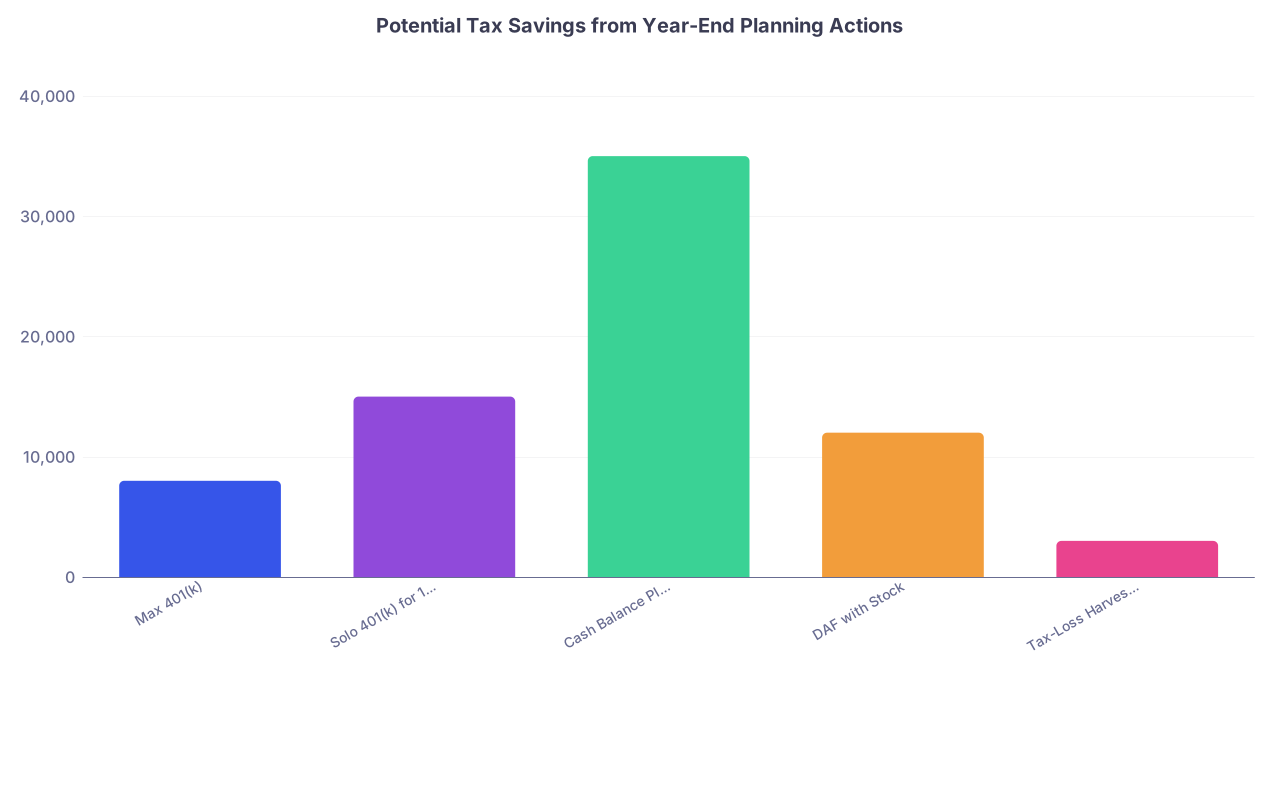
| Max 401(k) | 8000 |
| Solo 401(k) for 1099 | 15000 |
| Cash Balance Plan | 35000 |
| DAF with Stock | 12000 |
| Tax-Loss Harvesting | 3000 |
(Approximate federal + state tax savings for a typical high-income physician, ranges vary.)
Week 7–8: Charitable Strategy and Big‑Ticket Planning
By late November, you want your charitable game plan locked.
For high‑income physicians, the Donor‑Advised Fund (DAF) is usually the cleanest tool:
- You contribute a large lump sum this year (ideally appreciated securities, not cash).
- You get the full deduction this year (subject to AGI limits).
- You then grant money out to charities over several years.
At this point you should:
Identify which appreciated positions to donate:
- Typically, taxable brokerage holdings with:
12‑month holding period
- Large embedded gain
- Do not donate losing positions. You harvest those losses and give cash instead.
- Typically, taxable brokerage holdings with:
Decide on total charitable deduction you want this year:
- Based on your tax projection and itemization vs standard deduction math.
- Your CPA can show you where the deduction starts having diminishing marginal benefit.
Coordinate timing:
- Many custodians need a week or more to complete an in‑kind transfer to a DAF.
- Do not push this to December 29 and expect miracles.
You also want to revisit estate planning basics now (even if you handle details later):
- Beneficiary designations on:
- 401(k)s, 403(b)s, IRAs
- Group life policies
- Wills and trusts aligned with your current situation.
- If you are charitably inclined and very high income, this is when your attorney might bring up:
- Charitable remainder trusts
- Qualified charitable distributions (if age 70½+)

Days 61–90 (December): Final Moves, Deadlines, and Clean Books
Now you stop planning and actually do things. This is where physicians lose money: they “decide” but never execute.
Week 9–10 (Early December): Pull the Big Levers
At this point you should be:
Finalizing retirement contributions
- Confirm:
- Your W‑2 401(k) deferrals will hit the target by last paycheck.
- Solo 401(k) or group 401(k) plans are open.
- If you are an owner, plan when employer contributions will be funded (year‑end vs by tax filing). Cash balance plan funding often runs into the following year but is based on this year’s decision.
- Confirm:
Executing DAF/charitable transfers
- If donating appreciated stock, initiate the transfer now.
- Confirm with both:
- Your brokerage / custodian
- The DAF sponsor or charity
- Get confirmations and keep the documentation in one digital folder labelled like:
2024_Charitable_Receipts.
Tax‑loss harvesting trades
Coordinate with your advisor or, if you self‑manage:
- Sell positions with losses you want to realize.
- Immediately buy a not‑substantially‑identical replacement to maintain market exposure (wash sale rule).
- Track harvested losses; they carry forward indefinitely and offset future gains.
Week 10–11 (Mid‑December): Clean‑Up and Edge Cases
Now you start closing loops.
For practice owners / 1099:
- Reconcile books through November:
- Income vs deposits
- Business credit card and bank accounts categorized correctly
- Review for missed deductions:
- CME and conferences
- Licensure, board fees, DEA
- Malpractice, disability, umbrella premiums
- Home office (if legitimately used and documented)
- Mileage or auto expenses tied to business use
For everyone:
- Confirm you have:
- HSA contributions on track (if eligible)
- FSA spending lined up for “use it or lose it” rules
- Any 529 front‑loading you planned for state tax benefits (varies heavily by state)
If you are in a high‑tax state (CA, NY, NJ, etc.), ask your CPA about:
- Whether SALT cap workarounds (pass‑through entity taxes) apply to your practice or partnership. These often require elections or payments by year‑end to get the benefit.
| Category | Value |
|---|---|
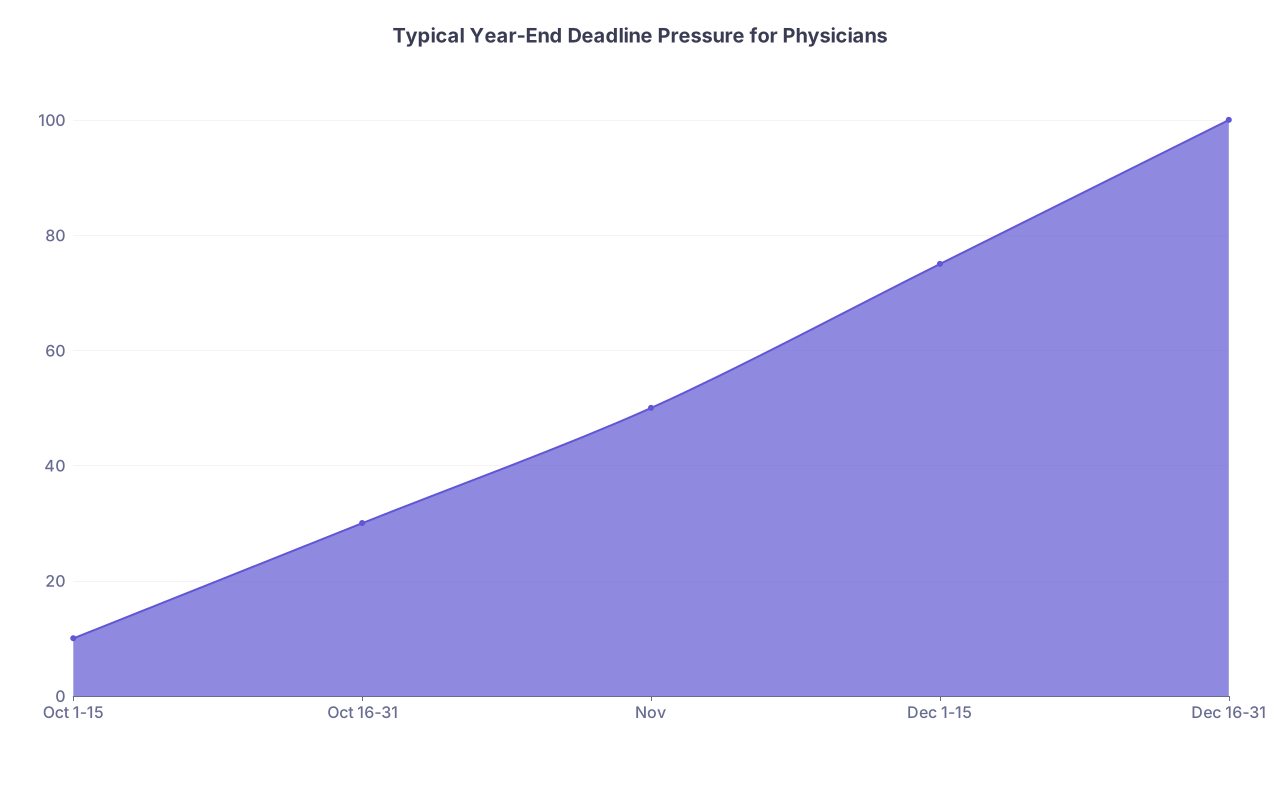
| Oct 1-15 | 10 |
| Oct 16-31 | 30 |
| Nov | 50 |
| Dec 1-15 | 75 |
| Dec 16-31 | 100 |
(Rough “pressure index” – how much is at stake if you delay, relative to the full period.)
Week 11–12 (Late December): Hard Deadlines and Documentation
This is the “no more procrastination” zone. Calendar days matter now.
At this point you should, by December 31:
Retirement and payroll items
- W‑2 401(k) elective deferrals must be taken from paychecks issued by year‑end.
- Solo 401(k) plan must be established (not fully funded, but legally in place).
- Any S‑corp payroll adjustments must be run through before year‑end to show on W‑2.
Charitable and DAF contributions
- All cash donations: date the check or charge by December 31 and keep receipts.
- All stock/asset transfers: must be completed by year‑end to count, not just “initiated” in theory. Custodians may have internal deadlines a few days earlier.
Final tax‑loss harvesting
- This is your last window to realize capital losses for the year. Do not create wash sales by rebuying the same or substantially identical security within 30 days.
End‑of‑year documentation
Create a single, organized folder structure. It will make your CPA like you and your life easier:
2024_TaxIncome_Statements(W‑2 projections, 1099 YTD, K‑1 drafts if any)Retirement_Contributions(401(k), backdoor Roth steps, HSA)Charitable_Receipts(letters, DAF confirmations)Business_Expenses(if 1099 / practice owner)Investments_TLH(trade confirmations with dates and amounts)
Do not trust your memory in March. You will not remember why you moved $40k into a DAF unless you label it now.

Quick “Last 10 Days” Checklist
If you ignored everything and it is December 21, here is the triage sequence:
Confirm:
- You maxed your 401(k) or at least hit the employer match.
- HSA and FSA are where they should be.
If 1099:
- Open a solo 401(k) immediately if you still can this year.
- Talk to your CPA about a last‑minute estimated payment to reduce penalties.
Execute:
- Any planned DAF/charitable contributions (especially appreciated stock).
- Obvious tax‑loss harvesting in taxable accounts.
Sweep:
- Reconcile business expenses if you are a contractor or owner.
- Save documentation and receipts into a 2024 tax folder.
If that is all you manage, you will still save yourself thousands versus doing nothing.
Final Takeaways
Three points to walk away with:
- In October, you diagnose. Get a projection, know your marginal rate, and decide on entity, retirement, and charitable strategies. No more “I’ll see where I land in April.”
- In November, you build the structure. Implement or amend retirement plans, tweak payroll, plan bonuses and big expenses, and lock your DAF/charitable and investment tax strategy.
- In December, you execute and document. Hit the contribution and withholding targets, complete transfers, harvest losses, close your books, and make sure everything is dated and recorded by December 31.
You are a high‑income physician. The tax code is not designed in your favor. But in the last 90 days of the tax year, with a clear timeline and some discipline, you control far more of the outcome than you think.


