

Only 27% of self‑employed physicians actually claim all the deductions they’re legally entitled to, according to IRS research on Schedule C filers. The rest leave money on the table—mostly because they assume “a business is a business” and all side gigs work the same.
They don’t.
If you remember nothing else: two physicians can earn the same $100,000 in “side income” and walk away with dramatically different after‑tax cash depending entirely on how that income is structured and what kind of activity it comes from. Same dollars, wildly different rules.
Let’s dismantle the “all side hustles are equal” fantasy.
Not All Income Is “Business Income” – Even If It Feels Like It
Here’s the first error I hear constantly: “I have a side hustle, so I get business write‑offs.”
Sometimes. Often not.
A lot of physician “side hustles” aren’t actually businesses in the tax sense. They’re either just more employment, or they’re passive investments. The IRS does not hand out the same benefits to each.
Think of three buckets:
- Active business income (self‑employment) – Locums as a 1099, expert witness work, telemedicine as an independent contractor, coaching, a small private practice you own.
- Passive investment income – Ownership in an ASC you don’t materially run, LP stakes in real estate syndications, silent partner in a med‑spa where you do not work.
- Employment income dressed up as a side gig – “Per diem” hospital work where you’re still a W‑2. Or a “medical director” role that’s actually W‑2 with no business risk.
Only bucket #1 gets the full suite of “business” tax tools. Bucket #2 gets totally different benefits. Bucket #3 is just another job. Zero side‑hustle magic.
You can see the tax differences in black and white when you lay them out.
| Side Hustle Type | Main Tax Category | Key Benefits Available |
|---|---|---|
| 1099 Locums | Active business | Deductions, SE tax planning |
| Telemedicine as contractor | Active business | Home office, equipment, QBI* |
| Expert witness work | Active business | Business deductions, retirement |
| ASC ownership (no work) | Passive investment | Depreciation, limited offset |
| Real estate syndication | Passive investment | Depreciation, but no SE tax |
| W‑2 per diem hospital shifts | Employment | Very limited (no Schedule C) |
*QBI = Qualified Business Income deduction (subject to lots of caveats)
So when a colleague says, “I started a side hustle so I can write off my car, phone, conferences, and part of my house,” your first question should be: What kind of income is it, really?
The Big Divide: Active Business vs Passive Investment
This is the line that changes almost everything.
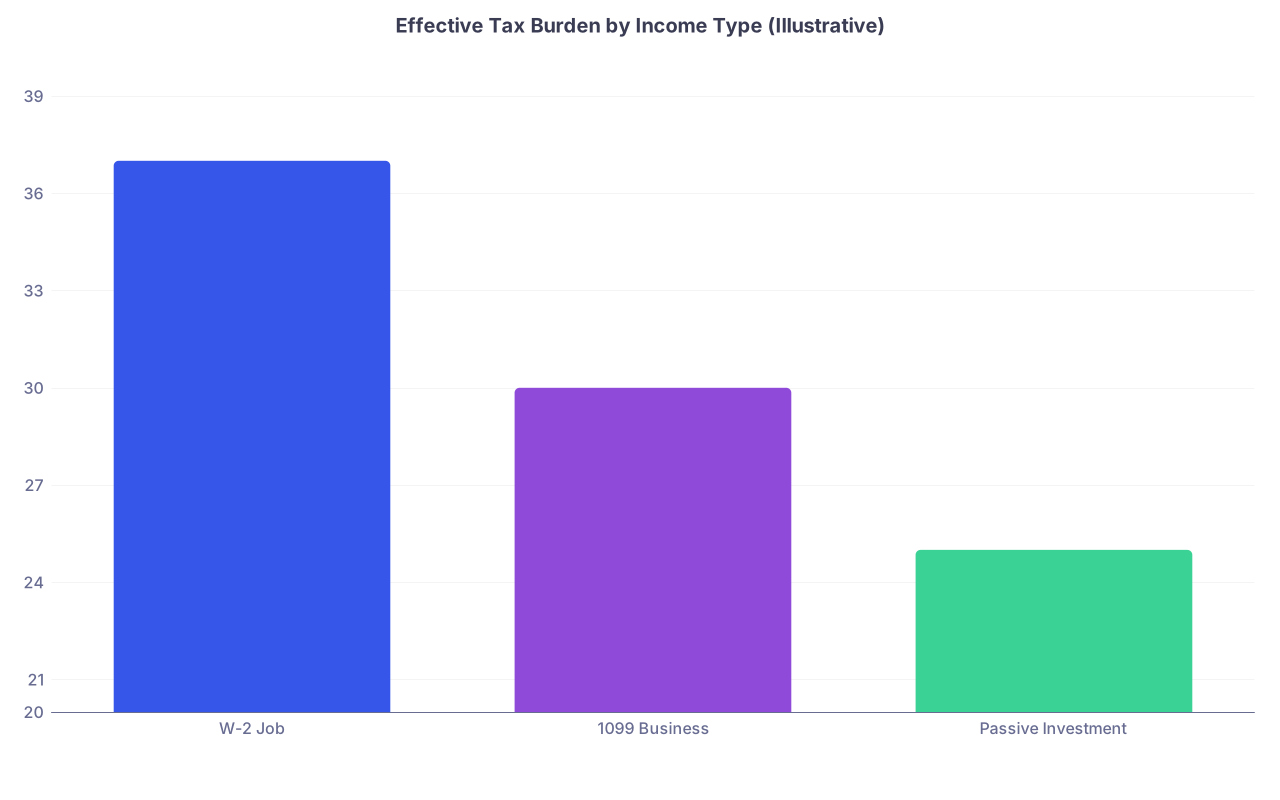
| Category | Value |
|---|---|
| W-2 Job | 37 |
| 1099 Business | 30 |
| Passive Investment | 25 |
Those numbers are not exact for you, but directionally they’re right: same top tax bracket, different effective burden.
Active business (Schedule C, partnership K‑1, or S‑Corp)
Active business income is where most of the juicy side‑hustle benefits live:
You can:
- Deduct ordinary and necessary business expenses: license fees, CME, subscription services, malpractice, software, marketing, some travel, etc.
- Contribute a lot more to retirement: solo 401(k), defined benefit plan, SEP‑IRA (with caveats).
- Potentially access the 20% QBI deduction, if your income and structure qualify.
- Potentially choose your entity (LLC taxed as S‑Corp, for instance) to manage self‑employment tax.
But here’s the catch nobody on Instagram mentions: if your work is in a “specified service trade or business” (SSTB)—including medicine, consulting, law—the QBI deduction phases out at relatively high income levels. Many attendings blow right past those thresholds. You do not automatically “get” QBI just because you have an LLC.
Passive investment
Your shares in an ASC, imaging center, or real estate deal? Whole different world:
- No self‑employment tax on true passive income.
- You get depreciation and sometimes very attractive paper “losses.”
- But those passive losses often cannot offset your W‑2 or 1099 active income unless you qualify under strict passive activity rules (e.g., real estate professional, material participation).
The classic misunderstanding: a physician making $600k W‑2, who buys into a real estate syndication that throws off a $50k passive loss, thinks “Awesome, I’ll wipe out $50k of my taxable W‑2 income.” No. In most cases that $50k gets trapped as passive loss carryforward.
Different side hustle. Different rules. Very different tax results.
Entity Choice: LLC vs S‑Corp vs “Just File a Schedule C”
Another myth: “If I make my side hustle an LLC, I’ll pay less tax.”
No. An LLC is a liability and legal wrapper. By default it doesn’t change your federal tax type if you’re a single owner. A single‑member LLC is usually just…a Schedule C sole proprietorship.
Where things do change is when you elect S‑Corp status (or have a multi‑member LLC taxed as a partnership). That’s where some physicians legitimately lower their overall tax burden.
But again: not all physician side hustles benefit the same from entity gymnastics.

Let’s illustrate with a simple example.
Two hospitalists each make $80,000 from telemedicine outside their W‑2 jobs:
- Dr. A: Files as a sole proprietor on Schedule C, no entity election.
- Dr. B: Sets up an LLC taxed as an S‑Corp, pays a reasonable salary of $45,000 and takes $35,000 as distributions.
Roughly:
- Dr. A pays self‑employment tax (Social Security and Medicare) on most of the $80,000.
- Dr. B pays payroll taxes only on the salary portion ($45,000), not on the $35,000 distribution.
So yes, in some cases, once your side hustle income is high enough, S‑Corp structure can legitimately reduce self‑employment tax. But now add three real‑world complications:
- Many physician side gigs are pure 1099 with no staff, no equipment, minimal overhead. S‑Corp administrative costs and payroll burden can wipe out the tax savings at lower income levels.
- If the side hustle is clearly an SSTB (which medicine is), high‑income docs will lose QBI anyway. Chasing QBI via S‑Corp is a waste of energy for them.
- If the income is actually passive (say, ASC dividends with no W‑2 role), S‑Corp election is often pointless or worse.
So again, two side hustles, same revenue, completely different playbook.
Self‑Employment Tax: The “Invisible” Cost People Forget
Physicians obsess over marginal income tax brackets. They almost never talk about the 15.3% self‑employment tax that smacks their 1099 earnings.
That’s another way the “all side hustles get the same benefits” myth blows up.
Earning an extra $100,000 from:
- W‑2 moonlighting – No business deductions; FICA split between you and employer; no Schedule C; probably no QBI. But you don’t pay the employer half of Social Security/Medicare.
- 1099 telemed – You owe both sides of Social Security/Medicare on that income (up to the Social Security cap), plus federal and state income tax. But you get business deductions and more retirement options.
- ASC investment distributions – Usually no self‑employment tax at all, but limited ability to offset non‑passive income.
So that $100k is not “just $100k.” It sits in a different tax ecosystem depending on the structure.
Here’s what a lot of physicians overlook: sometimes the right move is less 1099 income and more W‑2 income at a higher rate if the self‑employment tax plus headache wipes out the business benefits.
Or, if you are going 1099, you need a real business plan: track expenses, max appropriate retirement accounts, and consider entity choice—not just toss it all on a Schedule C in TurboTax on April 14th.
Deductions: Your Car and Your iPhone Are Not Magic
You’ve heard the guy at conference:
“I started a consulting LLC so now my phone, my car, my home office, my travel—everything is a write‑off.”
This is where a lot of physicians drift from aggressive into “audit bait.”
The rules don’t change just because you slapped “LLC” after your name.
- Expenses must be ordinary and necessary for your particular business.
- Mixed‑use items (car, phone, internet, home) must be allocated between business and personal. You do not suddenly get to deduct 100% of your Tesla because you did three locums weekends.
- Travel needs a real business purpose and documentation—not “I thought about opening a clinic in Maui while I was on the beach.”
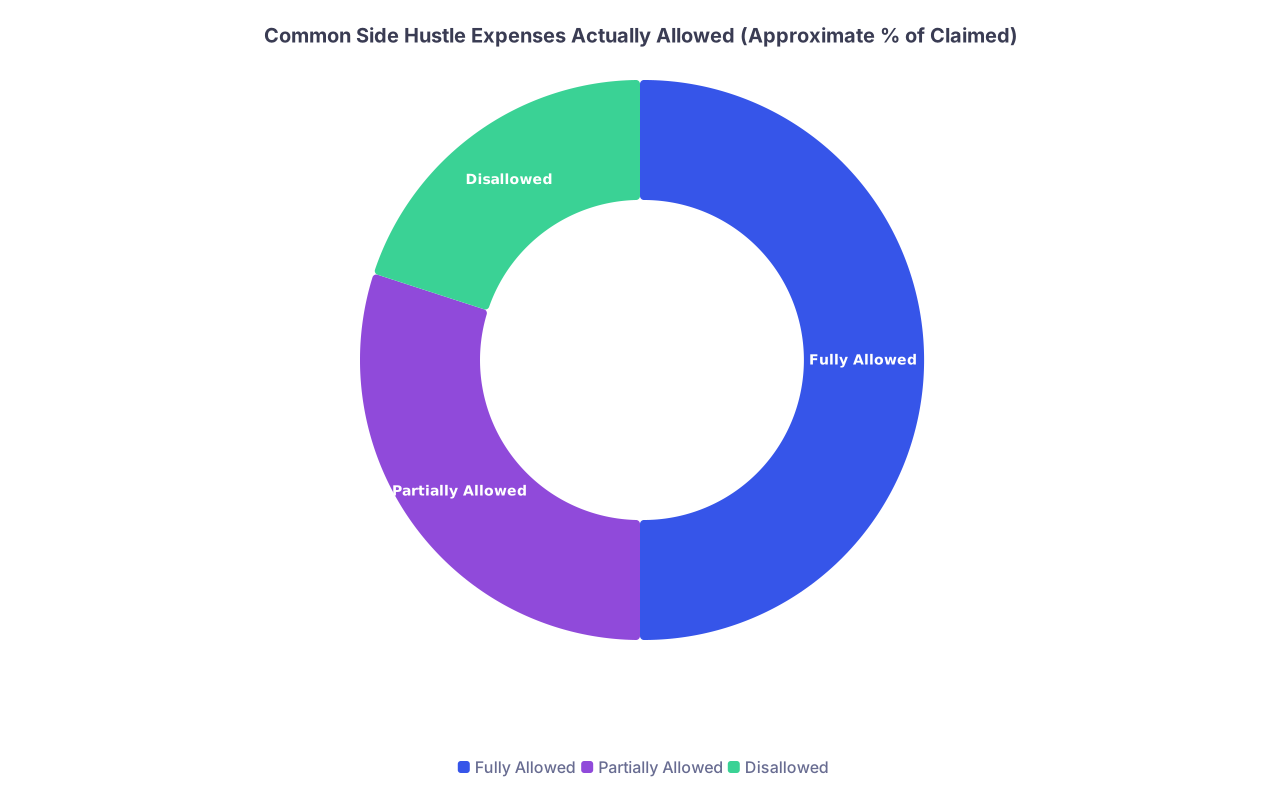
| Category | Value |
|---|---|
| Fully Allowed | 50 |
| Partially Allowed | 30 |
| Disallowed | 20 |
That rough breakdown lines up with IRS audit studies: a big chunk of sole proprietor “business” expenses get chopped down or disallowed entirely.
And again, not every side hustle needs or supports the same deductions. A telemed practice from your existing home office? Sure, allocate a portion of your office, internet, and equipment. A passive ASC investment? You’re not deducting your iPad against that.
Different activity. Different rules.
Retirement Accounts: The Most Misunderstood “Benefit”
One of the biggest real advantages of having true business side income is the ability to open additional retirement plans. But even here, people overgeneralize badly.

| Step | Description |
|---|---|
| Step 1 | Side Hustle Income |
| Step 2 | No extra business plan |
| Step 3 | Same overall limits apply |
| Step 4 | Solo 401k or SEP option |
| Step 5 | Complex plan design needed |
| Step 6 | 1099 or W-2? |
| Step 7 | Already maxed main job plan? |
| Step 8 | Have employees? |
Key reality checks:
- If you’re an employee with a 403(b)/401(k) and then pick up a 1099 side gig, your employee deferral limit is shared across all plans. You don’t magically get another $23k (2024 number) to defer just because you opened a solo 401(k).
- What you can get, with a profitable solo business, is employer contributions on that 1099 profit—essentially letting you shelter more pre‑tax dollars if your main job’s plan design or match is weak.
- If you own a side practice with staff, this becomes a whole ERISA puzzle. Those employees may have to be included in your plan. Suddenly the “cheap” SEP‑IRA is not so cheap when you have to fund 25% of salaries for everyone, not just yourself.
Now compare:
- Side hustle A: $40k consulting income, truly solo, no staff. Perfect candidate for a solo 401(k) design.
- Side hustle B: Passive investment K‑1 from a surgery center. No ability to create your own retirement plan around that income at all.
- Side hustle C: Med‑spa ownership with nurses and admin staff. You can build a very strong plan, but it’s a real design project with real compliance overhead.
Different side hustle. Different retirement possibilities. Not remotely the same.
Real Estate and “Tax Free” Income: The Seductive Half‑Truth
Real estate promoters love physicians. You’re high income, overworked, and desperate for “passive” tax breaks.
The pitch: “Invest $100k into our syndication, get $80k in paper losses this year, and eliminate your tax bill from your clinical job.”
Usually wrong.
For the average full‑time clinician:
- Those big K‑1 losses are passive.
- Your W‑2 and most 1099 work is active.
- Passive losses cannot offset active income unless you hit specific exceptions (real estate professional status, material participation, etc.).
- So the loss carries forward to offset future passive income or capital gains from that activity.
Still valuable. But not what was sold.
On the other hand, owning the building your private practice rents from your own LLC? Different story. Now you’ve got related‑party leasing, depreciation, and active business income intertwined. With thoughtful design, you can absolutely shift and manage taxes here. But that’s no longer a “pure” passive side hustle. It’s an integrated business‑plus‑real‑estate strategy.
Again: structure matters more than slogans.
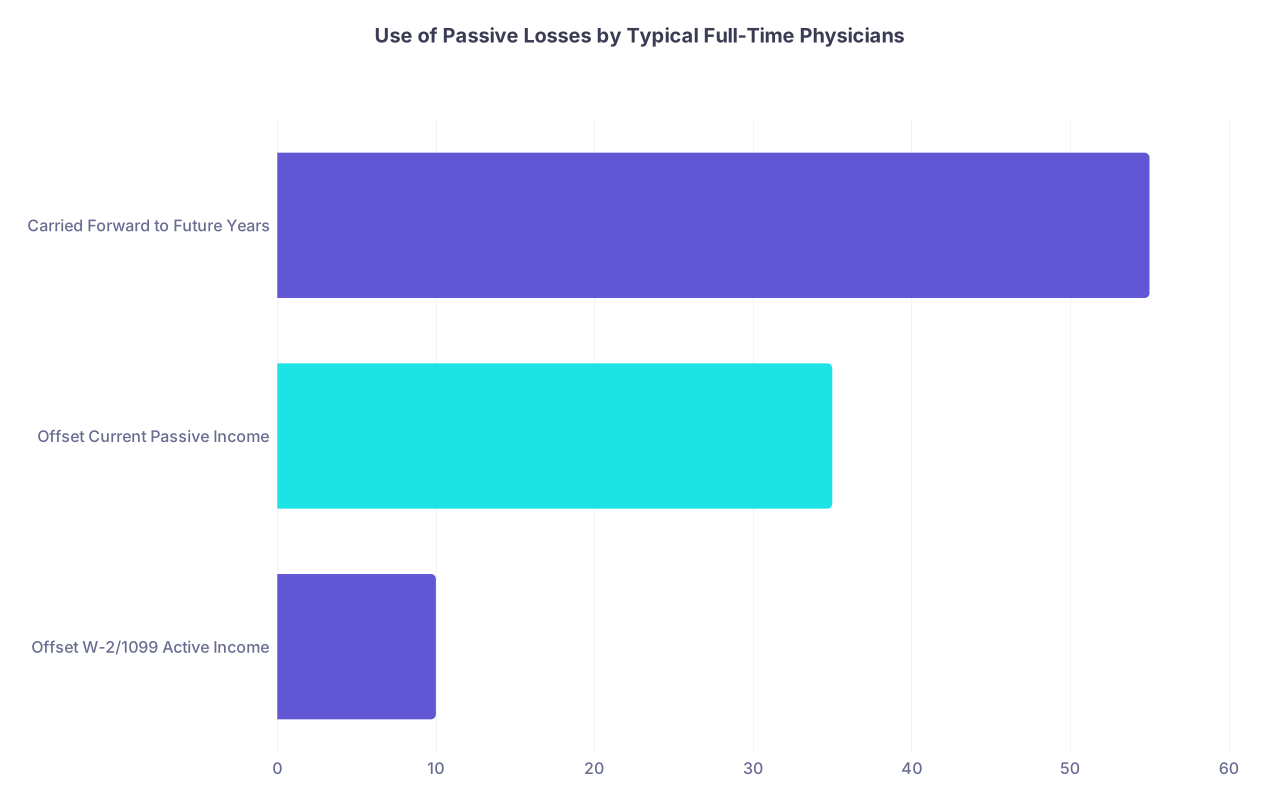
| Category | Value |
|---|---|
| Offset W-2/1099 Active Income | 10 |
| Offset Current Passive Income | 35 |
| Carried Forward to Future Years | 55 |
Most of those losses sit as carryforwards. That’s the quiet, boring reality behind the glamorous sales pitch.
The Boring Truth: Tax Strategy Follows Economics, Not Labels
Here’s the most useful mental shift: stop thinking “side hustle = tax benefits” and start thinking “economic reality determines tax treatment.”
Ask these blunt questions about any side activity:
- Are you providing services personally, with real effort and risk?
Probably active business income. Schedule C or S‑Corp/partnership. Full business toolkit, plus self‑employment tax. - Are you merely capital—money in a deal—without meaningful work?
Probably passive. Depreciation and loss rules apply, but no SE tax or business retirement plan attached. - Are you just an employee with another W‑2?
Almost no incremental tax tools. It might still be good money, but do not kid yourself about “side business” benefits.
And then ask the second‑order question nobody likes: Is the incremental complexity worth the actual dollar savings?
I’ve seen cardiologists making $800k/year burn 20 hours a month chasing maybe $5–10k of tax arbitrage through a sloppy side entity. Not smart. I’ve also seen a hospitalist build a $300k/year telemed S‑Corp with rock‑solid documentation, a custom 401(k) plan, and tens of thousands in real, ongoing tax savings. Very smart.
Same tax code. Different structure. Very different outcomes.

Three Things to Actually Do Differently
Let me end this without fluff.
- Label your side income correctly. Active business, passive investment, or employment. That alone will kill half the bad ideas.
- Build structure around real numbers, not vibes. S‑Corp, solo 401(k), defined benefit plan—these only make sense when you run the math on your actual income levels, staffing, and goals.
- Use the tax code to amplify good economics, not rescue bad ones. A lousy side gig does not become smart because you “get write‑offs.” The best tax benefit is still profit you get to keep.


