
The biggest tax problem academic physicians have is not their W‑2. It is the quiet, “helpful” perks your institution hands you that are absolutely taxable—and are often being misclassified, underreported, or ignored.
I’ve watched attendings at major academic centers get blindsided in audits because they thought, “If payroll or the department approved it, it must be fine.” That is not how the IRS thinks. HR cares about policy. Chairs care about budgets. The IRS cares about economic benefit. And the gap between those three is where you get hurt.
Let’s walk through what really happens behind the scenes with academic perks, and the specific things that are far more taxable than most physicians realize.
The Myth: “If It’s For Work, It’s Not Taxable”
Every year I hear the same line from faculty: “It’s for work, so it can’t be income.” That is not the rule.
The actual rule is simpler and harsher: if your employer gives you something of value—cash, reimbursement, or in-kind benefit—and it doesn’t fit into a fairly narrow list of exclusions, it is taxable compensation. Whether you used it for “work” doesn’t automatically save you.
This is what most academic physicians misunderstand. Universities and health systems love to call things:
- “Professional expense reimbursement”
- “Faculty development funding”
- “Education support”
- “Travel allowance”
- “Leadership stipend”
Internal labels don’t matter. If the IRS agent sitting across from you sees that you got economic benefit and it’s not clearly excluded in the tax code, they treat it as taxable wages or self-employment income.
I’ve sat in compliance meetings where the faculty rep says, “But our policy says…” and the tax counsel cuts them off with, “The IRS doesn’t care about your policy.” That’s the reality.
Travel, CME, and “Educational” Money – Where People Get Burned
This is the biggest landmine in academic medicine. Because almost every academic physician has some mixture of:
- CME funds
- Travel allowances
- “Faculty development” stipends
- Department-paid conference trips
- Industry-sponsored travel for talks or advisory boards
Some of these can be legitimately non-taxable. Many are not. And the line is not where most people think.
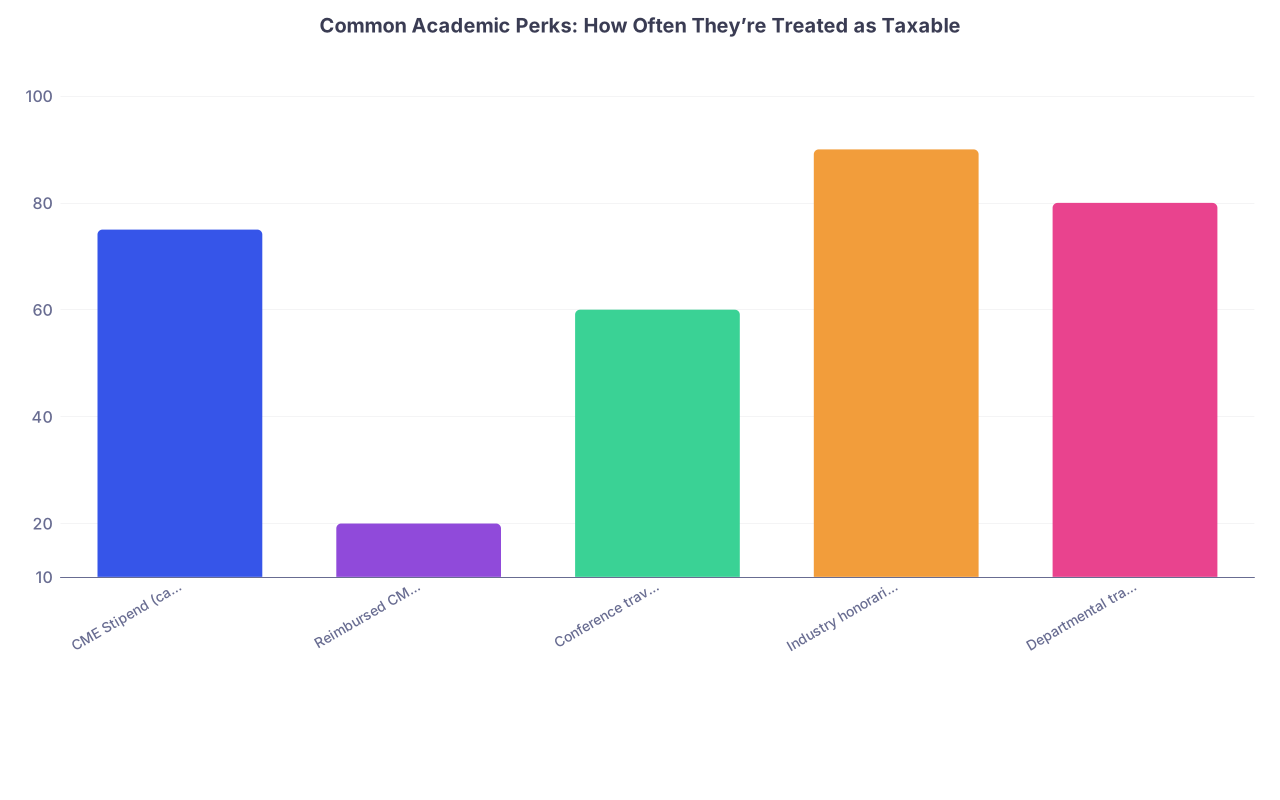
| Category | Value |
|---|---|
| CME Stipend (cash) | 75 |
| Reimbursed CME with receipts | 20 |
| Conference travel with personal days | 60 |
| Industry honorarium + travel | 90 |
| Departmental travel fund (no receipts) | 80 |
CME stipends vs. true reimbursements
Here’s the inside truth: payroll and accounts payable are constantly fighting about who “owns” CME and travel money. The outcome of that turf war determines your tax exposure.
If your institution:
- Gives you a flat $3,000–$5,000 CME “stipend” each year;
- Pays it in cash or as an allowance;
- Doesn’t require receipts tied to specific expenses;
that is taxable income. Period. I’ve seen one large Midwest academic center that called this “CME allowance” for a decade, never ran it through payroll, and then quietly changed policy after their own external audit raised flags. They didn’t tell the faculty what prompted the change. They just “updated” the policy.
Contrast that with:
- You pay for an approved CME conference;
- You submit detailed receipts with dates, locations, and proof of attendance;
- The department reimburses only those expenses that match;
That can qualify as an “accountable plan” reimbursement and stay non-taxable. But the moment they hand you a lump sum and do not require substantiation, you’ve drifted into taxable territory.
Do faculty know which system their department uses? Almost never. They just know there’s “CME money.” That vagueness is exactly where risk lives.
Mixing business and pleasure on travel
Another blind spot: adding vacation days to work travel.
If you fly out on Wednesday, give a talk Thursday, and then stay through Tuesday at a resort “because flights were cheaper” and the department pays the whole trip—an agent is going to look at how much of that looks like personal travel.
The institution will almost always book and pay as “business travel.” Internally they are thinking federal rules for grants or institutional compliance, not your personal tax liability.
But when you’re under audit, you are the one who has to justify that 6-day beach stay as “professional development.” If the department paid for your spouse’s ticket or the upgraded ocean-view suite? Even worse.
I’ve seen agents disallow large chunks of “business travel” tied to:
- Extra nights clearly for vacation
- Side trips to other cities with no documented work reason
- Family members’ travel and meals
The ugly part: if the institution doesn’t treat it as taxable to you, and the IRS later characterizes it as personal benefit, they can reclassify it as unreported compensation. With penalties.
The “Professional Expense Account” That’s Really Income
Departments love “professional expense accounts” because they feel like they’re supporting faculty, but they also avoid permanent salary increases. So they give you $10,000/year you can use for:
- Society dues
- Conference travel
- CME
- Books, laptops, software
- Sometimes even home internet or phone
What many physicians don’t realize: how that money is structured matters more than what you buy with it.
If the account:
- Is a notional bucket of money you “draw” from;
- You can direct it toward a very wide range of things;
- There’s minimal documentation, or broad approval standards;
then for tax purposes, large parts of that can be treated as a taxable fringe, or even just more W‑2 wages that your employer is failing to classify correctly.
I’ve seen “professional funds” used for:
- Airline tickets to visit a former fellow (no formal work event)
- An iPad that mysteriously lives entirely at home
- “Board review” courses that are half vacation
- Dues for clubs that are more social than professional
Nobody stops it. The department is happy, the division admin codes it as “faculty support,” and life goes on. Until the institution or the IRS scrutinizes it.
If the IRS determines that a pattern of these expenses is primarily personal, they can argue that the money used should have been taxed as wages to you.
You’ll hear people say, “But the university was audited and they were fine.” That doesn’t immunize you. A payroll or institutional audit isn’t the same as a focused examination of your specific benefits and reimbursements.
Hidden Tax Traps in Academic Leadership and Side Money
Let’s talk about the stuff nobody explains when they hand you that “small leadership role” or “extra opportunity.”
Leadership stipends and administrative roles
Program directors, associate PDs, clerkship directors, track leaders—these roles almost always come with money. Sometimes it’s obvious: a $20,000/year stipend, paid as W‑2. That’s clean.
But at a lot of places, the support is messier:
- Reduced clinical FTE but same total pay
- “Admin time” bought out by the hospital or the medical school
- Extra professional expense money instead of salary
- Travel and conference budgets tied to the leadership position
Behind closed doors, here’s what really happens: finance and HR make backdoor deals to keep total compensation within a range while massaging RVUs and FTE definitions. The written documents are vague.
If you’re getting extra funds, travel, or perks because of a leadership title, and they’re not going through payroll as wages, assume there is at least a question mark over the tax treatment. The fact that no one has said “this is taxable income” doesn’t mean it isn’t. It often means they haven’t thought about it.
Industry honoraria funneled through the institution
The classic academic move: an industry company pays the university or foundation an honorarium for your talk or advisory work, and then the institution:
- Keeps a slice
- Sends the rest to you as “professional funds” or “discretionary account”
Faculty tell themselves, “Well, I didn’t get a 1099, so that’s not my income.” Dangerous logic.
The IRS perspective is: a third party paid for services you performed. If the school is just a pass-through, you may still have taxable income—either as W‑2 (if treated as part of your employment) or as 1099/self-employment (if you’re effectively an independent contractor).
I’ve seen very senior faculty shocked to discover, years in, that:
- Their “industry-supported academic efforts” were being reported by the company on a 1099 to them personally under an old address.
- The university never told them.
- The IRS correspondence went to an address they’d left 5 years ago.
By the time they discovered it, there were multiple years of unreported income plus penalties.
If any company flew you somewhere, put you up, or gave your department money directly tied to your work—without you ever seeing a 1099—you need to ask some hard questions.
Housing, Parking, and Office “Perks” You’re Underestimating
You know what faculty complain about constantly? Parking. You know what they rarely think about? That parking itself can be a taxable benefit.
Same with housing assistance and home office support.

Subsidized or free parking
Under current rules, employer-provided parking can absolutely be a taxable fringe benefit above certain thresholds. What institutions do is allocate a portion as non-taxable and then either:
- Tax anything above the monthly limit, or
- Quietly eat the risk and hope no one asks questions
Many faculty are completely unaware of how their parking is being coded. The hospital may be:
- Charging you something below market and eating the difference;
- Providing “executive” or “reserved” parking that has incremental value;
- Running it through payroll in a confusing way that you never noticed.
I’ve seen payroll teams admit, candidly, “We assume no one will fight this on audit because the numbers are small per person.” True. Until they’re not small—across 10–15 years.
Housing assistance and relocation
Academic centers sometimes offer:
- Temporary housing near campus
- Subsidized apartments for new faculty
- “Forgivable loans” for housing
- Below-market rent in university-owned buildings
Faculty love these. Rightly so. But tax-wise, most of this is income unless there’s a very narrow “convenience of the employer” exception (think: you’re required to live in hospital housing for call coverage, like old-school residency).
I’ve seen assistant professors in high-cost cities get:
- $3,000/month rent instead of market $4,500
- A “housing support” stipend paid separately
- No withholding on that extra benefit
They just assumed this was a benefit like health insurance. In reality, much of the economic advantage could be treated as taxable compensation.
Same for “forgivable loans” tied to years of service. The loan amounts forgiven each year? That’s taxable income. If your institution isn’t clearly explaining and reporting that, the tax liability doesn’t vanish. It just gets delayed.
The “Gray Zone” Tools: Phones, Laptops, Home Office, and Subscriptions
Here’s the most candid thing I’ll say: the IRS knows you use your “work” phone for personal calls and your “work” laptop to watch Netflix. They don’t care about perfection. They care about abuse.
But institutions love to pretend that:
- Every phone is 100% business use
- Every tablet is exclusively for clinic and teaching
- Every internet bill is “for telemedicine”
And you, of course, go along with it.
The truth:
- Employer-provided phones and laptops used for convenience of the employer are usually not a big issue.
- Direct reimbursement of your personal cell or home internet can be taxable unless tied to a bona fide, documented business need under an accountable plan.
- Annual “technology stipends” (flat $1,500/year to cover whatever) are very likely income if not receipts-based.
I’ve watched departments hand out iPads at faculty retreats, call them “teaching tools,” and never track anything again. In isolation, no one’s chasing that. But if your total pattern of benefits looks like disguised personal consumption, that’s when someone starts adding things up.
How These Perks Actually Show Up On Paper (or Don’t)
Before you can fix anything, you need to understand where the bodies are buried on your paperwork.
| Perk Type | Where It *Should* Show Up |
|---|---|
| Cash CME stipend | W-2 wages (Box 1) |
| Reimbursed CME with receipts | Not on W-2 if under accountable plan |
| Flat “professional funds” | Often nowhere (risk) or W-2 |
| Industry honorarium via 1099 | Form 1099-NEC |
| Housing loan forgiveness | W-2 or 1099 depending on structure |
| Parking subsidy over limit | W-2 fringe benefit |
Here’s the pattern I’ve seen at multiple academic centers:
- Payroll is conservative on obvious salary and bonus.
- Departments get creative with “funds,” “allowances,” and “development money.”
- The CFO’s office worries about institutional audits, not your personal return.
- Faculty never connect the dots until they’re forced to.
You can’t just trust that “if it was taxable, I’d see it on my W‑2.” That assumption is how smart people get cornered in audits.
You need to:
- Pull a few years of W‑2s and 1099s.
- Compare them to your actual perks and business-related benefits.
- Ask: “Where did that money actually show up?”
If the answer is “nowhere,” that’s not always a victory. Sometimes it’s a time bomb.
A Simple Framework to Keep Yourself Out of Trouble
Let me cut through the noise and give you a blunt filter you can apply to every “perk” you get as an academic.
Ask yourself four questions:
- Did I receive something of economic value—cash, gift card, travel, housing, device, payment made on my behalf?
- Did I have to substantiate, with receipts and documentation, that it was only for legitimate business use under a written policy?
- Does the benefit fit into a clearly defined tax-exempt category (health insurance, qualified retirement contributions, bona fide business expense reimbursement under an accountable plan, de minimis fringe)?
- Can I point to how this was reported—to me or the IRS—on my W‑2 or 1099?
If your answers look like:
- “Yes, I got value.”
- “No, they didn’t really require receipts.”
- “I have no idea what category this falls under.”
- “I don’t see it on any tax form.”
then you’re in the danger zone. Maybe low risk. Maybe high. But not zero.
This is where a good physician-focused CPA earns their fee—not by plugging your W‑2 into TurboTax, but by taking your entire academic compensation ecosystem and saying, “This is reportable, this is defensible, this is a problem.”

| Step | Description |
|---|---|
| Step 1 | Identify Perk |
| Step 2 | Ignore for tax |
| Step 3 | Likely non taxable |
| Step 4 | Part or all taxable |
| Step 5 | Likely taxable income |
| Step 6 | Economic value? |
| Step 7 | Receipts required? |
| Step 8 | Business only? |
What You Should Quietly Start Doing Now
You don’t need a crusade. You need a record.

Three practical moves:
First, document the gray-zone benefits yourself. Keep:
- Emails approving “professional funds”
- Conference itineraries mixing work and personal time
- Memos about housing, phones, tech stipends
If an auditor ever asks you, “Why didn’t you report this as income?” you’ll want to show that you reasonably relied on your employer’s representations and policies, not that you were casually ignoring rules.
Second, have one hard conversation with a real tax professional. Not your co-fellow’s cousin who “does taxes on the side.” Someone who actually works with physicians and high-income W‑2 earners, ideally with academic clients. Sit down once, lay out everything you get beyond base salary:
- Stipends
- Travel
- Industry money
- Housing help
- Technology allowances
Let them classify it. One deep consult can clean up five years of confusion.
Third, push gently—very gently—on your department or HR for clarity. Not with an accusatory tone, but with specific questions:
- “Is our CME support run under an accountable plan?”
- “Are professional funds ever treated as taxable wages?”
- “How are housing stipends and parking benefits reported?”
If you do this calmly and in writing, you’ll either get cleaner structures over time or, at a minimum, you’ll have evidence that you tried to understand the rules.
The Bottom Line
Academic physicians over-trust their institutions when it comes to taxable perks. The quiet truth:
Most of the danger isn’t the big, obvious W‑2. It’s the travel money, professional funds, housing help, and leadership “extras” that no one has really thought through from a tax perspective.
Three things to remember:
- If you’re getting real economic benefit and no one’s asking for receipts, there’s a good chance at least part of it is taxable income—whether or not your employer treats it that way.
- Institutional policy is not tax law. HR and your chair are not the ones writing checks to the IRS if something was misclassified; you are.
- One serious, honest review of your total compensation package with a tax professional can prevent a lot of expensive surprises later—especially in an audit when those “hidden perks” finally get dragged into the light.