

What happens when a “can’t-miss” real estate deal ends up generating a five‑figure tax bill you never saw coming?
If you are a high‑income physician piling into real estate for “tax benefits,” you are exactly the person promoters and sloppy CPAs love. Because your W‑2 income is high, your time is limited, and you have just enough knowledge to be dangerous.
Let me walk you through the mistakes I see over and over from surgeons, anesthesiologists, EM docs, hospitalists. Different specialties. Same traps.
1. Confusing “Real Estate Professional” With “I Own Some Rentals”
The most expensive mistake physicians make in real estate tax planning is misunderstanding the Real Estate Professional Status (REPS) rules.
Here is the brutal truth:
- You almost certainly do not qualify as a “real estate professional” for tax purposes if you are practicing full‑time.
- Your CPA saying “we will just mark you as real estate professional” does not make it true.
- If you are not a real estate professional, your rental real estate losses are usually passive, and your ability to use them against your W‑2 income is extremely limited.
The actual IRS test you keep ignoring
To qualify for REPS under §469:
- More than half of your personal services in all trades or businesses must be in real property trades or businesses in which you materially participate; and
- You must perform more than 750 hours of services during the year in those real property trades or businesses.
So if you work:
- 2,200 clinical hours per year as a cardiologist, and
- 200 hours on rentals,
You fail. Pretty obviously.
I have seen attendings working 1.0 FTE plus call, claiming 800+ hours in real estate, “documented” by a spreadsheet conveniently created the week before an IRS response deadline. That is not documentation. That is a confession.
The fantasy that gets you audited
The script is predictable:
- You buy a large syndication deal or several rentals.
- The sponsor/marketer promises “huge paper losses you can use against your W‑2 income.”
- Your CPA “classifies” you (or your non‑working spouse) as a real estate professional, with zero serious time tracking.
- You write off $200K+ of bonus depreciation against your attending income.
- Three years later, you get the letter.
When the IRS agent asks for your contemporaneous time logs and actual evidence of hours, “I was really involved” will not work.
Quick red flags you are playing with fire
- You cannot clearly state how many hours per week you spend on real estate.
- Your documentation is a spreadsheet you filled out from memory at year‑end.
- Your spouse is claimed as a real estate professional but:
- does not attend property inspections,
- does not handle leasing or management decisions,
- cannot answer basic questions about the properties.
Do not casually claim REPS. If you want it:
- Reduce clinical hours deliberately.
- Document everything, in real time.
- Work with a tax advisor who has won REPS audits, not just heard of them.
2. Misunderstanding Passive Loss Rules and Getting Blindsided at Sale
The marketing line is seductive: “Real estate gives you tax‑free cash flow.”
Sometimes true. Often misused. Here is the catch many physicians learn the hard way: passive losses do not disappear; they pile up and explode later.

How passive activity rules actually hit you
Basic framework:
- Most rental and syndication income/losses are passive for you.
- Passive losses can offset passive income, but not your clinical W‑2/1099 income (unless REPS or specific grouping strategies apply).
- Unused passive losses are suspended and carry forward.
- They only fully unlock when you dispose of the entire passive activity in a taxable transaction.
What goes wrong:
- You buy into a big apartment syndication.
- Year 1: they show a $120K loss (mostly bonus depreciation).
- You are not REPS. So that loss is passive and gets suspended.
- You pay full tax on your W‑2 anyway.
- Your CPA says “don’t worry, you will use it later.”
- Year 6: the property sells with a huge gain.
- Several things happen at sale:
- The suspended losses free up.
- Depreciation recapture hits you at up to 25%.
- Capital gain is triggered.
- The result: You still face a large tax bill, especially if recapture exceeds your suspended losses.
The delusion of “I got a 100% write‑off”
A common physician line: “I bought a $300K interest in a deal and got a $300K tax deduction.”
Reality:
- You probably got a $300K passive loss.
- If you had no other passive income and no REPS, you had 0 actual tax reduction that year.
- The K‑1 looked great. Your tax return did not.
You cannot spend “paper losses.” You can only spend tax actually saved.
3. Over‑relying on Bonus Depreciation Without Seeing the Trap Door
The bonus depreciation party is winding down. Many physicians never understood it properly even at its peak.
Here is the pattern:
- Doc with $800K W‑2 income.
- Friend’s group texts about “amazing tax shelter” with “90%+ first‑year depreciation.”
- You invest $250K into a syndication, promoter touts bonus depreciation.
- You expect a $225K deduction against your W‑2 income.
- Then you learn: No REPS, no grouping strategy, no offset. You simply have a $225K suspended passive loss.
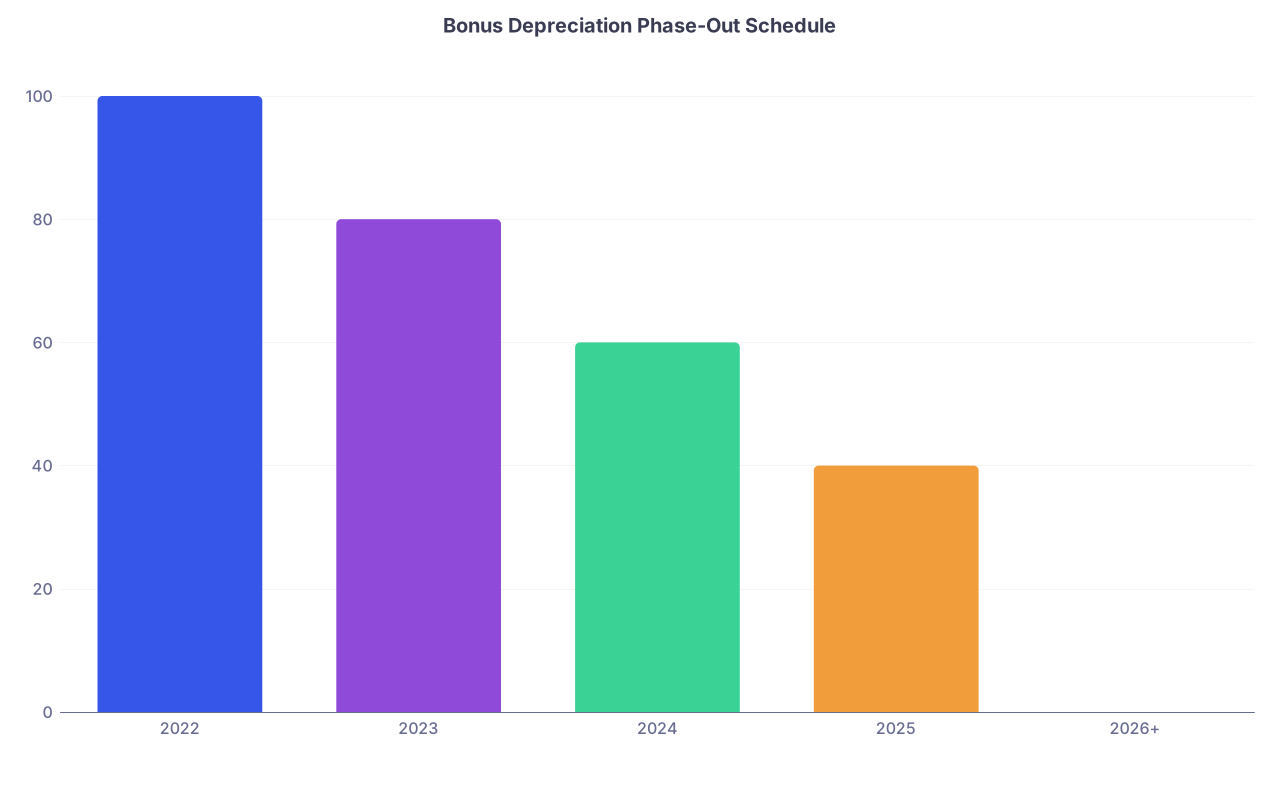
| Category | Value |
|---|---|
| 2022 | 100 |
| 2023 | 80 |
| 2024 | 60 |
| 2025 | 40 |
| 2026+ | 0 |
The timing mismatch no one tells you about
Bonus depreciation front‑loads deductions. That can be powerful. But:
- It does not eliminate total tax over the life of the investment.
- It shifts when you recognize it.
- If you do it wrong, you accelerate deductions into years where they are worthless to you (because they are passive and suspended) and then face heavy recapture on exit.
That is not tax planning. That is tax deferral with risk.
The mistake: chasing deduction size, ignoring deduction usability
You should be asking:
“Can I actually use this loss against my current active income?”
Not: “How big are the losses?”“What is the exit plan and expected recapture?”
Not: “How much can I write off in Year 1?”
Stop letting promoters throw big bonus depreciation numbers at you without showing you a projection of real tax savings by year.
4. Casual Grouping Elections That You Cannot Undo
One of the sneakiest traps: grouping elections under §469.
Many physicians never hear about them. The ones who do often use them recklessly.
What grouping actually does
The IRS allows you to group certain activities into a single “activity” for passive loss rules. This can help:
- Combine a REPS‑qualified activity with other rentals so that all rental losses are treated as non‑passive (if done correctly).
- Make material participation easier to meet.
But:
- Grouping elections are binding unless you can show a material change in circumstances.
- Screwing up the grouping strategy can trap you in a bad structure that hurts you later.
Common physician errors with grouping
- Grouping everything too early
New real estate‑curious attending:
- Buys one small short‑term rental plus several passive syndications.
- CPA says, “We will just group them, problem solved.”
- Down the road, he wants to sell one property and keep others, or he wants to do cost segregation selectively.
- The grouping structure makes it difficult to free specific suspended losses.
- Incorrect grouping to force non‑passive treatment
The worst: CPAs who casually group rentals with a physician’s clinical practice. That is almost always wrong and a red flag to an auditor.
You do not “group” your cardiology practice and a Phoenix apartment building into a single activity. Those are different universes.
If your CPA proposes grouping:
- Ask for a written memo explaining:
- What is being grouped.
- Why it is allowed under the regulations.
- How it affects your ability to use losses now and at sale.
- If they cannot articulate this in plain English, they probably do not understand it either.
5. Delegating Everything to “My CPA” and Then Being Shocked You Are Still Overpaying
Let me say something blunt: A lot of high‑income physicians assume “I have a CPA, I am fine.” No. You might be fine. Or you might be the 20th return they crank out in March.

Here is where physicians mess up:
Mistake: Asking “Can you save me taxes?” instead of specific questions
Vague ask → vague service. You need to push harder.
Ask:
- “Show me exactly how my real estate K‑1s interact with my W‑2.”
- “Explain which losses this year are:
- Passive and suspended
- Passive and used
- Non‑passive and used against my clinical income”
- “Are we doing cost segregation? If not, why? If yes, how much is actually usable this year?”
Mistake: Confusing tax preparation with tax planning
A 1040 filed correctly is not tax planning. It is compliance.
Signs you have a “form filler,” not a planner:
- You only talk in March/April.
- No one walks you through proactive decisions before you buy properties.
- You learn about big surprises (AMT, NIIT, depreciation recapture) after the fact.
6. Ignoring Entity Structure and Asset Protection While Chasing Deductions
Some physicians obsess over REPS and bonus depreciation but own five rentals in their personal name or in a random S‑corp someone set up in 2010.
You are focused on saving tax dollars, then ignore the seven‑figure lawsuit risk sitting right next to it.
The bad structures I see constantly
- Rentals titled in your own name, schedules thrown on your 1040.
- Using an S‑corp to hold rental property (generally a terrible idea).
- Mixing:
- Your clinical practice entity
- Rental activity
- Ownership of the building where you practice into one unholy mess, “to keep it simple.”
You do not want “simple.” You want defensible.
The cost of getting entity structure wrong
- Harder to do tax planning (e.g., cost segregation, partial asset dispositions).
- More exposed to plaintiffs’ attorneys.
- Potential state‑level tax mess (CA and NY are particularly unforgiving).
A reasonable structure might involve:
- Separate LLCs for individual properties or groups of similar properties.
- A holding LLC that owns membership interests.
- Clear separation from your clinical entity.
You work in a profession where one mistake can cost millions. Stop holding rental duplexes personally while worrying about saving $8K in tax.
7. Falling for Promoters Who Design the Deal Around Your Fear of Taxes
Real estate tax benefits are powerful. That is exactly why sketchy deals are sold to physicians wrapped in tax language.

You should be instantly suspicious when you hear:
- “You will pay almost no tax this year.”
- “This deal was structured specifically for physicians.”
- “We have a proprietary strategy the IRS doesn’t understand yet.”
Here is the hierarchy you keep reversing:
- Deal quality (sponsor track record, leverage, asset quality, underwriting reality)
- Liquidity and risk
- Alignment of incentives
- Tax optimization
The mistake: You jump straight to #4.
Classic “tax saver” deals that are usually just bad
- Conservation easements pitched primarily for massive deductions (a long‑time audit magnet).
- Tiny fractional oil and gas interests with huge intangible drilling cost write‑offs and terrible underlying economics.
- DSTs and UPREIT transactions that you do not understand, sold as capital gains escape hatches.
If the first 10 minutes of the pitch are about taxes, and the next 2 minutes hand‑wave the actual real estate fundamentals, walk away.
8. Forgetting That Real Estate Losses Do Not Magically Turn Your 37% Rate Into 0%
Let’s crush one more myth: “I am in the top bracket; real estate will wipe my taxes out.”
No. Some physician families can materially cut their effective tax rate with real estate. Many will not, especially if:
- Both spouses work clinically full‑time.
- There is no path to REPS.
- Most real estate is passive and syndicated, not personally managed.
| Situation | Real Tax Benefit Likely? |
|---|---|
| Single full-time W-2 physician, passive syndications only | Limited, mostly future |
| One spouse full-time physician, other truly REPS with active rentals | High potential |
| Dual high-income W-2 physicians, no REPS, mostly passive funds | Modest at best |
| Mix of W-2 and 1099, some active STRs, careful planning | Moderate to high |
| Late-career, planning large sale with 1031 and cost seg | High but complex |
What you should be solving for is not “pay zero tax.” It is:
- “How do I align my real estate, my clinical work, and my entity structure so I do not overpay tax for my specific situation?”
That answer might be:
- Moderate real estate holdings.
- Some depreciation used each year.
- No REPS.
- Fewer big surprises and no audit nightmares.
Boring. And usually correct.
9. Not Modeling the Exit: Depreciation Recapture and Capital Gains Ambush
Physicians get obsessed with Year 1 K‑1s and ignore Year 7 liquidation events.
Here is the pattern:
- You depreciate the hell out of a property.
- Your basis drops significantly.
- You think you are winning.
- Then you sell (or the syndication sells), and:
- You owe depreciation recapture (up to 25%).
- You owe long‑term capital gains on appreciation.
If you never modeled the full‑cycle tax effect, you can end up:
- With a nasty tax bill in a year you already have high income.
- Forced to scramble for estimated payments.
- Sitting on a loss of liquidity because “distributions were reinvested.”
A competent advisor should be giving you a before‑purchase scenario like:
- Year‑by‑year projected:
- Passive vs non‑passive losses
- Actual tax savings
- Expected recapture at exit
- And a plain‑English sentence:
- “If this goes as modeled, you save roughly $X over Y years, but will likely owe $Z in the exit year.”
If you do not have that, you are not planning. You are hoping.
10. Treating Short‑Term Rentals Like a Loophole You Can Phone In
There is one more trendy area physicians are abusing: short‑term rentals (STRs).
You may have heard:
- “You can get non‑passive losses from STRs without REPS.”
That can be true, if you:
- Meet the STR definition for tax (average rental period 7 days or less, with nuances).
- Materially participate under one of the IRS tests (500+ hours, or 100 hours and more than anyone else, etc.).
- Do not have a management company doing everything while you just sign documents.
What goes wrong:
- Doc hires STR management firm to “do everything.”
- Doc spends maybe 20–30 hours a year on:
- Picking décor
- Approving messages
- Looking at statements.
- CPA marks it as non‑passive and uses losses against W‑2.
- IRS challenges. Time logs are garbage. Result is ugly.
If you want to use STR as a non‑passive loss generator:
- Treat it like a real business.
- Track time daily or weekly, with specific tasks listed.
- Be the one actually doing the majority of the work.
No, approving an Airbnb message on your phone between cases does not suddenly make your $150K STR loss non‑passive.

| Step | Description |
|---|---|
| Step 1 | Physician considers real estate |
| Step 2 | High risk of bad deals |
| Step 3 | Consider quality first |
| Step 4 | Plan aggressive but defensible strategy |
| Step 5 | Focus on long term, passive use of losses |
| Step 6 | Work with real estate tax specialist |
| Step 7 | Reassess advisor and promoter claims |
| Step 8 | Primary goal |
| Step 9 | Can you qualify for REPS or STR material participation |
FAQs
1. Can I just have my non‑physician spouse claim Real Estate Professional Status so we can use all the losses?
Possibly, but not as casually as many people do. Your spouse must actually pass the REPS tests: more than 750 hours and more than half of all their working time in real property trades or businesses, with material participation. Being “on the LLC documents” is irrelevant. If your spouse works part‑time in another job and does not have clear, contemporaneous time logs for real estate activities, claiming REPS is risky. The IRS will not accept “she managed everything” without hard evidence.
2. My syndication K‑1 shows a huge loss. Why did my tax bill barely change?
Because that loss is almost certainly passive, and you probably had limited or no passive income to offset. In that case, the loss becomes a suspended passive loss. It carries forward and can offset future passive income or be used when the activity is fully disposed of. The K‑1 loss is not the same as an immediate, dollar‑for‑dollar tax reduction against your W‑2 income.
3. Do I need an LLC to get real estate tax benefits as a physician?
No. Most core tax benefits of real estate (depreciation, interest deductions, etc.) are available whether you own property in your name or through a disregarded single‑member LLC. The LLC is more important for liability protection and organizational reasons. The bigger mistakes are owning properties in the wrong type of entity (e.g., S‑corp) or mixing your clinical practice with real estate in the same structure.
4. Are short‑term rentals really a “loophole” for doctors to offset W‑2 income?
They can be powerful, but only if the rules are followed precisely. To treat STR losses as non‑passive without REPS, you must meet the STR definition and materially participate. That usually means hundreds of hours of real work and not outsourcing most functions to a management company. If you are on call every third night and working a 1.0 FTE schedule, claiming heavy STR losses as non‑passive without bulletproof documentation is asking for trouble.
5. How do I know if my CPA actually understands physician real estate tax planning?
Ask very specific questions and listen to the clarity of the answers. For example: “Given my current W‑2 income, my spouse’s work situation, and these specific properties, what portion of my real estate losses this year will reduce my clinical income, what portion will be suspended, and what are the likely tax consequences at sale?” If you get hand‑waving answers, buzzwords, or only hear about Year 1 bonus depreciation with no discussion of exit tax, REPS audits, or grouping implications, you need a second opinion.
Key points to remember:
- Do not claim Real Estate Professional Status or non‑passive STR treatment unless you can actually prove it, hour by hour.
- Stop letting giant K‑1 losses seduce you; focus on usable tax savings, not just paper losses.
- Demand full‑cycle modeling and clear explanations from your advisors; if they cannot explain it plainly, they should not be steering your seven‑figure career into complex real estate tax strategies.


