

What happens when you go from a $65,000 resident salary to $350,000 as an attending… and the IRS treats you like you knew what you were doing all along?
That first high‑earning year is where many physicians quietly burn tens of thousands of dollars. Not from bad investments. Not from getting “ripped off.” Just from avoidable, boring, unglamorous tax mistakes.
I have watched brand‑new attendings:
- Owe $40,000+ in April with no cash set aside
- Miss six‑figure Roth opportunities they will never get back
- Trigger penalties because they “trusted HR” on withholding
- Overpay student loan interest and underfund retirement in the same year
All while telling themselves, “I’ll figure it out once I’m more settled.”
That is the mistake.
Let me walk you through the biggest tax traps in your first high‑earning attending year so you do not sponsor the IRS more than legally required.
1. Pretending Your Tax Life Is Still “Resident Simple”
The worst assumption: “I’ll just let HR handle it like residency. They took out enough then; they’ll take out enough now.”
This is how you end up with a five‑figure surprise bill.
What changes the second you become an attending
As a resident:
- Your gross income was relatively low.
- Withholding tables were reasonably accurate.
- Standard deduction plus student loan interest deduction did some heavy lifting.
- You were safely in lower brackets.
As a new attending:
- Your marginal bracket may jump into 32% or 35% federal, plus state.
- You might have:
- Signing bonus
- Relocation bonus (often taxable)
- Moonlighting income
- Back pay or extra call payouts
- You may lose deductions and credits you quietly benefited from before.
If you treat this like “same system, bigger numbers,” you are already behind.
The “withholding will cover it” lie
Your employer’s payroll system has one blunt tool: the W‑4. It does not “know”:
- That you have another side gig as an independent contractor
- That you got a $50,000 signing bonus in a separate check
- That you live in a high‑tax state but plan to moonlight across state lines
- That loan payments or spouse income changed dramatically
I have seen attendings with:
- $350k W‑2 income
- $80k 1099 locums income
- Standard employer withholding
Result? $25k–$40k due at tax time, plus underpayment penalties.
Do not wait for a refund or bill to tell you if you underpaid. You need proactive estimates in that first year.
2. Ignoring Quarterly Estimated Taxes (Especially With 1099 Income)
Here is where many new attendings get blindsided: that locums or telemedicine side gig that pays “really well”? The IRS calls that self‑employment income.
Self‑employment = income with no tax withheld unless you do it yourself.
The misunderstanding
New attendings often assume:
- “I’ll just pay whatever I owe in April.”
- “If I underpay, I’ll just cover it when I file; I can afford it now.”
The IRS does not want your money next April. It wants it as you earn it.
That is why there are underpayment penalties.
When you need to pay quarterly estimates
If you have:
- 1099 income (locums, consulting, telehealth, speaking, chart review)
- Partnership K‑1 income from a group practice
- Investment income (large dividends, capital gains)
…you likely need quarterly estimated payments.
Typical attending mistake: a first year with $75k of 1099 locums income and zero estimates. That “extra” $75k is not extra.
On that 1099 income, you may owe roughly:
- Federal income tax (say 24–35% depending on your bracket)
- Plus self‑employment tax (~15.3% on the first chunk, then ~2.9%)
- Plus state tax if applicable
It is not crazy for 35–45% of that 1099 income to belong to federal + state + payroll taxes.
If you do not peel that money off as you earn it, it quietly turns into a tax bomb.
3. Misusing or Ignoring Tax‑Advantaged Retirement Accounts
This one stings because it is not just this year’s mistake. It compounds for decades.
New attendings frequently:
- Underfund retirement accounts early on (“I’ll catch up later”)
- Lose out on Roth access they will never qualify for again
- Confuse pre‑tax vs Roth contributions at their new income level
- Ignore the backdoor Roth until it becomes a paperwork mess
The classic early‑career retirement blunders
- Not maxing your employer plan in the first high‑earning year
You go from resident income to attending and still contribute like a resident. Or not at all.
At attending income, failing to max a 401(k)/403(b):
- Costs you a significant, guaranteed tax deduction now
- Reduces your long‑term compounding in a way you never truly “catch up”
- Choosing Roth blindly in the highest bracket
Roth 403(b)/401(k) sounds sexy. “Tax‑free forever.”
But if you are in the 35% bracket now and likely to be in a lower bracket in retirement, plowing everything into Roth may be exactly backward.
- Skipping the backdoor Roth IRA when you still qualify
Your first year or two as an attending are often your last realistic window to:
- Make clean, paperwork‑light backdoor Roth contributions
- Before:
- You get complicated outside pre‑tax IRAs
- Your income grows and your situation becomes messy
Every year you skip is one more year of tax‑free compounding you never get back.
| Account Type | Typical 2024 Limit | Common Mistake |
|---|---|---|
| 401(k) / 403(b) | $23,000 | Not maxing or misusing Roth |
| Backdoor Roth IRA | $6,500 | Ignoring / delaying setup |
| 457(b) (if offered) | $23,000 | Leaving it unused for years |
If you are not coordinating all of these with your tax bracket, you are leaving money on the table.
4. Letting Your Student Loans and Taxes Work Against Each Other
New attendings often separate student loans and taxes in their head.
That is wrong. Your tax return literally drives how much you pay on income‑driven repayment plans.
Common disaster sequence:
- You finish residency on an IDR plan with low payments
- You jump to $350k attending income
- You do not adjust your loan strategy
- You also do not change withholding or estimated payments
- You end up with:
- Much higher IDR payments and
- A huge tax bill the following April
Painful.
Where taxes and loans conflict
For many borrowers:
- Lower taxable income = lower IDR payment
- But aggressive pre‑tax saving to shrink IDR payments can:
- Be smart
- Or be a trap if you also have other high‑interest debt
The mistake is not “choosing wrong.” The mistake is not matching your loan strategy to your new tax situation at all.
Your first high‑earning year is when:
- Some attendings should exit PSLF paths and refinance
- Others should stay the course
- Some should pile pre‑tax contributions to manage IDR payments
- Others should ignore loan payment size and focus on high pre‑tax saving for wealth building
If you do nothing and just “let autopay ride,” you will almost certainly overpay somewhere: to the IRS, to your lender, or both.
5. Treating a Signing Bonus Like Free Money (It Is Taxable)
I have watched more signing bonuses disappear into cars, furniture, and “I deserve this” trips than I care to admit.
Here is the quiet part programs rarely explain clearly:
That $30k–$100k signing bonus in your offer letter is almost always fully taxable.
If it is paid:
- Up front
- As W‑2 income
- Often with a flat supplemental withholding rate
…you may still owe more at tax time, especially if your other income pushes you up the bracket ladder.
The trap
Scenario:
- $50k signing bonus
- Withholding at, say, 22%
- But your real marginal rate (federal + state) closer to 35–40%
You spend the net. Months later, when your return is calculated:
- Surprise: That “extra” income pushed more of your total earnings into higher brackets
- The difference surfaces as part of your big April bill
The right way to think about a signing bonus:
- Peel off an additional chunk for future taxes the moment it hits
- Or ideally, route part of your newfound cashflow toward retirement and savings, not lifestyle explosion
The bonus is not a lottery ticket. It is often just pre‑paid salary with strings.
6. Confusing W‑2 vs 1099 vs Partnership Income (And Missing Deductions or Getting Audited)
Many new attendings for the first time see multiple forms:
- W‑2 from the hospital
- 1099‑NEC from locums or telemed
- K‑1 from a private group
- 1099‑INT/1099‑DIV from investments
Then they try to “DIY” on tax software like they did as a resident.
That is where errors and audits show up.
Where physicians mess this up
Common errors:
- Treating 1099 income like W‑2 (no Schedule C, no self‑employment tax properly calculated)
- Double‑counting income when employer issues both W‑2 and 1099 for the same work
- Claiming “business deductions” aggressively without a clear business structure or records
- Ignoring state and local business tax obligations (city business tax, local licenses, etc.)
The IRS has seen every “my scrubs are a deduction” story on earth. If your return suddenly shifts from simple W‑2 only to:
- Multiple schedules
- Large new deductions
- Dramatically higher income
…you look different on their radar.
I am not saying you should not take legitimate deductions. You should.
Mistake is:
- Not understanding how to properly report each type of income
- Swinging wildly between over‑deducting (audit risk) and under‑deducting (overpaying)
7. Not Adjusting Lifestyle to Your After‑Tax Income
This is not a moral lecture. It is a math problem that ruins a lot of physicians.
You go from:
- $65k resident salary
- To $300k–$500k attending
And your brain anchors on the gross number.
Then:
- You buy the house your co‑resident just bought
- You upgrade the car
- You decorate like a person who “finally made it”
- You assume, “I can finally stop worrying about money”
Except:
- Federal tax
- State tax
- Payroll tax
- Retirement contributions (if you bother to do them)
- Loan payments
…shrink your real take‑home more than you expect.
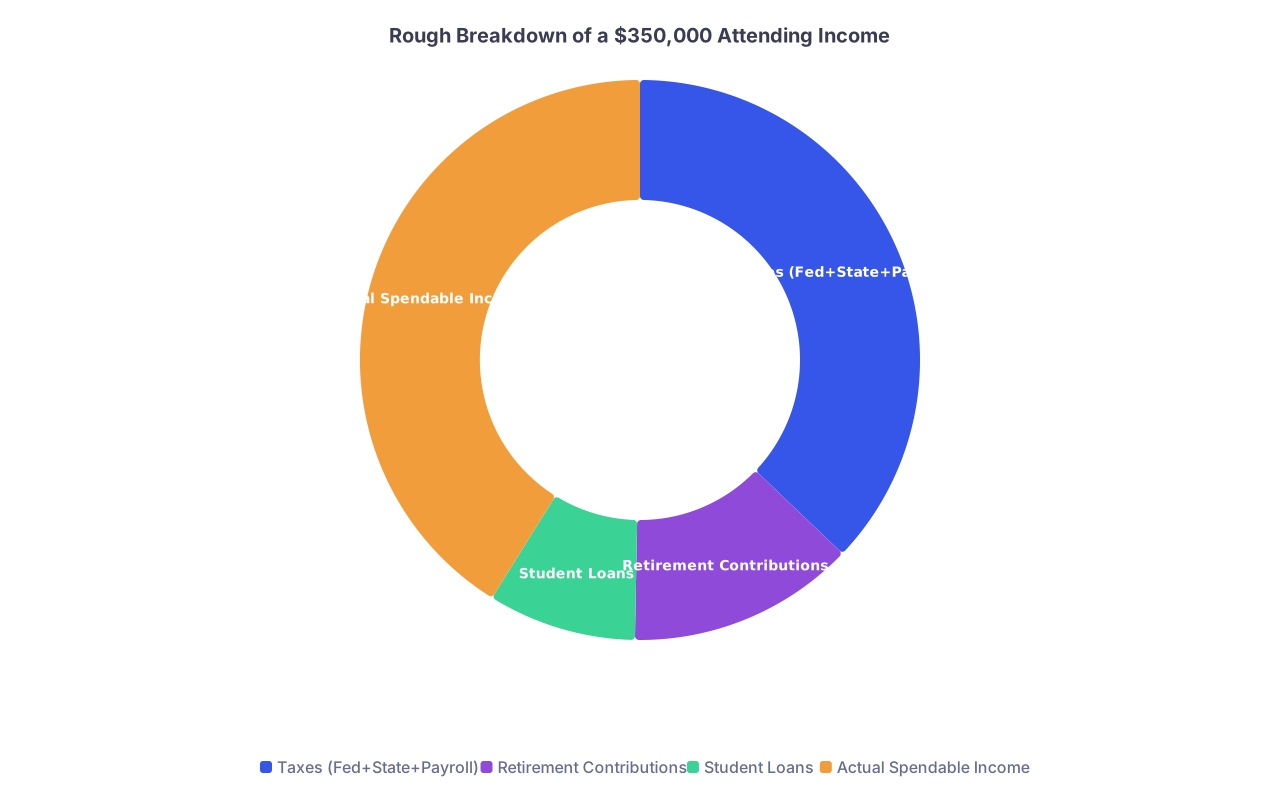
| Category | Value |
|---|---|
| Taxes (Fed+State+Payroll) | 130000 |
| Retirement Contributions | 46000 |
| Student Loans | 30000 |
| Actual Spendable Income | 144000 |
That $350k can feel uncomfortably close to “not that much” once you commit to:
- 20% retirement savings
- Aggressive loan paydown
- Supporting family
- High cost‑of‑living city
The tax mistake here is indirect: you plan your lifestyle around gross or naive net, then you cannot:
- Pay what you owe in April
- Max accounts
- Handle unexpected bills
That drives physicians right into credit card debt despite high income. It is much harder to unwind than to avoid.
8. Blowing Off State and Local Tax Nuances
New attendings love big‑name programs and big cities. The tax authorities in those places love you too.
Common misses:
- Moving from no‑tax state (e.g., Texas) to high‑tax state (e.g., California, New York) and underestimating the hit
- Working in multiple states (locums, telehealth) and assuming only your “home” state matters
- Not understanding city‑level or local occupational taxes
You can absolutely end up:
- Owing in more than one state
- Missing credits you should claim
- Or worse, getting a notice from a state you forgot you technically worked in
For multi‑state work, amateurs guess. Professionals allocate. If you are doing regional locums in multiple states your first year, do not wing it.
9. Waiting Until Next April to Talk to a Tax Pro
The single most expensive timing mistake: treating tax help as a once‑a‑year, backward‑looking service.
Your first high‑earning year is different. It is not about last year. It is about this one. Right now.
If you wait until:
- March or April of the following year
- Drop a stack of W‑2s, 1099s, and loan statements on a CPA’s desk
…you have essentially locked in whatever damage was done:
- You either did or did not make estimated payments
- You either did or did not fund pre‑tax accounts strategically
- You either triggered penalties or you did not
A good tax pro in your first attending year is not there to type numbers into software. They are there to:
- Project your liability early
- Adjust withholding and estimates
- Coordinate with your loan and retirement strategy
Yes, they cost money. But so does a $10k–$30k mistake.
10. Sloppy Record‑Keeping for Business and Education Expenses
Your deduction is only as good as your documentation. Physicians are notorious for:
- Losing CME receipts
- Mixing personal and professional travel without clear breakdown
- Paying for licensing, boards, and exams out of personal accounts with no system
Then at tax time they either:
- wildly guess (“I probably spent around $5,000…”)
- or claim nothing because they do not feel “sure enough”
Both are bad.
You want a low‑friction system from day one:
- One dedicated card for professional expenses (licensing, boards, CME, books, conferences)
- Simple spreadsheet or finance app to tag those transactions quarterly
- A folder (digital or physical) where invoices and confirmations live
No drama. No shoebox full of crumpled receipts in March.

11. Ignoring Employer Benefits That Have Immediate Tax Impact
New attendings skim their benefits booklet, circle health insurance, and ignore the rest.
That is a mistake.
The first year is when you set:
- HSA participation (if eligible)
- FSA elections (healthcare, dependent care)
- Group disability and life selections
- Certain legal or financial benefits (legal plan, financial counseling, etc.)
The tax‑relevant ones you are under‑using or misusing:
Health Savings Account (HSA)
- Triple tax advantage
- Often the single most tax‑efficient account you have
- Many physicians do not max it even when eligible
Dependent Care FSA
- If you have kids in daycare, this is real money
- But elections are use‑it‑or‑lose‑it; sloppy forecasting leads to waste
Skipping these is not as dramatic as a $20k tax bill. But over a decade? It adds up to tens of thousands of dollars in missed deductions and tax‑free growth.
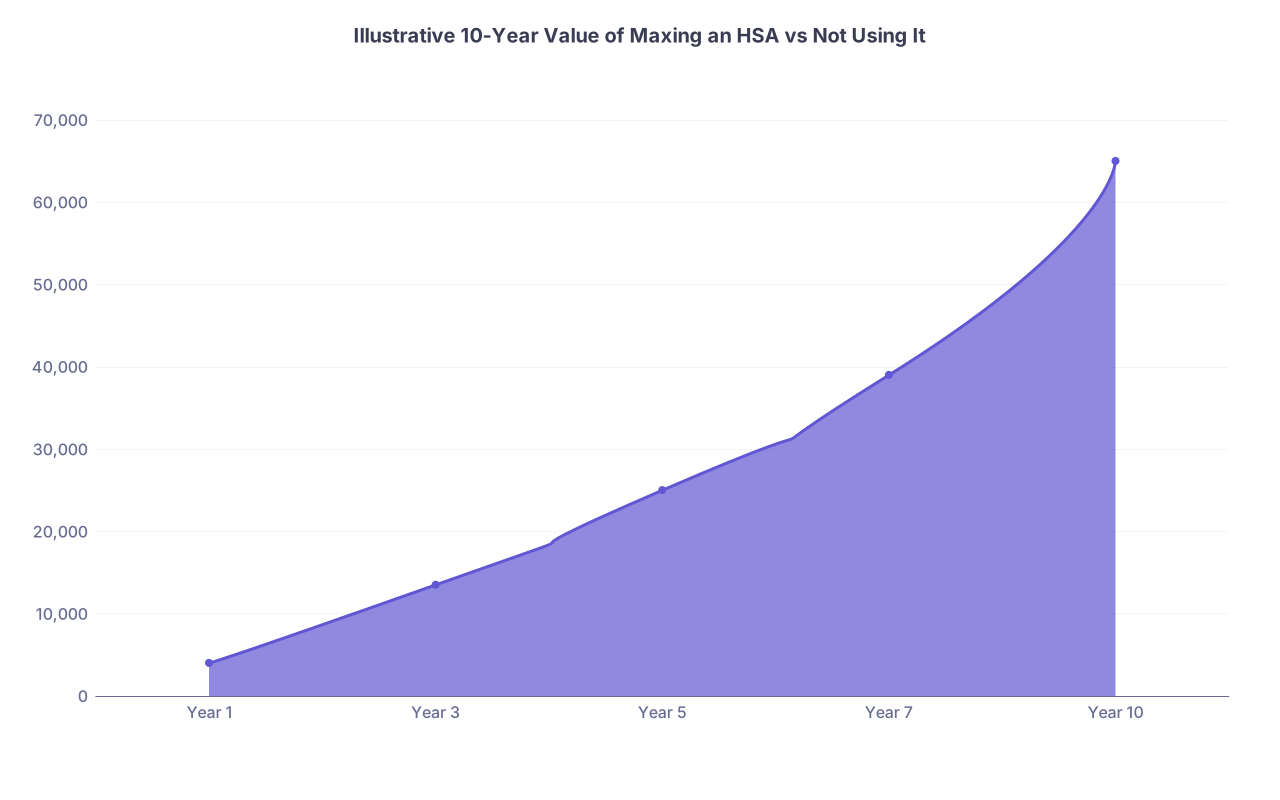
| Category | Value |
|---|---|
| Year 1 | 4000 |
| Year 3 | 13500 |
| Year 5 | 25000 |
| Year 7 | 39000 |
| Year 10 | 65000 |
12. Thinking High Income Makes You “Audit‑Proof” or “Audit‑Target”
You will hear two equally wrong takes from colleagues:
- “I make a lot now, the IRS is not going to bother me over a few things.”
- “I am a high earner; if I deduct anything they will for sure audit me.”
Both are nonsense.
Reality:
- High, stable W‑2 income + clean, consistent returns is usually low drama
- Weird swings, new large deductions, messy 1099 reporting = more attention
- Medical professionals do get audited, but you are not special; the system is rule‑driven, not reputation‑driven
Your job is simple:
- Report all income correctly
- Take every legitimate deduction and credit you reasonably can
- Keep documentation for anything non‑obvious
- Do not play games you would be embarrassed to defend in writing
You are not supposed to leave money on the table out of fear. You are supposed to be accurate and prepared.

How to Avoid Making Your First Year a Tax Disaster
You do not need to become a tax expert. You do need to avoid the rookie errors.
At a minimum in your first attending year:
Do an early tax projection
- Within the first few months of your new job
- Include salary, bonuses, 1099 side work, and your spouse’s income
- Adjust W‑4 and set up quarterly estimates if needed
Max reasonable tax‑advantaged accounts intentionally
- Employer 401(k)/403(b), possibly 457(b)
- HSA if eligible
- Backdoor Roth IRA if appropriate and coordinated
Decide on a student loan strategy that fits your new tax reality
- Do not let autopilot drive this
- Coordinate with any refinance or PSLF decisions
Scale your lifestyle to your after‑tax number, not your gross
- Know your real monthly net after taxes, retirement, and loans
- Design your fixed expenses under that
Get professional help early, not just at filing time
- The cost of one or two proactive planning meetings is trivial relative to a six‑figure income and five‑figure potential mistakes

| Step | Description |
|---|---|
| Step 1 | Start New Attending Job |
| Step 2 | Estimate Total Income |
| Step 3 | Set Quarterly Estimates |
| Step 4 | Adjust W4 Withholding |
| Step 5 | Choose Retirement Strategy |
| Step 6 | Max Employer Plans |
| Step 7 | Consider Backdoor Roth |
| Step 8 | Review Student Loan Plan |
| Step 9 | Align Loans With Tax Plan |
| Step 10 | Review State and Local Taxes |
| Step 11 | Confirm Multi State Obligations |
| Step 12 | Meet Tax Pro Mid Year |
| Step 13 | Any 1099 or Locums? |

The Bottom Line
Do not make your first high‑earning year the most expensive learning experience of your career.
Three key points:
- Your tax life does not “scale up” automatically from residency; you must actively adjust withholding, estimates, and retirement strategy in that first year.
- The big hidden leaks are 1099 income with no estimates, underused tax‑advantaged accounts, and lifestyle built on gross instead of after‑tax income.
- A single proactive planning year with competent help is almost always cheaper than the avoidable mistakes new attendings make flying blind.


