

The way physician bonuses are structured is not about “rewarding excellence.” It’s about taxes. Your taxes. Your employer’s taxes. And the quiet games CPAs, hospital CFOs, and practice owners play in the background.
You’re told your bonus is about RVUs, quality metrics, “alignment with institutional priorities.” Partially true. But behind the HR language, someone in a windowless conference room has already modeled exactly how to move money to you in a way that minimizes their taxes and often—if they’re smart—your taxes too.
Let me walk you through how this really works, because nobody explains this honestly to residents, new attendings, or even seasoned docs. But the attorneys, compensation consultants, and CFOs talk about it very openly when you’re not in the room.
The First Truth: Your Bonus Is a Tax Tool
Inside every hospital CFO meeting I’ve ever sat in, the conversation about bonuses starts with one question:
“How do we move this much compensation without blowing up payroll tax or violating Stark/AKS?”
Not: “How do we best reward Dr. Smith?”
W‑2 salary, by default, is the worst way to pay a physician from a tax perspective:
- Fully subject to federal income tax
- Fully subject to FICA (Social Security up to the cap + Medicare)
- Fully deductible for the employer, yes—but it hits your paycheck hard
So what do sophisticated systems and group practices do?
They slice compensation into different “buckets” that are all labeled as “bonus” or “incentive pay,” but under the hood they’re aiming at things like:
- Deferring your tax to a later year
- Shifting income into pre‑tax or tax‑favored vehicles
- Recharacterizing some of what smells like salary into something that behaves differently for tax or benefit purposes
- Timing the payments to straddle tax years or fiscal years
That’s why two cardiologists with the “same” $100k bonus on paper can end up with wildly different after‑tax results—depending on how the bonus is designed.
The Hidden Buckets: How Bonuses Are Quietly Repackaged
Let’s unpack how the smarter players actually do this. Because most physicians only see “Annual Productivity Bonus” on a line item and think that’s the whole story. It is not.
1. Straight Cash Bonus (The Lazy Default)
This is what unsophisticated groups or small practices do:
- End of year: “We made money, here’s $50k, congrats.”
- It shows up in your W‑2 as regular compensation.
- You get hammered with ordinary income tax + payroll tax.
From a tax planning perspective, this is amateur hour.
Hospital payroll will “gross up” withholdings, sure, but there’s no structure, no deferral, no optimization. If this is your only bonus mechanism, the group either doesn’t know better or doesn’t care.
2. Nonqualified Deferred Compensation (The Quiet Backroom Favorite)
Here’s where things get more interesting.
Larger health systems and big multispecialty groups often use nonqualified deferred compensation plans (NQDC) for high earners. You’ll almost never hear this discussed in resident orientation.
What they actually do:
- They give you the option (or require high earners) to defer part of your bonus—say $50k–$150k—into a side plan.
- You don’t pay tax on that piece this year.
- It grows tax-deferred.
- You get it later: at separation, retirement, or on a fixed schedule.
And here’s the part nobody explains:
This is specifically structured to comply with IRC §409A. You cannot casually change your mind later. Elections must be made in advance (often the year before). If you screw up 409A, the IRS torches the whole thing—20% penalty + interest.
Why do systems like this?
- It lets them promise large bonuses without you actually taking the full tax hit immediately.
- It can serve as a “golden handcuff”—walk early, lose favorable vesting.
- It allows better alignment between hospital fiscal years and payout timing.
For you, when used well, it’s a way to shovel income out of your peak-earning, highest-bracket years and into lower-income retirement years.
| Bonus Type | Tax Timing | Payroll Tax? | Typical User |
|---|---|---|---|
| Straight cash bonus | Current year | Yes | Small groups, basic HR |
| Deferred comp (409A NQDC) | Future distribution | Yes (at pay) | Large systems, exec plans |
| 401(k)/403(b) match as bonus | Current year (pre-tax) | FICA usually yes | Employed physicians |
| Profit distribution (K-1) | Current year | No FICA | Partners, owners |
| Supplemental DB/cash balance | Future retirement | No FICA | High earners, groups |
3. “Bonus” as Retirement Stuffing: 401(k), 403(b), Profit Sharing, Cash Balance
This is where the backroom conversations get very pointed.
I’ve heard practice owners say it flat out:
“We’ll call it a ‘bonus,’ but most of it’s going into the plan. They don’t need it all as paycheck.”
Hospitals and groups quietly redirect “bonus” dollars into:
- 401(k) or 403(b) employer contributions or matches
- Profit-sharing contributions
- Cash balance / defined benefit plans
Why? Because this is one of the only legal ways to:
- Reduce current taxable income for you
- Reduce current taxable income for the entity (if it’s a taxable group)
- Avoid paying out raw cash that just gets eviscerated at your highest marginal rate
You still get the money. Just not today. And not in a form that shows up as another $100k of W‑2 ordinary income this April.
Here’s the piece most physicians don’t appreciate:
Once you’re making $350k–$600k+, the marginal value of each additional W‑2 dollar is brutal. Pushing that same “bonus” into a well‑designed qualified plan starts to look very smart.
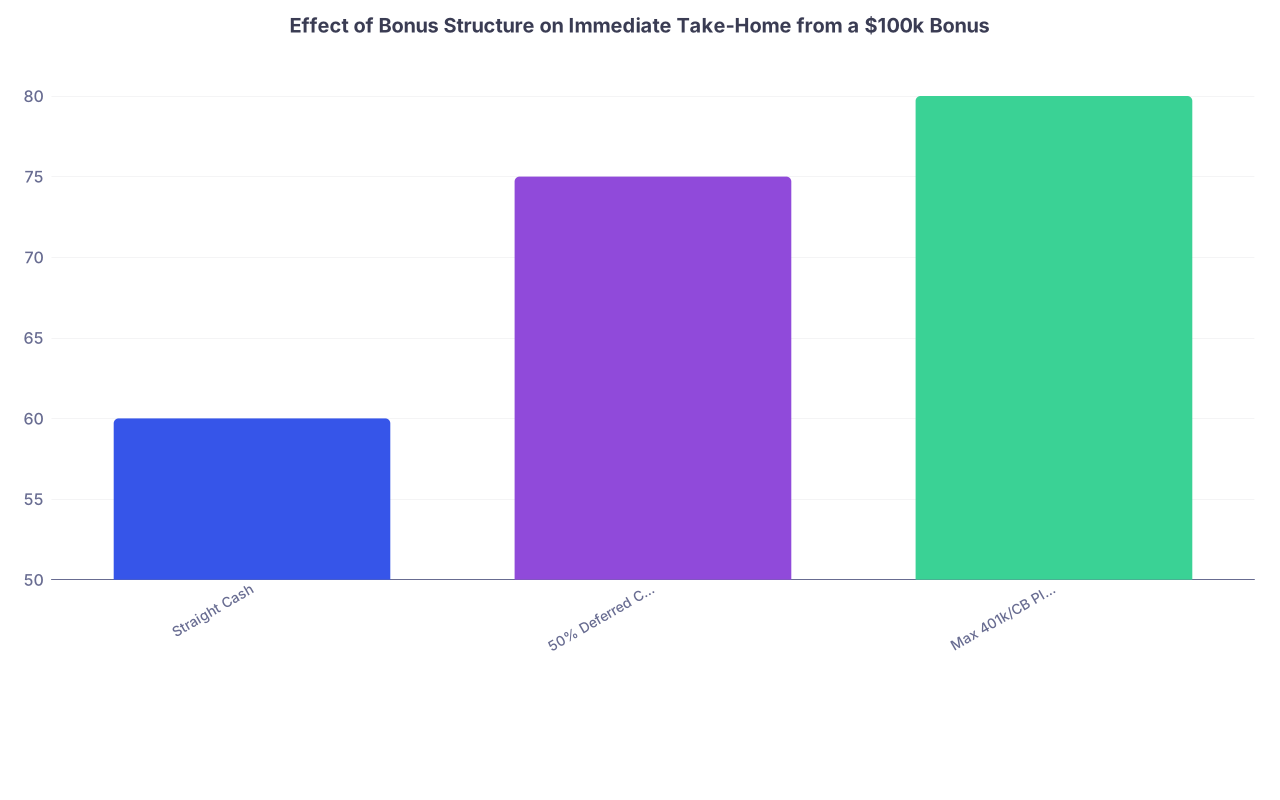
| Category | Value |
|---|---|
| Straight Cash | 60 |
| 50% Deferred Comp | 75 |
| Max 401k/CB Plan Use | 80 |
Those values are rough, but directionally accurate: pure cash is often the worst outcome in high brackets once you factor federal, state, and payroll taxes.
4. Ownership Bonuses: Converting Salary Into Business Income
This is the real backroom game: moving you from an employee getting W‑2 bonus to an owner getting distributions, guaranteed payments, or K‑1 income.
In private practices and some PE-backed groups, the compensation consultants literally sit there and draw two columns on a whiteboard:
- Column A: W‑2 salary + bonus
- Column B: Modest W‑2 salary + “bonus” as profit distribution
Two agendas:
Reduce payroll tax exposure.
W‑2 comp is hit with full FICA/Medicare. Distributions from an S‑corp or partnership typically are not.Separate “labor” from “capital.”
The IRS wants to see you paid reasonably for your work. Beyond that, the excess can often be treated as return on ownership—taxed differently.
So the “bonus” becomes:
- Higher quarterly distributions
- True-up at year-end based on productivity
- Performance-based “owner draws” tied to net income rather than pure RVUs
This is why partners in the same group can openly say, “My bonus was $300k,” and what they really mean is, “My K‑1 distribution after expenses was $300k.”
Legally and for tax purposes, that’s a different animal than a W‑2 bonus check.
The Timing Tricks: Shifting Which Year You Pay
Next layer: timing.
Your CFO, practice administrator, and outside CPA argue about this behind closed doors every December. You seldom hear about it.
The two classic levers:
- Accrue bonus this year, pay next year
- Delay bonus decision to next fiscal year entirely
The goals:
- For the employer: match expenses to the right fiscal year; manage reported profitability.
- For you (if they’re thoughtful): push bonus into a year with lower overall income, or at least give you room for pre‑tax moves (maxing retirement, defined benefit plans, etc.).
I’ve seen groups do this:
- You crush it in Year 1, technically earning a huge bonus.
- The board “approves” and “declares” the bonus in December of Year 1 to take the deduction.
- They actually pay you in January of Year 2.
Result:
- Entity gets Year 1 deduction.
- You recognize taxable income in Year 2.
- If Year 2 you drop hours, go 0.8 FTE, or retire mid‑year, that timing becomes very friendly.
This is fully intentional. The language in your contract about “bonus determination and payment” is not filler. It’s tax engineering.

| Step | Description |
|---|---|
| Step 1 | Work and produce RVUs in Year 1 |
| Step 2 | Bonus calculated in Q4 Year 1 |
| Step 3 | Employer takes deduction Year 1 |
| Step 4 | Bonus paid Jan Year 2 |
| Step 5 | Physician taxed Year 2 |
| Step 6 | Bonus decided in Year 2 |
| Step 7 | Deduction and income in Year 2 |
| Step 8 | Board declares bonus in Year 1 |
Hospital vs Private Practice: Very Different Games
You need to understand which game you’re in. Because the tax levers are different.
Employed by Hospital / Academic Center
Here’s the behind-the-scenes truth:
- Almost everything you earn is W‑2, period.
- Your “bonus” lives in a rigid structure: RVU-based incentive, quality metric payouts, signing bonuses, retention bonuses.
- The tax games are mostly: deferral (NQDC), timing, and retirement plan maximization.
Common hidden tactics:
- Rebranding part of a “raise” as bonus so it can be flexibly suspended in bad years.
- Shifting money into 403(b)/457(b) and sometimes 457(f) plans for higher earners.
- Using retention bonuses structured over several years to spread your tax hits.
Partner / Owner in Group Practice
Whole different animal. Here you get access to:
- K‑1 income vs W‑2
- S‑corp strategies (for smaller groups)
- Defined benefit and cash balance plan designs targeting $100k–$300k+ contributions per year
- Buy-in and buy-out structures that effectively convert part of what would be bonus into capital gain or amortized payments
What I’ve seen in backroom partner retreats:
- They knowingly set low “base salary” for partners.
- They funnel the majority of compensation as “productivity pool” or “profit distribution,” which everyone casually calls “bonus” but is really K‑1 income.
- They layer in a cash balance plan so a chunk of that “bonus” never hits your taxable W‑2 at all—it’s employer contribution to the plan.
Is this about rewarding you? Partially.
It’s also about minimizing payroll taxes and creating structures that benefit long‑term partners more than short‑timers.
The Stark / AKS Angle: Why They Obsess Over Formula Language
In hospital-based and some outpatient referral-heavy settings, bonus design isn’t just about tax. It’s about not going to prison.
So in those closed‑door comp meetings, two legal constraints keep coming up:
- Stark Law (self-referral)
- Anti‑Kickback Statute (AKS)
This is why your bonus language looks so weird and hyper‑specific:
- “Compensation must be fair market value.”
- “Cannot be determined in a manner that takes into account the volume or value of referrals.”
- “wRVU-based productivity not tied to designated health services volume.”
But here’s what they’re actually doing in practice:
- They construct RVU formulas that look clean for Stark/AKS.
- Behind that, they adjust conversion factors, thresholds, and True‑Up pools so total comp remains competitive.
- They route extra dollars via “administrative stipends,” “medical directorships,” or “call stipends,” which are fully taxable but structured separately to get around pure RVU constraints.
All of this lives inside what’s labeled as “compensation plan with incentives/bonuses,” and you’re told the tax is just “regular income.”
Technically true. Strategically incomplete.
In the background, lawyers and tax people are constantly balancing:
- Not triggering Stark/AKS issues
- Still pushing as much as possible into structures that can defer or recharacterize income
- Keeping the hospital and high earners in a more favorable tax posture over time
Where Physicians Leave Money on the Table
Here’s the part where you’re probably losing.
You assume the bonus structure is fixed and your only job is to “hit target.” That’s how residents are trained to think—hit the number, get the gold star.
In reality, there are at least five places you can quietly optimize (and almost nobody teaches you this):
Bonus deferral elections
If your employer offers any kind of 409A plan or deferred comp, the election timing is everything. You need to plan a full year ahead to decide what to defer. Most physicians ignore the email, then complain about taxes in April.Maximizing qualified plan usage
If your group uses profit sharing or cash balance, the “bonus” number on the summary sheet may not reflect how much is being put away pre‑tax in your name. Understanding that ratio and pushing for higher plan contributions can dramatically lower current taxes.Negotiating bonus classification as you become partner
When you transition from employed to partner, that’s the moment to push for how much shows as guaranteed payment vs. distribution vs. W‑2. You only get to shape that once.Timing big life changes around bonus years
Cutting back FTE, maternity/paternity leave, moving, or retiring in a high bonus year without paying attention to timing is how you accidentally pile a massive bonus into a year with already huge income and no tax strategy in place.Misusing “signing bonus” and “loan forgiveness”
Those big signing “bonuses” and student loan “repayment” perks are often fully taxable income. But with careful structuring—spreading them over years, pairing them with retirement contributions, or wrapping them into relocation allowances—you can soften the blow. Most people just sign.
A Simple Mental Model: Ask These Three Questions
Whenever you see the word “bonus” in your contract, stop and ask:
What bucket is this really in?
W‑2 cash? Deferred comp? Retirement contribution? K‑1 distribution? Loan forgiveness?
Each behaves differently on your tax return.When is it actually earned vs. when is it actually paid?
That gap is fertile ground for planning. If it’s earned in Year 1 but paid in Year 2, you can pair it with life changes, extra retirement moves, or deferral options.Can any portion be re-routed?
Into deferred comp. Into a cash balance plan. Into additional 401(k)/403(b) contributions. Into owner distributions instead of salary once you’re a partner.
You will not get this handed to you in plain English from HR. They’re not hiding it to screw you; they just assume doctors don’t care or won’t understand it. That assumption costs you real money.
FAQs
1. Are physician bonuses always taxed as ordinary income?
From the IRS perspective, yes—most physician bonuses are taxed as ordinary income. But “ordinary income” doesn’t mean it has to hit your W‑2 this year in cash. It can be:
- Deferred into a 409A plan and taxed later
- Routed into qualified plans (401(k), 403(b), cash balance) and deducted now, taxed at retirement
- Paid as K‑1 income if you’re an owner, which may avoid payroll taxes even though it’s still ordinary
So the character is usually ordinary, but the timing and form are where the planning happens.
2. Can I ask my employer to structure my bonus differently to save taxes?
You have more leverage than you think, especially at contract renewal, retention discussions, or partner track negotiations. Large hospitals won’t redesign their whole system for you, but you can:
- Ask about access to any deferred comp or 457(b)/457(f) plans
- Maximize employer retirement contributions tied to “incentive” or “bonus” pay
- Clarify timing of payouts (December vs January) and push for flexibility where allowed
In private groups, you can go further—pushing for owner distributions instead of inflated W‑2 bonuses once you’re a partner.
3. Is deferred compensation always a good idea for physician bonuses?
No. It’s powerful, but dangerous if you do it blindly. You should understand:
- Your current vs expected future tax brackets
- The solvency and stability of the employer (because nonqualified plans are subject to employer credit risk)
- The specific 409A rules on elections and distributions—you can’t just change your mind last minute
Used well, it’s a sharp tool. Used casually, it’s a trap.
4. How do cash balance or defined benefit plans interact with bonuses?
In many high-earning physician groups, the “bonus” pool is partially or heavily directed into a cash balance or defined benefit plan. That money:
- Counts as employer contribution
- Is deductible to the practice
- Grows tax-deferred for you, with future taxation at withdrawal
So when a group says, “Partner bonus is $250k,” what they might mean in economic terms is: $150k in current-year cash or K‑1, $100k stuffed into the cash balance plan in your name.
5. Where should I start if I feel my current bonus setup is tax-inefficient?
Three concrete steps:
- Get your last 2–3 years of pay stubs and W‑2/K‑1s and map out exactly how your comp is structured now.
- Read your contract’s compensation and bonus sections carefully, paying special attention to timing, vesting, and any mention of deferred comp or retirement plans.
- Sit down with a CPA who actually specializes in physicians (not a generic tax preparer) and say: “Here’s my current structure; if you could redesign how my bonus flows, what would you do?”
Once you see your bonus as a tax design problem—not just a reward—you’re playing the same game your CFO and practice owners have been playing for years.
And that’s when you stop just being “well‑compensated” and start being strategically compensated.
With that mindset, you’re ready for the next level: how buy-ins, buy-outs, and equity deals are written to shift income into capital gains and long-term wealth. But that’s a story for another day.


