

The way hospital contracts shift taxes onto physicians is not an accident. It’s a design choice.
I’ve sat in too many closed-door meetings where hospital lawyers and finance people talk about “comp structure optimization” and “benefit load reduction” while everyone pretends this is about alignment and flexibility. It is not. It’s about moving tax and benefit costs off the hospital’s books and onto yours—and doing it so quietly that most physicians never realize what they signed away.
Let me walk you through how this actually works behind the curtain.
The Core Game: Convert Hospital Costs Into Your “Choices”
Hospitals hate fixed costs. Payroll taxes, benefits, retirement matches—those are hard dollars they own. So the entire game is: keep your clinical revenue, but carve off as much of the tax and benefit cost as possible and put it back on your shoulders.
The tools they use are boring words that sound harmless:
- “Productivity-based”
- “Professional services agreement”
- “Independent contractor”
- “Hybrid comp”
- “Flexible benefit options”
Behind those labels, three big levers quietly move:
- Who is the employer of record (W‑2 vs 1099).
- Who carries payroll taxes and benefits (Social Security/Medicare, health, malpractice, retirement).
- How much of your compensation is “guarantee” vs “at risk” vs “bonus” (which changes what protections you really have).
Here’s the part most physicians miss: two offers with the same “$400K total compensation” headline can leave you with a $30–60K annual difference in real after‑tax take‑home, just from these structural details.
W‑2 vs 1099: The Quiet Reclassification Trick
Whenever administration insists, “This is a 1099 professional services agreement, very standard,” your tax liability meter should start screaming.
On paper, here’s the difference:
| Feature | W-2 Employee | 1099 Contractor |
|---|---|---|
| Social Security/Medicare | Half paid by employer | You pay 100% (self-employment) |
| Benefits (health, LTD, etc.) | Employer subsidized or provided | You pay fully, often at retail |
| Retirement plan | Hospital 401k/403b with match | You must set up your own plan |
| Malpractice insurance | Often employer-paid | Often paid by you |
| Payroll withholding | Automatic | You must manage estimates |
Hospitals know the math. On a 1099 $400K contract:
- You’re paying both halves of FICA/Medicare (self-employment tax).
- You lose access to institutional benefit pricing and subsidies.
- You usually lose the 403(b) match and defined benefit or cash balance plans.
They pitch it as “You’ll have more deductions as a contractor.” I’ve heard that line verbatim in a comp committee meeting. It’s misleading.
Yes, you can create deductions as a 1099 (solo 401(k), defined benefit, expenses, entity structure). But that only helps if you:
- Actually set up the right structure (S‑corp/PLLC/PC, good payroll, proper retirement plan), and
- Have a sophisticated tax strategy and high discipline.
Most physicians don’t have either when they sign. So what really happens?
You absorb more tax. The hospital unloads more cost. They call it “market standard.”
How Contracts Bury the Tax Shift in Nice-Sounding Clauses
The contract doesn’t say, “We’re offloading our tax burden onto you.” It says things like:
- “Physician shall be solely responsible for all federal, state, and local taxes.”
- “This is an independent contractor arrangement; no employer-employee relationship is created.”
- “Hospital shall pay group professional fees; physician is responsible for personal tax obligations.”
I watched an anesthesia group in the Midwest go through this transformation. For years, they were hospital-employed W‑2. Then administration came in with a “modernization plan”:
- Convert to a professional services agreement.
- Form a separate physician group “for autonomy.”
- Same gross pay, “more upside” via productivity.
Here’s what changed overnight:
- Hospital stopped paying employer-side payroll taxes.
- Hospital dropped its funded retirement plan responsibility.
- Health benefit cost was no longer their headache.
- Malpractice coverage shifted from being fully funded by the hospital to a blended “subsidy” through the new group.
The physicians saw the same top-line number. Their net? Many were down $30–40K a year after tax and benefits, unless they aggressively optimized their own entity setup. A few did. Most didn’t.
The RVU Mirage: How “Productivity” Hides Financial Risk
wRVU-based comp is where I’ve heard the most nonsense thrown at physicians.
The classic sales pitch:
- “Base salary + productivity bonus”
- “You get paid for what you do”
- “Unlimited upside”
Here’s the quiet tax and risk story administrators don’t say out loud:
High wRVU conversion factors usually come with reduced guaranteed base. Less base = less stable W‑2 income to justify good group benefit design, loan refinancing, and personal planning.
The more your comp swings with RVUs, the easier it is for the hospital to eventually nudge you into a “semi-independent” or group model where you assume staffing, benefits, and tax overhead.
They can claim “our employer cost per wRVU is too high” and “we need to align incentives,” which is code for: your comp and benefits cost too much, we’re going to convert some of that into your problem.
Productivity is not inherently bad. But combined with:
- Thin or no guarantee
- Short notice for compensation plan changes
- and “independent contractor” language
…it becomes a very effective tool to push costs off the hospital’s ledger and onto you, while making it feel like you’re chasing more upside.
Benefit Structures: The Hidden Tax Subsidy You Lose
Here’s something most physicians never hear plainly: rich W‑2 benefit plans are a tax subsidy from the hospital to you.
When you’re W‑2 at a big system (think Mayo, Cleveland Clinic, large academic centers), they’re often covering:
- 50–70% of your health insurance premium
- A defined benefit or cash balance plan you could never set up as an individual
- Disability, life, CME, licensure, credentialing
- Employer contributions to 401(k)/403(b) and possibly 457(b)
That’s not just benefits. That’s pre-tax value.
When hospitals want to slash their long-term cost structure, they don’t always slash your base outright. They:
- Freeze or shrink the match.
- Move from defined benefit to defined contribution.
- Cap or cut 457(b) contributions.
- Shift to “employee-paid” options that used to be partially funded.
I’ve sat in finance meetings where the slide literally showed: “Benefit load reduction target: 4–5% over 3 years.” That doesn’t hit the press release. But it hits you.
For a mid-career physician making $350–500K, the difference between a “rich” hospital benefit package and a bare-bones or shifted one can easily be:
- $15–25K in extra health/disability/life costs paid post-tax
- $10–30K a year less in employer retirement contributions
- Loss of 457(b) or defined benefit plan that allowed six-figure pre-tax savings
You don’t see it in the base salary box. You see it in your tax return five years later when you realize how little is sheltered.
The Employed-But-Not-Really Trap
There’s another sneaky middle ground: you’re technically a W‑2, but the contract is written like they’re trying to get all the 1099 advantages without calling you a contractor.
Looks like this:
- You’re paid by a physician group that’s “aligned” with the hospital, not directly by the hospital.
- The group’s hospital contract is renegotiated every 1–3 years.
- Your individual contract says compensation can be changed at any time by the group board or comp committee.
- Benefits are “subject to change” independent of your salary.
Translation:
The hospital offloads risk to the group.
The group can offload risk to you.
Your W‑2 status exists, but your security and benefits don’t look like traditional employment.
This structure is everywhere in:
- Emergency medicine
- Anesthesia
- Hospitalist medicine
- Radiology
- Some surgical subspecialties
The big private equity–backed groups mastered this model. Many health systems watched and copied the “risk offload” mechanics, just with nicer branding.
What This Means for Your Actual Tax Bill
Let’s stop talking theory and look at real numbers. Suppose two physicians both see “$450K” on an offer.
Physician A – true W‑2 hospital employed
Physician B – 1099 “independent contractor” for the same hospital
Basic federal tax picture (oversimplified, but directionally accurate):
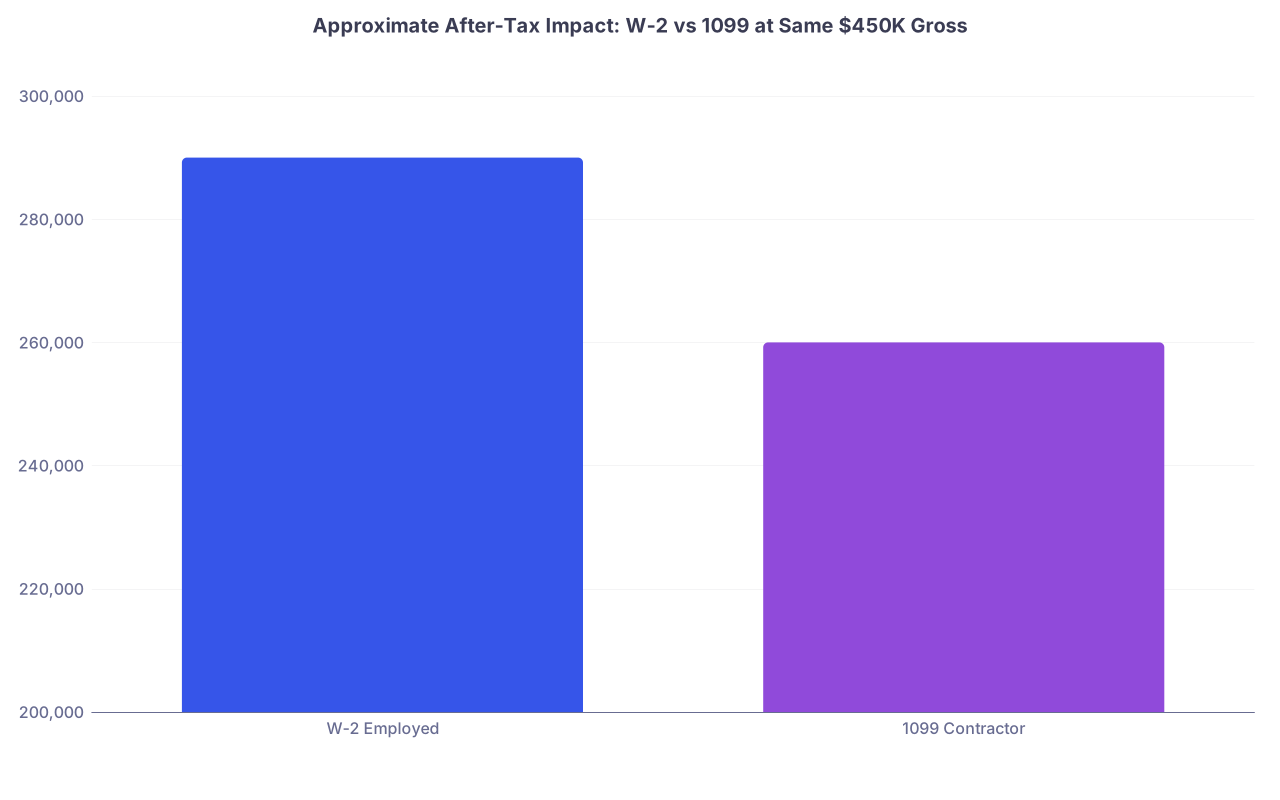
| Category | Value |
|---|---|
| W-2 Employed | 290000 |
| 1099 Contractor | 260000 |
Why the gap?
- Self-employment tax: On 1099, you’re covering both halves of Social Security/Medicare on your comp. Some gets deducted, yes, but cash outflow is still higher.
- Lost employer benefits: Health, disability, retirement match—if you replace them yourself, you’re buying with after-tax dollars or using more limited pre-tax structures.
- Plan design: Hospitals can run multiple layers of retirement plans with high limits that are hard to replicate as a solo contractor without serious planning and compliance cost.
Can a well-structured 1099 physician with a PLLC + S‑corp + solo 401(k) + defined benefit rescue this? Sometimes, yes. But that requires:
- Sophisticated advisors
- Discipline to actually fund plans every year
- Comfort with complexity and audit risk
Hospitals are not reorganizing you into 1099 land to make you richer. They’re doing it because, on average, it shifts cost and tax burden away from them and onto you.
Red Flags in Contracts That Scream “We’re Moving Costs To You”
You want concrete tells. Fine. Here are the phrases I see over and over when hospitals are quietly pushing tax and benefit burdens your way:
- “Independent contractor” used anywhere, with no employer-side tax or benefit commitments.
- “Physician will be responsible for obtaining and maintaining malpractice insurance, with hospital providing a stipend of X.”
- “Compensation model subject to change at the discretion of Hospital or Medical Group with 60–90 days’ notice.”
- “Benefits are not guaranteed and may be modified or discontinued at any time.”
- “Professional services agreement” with no guaranteed term, or a short term and easy termination.
- “Productivity-based compensation with limited or no base guarantee.”
And my personal favorite, from a real contract I reviewed:
“This arrangement is intended to provide maximum flexibility for both parties.”
Every time I’ve seen that line, all the flexibility is on the hospital’s side. Your tax and benefit risk is the one that’s flexible.
How Program Directors and Chairs Really Talk About This
You won’t hear this on interview day. You’ll hear it in the workroom after everyone’s gone.
I’ve heard department chairs say things like:
- “Legal wants them on contractor status so we’re not on the hook for benefits if volumes drop.”
- “Finance is pushing us to reduce our ‘benefit load’ by 2–3% next year.”
- “The new comp plan is mostly about getting cost off the hospital balance sheet.”
Most chairs are caught in the middle. They’re told:
- “You need to recruit.”
- “You need to keep your docs happy.”
- “Also, you must move them to this new model.”
So they sell the “upside” and “flexibility” because that’s the script they’ve been given. Some believe it. Some don’t. But very, very few will sit you down and say:
“If you sign this version of the contract, your long-term tax and benefit position is worse than the old model. Here’s the actual net effect in dollars.”
They’re not going to run a lifetime tax projection for you. You have to do that yourself, or get someone who will.
Using the System Instead of Getting Used by It
You’re not powerless here. You just have to stop fixating exclusively on the top-line salary and start valuing what the hospital is trying to shed.
Three big moves:
Value benefits like cash.
A rich hospital benefits package can be worth 15–30% of salary in pre-tax value. When you compare offers, translate health, retirement, disability, and 457(b)/pension into real annual and lifetime dollars. The “lower salary” academic or large-system job sometimes beats the “higher salary” community or contractor job after tax.If you accept 1099, play it like a pro, not like a confused high earner.
That means:- Entity structure (PLLC/PC taxed as S‑corp in many cases).
- Intentional salary vs distribution planning.
- Solo 401(k) or defined benefit plan if appropriate.
- Quarterly taxes handled systematically, not as an afterthought. If you’re going to carry the hospital’s tax burden, you’d better also capture every structural advantage they just gifted themselves.
Negotiate structure, not just numbers.
Hospital lawyers will not rewrite the legal backbone of their templates for you, but there’s usually more room than residents think:- Push for W‑2 if the work relationship is obviously employee-like (fixed schedule, integrated into teams, no real autonomy in business ops).
- Ask for hospital-paid malpractice, tail included, or at least a full-cost subsidy.
- Push to preserve retirement match/plan eligibility and document it clearly.
- Question vague “compensation subject to change” language—get timelines, caps, or formulas.
You won’t win every point. But I’ve watched physicians claw back $20–50K a year in real value just by refusing to be steamrolled by “this is our standard agreement.”
A Quick Reality Check: Why Hospitals Won’t Stop Doing This
Hospitals are operating in a brutally tight margin environment. CMS cuts, commercial payer pressure, staffing costs up, capital needs constant. Their CFOs are rewarded for keeping labor and benefit costs under control.
So they’ll keep:
- Rewriting contracts
- Pushing professional services agreements
- Converting to group models
- Reducing benefit richness quietly over time
They’ll phrase it as “alignment with market norms” or “protecting sustainability.” Internally, it’s a cost-shift strategy dressed up as modernization.
You cannot fix that system-level behavior on your own. What you can do is refuse to be the naive attending who only looks at the salary line and ignores the tax and benefit structure that will make or break your financial life fifteen years from now.

| Step | Description |
|---|---|
| Step 1 | Hospital Cost Pressure |
| Step 2 | Revise Compensation Models |
| Step 3 | Shift to 1099 or Group Model |
| Step 4 | Reduce Benefit Richness |
| Step 5 | Physician Pays Self Employment Tax |
| Step 6 | Physician Buys Own Benefits |
| Step 7 | Lower Employer Retirement Funding |
| Step 8 | Higher Out of Pocket Premiums |
| Step 9 | Higher Annual Tax Burden |
| Step 10 | Less Pre Tax Savings |
| Step 11 | Lower Net Take Home |
FAQs
1. Is being a 1099 physician always worse than being W‑2?
No. It’s riskier and more complex, not automatically worse. If you set up a proper entity, pay yourself a reasonable salary, use S‑corp strategy where appropriate, and aggressively fund retirement plans, you can sometimes come out ahead—especially at very high incomes. But that’s if and only if you actually do the work and get good advice. For the average physician who just cashes the checks and files a simple return, 1099 usually means higher tax and weaker benefits.
2. How can I quickly tell if a “$X total compensation” offer is actually good after tax?
You need to break it into: cash salary, bonus/prod, benefits (health, retirement, disability, CME), and tax structure (W‑2 vs 1099). Then run a back-of-the-envelope comparison: what will I pay in payroll/self-employment taxes, what’s the real value of employer retirement contributions, what does replacing lost benefits cost me? A good physician-focused CPA or planner can run side-by-side scenarios in an hour. Do that before you sign, not after your first year.
3. What contract terms most strongly affect my long-term tax planning?
Employment status (W‑2 vs 1099), retirement plan access and employer contributions, whether malpractice and tail are employer-paid, and any clause that lets the hospital or group unilaterally change compensation or benefits on short notice. Those four areas drive whether you can build consistent pre-tax savings, manage risk, and avoid being whipsawed by comp plan changes that blow up your tax and savings strategy.
4. If my hospital is “restructuring contracts,” what should I do before signing anything new?
Assume the restructuring is designed to shift risk and cost off of them. Get the old and new contracts side by side. List out: base, bonus structure, employment status, benefits, retirement, malpractice, call pay, and termination clauses. Then have a healthcare attorney and a tax-savvy advisor translate what those changes mean in real after-tax dollars over 5–10 years. You’re not just signing a new job; you’re resetting your entire tax and benefit trajectory. Treat it that seriously.
Key points: hospitals do not “modernize” contracts for your benefit; they do it to move tax and benefit costs off their books. The W‑2 vs 1099 and benefit design details matter more than the headline salary. And if you understand that going in, you can structure your career to capture the upside—rather than quietly subsidizing the hospital with your own tax bill.


