

The fastest way for a high‑earning physician to overpay taxes is to mishandle retirement contributions.
You do not fix this with another side gig. You fix it by not wasting the tax space you already have.
Below are the errors I see over and over in attending physicians’ finances—often years into practice, with six‑figure tax bills that could have been much lower.
1. Treating Retirement Accounts Like Optional “Extras”
If you are a W‑2 physician and you are not maxing the work retirement plan before dabbling in taxable brokerage accounts or real estate, you are lighting tax shelter on fire.
Here is the pattern I see constantly:
- Hospitalist making $350k
- Contributing 5–10 percent to a 403(b)
- No backdoor Roth
- Taxable account at a big-name brokerage
- Complaining every April 15 about the size of their tax bill
That 403(b) is not a “nice to have.” It is one of the only tools you get to stuff income into a lower tax future.
The specific mistake
- Contributing some comfortable percentage (6%, 10%, 15%) instead of targeting the IRS limit
- Ignoring the catch‑up contributions after age 50
- Letting HR auto‑enrollment (3–5%) dictate your savings
For 401(k)/403(b)/most 457(b) plans, your employee elective deferral limit for 2025 is:
- $23,000 under age 50
- $30,500 age 50 or older (includes $7,500 catch‑up)
If you are a full‑time attending, not hitting that cap is almost always a mistake.
Why this wastes tax space
- You lose:
- Deduction (traditional) or
- Long‑term tax‑free growth (Roth)
- You may miss:
- Employer match
- Additional employer nonelective contributions
- You replace:
- Tax‑protected growth
- With fully taxable annual dividends, interest, and capital gains
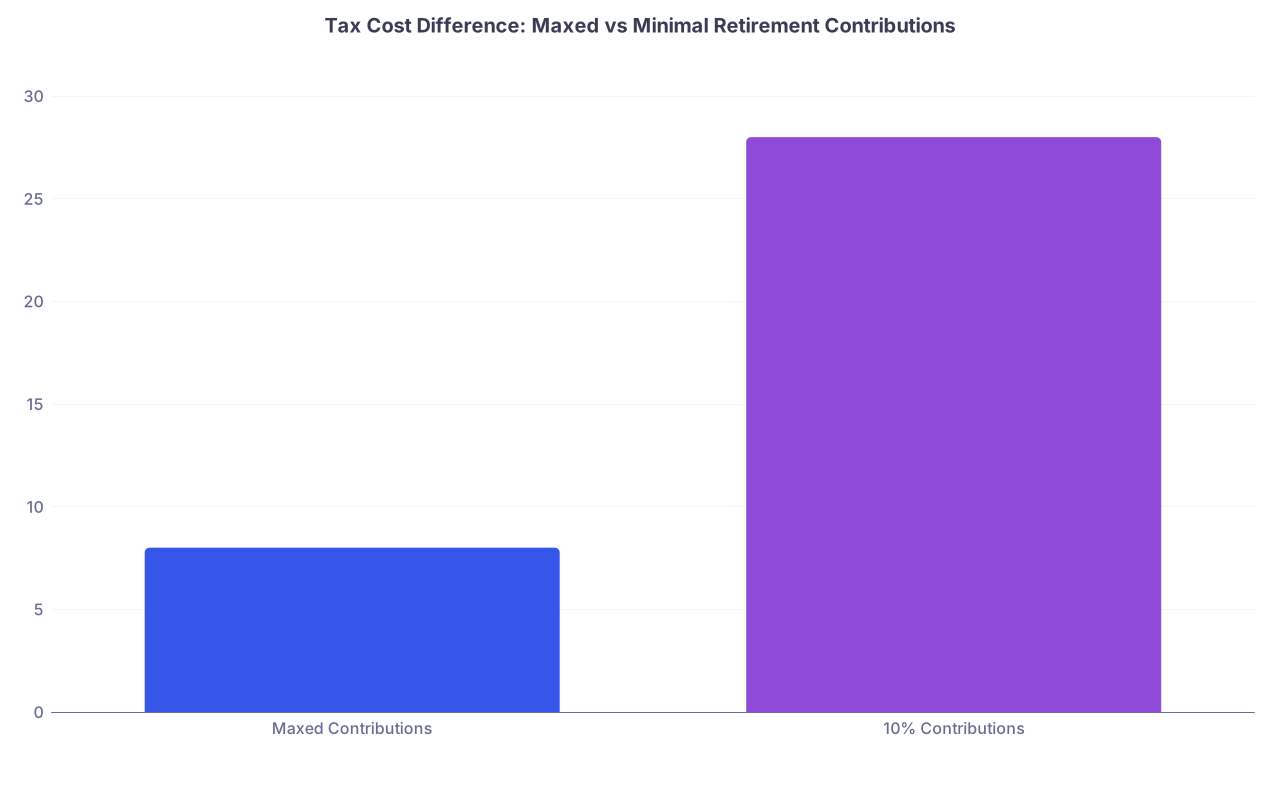
| Category | Value |
|---|---|
| Maxed Contributions | 8 |
| 10% Contributions | 28 |
(Approximate marginal federal + state tax bill in thousands for a $23k vs $10k pre‑tax contribution at a 40% combined marginal rate.)
How to avoid it
Stop thinking “percentage.” Think “dollar limit.”
- Set your contribution per paycheck to hit the annual limit
- For age 50+, add the catch‑up amount
- Re‑check after any:
- Raise
- Job change
- New pay schedule
If cash flow is tight as a new attending with loans, you can ramp up over 6–12 months, but the goal is the full IRS limit, not a comfortable percentage.
2. Ignoring the “Other” Plans: 457(b), Cash Balance, and HSA
A lot of doctors stop at the 401(k)/403(b) and think they are done. Meanwhile, they leave hundreds of thousands in extra tax‑advantaged space untouched.
Common wasted accounts
- Governmental 457(b)
- Non‑governmental 457(b) (tricky, but often useful)
- Cash balance / defined benefit plan
- Health Savings Account (HSA)
I routinely see physicians with access to both a 403(b) and a 457(b) plan, but they only use one.
| Account Type | Approx Annual Limit |
|---|---|
| 401(k)/403(b) employee | $23,000 |
| 401(k)/403(b) age 50+ | $30,500 |
| 457(b) employee | $23,000 |
| HSA family coverage | ~$8,300 |
| Cash balance plan | $20k–$200k+ |
That is not small change. That is a multi‑six‑figure lifetime tax shelter you either use or forfeit.
The specific mistakes
- Using only the 403(b) and ignoring a governmental 457(b) that allows an additional $23k
- Dismissing a non‑governmental 457(b) without understanding employer credit risk and distribution rules
- Paying for a high‑deductible health plan but not contributing to the HSA
- Group of partners refusing to set up a cash balance plan because “it sounds complicated”
Why this wastes tax space
You are voluntarily choosing:
- Higher current taxable income
- Lower sheltered growth
- Less flexibility in retirement drawdown
The HSA is especially abused. An HSA used correctly is triple tax advantaged:
- Pre‑tax contribution
- Tax‑free growth
- Tax‑free withdrawal for qualified medical expenses
Yet I see physicians using it as a checking account and never investing the balance.
How to avoid it
You need to read your benefits booklet. All of it. Or pay someone competent to do it.
Order of operations for a typical W‑2 physician (simplified):
- Get employer match in 401(k)/403(b)
- Max HSA
- Max 401(k)/403(b)
- Max governmental 457(b) (if available and plans to stay with employer a while)
- Do backdoor Roth IRA
- Evaluate non‑gov 457(b) and cash balance options
Never ignore a plan just because the acronym is unfamiliar. That is precisely how people leave $10k+ per year on the table.
3. Botching the Backdoor Roth IRA
If there is one area where physicians repeatedly invite IRS trouble, it is the backdoor Roth.
The concept is simple:
- Contribute non‑deductible money to a traditional IRA
- Convert to Roth IRA shortly after
- Growth is tax‑free forever
The execution, however, is where people screw it up.
The critical mistake: Pro‑rata rule ignorance
I see this constantly:
- You have $150k in a rollover IRA from your prior 401(k)
- You add $7k nondeductible contribution this year
- You convert $7k to Roth and think you “did a backdoor Roth”
You did not. The IRS sees all your traditional, SEP, and SIMPLE IRAs as one big pot. Your conversion is pro‑rated across pre‑tax and after‑tax dollars.
So that $7k conversion? Mostly taxable.

| Step | Description |
|---|---|
| Step 1 | Has pre tax IRA balance |
| Step 2 | Convert to Roth |
| Step 3 | Conversion taxed pro rata |
| Step 4 | Zero pre tax IRA |
| Step 5 | Clean backdoor Roth |
| Step 6 | Add nondeductible IRA? |
Other common backdoor errors
- Not filing Form 8606, so the IRS assumes your contribution was deductible
- Double counting basis and creating a mess years later
- Leaving pre‑tax IRA money sitting in a SEP IRA while doing annual backdoors
- Advisors rolling old 401(k) plans into IRAs “for convenience,” wrecking your ability to do clean backdoors
How to avoid it
- If you have any pre‑tax IRA money (traditional, SEP, SIMPLE):
- Roll it into a workplace 401(k)/403(b) before you start doing backdoor Roths
- Or convert it all to Roth and pay the tax (not always wise)
- Each year you:
- Contribute $6,500–$7,000 (depending on current limit) to traditional IRA as non‑deductible
- Convert the entire balance to Roth shortly after
- File Form 8606 correctly to track basis
- Do not let an advisor roll old plans into an IRA without understanding the backdoor impact.
Mess this up for 5–10 years and untangling it becomes a forensic accounting project. I have watched CPAs charge more to fix backdoor Roth errors than the Roth accounts were worth.
4. Overfunding the Wrong Bucket: Roth vs Traditional Mistakes
Physicians love Roth. The marketing is irresistible: “Tax‑free forever!” But for a lot of mid‑career or late‑career attendings, all‑Roth‑all‑the‑time is a tax planning disaster.
The mistake
High‑earning physician in 37–45% marginal bracket:
- Elects Roth 403(b) contributions only
- Skips traditional pre‑tax contributions
- Also does backdoor Roth IRA and maybe Roth 457(b)
- Ends up with very little pre‑tax space for future income smoothing
What they do not realize: paying 40% tax now to avoid potentially 20–25% later is usually bad arithmetic.
Why this wastes tax space
You get one chance each year to:
- Defer income at a high marginal rate with traditional contributions
- Pull it out decades later, likely at a lower blended tax rate in retirement
If you fill too much Roth while earning peak attending income, you:
- Shrink your future room for tax‑rate arbitrage
- Risk ending up with huge, forced RMDs from other accounts anyway
- Miss the chance to control income in retirement for ACA, IRMAA, and tax bracket management
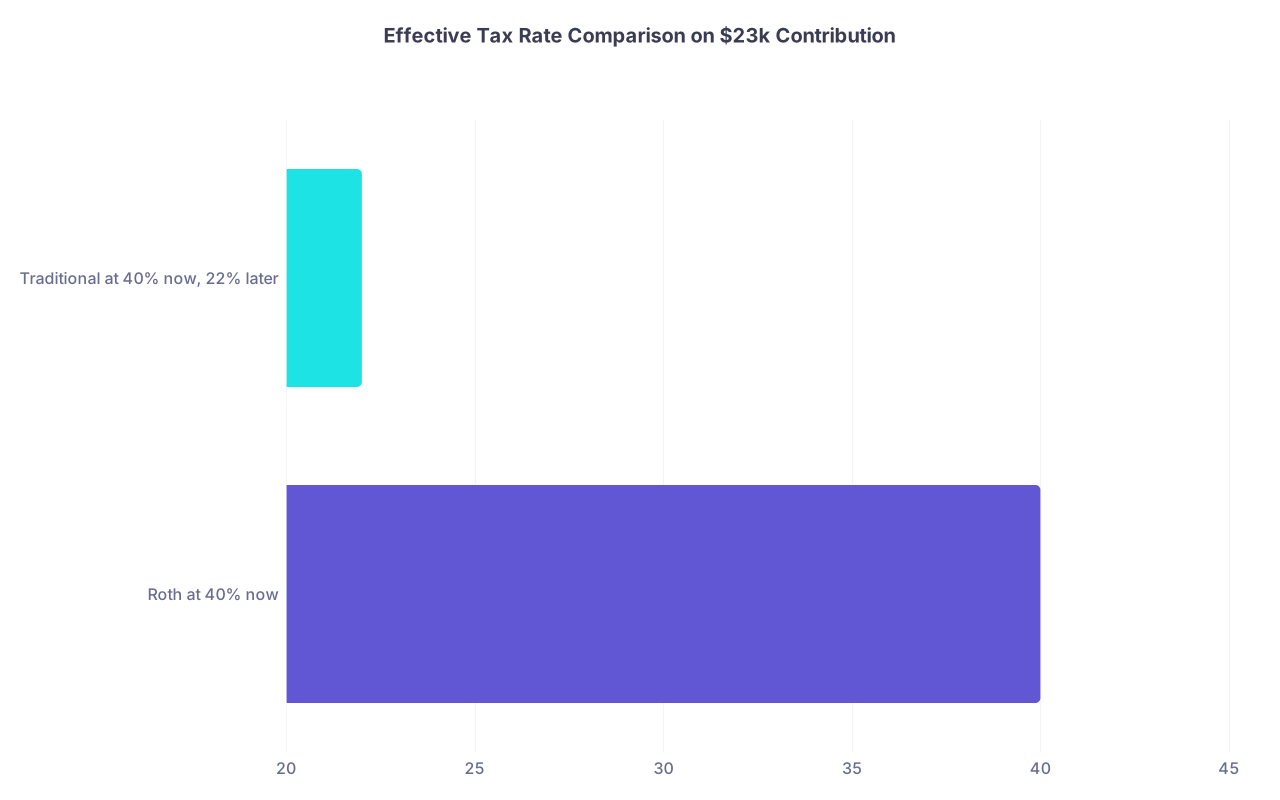
| Category | Value |
|---|---|
| Roth at 40% now | 40 |
| Traditional at 40% now, 22% later | 22 |
Yes, Roth still has benefits (no RMDs for you, easier estate planning, etc.). But blindly maxing Roth as a high‑income physician is often the wrong move.
When Roth can still make sense
- Residents and fellows (very low current bracket)
- Early attendings with temporarily low income
- Those expecting extremely high pensions or future income
- Years with atypically low income (sabbatical, part‑time, disability)
How to avoid it
- During peak earning years, lean heavily toward traditional contributions in workplace plans
- Use backdoor Roth IRA for Roth exposure without blowing up your current tax bill
- Reassess annually if your income or tax law changes dramatically
The mistake is not using Roth. The mistake is using Roth reflexively without doing the math.
5. Failing to Coordinate Multiple Employers and Plans
Multi‑hospital moonlighter? Locums? Partner plus W‑2 teaching gig?
You are exactly the type of physician who messes up contribution limits across multiple plans and has to unwind it later—with penalties.
The misunderstandings
Two big ones:
- The employee deferral limit ($23k) is per person, not per plan
- Employer contributions and certain plan types have separate limits
Common scenario:
- You are a W‑2 hospitalist with a 401(k)
- You also moonlight as an independent contractor with a solo 401(k)
- You max $23k at the hospital
- Then also try to contribute $23k employee deferral into your solo 401(k)
You cannot do that. The $23k employee limit is shared across all 401(k)/403(b)/most 457(b) plans.
Where there is extra space physicians miss
- Solo 401(k) employer (profit‑sharing) contributions on 1099 income
- Total 415(c) limit (employee + employer) of $69k+ in some years, per unrelated employer
- Governmental 457(b) having its own $23k limit in addition to 401(k)/403(b)
This is where people both overfund and underfund. Simultaneously.
You might be:
- Over‑contributing employee deferrals across jobs (creating a correction mess)
- Under‑using employer/profit‑sharing space because you assume you “already maxed out”
How to avoid it
You need a simple tracking system. Excel is fine.
Each year:
- Track employee elective deferrals across all 401(k), 403(b), and 457(b) plans
- Confirm you do not exceed the combined $23k (plus catch‑up) employee limit
- Separately, maximize:
- Employer contributions (W‑2)
- Profit‑sharing to solo 401(k) on 1099 income
- Governmental 457(b) (distinct limit)
If this confused you while reading, that is the point. The IRS does not design this for clarity. You either learn it, or you pay someone who has.
6. Underusing or Misusing Spousal Retirement Space
Physician married to a non‑physician. I see this pattern constantly:
- Physician maxes their 401(k)
- Spouse has an unused retirement plan or no plan at all
- They file jointly
- Half of the family’s available tax space is ignored
If your spouse works and has access to:
- 401(k) or 403(b)
- SIMPLE or SEP IRA
- Governmental 457(b)
…then those are your tax shelters too. Joint money, joint future.
The other missed opportunity: spousal IRA contributions.
Even if your spouse does not work, as long as:
- You are married and file jointly
- You have enough earned income to cover both contributions
…you can usually contribute to an IRA in your spouse’s name. And if your joint income is too high for direct Roth, you can likely do a spousal backdoor Roth IRA.
Missing spousal retirement accounts wastes:
- Annual Roth space that compounds for decades
- Asset protection opportunities (ERISA and state laws vary, but more buckets can help)
- Flexibility in retirement income (two Roth IRAs, two 401(k)s, etc.)
Do not be the couple where the physician has $3 million in pretax accounts and the spouse has $0 in their name because “we never looked at her plan.”
7. Leaving Money in Terrible Legacy or Employer Plans
Another quiet tax‑space leak: old employer plans that never get rolled or cleaned up.
Typical situation:
- Multiple old 401(k)/403(b) plans from residency, fellowships, and prior jobs
- Some with:
- Expense ratios over 1.5%
- Horrible fund options
- Outdated beneficiaries
- No integrated allocation with current plans
You think, “They are tax‑deferred, so it is fine.” It is not fine if:
- Fees eat 1%+ per year for decades
- You cannot execute clean backdoor Roth contributions because of lingering IRAs from rollovers
- You miss better Roth/traditional mix or lower‑fee institutional share classes in a current plan
You are not “saving taxes” if the plan is siphoning your returns in fees.
How to avoid it
- Make a list of every retirement account you own, with:
- Provider
- Plan type (401(k), 403(b), 457(b), traditional IRA, Roth IRA, SEP, SIMPLE, etc.)
- Balance
- Expense ratios / fee structure
- Decide which should be:
- Consolidated into the current 401(k)/403(b)
- Converted to Roth (if balances small and tax hit reasonable)
- Left alone (e.g., unusually good institutional options)
Do not reflexively roll everything into an IRA. That is exactly how you blow up future backdoor Roth flexibility.
8. Treating Retirement Contributions as “Set and Forget” in a Changing Tax World
Tax law moves. Your life moves. Your contributions cannot be frozen in 2019 logic.
Common static behaviors that become wrong over time:
- Never adjusting Roth vs traditional mix after major raises
- Keeping contribution percentages the same despite new child, new house, or entering high retirement savings window (age 45–60)
- Ignoring changes in:
- IRS limits
- Catch‑up rules
- Plan offerings (new 457(b), new mega backdoor option, etc.)
There is also the “late realization” problem. I have met too many 58‑year‑old physicians who finally decide they care about retirement. They do not have decades left to let compounding bail them out. For them, maximizing every last remaining year of tax space is critical.

How to avoid it
Once a year—ideally early in the calendar year:
- Re‑read your benefits summary
- Check IRS limit updates for:
- 401(k)/403(b)/457(b)
- HSA
- IRA
- Decide your Roth vs traditional mix for that specific year
- Confirm that:
- You are using all available accounts that make sense
- No contribution is at some random percentage left over from residency
If you refuse to do this yourself, pay a fee‑only planner who actually understands physician comp and retirement plans. Not one who just wants to sell you whole life insurance.
9. Confusing “Taxable Account” Investing With Failure
A final subtle error: once you have truly maxed all legitimate retirement tax space, you still need to save aggressively in taxable. Some physicians delay investing in taxable accounts for years because they feel like it is “inefficient” compared to retirement accounts.
Here is the actual mistake:
- Under‑utilizing existing retirement accounts for years
- Then finally maxing them
- But refusing to invest beyond them because “that is not tax‑advantaged”
Result: underinvestment in wealth‑building.
The real waste is not using retirement accounts and then stopping. You should:
- Max every sensible tax‑advantaged account you can
- Then invest heavily in a tax‑efficient taxable portfolio
You do not get an award for having only tax‑advantaged accounts and an undersized portfolio.
The key is sequence, not purity:
- First: do not waste your limited retirement tax space
- Next: accept that additional investing will be taxable and structure it smartly (index funds, ETFs, loss harvesting, etc.)

10. When To Get Professional Help (And When It Is a Waste)
There is one more mistake: assuming every “financial professional” understands physician retirement and tax planning. Many do not.
Red flags:
- Advisor pushes whole life or variable annuities before fully maximizing all retirement and HSA space
- Cannot explain pro‑rata rules on backdoor Roth IRAs without looking it up
- Suggests rolling your excellent prior 401(k) into an IRA without asking about backdoor Roths
- Acts vague when you ask about total 415(c) limits and multi‑employer contributions
Those people will happily help you make the mistakes above. For a fee.
Good uses of professional help:
- CPA or EA who:
- Files Form 8606 correctly
- Understands multi‑plan contribution limits
- Helps with Roth vs traditional analysis
- Fee‑only planner with multiple physician clients and deep familiarity with your specific employer’s plans
Key Takeaways
- Your retirement accounts are scarce tax shelters, not optional extras. Maximize the right ones (401(k)/403(b), 457(b), HSA, backdoor Roth) before worrying about fancy investments.
- Most costly physician mistakes come from ignorance of rules (pro‑rata, multi‑plan limits, Roth vs traditional tradeoffs) and inattention to available plans (ignored 457(b), unused spousal accounts, unmanaged legacy plans).
- Fixing years of errors is painful and expensive. Use each January as a reset point to review your plans, contributions, and mix—so you do not waste another year of physician‑level tax space.


