

The fastest way for a dual-physician household to waste five figures a year is to pick the wrong tax filing status and never question it.
I have watched married attendings add $15,000–$30,000 to their tax bill for years because someone once told them, “High earners should always file separately” or “Married filing jointly is always better.” Both blanket statements are wrong. And expensive.
You do not get a do‑over on this one after the filing deadline passes. So you cannot afford to guess.
Let’s walk through the biggest filing status mistakes I see married physicians make—and how to avoid handing the IRS money it did not earn.
Mistake #1: Assuming “Married Filing Separately” Saves Taxes for High Earners
The most common and costly mistake: a well-meaning CPA or colleague says, “Your incomes are high. You should file married filing separately to avoid the marriage penalty.”
So you and your spouse file separately.
Your tax bill jumps.
You assume that is just the price of being successful.
No. That is the price of bad advice.
Here is the problem: the U.S. tax code is deliberately hostile to “Married Filing Separately” (MFS) for most physicians.
| Feature | Married Filing Jointly (MFJ) | Married Filing Separately (MFS) |
|---|---|---|
| Student loan payment calc | Uses combined AGI | Uses individual AGI |
| Child tax credit | Full access | Severely limited / denied |
| Education credits | Available | Usually disallowed |
| Roth IRA contribution | Allowed (within limits) | Phase-out at very low income |
| AMT treatment | More favorable | Often worse |
The tax code punishes MFS by:
- Cutting you off from many credits and deductions
- Shrinking phase‑out thresholds
- Creating quirky rules around IRA/Roth eligibility
For a typical attending couple—say $280k + $320k W‑2 income—filing separately usually means:
- Higher combined federal tax
- Lost credits and deductions
- More complexity, more forms, more room for error
And yet I still see physicians put on MFS “to avoid the marriage penalty” without anyone running side‑by‑side calculations.
When MFS might actually make sense
There are narrow, legitimate reasons for MFS. But they are not “because our income is high.”
Situations where MFS can be appropriate:
- One spouse has massive medical expenses or miscellaneous deductions tied to their own AGI
- One spouse has significant legal or liability concerns, and an attorney/tax advisor recommends separate returns as part of a broader asset protection plan
- Federal student loan repayment strategies (we will come back to this—because this can be a valid exception)
- State tax issues in a community property state where separate reporting yields some advantage (rare, but it happens)
Even then, it is not a guess. A competent CPA will run both MFJ and MFS projections and show you the actual dollar difference.
If nobody has ever shown you those side‑by‑side numbers and you are currently filing separately, that is a red flag. Fix it before you write another oversized check.
Mistake #2: Ignoring the Student Loan Angle (Or Misusing It)
Here is where many married physicians get tripped up: student loans and income-driven repayment (IDR).
Someone in residency or early attending years says, “File separately so your IDR payment is lower.” Half-true. Half-dangerous.
For plans like PAYE, SAVE, IBR, your monthly payment is based (often) on your income as reported on your tax return. Married filing jointly includes both incomes. Married filing separately may allow payments to be based only on your own income.
That can slash payments and maximize forgiveness under PSLF.
But here is the trap: many couples see a lower student loan payment and never look at the higher tax they are paying to get it.
Most do not run the math. They just see “lower monthly payment” and assume it must be good.
You must compare:
- Extra federal (and state) income tax from using MFS
versus - Savings in student loan payments and increased forgiveness value
If the “tax penalty” from MFS is $12,000 a year and you save $6,000 a year in loan payments, you lost the game. You paid double in tax to save half in loans.
On the flip side, if:
- Your spouse has very low income
- You have large federal loans under PSLF
- MFS drops your loan payment by, say, $1,500/month ($18,000/year)
- And the tax cost is only $5,000 extra per year
Then it might be smart.

| Category | Value |
|---|---|
| Extra Tax (MFS) | 6000 |
| Loan Savings (MFS) | 15000 |
I have seen physicians do MFS for five years purely on student loan “advice” and then discover:
- Total extra tax paid: ~$40,000–$60,000
- Actual incremental forgiveness benefit: maybe $10,000–$20,000
That is not optimization. That is a preventable error.
If anyone is telling you “file separately to lower loan payments” without handing you:
- A written MFJ vs MFS tax comparison, and
- A year‑by‑year loan payment/forgiveness comparison
they are guessing with your money.
Mistake #3: Overlooking How Filing Status Affects Roths, IRAs, and Credits
Another quiet way married physicians burn money: not realizing how MFS wrecks retirement account options and various credits.
Here is the part almost nobody tells you:
- Married Filing Jointly has relatively high income limits for Roth IRA contributions (phaseout starting at $230,000 MAGI in 2024, for example).
- Married Filing Separately has a phaseout that effectively kills direct Roth IRA contributions for almost all physicians (it starts extremely low).
So that well‑intended move to file MFS?
Now:
- Your ability to do direct Roth IRA contributions is basically gone.
- Certain education credits (if you have kids later) become unavailable.
- Student loan interest deduction: gone.
- Some itemized deductions get restricted or behave differently.
Most physician couples already earn too much for many credits, yes. But I routinely see upper‑mid income couples—one attending, one fellow or non‑physician spouse—lose eligibility for things they could have kept simply because someone slapped “MFS” on the return for a narrow reason and never revisited it.
The downstream effects can last years:
- No Roth contributions during key compounding years
- Less tax‑advantaged space built up
- Lower long‑term flexibility
You think you made a small paperwork choice. You actually changed your entire tax environment.
Mistake #4: Letting the Software or HR System “Choose” For You
Another sneaky problem: default settings.
I have watched more than one dual‑physician couple sleepwalk into bad filing choices because of:
- “Married, but withhold at higher single rate” chosen in hospital HR
- TurboTax/H&R Block defaulting silently to a particular scenario
- An initial resident decision that never got revisited as income soared
Your withholding status and your tax filing status are not the same thing. But people mix them up all the time.
HR forms might say things like:
- “Married, filing jointly”
- “Married, but withhold at higher single rate”
That is about how much tax gets taken out of each paycheck. It does not lock in how you must file your return. But I have seen CPAs glance at a W‑2 checkbox and just copy it over to the return without thinking.
Or a couple logs into DIY software. It asks a bunch of rapid‑fire questions. They accidentally answer something that pushes them into an MFS scenario and never understand the consequences.
If you cannot clearly state why you are:
- Married Filing Jointly
or - Married Filing Separately
in one or two sentences, you did not choose. The system chose for you.
And the system is not trying to minimize your tax bill. It is trying to get a valid return filed with the fewest questions possible.
Mistake #5: Underestimating the “Marriage Penalty” (Or Overestimating It)
There is a lot of bad folklore in physician circles about the “marriage penalty.”
Here is the reality for high‑income doctors:
- For many brackets, MFJ tax brackets are just double the single brackets. This reduces or eliminates the classic “marriage penalty.”
- The marriage penalty is more about specific thresholds (Medicare surtax, Net Investment Income Tax, some credit phaseouts) than the core bracket tables.
- You absolutely can trigger a penalty if both of you are high earners in similar ranges. But that does not automatically make MFS better.
The wrong move is to think:
“We are both attendings making $300k. Marriage penalty must be huge. Let’s file separately to fix it.”
No. Filing separately usually increases your combined tax relative to MFJ, even with a marriage penalty in the background.
Where the marriage penalty becomes real and noticeable for physicians:
- Combined income pushing you over key thresholds:
- 3.8% Net Investment Income Tax (NIIT) thresholds
- Additional 0.9% Medicare tax
- Losing access to some itemized deductions or credits based on joint AGI
- Certain state tax brackets that are not simply “double for married”
But again: you do not solve this by reflexively choosing MFS. You solve it by doing actual math on MFJ vs MFS and, in some cases, by changing your income mix (solo 401(k), defined benefit plan, charitable planning, etc.) rather than butchering your filing status.
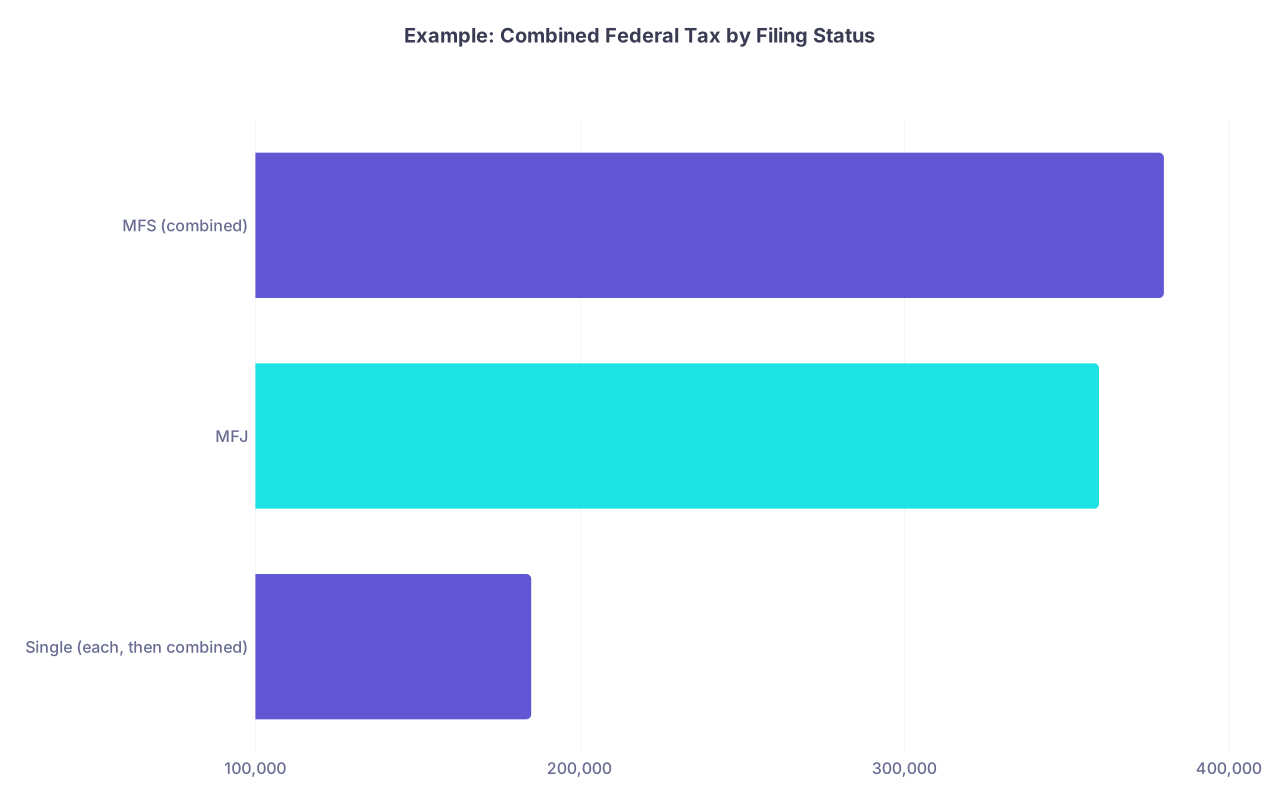
| Category | Value |
|---|---|
| Single (each, then combined) | 185000 |
| MFJ | 360000 |
| MFS (combined) | 380000 |
In many realistic physician scenarios, MFJ still wins.
Mistake #6: Ignoring State Tax Rules for Married Physicians
Federal is only half the story. State rules can quietly blow up a well‑constructed federal plan—or rescue a bad one.
Some traps I have seen:
- Community property states (California, Texas, Arizona, etc.), where income splitting rules make separate filing more complex and sometimes more attractive, sometimes much worse.
- States that do not recognize certain federal filing choices the same way (for example, requiring the same status at state level as federal).
- Progressive state brackets where married brackets are not equal to “double the single”—creating a real marriage penalty on the state side.
A common unforced error:
A couple files MFS federally to manage IDR and PSLF, but then nobody re‑runs the state return scenarios. Turned out the state hit them with an extra $3,000–$6,000 of tax annually vs what they would have owed MFJ, dwarfing the federal benefit.
Or the opposite: in a specific state, MFS may mitigate a brutal state‑level marriage penalty—but no one checked because “we always file jointly.”
You cannot evaluate filing status in a vacuum. It has to be:
- Federal MFJ vs MFS
- Plus state MFJ vs MFS
- Plus student loans
- Plus planning around retirement accounts/credits
If your advisor is only showing you one side of that equation, you are not getting planning. You are getting partial data.
Mistake #7: Never Revisiting Filing Status After Life Changes
Here is another subtle, expensive pattern: physicians make one decision early on and then freeze it in place for ten years.
Typical story:
- R1 + R2: File MFJ, both broke, simple returns
- R3 + early attending: One on PSLF, one in training, switch to MFS to lower IDR payments
- Both become attendings, big income jump, loans mostly forgiven or refinanced
- Still filing MFS five years later because “that is how we always do it”
Nobody re‑runs the numbers. Nobody asks the obvious question: “Does this still make sense now that our situation is different?”
You must revisit filing status when:
- One of you finishes training and your income changes drastically
- Loans move from federal to private refinance
- PSLF is achieved or abandoned
- One spouse stops working or significantly cuts back
- You move to a new state with different tax rules
- You start or buy into a practice and your income structure changes
Filing status is not a tattoo. Treating it like one is how you lock in years of preventable over‑taxation.
Mistake #8: Blind Trust in “Doctor Specialists” Who Do Not Show Their Work
The physician‑only financial advisor or CPA who “specializes in doctors” is not automatically competent. I have seen some brilliant ones. I have also seen some of the worst tax planning justified with, “We work only with physicians.”
Red flags:
- They always recommend the same status (“we always do MFS for PSLF docs” or “we always do MFJ; MFS is never worth it”).
- They do not provide an explicit MFJ vs MFS comparison based on your household.
- They talk in generalities like “doctors always get killed by the marriage penalty” without numbers.
You want to see something like:
- Federal MFJ total tax vs MFS total tax
- State MFJ vs MFS
- Loan payments and projected forgiveness under each scenario
- Retirement account/Roth implications highlighted
- Net household result clearly stated in dollars
If you ask, “Show me the 5‑year difference in total out‑of‑pocket taxes + loans between MFJ and MFS for us,” and they cannot or will not, you need a new advisor.
What Competent Planning Actually Looks Like
Let me outline what a careful, mistake‑avoiding process for a married physician couple should look like. This is what you should demand.

| Step | Description |
|---|---|
| Step 1 | Married Physicians |
| Step 2 | Gather income and loan data |
| Step 3 | Run MFJ tax projection |
| Step 4 | Run MFS tax projection |
| Step 5 | Evaluate state tax both ways |
| Step 6 | Model loan payments under MFJ and MFS |
| Step 7 | Compare total 5 year cost |
| Step 8 | File MFJ |
| Step 9 | File MFS with clear rationale |
| Step 10 | Which is lower? |
Done correctly, the conversation should end with a clear answer like:
- “Over the next 5 years, MFJ will cost you about $28k less in combined federal + state tax than MFS, and the loan impact is minimal. We recommend MFJ.”
or
- “MFS costs about $7k more in tax per year, but it reduces your loan payments by $19k/year and increases projected forgiveness by ~$45k. Net benefit strongly favors MFS while PSLF is in play. We will revisit annually.”
Anything fuzzier than that is laziness, not planning.
How to Audit Your Own Situation (Without Becoming a Tax Pro)
You do not need to become a CPA. You do need to be dangerous enough to spot nonsense.
Here is a simple self‑audit you can do:
- Pull last year’s federal and state returns.
- Note your filing status on both.
- Write down, in one sentence, why you used that status. If you cannot, that is your first problem.
- Ask your CPA (or yourself, with software) to:
- Run an MFJ return and an MFS return for last year, side by side.
- Include state differences.
- Show the difference in total tax liability, not just refund vs amount due.
- If you have federal loans:
- Ask your loan planner (or servicer, or an independent calculator) to show your IDR payments and projected forgiveness under both MFJ and MFS assumptions.
- Put both pieces together:
- Tax difference vs loan difference over at least 3–5 years.
If your professional cannot or will not do this, that is your sign.
The Bottom Line: Stop Guessing With Your Filing Status
Married physicians are uniquely exposed to filing status errors. High incomes, complex student loans, multiple states, practice ownership, and PSLF all collide in the worst possible way if you just pick whatever seems “normal.”
Three things I want you to remember:
- “Married Filing Separately” is almost never a tax win on its own. It must earn its keep by delivering larger student loan or state‑level benefits than the additional tax cost. With numbers, not hand‑waving.
- Filing status is not a one‑time decision. Re‑evaluate it whenever loans, income, state, or job structure change significantly. Locking into a resident‑era choice as an attending is how you bleed out five figures.
- Demand hard comparisons. Federal, state, and loans—side by side, over multiple years. If the person advising you cannot show you the math, they are not planning; they are guessing. And guessing with a physician‑level tax bill is not a harmless mistake.


