

The buy‑in number your group quoted you isn’t about “fairness.” It’s about taxes. Specifically, their taxes.
Once you see that, the whole game looks different.
I’ve sat in those closed‑door meetings where senior partners and their CPA are “setting” the buy‑in for new physicians. They do not start with, “What’s a reasonable number for the junior?” They start with, “How do we get money out at capital gains rates, keep our basis high, and not blow up our depreciation strategy?” You’re the variable, not the goal.
Let me walk you through how senior partners actually use tax planning to shape, inflate, and control physician buy‑ins—and what you should be looking for before you sign anything.
The Real Objective Behind Most Buy‑Ins
Senior partners have three goals, in order of importance:
- Extract value when you join.
- Minimize their current tax bill.
- Preserve or grow their long‑term equity and control.
“Bringing in new partners” is the talking point. Tax planning and control are the real levers.
Here’s the core trick: they use entity structure and tax rules to change what your payment looks like on paper so it’s tax‑friendly to them—even if it’s painful for you.
They’ll tinker with:
- Whether you’re “buying stock” versus “buying assets” versus “buying units” in an LLC / partnership.
- Whether your payments are called capital contributions, purchase price, or disguised compensation.
- Whether they classify your payments as ordinary income to them (bad for them, good for you) or capital gain (fantastic for them, more expensive for you).
You’re walking into a negotiation they’ve been preparing for 10–15 years with a tax attorney and a practice‑focused CPA. You’ve got…Google and maybe a buddy who did a buy‑in last year.
That’s the asymmetry.
How Entity Structure Gets Weaponized Against You
The biggest lever is the entity type. That’s where the tax planning starts, long before you’re recruited.
S‑Corp vs Partnership vs C‑Corp vs “Two‑Entity” Games
Most physician groups are either:
- S‑corporations or professional corporations (PCs taxed as S‑corps)
- LLCs or partnerships (taxed as partnerships)
- Occasionally, some Frankenstein “S‑corp + LLC” or “PC + management company” setup
Each structure changes how your buy‑in hits their tax return.
Here’s a simplified comparison of what senior partners usually want:
| Structure | What Seniors Want Most |
|---|---|
| S‑Corp stock sale | Capital gains on buy‑in |
| Partnership units | Capital gains + basis management |
| Asset sale to you | Depreciation recapture pushed |
| Two‑entity structure | Split income, shift value, control |
Let me translate:
S‑Corp / PC stock sale
Seniors love this. You “buy stock” in the practice entity. They get capital gain treatment on most of what you pay. They’ve held the stock for years, so they’re well past any holding period issues. You pay with after‑tax dollars, often financed, and they book a relatively low‑tax windfall.LLC / partnership interest purchase
They sell you “units” or a “partnership interest.” Done correctly, a big chunk of what they receive is also capital gain. But they also get to play games with basis and built‑in gains that you won’t see unless you have a tax person look at the agreement line‑by‑line.C‑Corp or “old PC” with asset inside
This is where things get ugly. If they’ve got a C‑corp (often older groups, anesthesia, radiology, or legacy hospital‑aligned practices), they will be very careful not to trigger corporate‑level tax on an asset sale. That means they’ll push hard for you to buy stock, not assets—even if that’s worse for you—because they do not want double taxation on the way out.Two‑entity structure
Common trick: they split the practice into a clinical entity and a “management company” or real estate LLC. The real equity and appreciation lives in the side entity that you’re either not invited to initially, or that has a second, later, even more expensive “buy‑in.” Tax wins for them: they can harvest capital gain in stages and keep lucrative streams (like real estate rent) taxed the way they like and controlled by the inner circle.

| Step | Description |
|---|---|
| Step 1 | Operating Practice Entity |
| Step 2 | Senior Partners |
| Step 3 | New Partner |
| Step 4 | Management Company LLC |
| Step 5 | Senior Partners Only |
| Step 6 | Real Estate LLC |
The buy‑in you’re being shown usually only touches box A. The real wealth is often in D and F.
Valuation: How Tax Planning Quietly Inflates (or Hides) the Number
The buy‑in “valuation” is almost never neutral. It’s engineered around tax positions the seniors have already taken.
Here’s what that looks like behind the scenes.
1. Depreciation and “Tax Basis” Theater
Let’s say the group bought equipment and furniture for $1,000,000 over the last decade.
- On their tax return, they’ve aggressively depreciated that to near zero. They’ve enjoyed the tax deduction for years.
- On the valuation, magically, that same equipment suite is now “worth” $600,000, and it ends up in your buy‑in.
You are effectively paying again for equipment they already expensed.
From the seniors’ perspective this is perfect: they took ordinary deductions at high income years, and now they convert what’s left into capital gains when you pay to “buy” the depressed but still valued assets.
You may be told, “We’re just following the appraisal.” What they won’t say is: the appraisal method was chosen precisely because it supports that recapture of value in a tax‑efficient way for them.
2. Goodwill: The Invisible Tax Lever
Goodwill is where most of the abuse happens.
Internal phrase I’ve heard from more than one CPA: “Stuff as much as you can into goodwill.”
Why? Because:
For seniors selling ownership:
Goodwill is usually taxed at capital gains rates. That’s gold. They want as much of your payment classified as “purchase of goodwill” as possible.For you buying in:
You might or might not get to amortize that goodwill over 15 years (tax benefit to you). But that’s a slow drip compared to the upfront pain.
So they:
- Pick a valuation method that heavily weights “excess earnings” and translates that into goodwill.
- Downplay hard assets (which might trigger recapture and more complex tax issues for them).
- Keep working capital games quiet (more on that in a second).
I’ve seen 7‑figure “goodwill” numbers in relatively modest speciality groups where, realistically, if two partners left, the hospital or a larger system would pick up the physicians and the “goodwill” would vanish. On a real market sale, that number would be far lower.
But for internal tax planning? They inflate it. And you pay.
Working Capital: The Hidden Check You Don’t Realize You’re Writing
The buy‑in paperwork your administrator slides across the table focuses on “number of shares” or “percentage interest.” That’s the shiny object.
The real money gets moved with how they handle working capital and cash.
Common patterns:
You buy into AR and cash, but they keep the cushion.
Translation: they quietly sweep out excess cash, bonuses, or “true up” distributions to themselves before you enter, then “sell” you a capital account that’s technically correct on paper but stripped of any real buffer.They require a capital contribution on top of buy‑in.
So you’re not just paying for equity; you’re also funding the practice’s operating cushion. On their side, this lets them keep prior retained earnings and still have you replenish the tank. Tax angle: they already paid tax on prior retained earnings, then effectively pull them out as tax‑free distributions while you put fresh, already‑taxed money in.Accounts receivable games.
Some groups make you pay to “buy” into AR. Others let you earn into it over time. Guess which is better for them? If you see a big AR component in the buy‑in, remember: you’re paying for revenue that largely accrued under their watch.
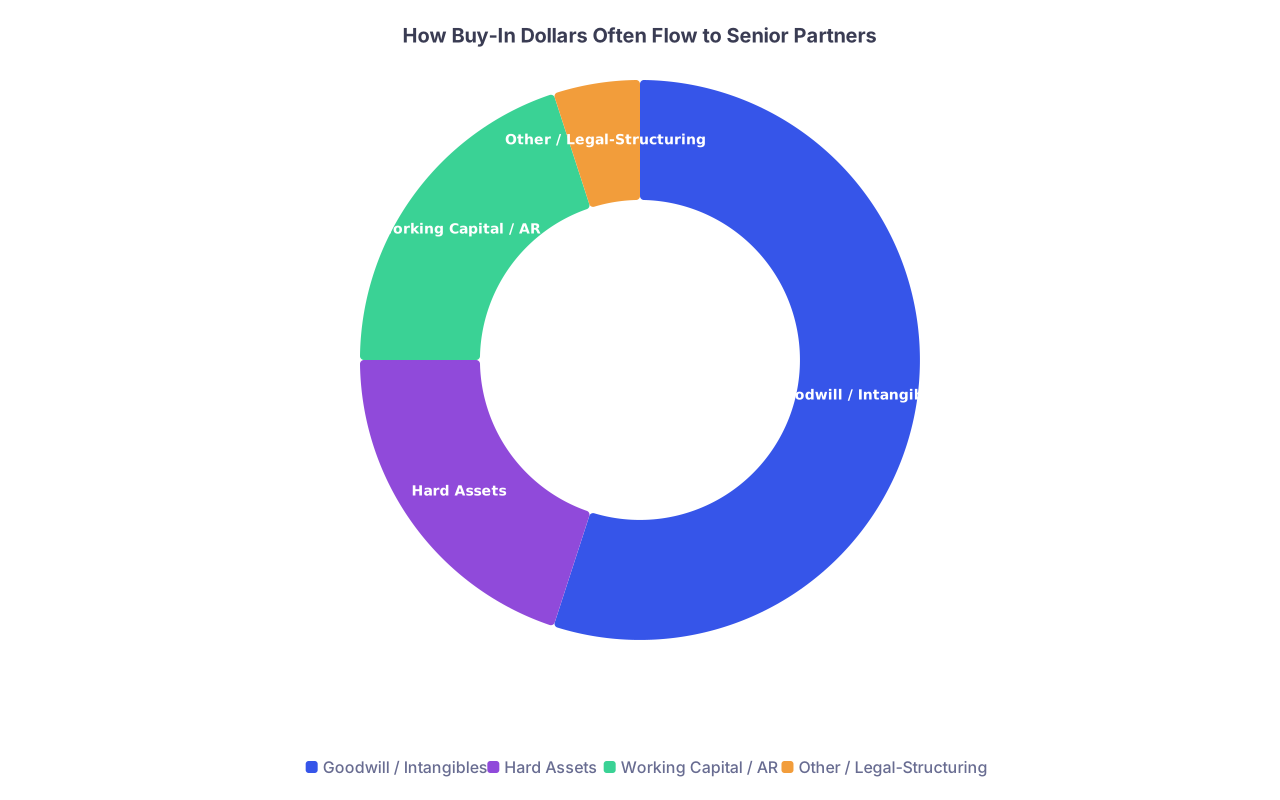
| Category | Value |
|---|---|
| Goodwill / Intangibles | 55 |
| Hard Assets | 20 |
| Working Capital / AR | 20 |
| Other / Legal-Structuring | 5 |
They’ll tell you, “This is standard.” It isn’t. It’s just very common, because it’s tax‑efficient for them.
Installment Payments and Capital Gains: Why They Love Long Schedules
You might think a 5–10‑year buy‑in schedule is an act of kindness. “We’re making it affordable for you.”
No. They’re managing:
- Their capital gains spread over years.
- Their own cash flow.
- The optics of the number.
When you pay in installments to purchase equity or goodwill, senior partners can often treat those payments as installment sale proceeds. That lets them recognize capital gains gradually, which:
- Smooths their tax bracket.
- Lets them plan estimated taxes.
- Sometimes keeps them under Medicare surtax thresholds.
I’ve literally heard a tax attorney say in a partner meeting: “If we push more into the installment price for goodwill and less into comp, we can keep you all off the 3.8% surtax for the next several years.”
You? You’re paying with after‑tax dollars from your compensation, often at top marginal rates, while they enjoy preferential capital gains over time.
And here’s the other twist: those long schedules make the sticker price less scary for recruits. “It’s $400,000, but spread over 8 years” sounds way softer than “You’re paying $50,000 a year, after tax, for something we got for pennies 20 years ago.”
Disguised Compensation: Where They Dump Their Tax Burden Onto You
Senior partners also use tax planning to make you absorb expenses that support their tax strategy.
A few patterns you don’t see in the brochure:
Low salary, high “distribution” structure
Many groups pay relatively modest W‑2 salaries and high K‑1 distributions. That can be tax‑efficient for everyone—if ownership and control are genuinely shared.But with buy‑ins, I see this used to justify:
“You’ll get the same distribution as us once you’re in,” while quietly keeping economic preferences, side deals, or different classes of units that shield seniors from risk and give them higher guaranteed draws.Shifting call/production to fund their exit
They lower their clinical work, maintain high distributions, and effectively have junior partners’ increased production pay the installment price of the seniors’ exit—while still tagging favorable tax treatment on their end.Covenants and restrictions with tax hooks
Non‑competes, vesting schedules, and clawbacks often have quiet tax angles. For example, if you leave early, they reclassify part of what you paid or were paid as “compensation” instead of capital. That’s not an accident; they designed it to protect their tax treatment if the deal unwinds.
There’s another dirty little tactic: calling part of what should be your compensation a “capital contribution” or “buy‑in” so they can push more of the payment you’re making into capital gain on their side.
You’ll hear something like, “All partners earn on the same formula. But your draw will be slightly lower for the first X years to reflect your buy‑in.” Translation: they’re using compensation reduction as a disguised purchase price, usually without modeling what that really costs you over time.
Two‑Tier and “Shadow” Equity: Control Without Sharing the Real Upside
Now let’s talk about how control and equity get split.
A nasty but common structure:
- Tier 1 equity – full voting, access to all entities (practice, management company, real estate), richer distributions.
- Tier 2 equity – “partner” in title, buy‑in to clinical entity only, limited or no access to side entities, perhaps capped distributions.
Tax planning here is all about steering appreciation and cash flow into the entities where Tier 1 partners sit—and then using buy‑ins to monetize those streams gradually.
Example I’ve seen more than once:
- You’re offered 3% in the practice entity for $300,000.
- The real estate is a separate LLC owned by “founding partners.”
- The management company that “owns” ancillaries, imaging, ASC, or UR is yet another LLC where you might be “eligible” down the road.
- Rent and management fees are set high. That drains profit from the practice (where you own something) and pushes profit into the side entities (where you don’t).
From a tax standpoint:
- Those side entities often generate a mix of rental income and pass‑through business income with different tax treatments.
- Seniors time their own entry and exit to harvest gains from those entities, not just the practice.
From your standpoint: you bought into the shell with the payroll and overhead. They keep the good stuff.
What You Should Actually Ask For (That They Don’t Expect You to Know)
You’re not going to out‑tax‑plan a team that’s been optimizing this for 15 years. But you can stop walking in blind.
At minimum, before agreeing to any buy‑in, you want:
- Entity diagrams and ownership breakdown of every entity that touches the practice: PCs/PLLCs, LLCs, real estate, ASC, imaging, management companies. All of it.
- The last 2–3 years of K‑1 templates for partners at your intended level (new partner, not founding partner).
- A clean breakdown of what your payments are actually for: stock vs units vs goodwill vs capital contribution vs working capital.
- A summary of how prior partners bought in and, critically, how departing partners have been bought out.
Then you run that through a physician‑savvy CPA or attorney who is not connected to the group and ask them one very simple question:
“Who is winning, on a tax basis, from this structure—me or the seniors?”
You’d be surprised how many times the answer is, “This is heavily tilted to the seniors, but here are two levers you can reasonably push on.”
Sometimes just asking for a clearer split between:
- Purchase price for equity (capital)
- Capital contribution (practice cushion)
- Compensation (for your labor)
…forces them to reveal what they’re actually doing.

| Category | Value |
|---|---|
| Equity Purchase | 50 |
| Capital Contribution | 20 |
| Disguised Comp Reduction | 30 |
Most groups expect you to negotiate the headline buy‑in number. The smarter move is to negotiate the tax character of what you’re paying and what you’re actually getting in return.
The Realpolitik: When It’s Still Worth Saying Yes
Let me be blunt: almost every established group tilts their tax planning in favor of senior partners. That doesn’t automatically make a buy‑in bad.
It becomes unacceptable when:
- The effective price you pay (in cash + reduced compensation) is wildly disproportionate to your future economics.
- You’re not getting access to the same entities and streams that make the seniors wealthy.
- Tax planning has been weaponized to push all the pain to you (ordinary income, limited deductions) and all the favorable character (capital gain) to them.
But a “tilted but transparent” structure in a lucrative specialty with strong long‑term earnings? That might still be a good deal.
What you can’t afford is ignorance. Once you understand how they’ve used tax law to design the game, you can at least decide if the game is worth playing.
FAQ (Exactly 5 Questions)
1. Is it always bad if senior partners get capital gains on my buy‑in?
No. Capital gains to them isn’t inherently unfair. The question is proportionality. If they’re harvesting a massive gain while you’re taking on high payments, reduced compensation, and only partial access to the real profit centers, then the tax advantage becomes part of an overall bad deal. But in a fair, well‑shared structure, seniors getting capital gains as they gradually sell down shares is normal.
2. Should I insist on an independent valuation before buying in?
You should insist on understanding the valuation methodology and who hired the appraiser. An “independent” valuation paid for and framed by the existing partners can still bake in assumptions that favor them (especially around goodwill and working capital). Having your own advisor review the report and the operating/partnership agreement is more valuable than just another appraisal.
3. Is buying into goodwill always a red flag?
No, but it’s where most abuse happens. Some practices genuinely have transferable goodwill: strong brand, contracts, referral networks that survive partner turnover. In that case, some goodwill component is reasonable. It becomes a red flag when goodwill is a giant number in a practice that would largely evaporate if the current seniors left, or where the goodwill number seems to be doing nothing except turning your payments into capital gains for them.
4. Can I negotiate the tax character of the buy‑in, or is that fixed?
You can absolutely negotiate it, though groups won’t volunteer that. You can push for more of your payments to be treated as compensation (deductible to the entity, taxable to you as ordinary income) and less as purchase price, or vice versa, depending on your situation. You can also negotiate how much is capital contribution versus purchase of equity. You need a tax advisor modeling both sides, but the structure is not preordained; it’s drafted.
5. When should I walk away from a buy‑in offer?
You walk when: the structure is opaque and they refuse transparency; you’re clearly locked out of key profit centers (ASC, imaging, real estate) indefinitely; your total effective cost (including reduced comp) is out of line with comparable groups; and their advisors dismiss your tax concerns with “this is just how it’s done.” Long‑term, that kind of culture and structure will keep you paying for their exit while never truly owning your future.
Key points: senior partners design buy‑ins around their tax strategy, not your fairness; the real battle is over structure and tax character, not just the headline number; and you need independent eyes on the agreements to see where your money is really going.


