

Last week, a resident told me she’d just found out she’d been filing something “wrong” on her taxes for three years straight. Her words: “Did I just lose like… a house?” She was only half joking. I’ve watched attendings freeze mid-call shift because a random Reddit thread convinced them the IRS was about to destroy their life.
You’re not crazy for wondering if one tax mistake could really cost you six figures over your career. It absolutely can. But the part nobody explains is which mistakes matter, which ones are fixable, and which ones just feel catastrophic at 2 a.m. but aren’t.
Let’s break this down before your brain continues doom-scrolling hypothetical audits instead of sleeping.
The Ugly Truth: Yes, One Tax Decision Can Be a Six-Figure Problem
Let me just answer the question straight: yes, a single tax mistake or bad decision, repeated over time, can easily cost you six figures as a physician.
Not because the IRS fines you $100,000 in one hit. That’s the movie version.
It’s because:
- You make the same bad choice every year.
- Compounding quietly murders your long-term net worth.
- The stakes are higher for you than for almost anyone else.
You’re a high earner with a long runway. That’s a blessing and a liability. The margin for error is bigger. The penalties for not optimizing are bigger too.
Here are a few very real ways one “small” mistake snowballs.
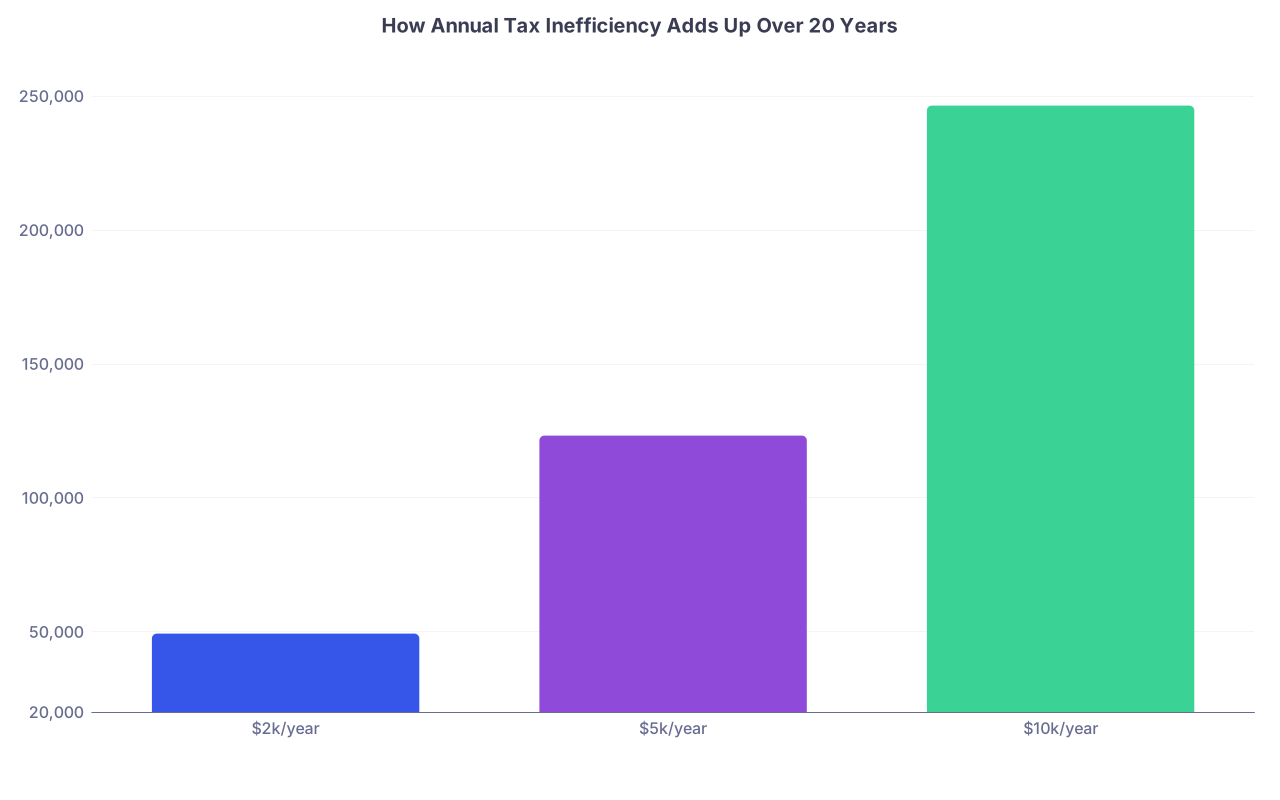
| Category | Value |
|---|---|
| $2k/year | 49282 |
| $5k/year | 123205 |
| $10k/year | 246411 |
Those totals assume you invested the tax savings at 7% instead of handing it to the IRS. So every year you miss something, it’s not just that year’s cash. It’s all the compounding you never get.
So yeah. Tiny leaks. Huge long-term damage.
But before you spiral: this is about patterns, not a single typo. One wrong box one year usually isn’t the end of the world. It’s the wrong strategy, on autopilot, that hurts.
The Big Offenders: Tax “Mistakes” That Actually Cost Six Figures
This is where I’ve seen physicians really bleed money without realizing it. None of these feel dramatic in real time. But they are.
1. Not Maximizing Tax-Advantaged Accounts Early
You know this in theory. In practice, residency is chaos and retirement accounts feel fake.
So you think: “I’ll worry about that once I’m an attending.”
That “I’ll start later” decision? That’s a six-figure mistake.
Say you skip doing any serious retirement contributions for your first 5 years as an attending, when you could’ve put $22,500/year into a 401(k) (plus maybe a 403(b) or 457(b)). Just that gap:
- $22,500/year × 5 years = $112,500 not contributed
- Let it grow for 25 more years at 7% = roughly $609,000 you don’t have
Same “mistake.” Repeated. Quietly.
And I get why this happens. You’re finally making money, you’re drowning in loans, you’re exhausted, and the HR onboarding packet looks like a bad escape room puzzle. So you default to minimums or nothing.
But that “I’ll figure it out later” choice? That’s the kind of thing that absolutely can cost you several hundred thousand dollars over your career.
2. Filing as the Wrong Entity (or Never Changing It)
This one hits self-employed physicians and moonlighters hard.
You start moonlighting or open a small side practice as a sole proprietor because:
- It’s easy
- You don’t know what else to do
- You plan to “look into S-corps later”
If you’re making serious 1099 income and never talk to anyone about whether an S-corp, partnership, or PLLC might save you on self-employment tax? That’s where you quietly lose five figures per year.
Example I keep seeing:
- 1099 income: $200,000/year as a locums/independent contractor
- Sole proprietor vs S-corp with reasonable salary/distribution split
- Self-employment tax savings alone can be $8,000–$15,000/year if done properly
Stick with the wrong structure for 10–15 years? You’ve just donated $80,000–$225,000+ to the IRS. And that’s before considering retirement plan structures you could have used (solo 401(k), defined benefit plans, etc.).
Will the IRS show up and say “you owe us $200k”? No. But the absence of planning is silently doing that to you in reverse.

3. Mishandling Student Loan and Tax Strategy Together
This one’s sneaky and dangerous.
Your loan strategy and your tax strategy are joined at the hip. Pretending they’re separate? Expensive.
Two common painful scenarios:
Scenario A: Chasing PSLF but Filing the “Wrong” Status
You’re going for Public Service Loan Forgiveness (PSLF). Your payments under an income-driven plan are based on your AGI (adjusted gross income). Then you:
- Get married
- Automatically file “Married Filing Jointly” without thinking about AGI impact
Now your spouse’s income gets pulled into your payment calculation. Your IDR payments shoot up by hundreds or thousands per month. Over 10 years, that can easily cost $50,000–$150,000 more in payments you didn’t need to make if “Married Filing Separately” was a better fit.
Yes, filing separately can increase your overall tax bill. But sometimes the combined effect (taxes + loan payments) is lower with a different filing choice. If your accountant only looks at taxes and not loans? That’s how you get screwed.
Scenario B: Extra Payments When You Shouldn’t Be Paying Extra
If you’re dead serious about PSLF, every extra voluntary payment you make is often just… donation.
I’ve seen people aggressively pay down principal during training, then still qualify for PSLF later. They basically lit tens of thousands of forgiven dollars on fire out of fear and bad advice.
Is that technically a “tax” mistake? Indirectly, yes—because they didn’t realize how AGI, deductions, and filing strategy interact with loan programs.
4. Ignoring Backdoor Roth IRAs (or Doing Them Wrong)
You’re a physician. You will almost certainly cross the income limits for direct Roth IRA contributions. At that point, if you’re not doing a backdoor Roth IRA each year, you’re leaving long-term tax-free growth on the table.
Skipping it for a decade?
- $6,000/year for 10 years = $60,000
- Growing tax-free for 25 years at 7% ≈ $325,000+ in a Roth vs fully taxable brokerage scenario
Even if the real gap is smaller after tax effects, we’re still talking serious money.
And then there’s the other problem: doing the backdoor Roth wrong because you didn’t understand the pro-rata rule. If you have pre-tax money in other traditional IRAs and you “backdoor” without cleaning that up, you can create surprise tax bills and lose a big chunk of the benefit.
Again: one concept, misunderstood, repeated yearly. Six-figure haircut.
| Tax Decision Error | Typical Annual Impact | 20+ Year Potential Cost* |
|---|---|---|
| Not maxing 401(k)/403(b) early | $5k–$15k lost savings | $120k–$400k+ |
| Wrong entity for 1099 income | $5k–$10k extra tax | $100k–$250k+ |
| Skipping backdoor Roth IRA | $1k–$3k in tax drag | $75k–$200k+ |
| Poor PSLF/tax filing coordination | $3k–$10k loan overpay | $50k–$150k+ |
*Assuming investing the difference with long-term growth, rough ballpark ranges.
What About the Classic Fear: “Will One Mistake Get Me Audited and Ruined?”
Let’s talk about the nightmare scenario your brain keeps running at 3 a.m.
The form was confusing. You clicked the wrong box. You forgot to report something small. You mis-entered your moonlighting income. And now: you’re convinced an agent in a dark room has your name highlighted in red.
Here’s the un-dramatic reality:
- A simple one-time error usually leads to: a correction notice, maybe some interest, maybe a small penalty. Annoying? Yes. Life-destroying? No.
- The IRS absolutely does not have the time or budget to nuke people over honest, modest mistakes.
- What actually raises red flags is a pattern of nonsense: huge, unjustified losses year after year, crazy business deductions that don’t match your specialty, unreported large 1099 income repeatedly, etc.
I’ve seen physicians panic over:
- Forgetting a 1099 for $700 one year
- Messing up the HSA contribution amount
- Entering the wrong loan interest number
Those are fixable. You amend the return. You pay any difference. You move on. It stings, but it’s not a six-figure career-long wound.
What is risky:
- Consistently using a sketchy “doctor tax specialist” who pushes obviously aggressive schemes (like making your kids “consultants” for your W-2 job)
- Repeated underreporting of substantial income
- Ignoring IRS letters because you’re so anxious you can’t open the mail
The IRS is more like a slow, bureaucratic hospital than a SWAT team. If something’s off, they usually send a standard letter first, not a raid.

| Step | Description |
|---|---|
| Step 1 | Notice possible mistake |
| Step 2 | Gather documents |
| Step 3 | Talk to tax pro |
| Step 4 | File amendment if needed |
| Step 5 | Hire CPA or tax attorney |
| Step 6 | Correct past returns |
| Step 7 | Update strategy going forward |
| Step 8 | Size of issue |
The Part You Need to Hear: Most of This Is Fixable If You Don’t Freeze
Your biggest enemy here is not the IRS. It’s avoidance.
You see something confusing → you get anxious → you delay → you reuse last year’s choices → years pass → the pattern calcifies.
Here’s how to pull yourself out of that spiral without needing to become a tax expert:
Decide you’re allowed to ask “dumb” questions.
The people who lose the most money are the ones who are too embarrassed to say, “I don’t get this.” I’ve seen cardiologists read echo reports like poetry but freeze at the words “basis” and “pass-through.”Do a “tax autopsy” on just the last 1–2 years.
Not your entire life. That’s overwhelming and you won’t do it. Start with:- How much did you pay in total federal + state tax?
- Did you max retirement accounts available to you?
- Are you doing a backdoor Roth if your income is high enough?
- If you’re 1099, do you have an entity? Are you using it properly?
Get one real, physician-literate professional opinion.
Not your Aunt’s friend who “does taxes on TurboTax for fun.” Someone who:- Has multiple physician clients
- Understands student loans if you’re still in that phase
- Can explain PSLF vs payoff vs refinance vs IDR in English
Fix what’s fixable. Then stop punishing yourself.
You can generally amend returns for the last 3 years. You might recover missed deductions or clarify something wrong. Or at least stop the bleeding going forward.Install a yearly “tax strategy check-in” on your calendar.
30–60 minutes sometime between October–December, every year, where you:- Look at projected income
- Ask if anything major changed (marriage, kids, loans, side gig)
- Confirm your strategy still makes sense
Is this annoying? Yes. But so is residency q4 call. You survived that. You can survive a once-a-year calendar block.
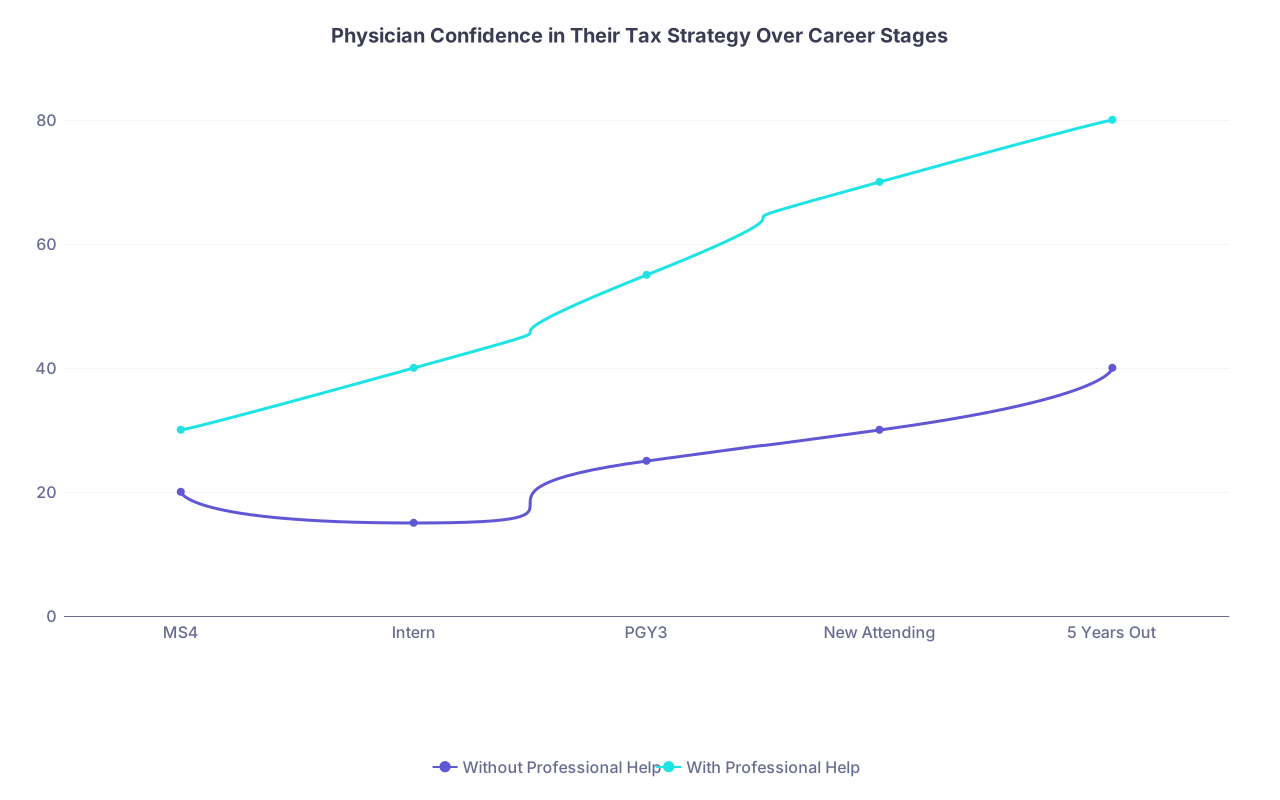
| Category | Without Professional Help | With Professional Help |
|---|---|---|
| MS4 | 20 | 30 |
| Intern | 15 | 40 |
| PGY3 | 25 | 55 |
| New Attending | 30 | 70 |
| 5 Years Out | 40 | 80 |
So… How Worried Should You Actually Be?
Here’s my blunt take.
If you:
- Have never thought about tax strategy
- Are 5–10 years into attending life
- Have 1099 income or big loans
- And everything so far has been “just whatever HR or TurboTax said”
Then yes, there’s a very real chance you’ve already lost tens of thousands, maybe low six figures in potential long-term wealth. Not because you’re dumb. Because the system basically assumes you’ll screw this up unless you proactively learn or get help.
That should motivate you. Not paralyze you.
On the other hand:
If you:
- Made a one-off mistake on a form
- Forgot to do a backdoor Roth for a couple years
- Didn’t max out in residency because you literally couldn’t afford it
No, you didn’t “ruin your future.” You’re not barred from financial independence because you didn’t understand the 457(b) fine print at 26 while on nights. You can absolutely course-correct and still end up very comfortable.
The damage is worst when panic turns into avoidance. You’re already ahead of the game simply by asking this question instead of shoving your unopened W-2s back in a drawer.
FAQ
1. I just realized I’ve never done a backdoor Roth IRA and I’m 35. Did I blow it?
No. You missed some tax-free growth, which sucks, but it’s not fatal. Start now. You can’t go back and fill prior years unless you actually made contributions, but you can absolutely use the strategy going forward. And you can compensate somewhat by increasing contributions to other tax-advantaged accounts (401(k), 403(b), 457(b), HSA if eligible). Think “I lost some upside,” not “my future is ruined.”
2. I’ve been 1099 for a few years with no entity. Should I panic about past years?
Don’t panic. You probably overpaid tax, not underpaid. The IRS isn’t mad about that. Talk to a CPA about whether an S-corp or other structure makes sense going forward. For past years, sometimes you can’t recover what you lost in self-employment tax, but you can at least make sure you took all legitimate deductions (CME, malpractice, licensing, home office if appropriate, etc.). The real win is to stop overpaying now.
3. I’m going for PSLF and just found out we’ve been filing Married Filing Jointly. Did I lose PSLF?
You didn’t lose PSLF itself, but you may have overpaid on your loans. That hurts, but it’s not unrecoverable. Run the numbers with someone who understands both taxes and student loans to compare: MFJ with lower taxes vs MFS with potentially lower IDR payments. You can’t retroactively change filing status for most prior years, but you can adjust your strategy for future years and make sure your servicer has updated information. Focus on optimizing from here, not reliving the past.
4. How do I know if I need a CPA vs just using software like TurboTax?
If you’re a W-2 only resident with no side gigs, simple finances, and no PSLF complications, good software plus some careful reading may be enough. Once you add 1099 income, material investment accounts, complex student loans, or you become an attending with high income, I strongly favor working with a CPA or EA who has multiple physician clients. The cost of one or two hours of their time is tiny compared to the five- to six-figure mistakes we’ve been talking about.


