

It’s March 28th. You’re post‑call, half‑awake, scrolling on your phone. Your co‑resident is complaining in the workroom: “My tax guy said I owed this year. How is that even possible on a resident salary?” Somebody else shrugs and says, “I just use TurboTax and hope for the best.”
Nobody in the room really knows what they’re doing. But they’ll all tell you they’re “too busy” to learn.
Fast‑forward 15–20 years. Same people. Now they’re attendings, making mid‑six figures, sitting in my office or venting in the physician lounge, saying things like:
- “I had no idea I could have wiped out my student loan interest with a simple tax move in residency.”
- “I threw away my Roth space when my income was the lowest it would ever be.”
- “I moved states between residency and attending life and had no idea how much that really cost me in taxes.”
- “I trusted the hospital HR session and the random CPA my co‑resident used. Big mistake.”
Let me walk you through what those older attendings wish someone had shoved in their face when they were where you are now.
Because nobody is going to teach you this formally. Not your PD. Not HR. And definitely not the hospital “financial wellness” lunch sponsored by an insurance broker.
1. The Big Picture: Why Tax Decisions in Residency Matter Way More Than You Think
The lie residents believe: “I don’t make enough money for taxes to matter. I’ll fix all this once I’m an attending.”
That’s how you lose six figures over your career.
Not because you missed a $200 credit one year. Because residency year after residency year you let opportunities expire that can never be reclaimed once you’re making attending money.
I’ve watched three main patterns of regret from older physicians:
- They wasted their “low‑income years” by not stuffing Roth accounts when the tax rate was cheapest.
- They never learned how student loans, income‑driven repayment, and AGI really interact — and it cost them tens of thousands.
- They were oblivious to state tax differences and timing moves between states, and paid more than they had to for no good reason.
And then there’s the smaller stuff that still adds up: bad moonlighting setups, missed deductions, terrible record‑keeping, trusting salespeople as tax experts.
Residency is not “just a few poor years.” It’s a one‑time window where certain tax moves are incredibly valuable. Once your income crosses certain thresholds as an attending, some doors slam shut.
2. Roth Regret: “I Wasted the Best Tax Deal I’ll Ever Get”
This one is almost universal.
Ask older attendings in a call room what they wish they’d done differently, and half of them will say some version of: “I should have maxed Roth in residency every single year, no matter what.”
Here’s the part most residents don’t see: your marginal tax rate in residency is probably the lowest it will ever be again as a practicing physician.
So when you ignore Roth IRAs and Roth 403(b)/401(k) in residency, you’re basically saying:
“I’d rather pay higher taxes later as an attending than pay lower taxes now.”
Most don’t even realize that’s the trade‑off.
Why attendings beat themselves up about this
By the time you’re an attending:
- Your federal marginal rate may jump from 12–22% territory up to 32–37%.
- State taxes become a much bigger absolute dollar figure.
- Direct Roth IRA contributions may phase out completely if your income is high enough and you’re married.
Older attendings look back and realize they had 3–7 years where:
- They could have put $6,000–$7,000 per year (depending on the year) into a Roth IRA.
- Could have chosen Roth contributions in their hospital’s 403(b)/401(k) plan.
- Paid tax at a low resident bracket instead of a high attending bracket.
Instead, they:
- Didn’t contribute at all (“I’m too broke”).
- Or put small amounts into pre‑tax, thinking “pre‑tax is always better,” which is flat wrong in your situation most of the time.
They now own a ton of pre‑tax money and very little tax‑free Roth. That means every withdrawal in retirement is another dance with the IRS.
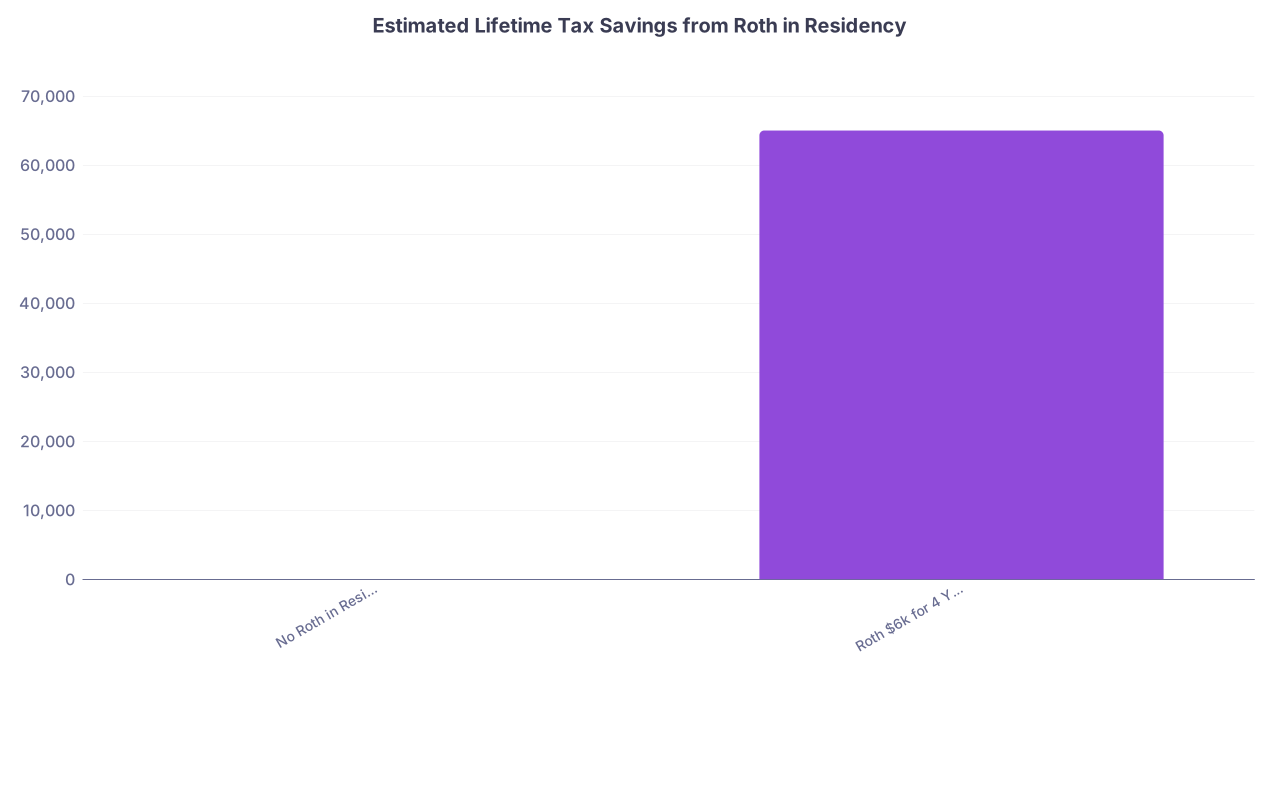
Concrete example: what this really costs
| Category | Value |
|---|---|
| No Roth in Residency | 0 |
| Roth $6k for 4 Years | 65000 |
That ~$65,000 is not some fantasy. It’s just compound growth on 4 years of Roth contributions, growing tax‑free, versus having the same dollars taxed later at higher rates.
Once older docs see the math, they say the same thing: “If I’d understood that, I would have found the money.”
The regret is not about being poor as a resident. It’s about letting those years pass without using the most tax‑efficient moves available.
3. Student Loans + Taxes: The Black Box That Burned Them
Let’s be blunt: most physicians, including faculty, never understood how income-driven plans, taxable income, and filing status truly interact. They just “picked something” on the loan servicer site.
The painful confession I hear over and over from attendings:
“I could have saved crazy money on my IDR payments and PSLF if I’d planned my taxes with my loans in mind from day one.”
You’re in a rare position. Student loans are huge. Your AGI is relatively low in residency. The tax code plus the loan rules actually give you levers to pull. If you know they exist.
Older attendings typically regret three specific things.
3.1 They ignored how AGI controls their loan payments
Income‑driven repayment (PAYE, REPAYE, SAVE, etc.) uses AGI, not gross salary. They never knew that shaving AGI down strategically could:
- Lower their required monthly payment
- Increase PSLF forgiveness later
- And still be perfectly legal, not “gaming the system”
Things that adjust AGI:
- Pre‑tax retirement contributions (traditional 403(b)/401(k), 457(b))
- HSA contributions (if available)
- Some deductible student loan interest (when they qualified)
- Certain moving/education expenses in specific years/contexts (less common now, but historically relevant for some older docs)
What they did instead:
- Never contributed to pre‑tax accounts “because I can barely live on my paycheck”
- Chose whatever plan looked cheapest month one, then never reassessed
- Never ran the math with PSLF in mind
I’ve seen actual numbers where a resident could have voluntarily contributed a few thousand to pre‑tax accounts, lowered AGI, cut IDR payments, and ended up with more forgiven at PSLF, netting a huge win.
They didn’t. Because no one explained the interaction.
3.2 They married and filed taxes without thinking about loans
There’s a very specific regret I hear from older attendings now tied into PSLF:
“We just filed ‘married filing jointly’ because that’s what TurboTax defaulted to. I didn’t realize it was blowing up my loan payments.”
Under some IDR plans, your payment is based on combined household AGI if you file jointly. Under others, you could file separately and keep your spouse’s income out of the calculation.
Residents:
- Got married PGY‑2 or PGY‑3.
- Spouse had a solid income.
- Filed jointly because “that’s what married people do.”
- Suddenly payments exploded.
- Years of high payments still counted for PSLF, but they could have been much lower with a better tax/IDR combo.
By the time they figured this out, they’d already paid tens of thousands more than necessary.
No one in the hospital or loan servicer warned them. Why would they? It’s not their job to minimize your taxes or loans.
3.3 They didn’t understand how PSLF and taxes intertwine
Here’s the quiet part people don’t say out loud: PSLF is a tax strategy as much as a loan strategy.
You’re essentially trying to:
- Minimize counted income (AGI) for 10 years
- Maximize the amount forgiven
- And avoid a tax bomb because PSLF forgiveness is tax‑free (unlike many other forgiveness programs)
Older attendings who stumbled into PSLF by accident often realize later:
“I could have saved so much more if I’d intentionally lowered AGI during residency with pre‑tax contributions while still planning Roth moves when it made sense.”
There’s nuance here. But the regret is straightforward: they never saw taxes and loans as connected systems.
You should.
4. State Taxes and Moving: Silent Killers
Nobody teaches residents that moving between states can trigger subtle but expensive tax problems.
Older attendings often realize — years after the fact — they gifted thousands to state tax departments because they didn’t time things right or pay attention to residency status.
Common regret patterns:
4.1 The “I didn’t understand part‑year residency” mistake
Residents:
- Match in State A
- Do fellowship in State B
- Take attending job in State C
Every move has state tax implications:
- When you leave a state mid‑year, it may still want tax on income earned while you were a resident there.
- When you move to a higher‑tax state, when during the year you move matters.
- Some states get aggressive about claiming you as a resident if you keep ties: driver’s license, car registration, home address.
What older attendings say:
“I made no attempt to think through when I moved or how it affected my tax year. I just did what was convenient. I probably burned several thousand for nothing.”
They’re not wrong.
4.2 The “I didn’t coordinate my contract and start date” problem
This one stings.
Attending signs a contract with:
- Large signing bonus
- Moving bonus
- Maybe a resident completion bonus from their training program
They often do this with zero thought about:
- Which calendar year that income will hit
- Which state they’ll be legally residing in at that moment
- How that state taxes bonuses, or whether they’re moving from no‑income‑tax state to high‑income‑tax
So what happens? They:
- Move from Texas (no state income tax) to California or New York late in the year.
- Start job in October/November.
- Get big signing bonus after establishing residency in the high‑tax state.
- Pay state tax on the whole thing, when a bit of planning could have shifted some or all of that income into a better year or state.
Older attendings rarely thought to ask: “Can we structure this bonus or start date in January instead of November?” Or, “Can part of this be paid while I’m still in my current state?”
That silence cost them real money.
5. Moonlighting, Side Gigs, and the 1099 Trap
This one is just ugly.
Residents see moonlighting as “extra cash.” Hospitals and groups see it as “easy 1099 labor.”
Older attendings remember one thing clearly: the year they got crushed by taxes on moonlighting income because no one explained estimated taxes or self‑employment tax.
What actually happened behind the scenes
I’ve seen residents:
- Pick up 1099 urgent care or telemedicine shifts.
- Earn $10–30k on top of PGY salary.
- Have zero withholding on that income.
- Spend all of it, then get hit with a giant tax bill in April.
Worse, 1099 income triggers:
- Both sides of Social Security and Medicare (self‑employment tax).
- Potential need for quarterly estimated payments.
Older attendings will tell you plainly: “No one told me to set aside 30–35% of every 1099 dollar. I learned the hard way — with an IRS letter.”
The regret isn’t that they moonlighted. It’s that they didn’t treat it like a small business from day one:
- Tracking income and expenses.
- Understanding they could deduct things (licensing, CME, maybe part of phone/internet).
- Using an accountant who actually understands physician 1099 work instead of the closest strip‑mall tax prep place.
6. Trusting the Wrong “Experts”: HR, Random CPAs, and Salespeople
Here’s the part nobody says out loud: a lot of the “guidance” you get in residency is either incomplete or conflicted.
Older attendings often regret who they trusted.
Three repeat offenders:
6.1 Hospital HR “financial wellness” sessions
You’ve seen them:
- Lunch talk about retirement plans
- Vendor shows up, passes around pamphlets
- They pitch target‑date funds and tell you “just pick one”
What they don’t do:
- Explain Roth vs pre‑tax in the context of physician lifetime income.
- Show you how contributions now affect your student loan payments.
- Tell you that the guy giving the talk is a salesperson, not a fiduciary planner.
Older attendings realize later those sessions were just distribution channels for whatever company the hospital partnered with. Not real tax planning.
6.2 The random CPA their co‑resident used
I hear this line constantly:
“I figured my taxes were simple, so I just went to the same guy my co‑resident used.”
Problem:
- Many generic CPAs don’t really understand IDR, PSLF, or physician‑specific issues.
- They file “married filing jointly” by default.
- They don’t ask about loan plans, PSLF, or future fellowship/state moves.
- They miss perfectly legal interactions (e.g., when to favor pre‑tax vs Roth given your future bracket).
The older attending regret: “I thought I was doing the responsible thing by hiring a pro. I didn’t know I needed someone who actually understood physician finances.”
6.3 Insurance and investment salespeople masquerading as planners
Some of you already had this experience:
- A “financial advisor” gives a free dinner talk.
- Half the evening is about “tax‑efficient strategies.”
- Next thing you know, they’re pushing whole life with a “tax‑free retirement” angle.
Older attendings who bought in residency later realize:
- They locked themselves into expensive, inflexible products.
- They did it at the very time when Roth + simple investing would have been way more powerful.
- The tax explanation was just a sales script.
They regret not having a filter to distinguish actual tax planning from disguised product pitches.
7. The “I Didn’t Bother to Learn the Basics” Regret
This is the part they don’t like to admit, but I’ve heard it enough:
“I was smart enough to pass Step 1, but somehow decided I was too dumb or too busy to understand a 1040. That was lazy.”
Older attendings look back and realize taxes are not magic. The basics are very learnable. You don’t need to become a tax attorney. You do need to know enough to:
- Recognize when a recommendation is nonsense.
- Ask better questions of accountants and planners.
- Make at least semi‑conscious decisions about Roth vs pre‑tax, filing status, and timing moves.
They regret outsourcing thinking instead of outsourcing paperwork.
Big difference.
8. What You Should Actually Do Differently (The Playbook They Wish They’d Had)
I’m not going to give you 47 steps. You’re in residency. You’re tired. You need the highest‑yield moves.
Think of it like this: your job is to avoid their biggest regrets, not be perfect.
At a minimum, older attendings wish they had:
Prioritized Roth contributions in residency years
- Roth IRA every year they could, even if it was a partial contribution.
- Roth 403(b)/401(k) contributions when possible, unless optimizing PSLF with pre‑tax was clearly more valuable after doing the math.
Treated student loans and taxes as a single system
- Picked IDR plans after understanding how AGI and filing status hit payments.
- Re‑evaluated once a year, especially with marriage, kids, or job changes.
- Considered whether pre‑tax contributions in certain years actually made sense for PSLF strategy.
Paid attention to state tax and move timing
- Asked simple questions about when bonuses, moving stipends, and first attending paychecks hit — and in which state.
- Actually changed legal residency (license, voter registration, address) thoughtfully instead of randomly.
Respected 1099 income
- Set aside 30–35% of every 1099 dollar immediately in a savings account.
- Filed estimated taxes when appropriate.
- Treated it like a mini‑business, not free cash.
Learned just enough tax basics to be dangerous
- Understood what AGI is.
- Knew the difference between credits and deductions.
- Understood Roth vs pre‑tax in the context of current vs future bracket.
Here’s how some of those tradeoffs look side‑by‑side:
| Decision Area | Short-Term Pain | Long-Term Benefit |
|---|---|---|
| Roth IRA in Residency | Less spending money now | Decades of tax-free growth at low initial tax cost |
| Pre-tax vs Roth 403(b) | Time to analyze with loans | Optimized PSLF or lower lifetime tax bill |
| Filing Joint vs Separate | Slightly higher prep complexity | Potentially much lower IDR payments |
| 1099 Moonlighting Planning | Setting aside 30–35% immediately | Avoid IRS bills, interest, and penalties |
| Timing State Moves/Bonuses | Mild inconvenience in scheduling | Lower state tax on big income chunks |
FAQ (3 Questions)
1. As a resident with loans, should I always choose pre‑tax over Roth to lower my AGI for IDR?
No. That blanket rule is lazy and wrong. Sometimes lowering AGI with pre‑tax is hugely beneficial for PSLF; other times, the long‑term value of Roth at residency‑level brackets wins. You need to actually run the numbers for your situation: loan balance, likelihood of PSLF, spouse income, and expected attending salary.
2. Is it worth paying a CPA in residency, or should I just use software?
If your situation is simple — single, standard deduction, no 1099 income, no PSLF planning — good software is usually fine. The moment you add: marriage, big loans with IDR/PSLF, 1099 moonlighting, or multi‑state issues, a physician‑savvy CPA or planner can be worth several thousand dollars in avoided mistakes. But only if they actually understand physician finance; vet them.
3. I feel behind — I’m PGY‑3 and have basically done none of this. Is it too late?
Not even close. Older attendings who did “wake up” in PGY‑3 or fellowship still salvaged a lot: started Roth, fixed filing status, cleaned up IDR choices, and planned their attending move more intelligently. You can’t get back the years already filed, but you can stop stacking future regrets on top of them.
Key points to walk away with:
- Residency is a one‑time window where Roth and smart AGI management are disproportionately valuable.
- Student loans, tax choices, and state moves are tangled together whether you acknowledge it or not.
- You do not need to be a tax guru — but if you repeat the “I’ll deal with this when I’m an attending” script, you’ll end up sounding exactly like the older docs complaining in the lounge now.


