

It is December 10th.
You just totaled your locums, telemedicine, moonlighting, and consulting checks.
Surprise: you pulled in $280,000 of 1099 income on top of your W‑2 attending job.
Now your CPA is tossing around phrases like "underpayment penalty," "quarterly estimates," and "marginal rate in the high 30s."
You are not trying to become a tax attorney.
You just want one thing: how do I cut this tax hit fast, without doing anything stupid or illegal?
Here is the playbook I use with physicians in exactly your spot.
Step 1: Get a Hard Number on the Damage
You cannot fix what you have not quantified. Most people guess. That is how they get burned.
1. Pull your real numbers
You need three pieces of data:
- Year‑to‑date W‑2 numbers
- Last pay stub of the year (or most recent):
- YTD gross pay
- YTD federal tax withheld
- YTD state tax withheld
- Retirement contributions (401k/403b, 457b, HSA, etc.)
- Last pay stub of the year (or most recent):
- All 1099 income
- Locums, telehealth, expert witness work, medical directorship, consulting, speaking, moonlighting
- Use:
- Bank statements (sort deposits from 1099 payors)
- Invoices or pay logs
- Big deductions you already have
- Retirement plan contributions
- HSA
- Student loan interest (if any)
- Mortgage interest
- Property taxes
- Charitable giving
2. Use a quick estimate (today, not "after busy season")
You do not need a perfect pro forma return. You need a ballpark marginal rate.
Options:
Use a decent online tax calculator (not the cutesy ones for residents)
Plug in:- Filing status, W‑2 wages, withholdings
- Self‑employment income (your 1099 total)
- Estimated deductions
Or have your CPA run a projection now.
Tell them bluntly: "I need my projected total tax and my marginal federal rate if I add $10,000 of 1099 income."
You are looking for:
- Estimated total tax for the year
- How much you have already paid/withheld
- Resulting tax due
- Your marginal tax rate (federal + state) on that last chunk of 1099
That marginal rate drives every decision that follows. If your combined marginal rate is 45%, a $1 deduction saves you 45 cents. You plan around that.
Step 2: Fix the Structure – Are You a Sole Prop, LLC, or S‑Corp?
If you did nothing formal, you are very likely a sole proprietor. Which is fine to start with. But it affects how much tax you pay.
Quick comparison
| Structure | Setup Speed | Payroll Required | SE Tax Savings Potential | Best When 1099 Income… |
|---|---|---|---|---|
| Sole Prop | Immediate | No | Low | < $75k |
| Single-Member LLC | Fast | No (until S-corp) | Low | Flexibility / liability |
| LLC taxed as S-Corp | Medium | Yes | High | > $150k and recurring |
If you are in Q4 of this year, you are mostly stuck with the structure you already used for income earned so far. But:
- You can clean up how you track and deduct expenses for this year.
- You can set up the right entity for next year right now, while you still remember how much this tax bill hurts.
For this year (too late for entity games for most of you)
- If you did not already elect S‑corp status effective earlier this year, do not try to backdate and play cute.
The IRS wins that game. - Treat yourself as sole proprietor or single‑member LLC. Same Schedule C. Same self‑employment tax rules.
For next year (if your 1099 is becoming recurring)
Here is a simple practical rule for physicians:
- If 1099 income is under $75k/year and somewhat sporadic →
Stay sole prop/LLC, focus on deductions and retirement. - If 1099 income is $75k–$150k and regular →
Consider S‑corp, but only if you are willing to run payroll and keep it clean. - If 1099 income is > $150k and likely to continue →
An LLC taxed as S‑corp is usually worth running the numbers on.
The S‑corp play is about reducing self‑employment tax by splitting income into:
- Reasonable salary (subject to payroll tax)
- Distributions (not subject to SE tax)
If you hate admin, do not push this early. A sloppily run S‑corp causes more pain than it solves.
Step 3: Load Up the Big, Clean Deductions First
This is where most physicians leave tens of thousands on the table. You are busy arguing whether a white coat is deductible while ignoring a six‑figure retirement plan.
1. Retirement accounts – your main weapon
Order of operations for a high‑income physician with W‑2 + 1099:
Max your employee side at W‑2 job
- 401k/403b employee deferral: $23,000 (2024; catch‑up if age 50+ adds more)
- 457b (if offered) is separate from 401k/403b limits. You can usually do both.
- Check current YTD contributions; you may be able to front‑load the rest this year by increasing your percentage heavily for the remaining pay periods.
Use an HSA if you have a high‑deductible health plan
- 2024 limits: $4,150 self‑only / $8,300 family (+$1,000 catch‑up if 55+)
- If you are not at the limit, increase contributions before year‑end or make a direct contribution to the HSA custodian.
Create a Solo 401(k) for 1099 income
If you have 1099 income and no employees under that business:- Open a Solo 401(k) before December 31 of the tax year (critical deadline).
- You, as the "employer," can generally contribute up to 20% of net self‑employment income as employer contributions, subject to overall limits.
For example:
- 1099 net income (after expenses): $200,000
- Employer contribution (roughly): 20% → $40,000
- If you already maxed the employee deferral at your W‑2, you still get this employer piece.
If you are reading this in December and do not have a plan yet, open a prototype Solo 401(k) ASAP with a custodian that can do fast setup.
Defined benefit / cash balance plan (for very high 1099)
If your 1099 income is >$250k–300k and fairly predictable, and you want to shovel six figures into tax‑deferred buckets:- Consider a cash balance plan on top of Solo 401(k).
- This requires an actuary and a real commitment; do not attempt as a one‑year toy.
- I have seen physicians shelter $150k–250k per year this way when they had a monster locums year.
The key: these are above‑the‑line deductions. You do not need to itemize to benefit. They hit your AGI directly.
2. Health and benefit accounts
HSA – already mentioned. Triple tax advantage. If eligible, max it.
Self‑employed health insurance deduction
If you pay for your own health insurance and are not eligible for a subsidized employer plan:- Premiums can often be deducted against 1099 income directly on Schedule 1.
- Good chunk of change in high premium markets.
Step 4: Ruthlessly Capture Every Legitimate Business Expense
1099 income is business income. You are running a business whether you like it or not. That means:
Every expense that is ordinary and necessary for that work is potentially deductible.
Make a clean pass through your year
Go through:
- Credit card statements
- Bank statements
- Calendar (to recall work‑related travel and events)
Mark anything tied to 1099 work. For each expense, ask:
"Would I have this cost if I stopped all 1099 work tomorrow?"
If the answer is "no", it is likely a business expense.
Common categories for physicians:
- Professional fees and licenses
- State medical license (if required for that work)
- DEA registration (if relevant)
- Specialty society dues
- Board certification / recert fees (when tied to maintaining practice/income)
- Malpractice premiums (if paid personally for locums/telehealth)
- Home office (used regularly and exclusively for the 1099 work)
- Actual expense method (portion of rent/mortgage interest, utilities, insurance)
- Or simplified method (square footage x IRS rate)
- Do not be scared of this. Done correctly, it is legitimate.
- Equipment and supplies
- Laptop, iPad, monitor, webcam, microphone used for telemed/consults
- Medical equipment purchased for your 1099 gigs (if not reimbursed)
- Office furniture (desk, chair) – often depreciated or §179 expensed
- Software and subscriptions
- EMR subscription (if you pay it)
- Telehealth platform subscriptions
- Scheduling software, e‑fax, secure messaging
- Medical journal and reference subscriptions used for your work
- Phone and internet
- Reasonable business percentage of your mobile and internet bill
- Document how you estimate the percentage (e.g., 50% business use)
- Travel
- Mileage for driving to non‑regular job sites (not your main W‑2 hospital)
- Flights, hotels, rental cars, Uber for locums gigs or speaking
- Per diem meals or actual receipts while away from tax home
- Continuing medical education (CME)
- Course fees, conferences directly related to your specialty/line of work
- Travel and lodging tied to those
Do not get cute:
- Your personal gym membership? No.
- Family vacation you wrapped around a 2‑hour dinner talk? Mostly no.
- Your Tesla "because I drive to the hospital"? Very likely a red flag.
Clean books in a day
You do not need full‑blown QuickBooks if you are under, say, $200k 1099 and one person:
- Export bank and card transactions to CSV.
- Toss them into a simple spreadsheet.
- Create broad categories: "Income," "Malpractice," "Travel," "Supplies," etc.
- Sum totals by category. That becomes the basis for your Schedule C.
If this sounds miserable, pay a bookkeeper a few hundred bucks to do a one‑time cleanup. Cheaper than overpaying tax because you gave up.
Step 5: Handle Quarterly Estimates and Penalties
If this was your first big 1099 year, odds are good your estimated payments are a mess or nonexistent.
There are two problems to solve:
- Avoiding underpayment penalties
- Making sure you do not show up on April 15 owing $80,000 with $10,000 in cash
Safe harbor rules: your shield against penalties
The IRS will generally not penalize you for underpaying during the year if you meet a "safe harbor." For high‑income docs:
- Pay at least 110% of last year's total tax liability, OR
- Pay at least 90% of this year's actual tax, OR
- Owe less than $1,000 after subtracting withholdings and credits.
For a physician whose income spiked this year, the smart move is:
- Look at last year's Form 1040, line "total tax"
- Multiply by 110%
- Ensure your combined W‑2 withholding + any estimated payments for this year meet or beat that number.
If you are under that and it is still before year‑end:
- You can increase W‑2 withholding drastically for the last few paychecks.
- You can also do a "catch‑up" estimated payment (Form 1040‑ES) before January 15.
Pro tip: Withholding on a paycheck is treated as if paid evenly throughout the year, while estimated payments are tied to actual dates. That means:
- If you are behind, jacking up W‑2 withholding on a year‑end bonus or final paycheck is often the cleanest way to plug the penalty hole fast.
Cash planning so you do not get crushed in April
Run a simple cash calculation:
- Project total tax for the year.
- Subtract:
- YTD W‑2 withholdings
- Estimated payments made
- The number left is your remaining tax liability.
Make a plan now:
- If the number is scary high, open a separate "tax savings" account. Move funds there each time 1099 money hits your main account.
- Rule of thumb if you are not projecting monthly:
- Skim 30–40% of every 1099 check into the tax savings account (depending on your marginal bracket and state).
Step 6: Use the Right Tax Advisor (or Fire the Wrong One)
I see the same pattern:
- Generic CPA who knows small retail or restaurants.
- Has no idea how locums, telehealth, multiple states, and high‑income retirement stacking works.
- Tells physicians "you are already maxing out what you can do" when they are not.
You need someone who:
- Handles high‑income service professionals routinely.
- Understands Solo 401(k) + cash balance structures.
- Has seen multi‑state filings for traveling physicians.
- Is comfortable doing mid‑year and Q4 tax planning, not just compliance in March.
Ask directly:
- "How many 1099 physicians like me do you work with?"
- "Do you design and maintain Solo 401(k) or cash balance plans, or do you coordinate with another specialist?"
- "Will you run tax projections in the fall every year?"
If they dodge, move on. Your tax return is not where you save the money. Your planning during the year is.
Step 7: If You Still Have Time This Year – High‑Impact, Last‑Minute Moves
If it is still before December 31, here is what you can do right now that actually moves the needle.
1. Max or front‑load retirement contributions
- Increase W‑2 deferrals aggressively for remaining pay periods (check HR deadlines).
- Open a Solo 401(k) this month if you plan to contribute off 1099 income.
- If eligible, fully fund HSA.
2. Push legitimate expenses into this year
If you are already planning:
- A new work laptop or tablet
- Upgrading your home office desk or ergonomic chair
- Required CME early next year
- Licensure renewals due in Q1
You can pull those into this calendar year. The expense happens when you are charged / pay, not when you "use" it.
Do not buy junk you do not need just for a deduction. Spending $1,000 to save $350 still leaves you $650 poorer.
3. Charitable giving – but do it correctly
If you itemize deductions, charitable donations may help. Strategy:
If you are already charitably inclined and in a high bracket this year:
- Consider bunching several years of donations into this year.
- Use a Donor‑Advised Fund (DAF) to front‑load giving, then grant out slowly.
If you have large unrealized capital gains in a taxable account:
- Donate appreciated stock to a DAF or directly to charities.
- You get a deduction for fair market value and avoid capital gains tax.
This is more powerful for people with sizable taxable investments. On pure 1099 cash flow, retirement contributions usually beat this on impact.
Step 8: Build a Simple System for Next Year So You Do Not Repeat This
You do not want another December panic. The cure is a simple, boring system:
Business checking account for 1099 work
- All 1099 income deposits there.
- All business expenses paid from there.
- Easy to see your real net and save for taxes.
Automatic tax skim
- Every time money hits that account:
- Move 30–40% to a separate high‑yield savings labeled "TAX."
- This is non‑negotiable. Future you will be very grateful.
- Every time money hits that account:
Monthly or quarterly review
- 30 minutes on your calendar:
- Update a simple spreadsheet / bookkeeping app.
- Check year‑to‑date 1099 net income.
- Confirm you are on track with retirement contributions.
- 30 minutes on your calendar:
Schedule a fall planning call
- Put a recurring event for September:
- “Send CPA year‑to‑date numbers for tax projection.”
- This is when you adjust estimates, tweak contributions, and avoid scramble.
- Put a recurring event for September:
Formalize your entity if it makes sense
- If this year proved your 1099 is not a one‑off:
- Talk to your advisor about LLC + S‑corp election for next year.
- Set up payroll correctly from day one.
- If this year proved your 1099 is not a one‑off:
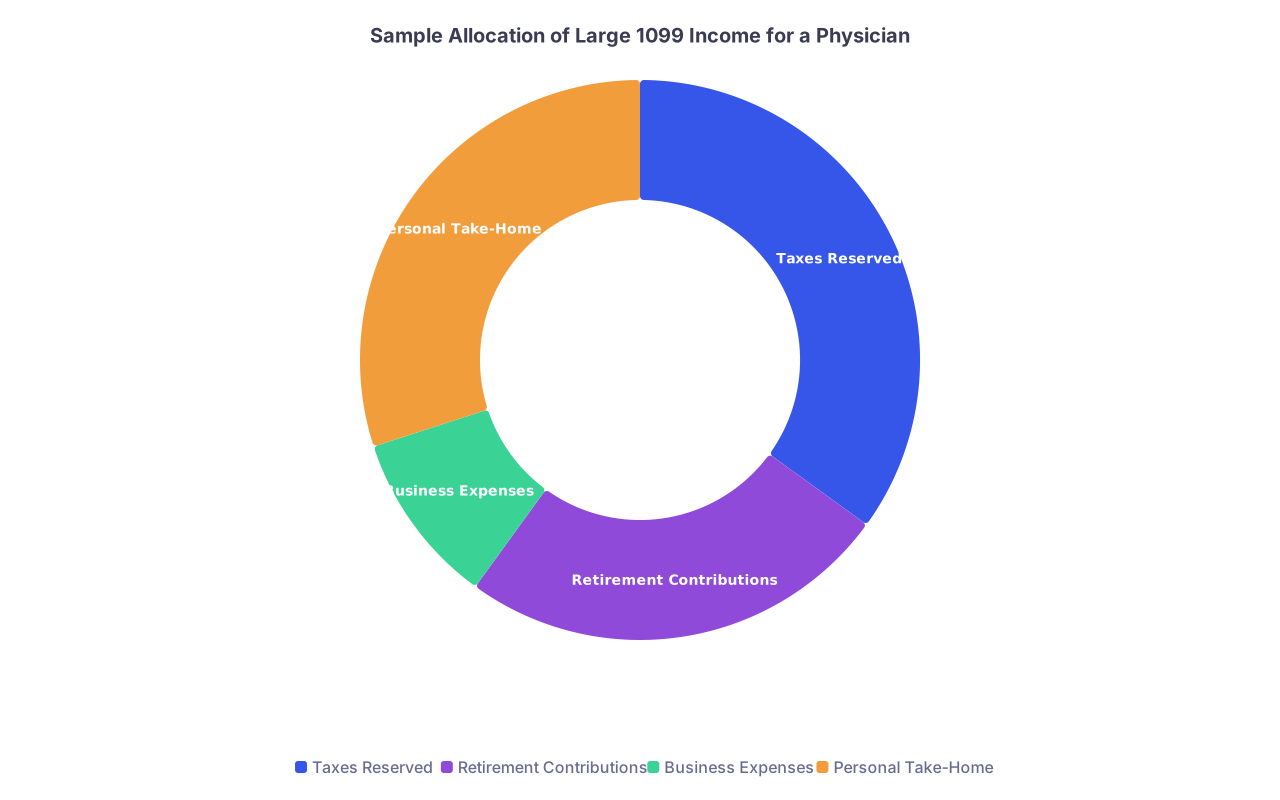
| Category | Value |
|---|---|
| Taxes Reserved | 35 |
| Retirement Contributions | 25 |
| Business Expenses | 10 |
| Personal Take-Home | 30 |
A Quick Example: Locums Hospitalist With a Big Spike
Let me walk through a real‑style scenario.
- W‑2 attending job: $260,000 salary, maxed 403(b) employee deferral.
- 1099 locums this year: $220,000 gross.
- State: 5% flat tax. Married filing jointly.
Without planning, he:
- Had standard withholding on the W‑2.
- Made no estimated payments.
- Spent locums money as it came.
Projection showed:
- Combined marginal rate on last dollars: ~37% federal + 5% state + SE tax on 1099 portion.
- April tax bill of ~$85,000 beyond W‑2 withholdings.
Here is what we did late in the year:
Opened a Solo 401(k) and rushed to get it established before Dec 31.
- Employer contribution: ~20% of 1099 net.
- Cleaned up ~$30,000 of bona fide business expenses he had ignored.
- Net business income: about $190,000 after expenses.
- Employer Solo 401(k) contribution: roughly $38,000.
Confirmed he had maxed his W‑2 employee deferral to the 403(b) and also used his 457(b). No extra there.
Marked:
- Malpractice,
- CME,
- Licensure,
- Home office,
- Proper share of phone/internet
that he had previously treated as "just life."
Jacked up W‑2 withholding for remaining paychecks and year‑end bonus to hit the 110% prior‑year tax safe harbor.
End result:
- Current year tax bill dropped by several tens of thousands.
- Underpayment penalties minimized.
- He created a playbook:
- 35% of 1099 to tax savings.
- 20% employer contribution to Solo 401(k) automatically every quarter.
- Quarterly check‑ins.
The biggest "savings" was not a clever loophole. It was using the retirement space fully and obeying basic safe harbor rules.

| Step | Description |
|---|---|
| Step 1 | Large 1099 Income |
| Step 2 | Estimate Total Tax and Marginal Rate |
| Step 3 | Max W2 Retirement and HSA |
| Step 4 | Open Solo 401k for 1099 |
| Step 5 | Capture All Business Expenses |
| Step 6 | Adjust Withholding or Estimates |
| Step 7 | Evaluate Entity for Next Year |
FAQ (Exactly 4 Questions)
1. I just found out I will owe a huge amount. Should I take out a loan to pay the tax or set up a payment plan with the IRS?
If the bill is due in a few months and you have decent credit, a short‑term bank loan or HELOC is usually cheaper than an IRS installment agreement. The IRS will charge both interest and penalties. Before borrowing, though, see if you can:
- Pull from a taxable investment account
- Temporarily cut back on discretionary expenses
Avoid tapping retirement accounts if at all possible. Early withdrawals trigger tax plus penalties and usually make the situation worse long term.
2. Can I deduct student loan payments against my 1099 income?
No. Your principal and most interest payments on student loans are not business expenses. The separate "student loan interest deduction" on your individual tax return phases out quickly at physician income levels. For most attendings, there is no significant federal deduction there. Do not try to force this into Schedule C.
3. Is a home office deduction safe for physicians, or is it an audit magnet?
Home office is not the audit boogeyman people think it is, if done correctly. The key requirements:
- A specific area used regularly and exclusively for your 1099 work
- Reasonable calculation of square footage and expense allocation
If your primary 1099 work (telemedicine, chart reviews, admin consulting) happens from that space, the deduction is justified. Sloppy, obviously inflated claims are what cause problems, not the concept itself.
4. Is an S‑corp always better than being a sole proprietor for 1099 income?
No. An S‑corp can save on self‑employment tax by splitting income into salary and distributions, but:
- It adds payroll complexity and costs
- You must pay yourself a reasonable salary, which limits how much you "save"
- For lower or irregular 1099 income, the extra admin often outweighs the benefit
It starts making sense when you have consistent, high 1099 profits (commonly >$150k) and are willing to keep clean books and proper payroll. Many physicians are better off optimizing retirement and deductions first as a sole proprietor or LLC before layering in the S‑corp.
Key takeaways:
- The biggest wins for high‑income 1099 physicians are clean structure, aggressive but legal retirement contributions, and meticulous expense tracking, not gimmicks.
- Use safe harbor rules and year‑end withholding adjustments to avoid penalties and cash‑flow shocks, and codify a simple system for next year so you never scramble like this again.


