
It is early March. Clinic ran late, three patients double‑booked into your “admin” hour, and you finally sit down to open your tax organizer. Within 10 minutes you know: this year is going to hurt.
Your income jumped. The 1099s are thicker than usual. You took extra locums shifts. Your spouse also had a strong year. And nobody did estimated payments like they were supposed to.
You are staring down a number that looks suspiciously like a resident’s full annual salary. Except this time, it is what you owe.
Let me be direct: you have less flexibility this late in the game. But you are not powerless. There are specific, concrete moves you can still make before you file that will:
- Cut this year’s tax bill as much as realistically possible.
- Keep you from getting crushed by penalties and interest.
- Put systems in place so you never feel this blindsided again.
This is not a theory piece. It is a checklist of moves I have watched dozens of physicians use when they realized—often in April—that tax season would be brutal.
Step 1: Diagnose the Damage Before You Panic
Before you start “doing things,” you need a clear picture of exactly how bad it is.
1. Gather everything in one sitting
Do not piecemeal this over 10 evenings. Block 2–3 uninterrupted hours and pull:
- All W‑2s (employed positions, academic appointments, hospital jobs)
- All 1099‑NEC / 1099‑MISC / 1099‑K (consulting, moonlighting, locums, speaking, online courses, telemedicine)
- 1099‑INT / 1099‑DIV / 1099‑B (brokerage and bank accounts)
- 1099‑R (retirement distributions if any)
- 1098‑T / 1098‑E / 1098 (education interest, mortgage interest)
- K‑1s (if you are in a partnership, ASC, imaging center, etc.)
- Last year’s tax return
If you are married, include your spouse’s documents. I routinely see people “forget” a spouse’s RSUs or side business and misjudge the whole picture.
2. Get a rough, fast estimate today
You have three options:
Your CPA – Best choice if you already have one. Ask for:
- A quick projection based on your documents so far.
- Explicit estimates of:
- Total tax owed
- Amount already paid/withheld
- Expected balance due
- Penalties/interest risk
Good tax software – TurboTax, ProSeries, etc. Not perfect, but good enough to know whether you are short by $5,000 or $50,000.
Back‑of‑the‑envelope if you are really stuck:
- Take total income from all W‑2s and 1099s.
- Subtract:
- 401(k)/403(b)/457 contributions already made
- HSA contributions already made
- SEP/Solo 401(k) contributions already made
- Multiply rough taxable income by:
- 30% if income under $250k (married filing jointly)
- 35–40% if income $250k–$600k
- 40%+ if above that or in high‑tax states
- Compare to what you have already paid in:
- Federal and state withholding on W‑2s
- Any estimated tax payments
- The gap is your problem.
You are not trying to be perfect. You are trying to answer one question:
“How big is the shortfall, and is this a cash‑flow crisis or just a painful check?”
Step 2: Hit Every Last‑Minute Deduction You Still Control
At this point, the year is over. You cannot go back and suddenly have bought more CME or driven more miles. But there are still levers you can pull after year‑end for the prior tax year.
1. Max out “late” retirement contributions
These are the big ones that still count for last year if you act before filing.
a) Traditional IRA / Backdoor Roth IRA
For last tax year, you can usually contribute until the April filing deadline:
- 2023 limit: $6,500 (under 50), $7,500 (50+).
- 2024 limit: $7,000 (under 50), $8,000 (50+).
If your income is high (it is, you are a physician), you likely:
- Do not get a deduction for a traditional IRA, but
- Do have the option to do a backdoor Roth IRA:
- Contribute to a non‑deductible traditional IRA.
- Convert to Roth shortly after.
This does not reduce this year’s income tax, but it improves your long‑term tax position. Still worth doing while you are in “tax mode.”
b) SEP‑IRA or Solo 401(k) for 1099 income
If you have side 1099 income (locums, consulting, telemed), you may still be able to create or fund:
- A SEP‑IRA, or
- A Solo 401(k) (better in many situations, especially if you want Roth or mega backdoor options later).
Key points:
- You can usually open and fund a SEP‑IRA up to your filing deadline, including extensions.
- Solo 401(k) rules are stricter:
- For 2023 and later, you can generally set up a plan and make employer contributions by the filing deadline.
- Employee deferrals usually must be elected by year‑end (or by first paycheck for W‑2 from your S‑corp).
Contribution range for 1099 income:
- Roughly 20% of net self‑employment income (after half SE tax) as “employer” contribution.
- Combined limit with other plans: $66,000 (2023), $69,000 (2024), across all 401(k)/403(b)/SEP type accounts.
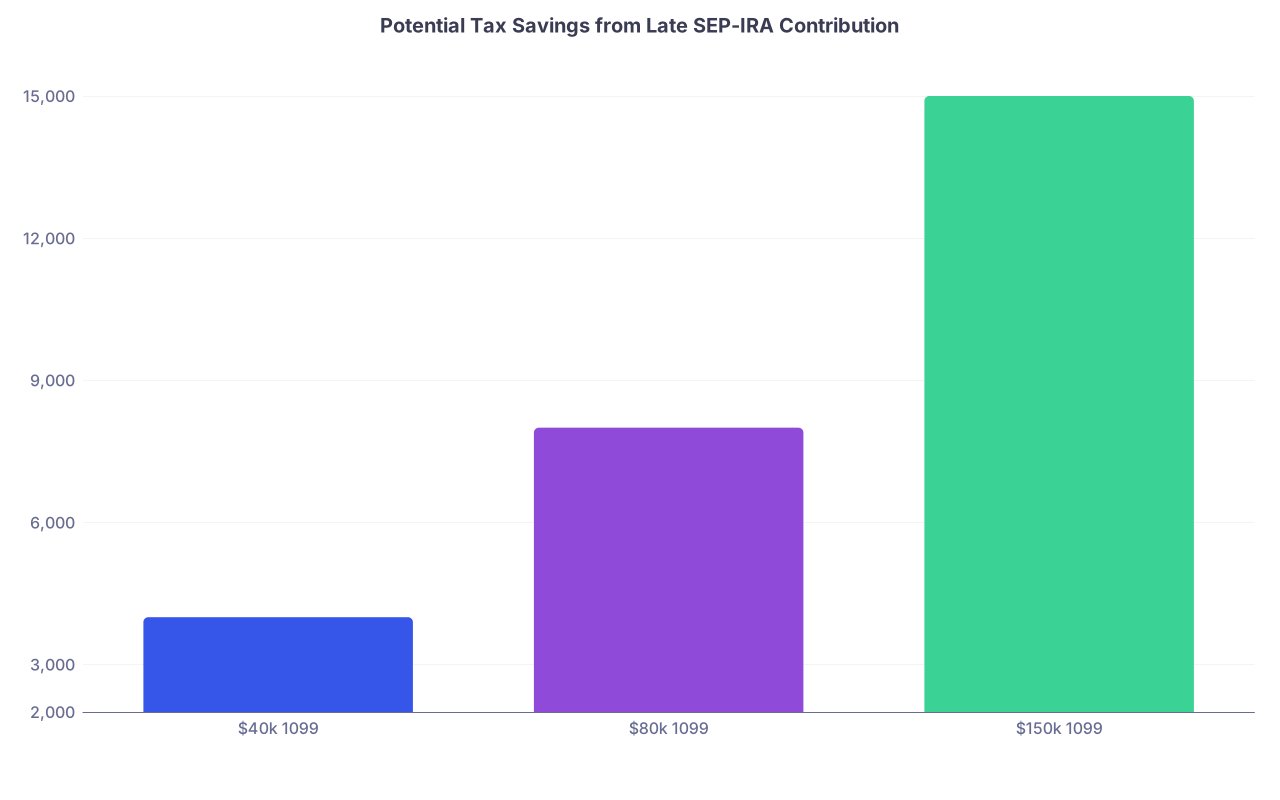
If you had, say, $80,000 in net 1099 income and have not set up anything:
- You could potentially put in around $16,000 into a SEP‑IRA.
- That can save you $5,000–$7,000 in federal tax, plus state.
Call a custodian (Fidelity, Vanguard, Schwab) and your CPA the same day. Do not guess the max yourself.
| Category | Value |
|---|---|
| $40k 1099 | 4000 |
| $80k 1099 | 8000 |
| $150k 1099 | 15000 |
(Assuming ~20% contribution and 30–35% marginal tax rate.)
2. Health Savings Account (HSA)
If you had a qualifying high‑deductible health plan for last year, you can still:
- Open an HSA now.
- Contribute for last tax year up to April filing deadline.
Contribution limits:
- 2023: $3,850 individual / $7,750 family (+$1,000 if 55+).
- 2024: $4,150 individual / $8,300 family (+$1,000 if 55+).
HSAs are triple‑tax‑advantaged. For high earners, they are non‑negotiable.
Concrete example:
- Family coverage HSA max (2023): $7,750
- At a 37% marginal federal + 5% state rate: ~42% savings
- Tax reduction: ~ $3,255 for a single contribution you can still make in March.
3. Spousal retirement contributions
If your spouse has:
- Their own 401(k)/403(b)/457 – confirm those were actually maxed. Many physicians assume HR “took care of it” and find out they contributed $12k instead of $22.5k.
- 1099 income – they may also be able to open a SEP‑IRA or Solo 401(k).
Do not overlook this. I have watched couples pick up an extra $10,000–$20,000 in deductible contributions just by fixing a spouse’s accounts.
4. Review last‑minute business deductions (for 1099s / small practices)
You cannot invent expenses now. But you can:
- Make sure every legitimate expense is actually recorded:
- CME, board exam fees, licensing, DEA fees
- Malpractice paid personally
- EMR subscriptions, medical apps
- Home office for truly separate, regular, and exclusive business use
- Accountant/legal fees tied to the business
- Phone, internet portion used for business
- Catch anything stuck on a personal card that never made it into your bookkeeping.
A rushed bookkeeper or DIY spreadsheet is notorious for missing thousands here.
Step 3: Prevent Penalties and Manage the Cash Crunch
You may not be able to eliminate the bill. But you can stop the bleeding from penalties and interest.
1. Understand your penalty exposure
The IRS likes to charge you in two main ways when you underpay during the year:
- Underpayment penalties (estimated tax penalties)
- Triggered when you did not pay “enough” tax during the year via withholding or estimates.
- Failure‑to‑pay penalties
- Triggered if you do not pay the total bill by the April deadline.
Your goal is to minimize both. Different strategies apply.
2. Use the “safe harbor” rules to your advantage
There are two safe harbors for avoiding underpayment penalties:
- Pay at least 100% of last year’s total tax (110% if your AGI was > $150,000).
- Or pay at least 90% of what this year’s tax ends up being.
For physicians with income that jumped this year, the 110% rule is your friend.
Example:
- 2022 total tax: $70,000
- 2023 AGI: $450,000, tax maybe $120,000
- If you paid at least $77,000 (110% of $70,000) through withholding/estimates in 2023:
- You can still owe $43,000 in April
- And owe zero underpayment penalty
So:
- Pull last year’s “Total Tax” line from your 1040.
- Check how much was withheld + estimates this year.
- If you met the 100%/110% safe harbor, your underpayment penalties drop sharply.
If you did not meet it, move to the next strategies.
| Task | Details |
|---|---|
| Early Year: Gather prior year docs | a1, 2024-02, 1m |
| Early Year: Last year contributions | a2, 2024-02, 1m |
| Mid Year: Mid year CPA review | a3, 2024-07, 1m |
| Mid Year: Adjust estimates | a4, after a3, 1m |
| Late Year: Year end planning | a5, 2024-11, 1m |
| Late Year: Final estimated payment | a6, 2025-01, 1m |
3. Annualized income method (Form 2210)
If a big chunk of your income came late in the year (e.g., locums from September–December), you can sometimes reduce penalties by:
- Using the annualized income installment method (Form 2210, Schedule AI).
- This lets the IRS see that you did not have that higher income all year long.
Many physicians:
- Worked like a normal year through August.
- Then picked up a ton of overtime, locums, or a new job Q4.
If your CPA does not automatically check this, ask them explicitly:
“Given my income was much higher late in the year, can we use the annualized income method to reduce underpayment penalties?”
4. If you cannot pay it all: choose your pain strategically
You have a big bill and not enough cash. Choices:
- Pay as much as you possibly can by the deadline.
- Decide where to carry the shortfall:
- IRS installment plan
- Short‑term borrowing (HELOC, margin loan, etc.)
- Liquidating taxable investments
You do not want to:
- Ignore the bill and hope “it works out.”
- Put the entire thing on a high‑interest credit card.
IRS installment agreement (if you are short)
For many physicians, an IRS payment plan is cleaner and less stressful than some of the alternatives.
- If you owe less than $50,000 and can pay within 72 months, you can usually:
- Apply online
- Get an automatic, no‑drama installment plan
- Interest continues (federal short‑term rate + 3%) plus small setup fees.
- Compared to 20% credit card APR, this can be downright reasonable.
If your gap is $10,000–$40,000 and you just need a year or two to catch up, this is a viable option.
Weighing other borrowing options
If you have:
- HELOC at 7–9%
- Margin loan at 8–10%
- Credit card at 20–30%
Compare those to:
- IRS interest + penalties (usually in the 7–10% total effective range in recent years).
Often:
- IRS installment + aggressive cash flow adjustments + cutting discretionary spending is the least bad option.
Talk numbers with your CPA or financial advisor. This is math, not emotion.
Step 4: Use Entity and Structure Tweaks (Where You Still Can)
If you are 100% W‑2, you have fewer levers here. If you have 1099 income or a small practice, you have more.
1. For pure W‑2 physicians: accept the limits
If all your clinical income is W‑2:
- You cannot convert to 1099 after the fact.
- You cannot retroactively pay yourself as an S‑corp.
- You cannot deduct unreimbursed employee expenses like you used to (those died in 2018 for most people).
Your best remaining levers this year are:
- HSA
- IRA / backdoor Roth
- Optimizing with spouse accounts
- Making sure your withholding is fixed going forward (more on that later)
That is it. Anything else someone is trying to sell you at this point (whole life, shady shelters, last‑minute “deductions”) is likely trouble.
2. For 1099 physicians / practice owners: confirm you used the right structure
This is not something you can usually fix retroactively for last year, but you need to know right now if you are set up dumb for next year.
Key questions:
- Are you running substantial 1099 income through your own name or a simple sole proprietorship?
- Is your net income from that work > $150,000–$200,000?
- Are you paying a huge amount of self‑employment tax?
If yes, you may want to shift to an S‑corporation structure going forward to save on payroll taxes (not ordinary income tax, but still real money).
You cannot backdate salary splits from this year, but:
- You can estimate how much you overpaid in SE tax this year.
- You can implement the S‑corp now and avoid repeating that mistake.
Do not let “this year is already bad” become an excuse to ignore a fix that might save five figures next year.
| Structure | Good For | Can Still Help Last Year? |
|---|---|---|
| Sole Prop/LLC | Small, irregular 1099 work | Yes (SEP-IRA, expenses) |
| S-Corp | Consistent high 1099 income | Mostly future only |
| Partnership | Group practices, ASC ownership | Limited, via K-1 review |
Step 5: Fix Withholding and Estimates So Next Year Is Boring
You do not want to live through this again. So while your frustration is fresh, you build a system.
1. If your main job is W‑2: over‑correct your withholding
Walk into HR or log into your payroll system and fix your W‑4.
Here is a simple, aggressive approach for high‑earning physicians:
- Set your status correctly (married vs single).
- Set 0 allowances.
- Add a flat extra dollar amount per paycheck for federal tax.
How much extra?
- Take the amount you were short this year.
- Divide by the number of remaining pay periods this year.
- Round up.
Example:
- You owed $24,000 more than what was withheld.
- You are paid biweekly (26 paychecks).
- $24,000 ÷ 26 ≈ $925.
- Add an extra $1,000 federal withholding per paycheck.
That will hurt a little now. It is far less painful than writing another $24,000 check in April.
2. If you have 1099 income: automate quarterly tax skims
This is where most of the damage happens. Physicians with 1099 income know they should “keep some aside,” but they do it by vibes.
Set up a dedicated business bank account for 1099 income:
- All 1099 checks direct deposit there.
- From that account:
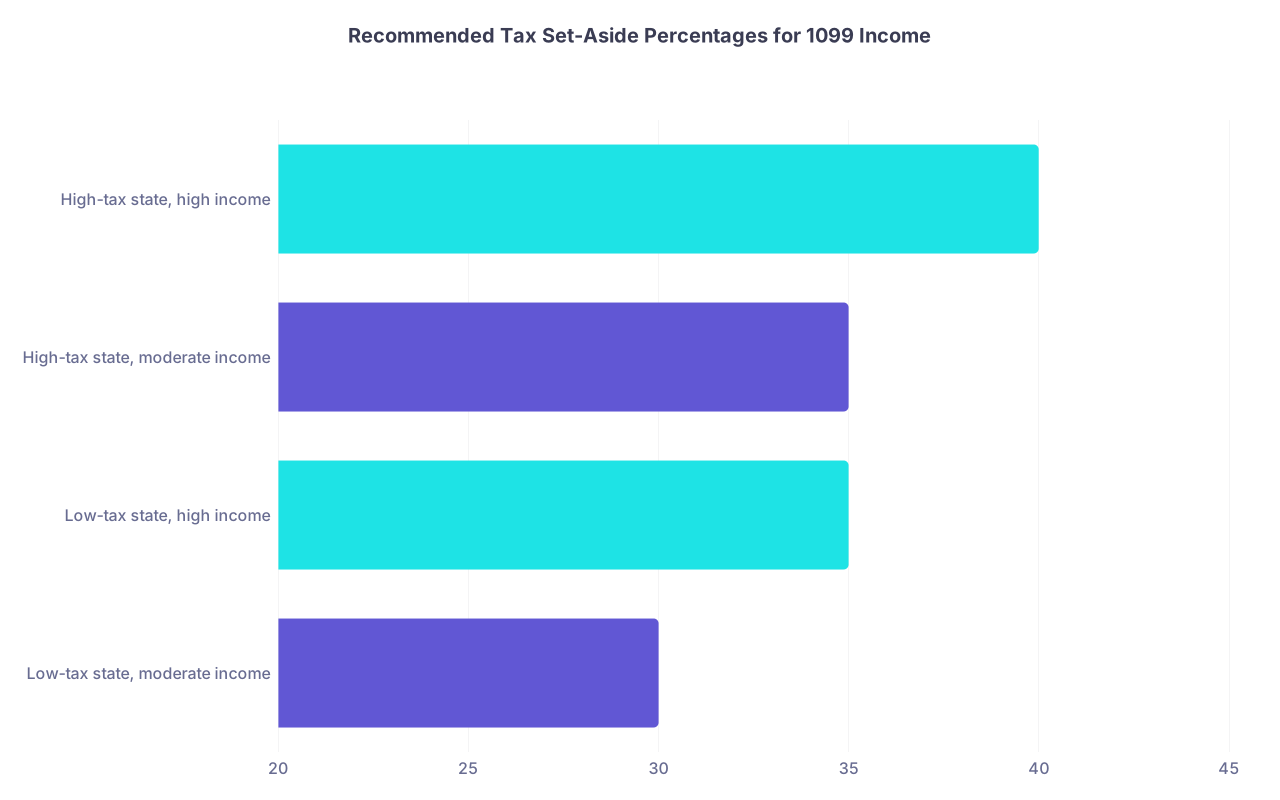
- Skim a set percentage every month into a “tax savings” sub‑account:
- 30% if you are in a lower‑tax state and moderate bracket.
- 35–40% if you are in a coastal/high‑tax state and high bracket.
- Use that tax account for:
- Quarterly estimated payments (Form 1040‑ES).
- Any additional tax due next April.
- Skim a set percentage every month into a “tax savings” sub‑account:
You want the tax money segregated so you never see it as “spendable.”
| Category | Value |
|---|---|
| Low-tax state, moderate income | 30 |
| Low-tax state, high income | 35 |
| High-tax state, moderate income | 35 |
| High-tax state, high income | 40 |
3. Calendar your quarterly payments like clinic days
Quarterly deadlines for estimated tax payments:
- April 15
- June 15
- September 15
- January 15 (of the following year)
Put these dates into:
- Your calendar
- Your spouse’s calendar if they handle finances
- Or your practice manager’s reminders if you have one
Treat them like OR days. They do not move.
4. Coordinate with a professional once a year—minimum
I am biased here, but I am also right: a high‑earning physician with any complexity (1099s, K‑1s, spouse income, state issues) needs at least one planning meeting per year with:
- A CPA who actually understands physician income patterns, or
- A combined financial planner + CPA setup.
Agenda for that meeting:
- Project current year tax.
- Confirm safe harbor strategy.
- Identify additional retirement / HSA / entity moves before year‑end.
- Update estimates.
You spend hours documenting for insurers who barely pay you. Spending one hour to protect tens of thousands in taxes is not optional. It is baseline adulting for a high earner.
Step 6: Do Not Fall for “Last‑Minute Tax Tricks” That Will Haunt You
When physicians panic about taxes, the vultures show up. Whole life sales, abusive shelters, insane “write off your car and home” schemes.
Here is the quick filter I use when a doctor tells me about a tax idea they heard at a conference or from a “guy” in their group:
1. Red flags that a strategy is garbage (or worse)
- You do not understand in plain language how it saves tax.
- The explanation leans heavily on:
- “The rich do this all the time”
- “The IRS does not audit this”
- “You are leaving money on the table”
- It involves:
- Offshore trusts you cannot explain.
- Huge upfront commissions.
- Non‑recourse loans and circular flows of funds.
- “Captive insurance” for a solo doc doing hospitalist shifts.
- The person selling it:
- Is not your CPA.
- Cannot show you the specific code section or IRS guidance.
- Makes more money from selling the product than your tax savings this year.
If it sounds like a cheat code, it is usually a landmine.
2. Things that are legitimate but mistimed
Some good strategies cannot be slapped on at the last minute for last year:
- Defined benefit/cash balance plans – powerful, but require planning and real contribution capacity.
- S‑corp salary strategies – require a proper setup and documentation.
- Real estate professional status – powerful but requires material participation and real estate activity, not a label.
You should learn about these. You just do not rely on them to fix this brutal year at the last second.

Putting It All Together: A Practical Checklist
If you feel overwhelmed, you are not alone. Here is the stripped‑down protocol I have used with many physicians who realized late that tax season would be brutal.
Same week (within 3–5 days)
Get the real number
- Consolidate all documents.
- Have your CPA or software estimate total tax, amounts paid, and balance due.
Hit last‑minute contributions
- Max HSA for last year if eligible.
- Add IRA/backdoor Roth contributions.
- If 1099 income: open/fund SEP‑IRA or Solo 401(k) within allowed limits.
Decide how you will pay
- Pay as much as possible by deadline.
- If short:
- Explore IRS installment options.
- Compare with any lower‑interest borrowing options.
Within 2–3 weeks
Clean up business records
- Sweep for any legitimate business expenses missed.
- Confirm CME, licensing, board fees, and subscriptions are captured.
Lock in next year’s plan
- Adjust W‑4 to add extra withholding.
- Create a 1099 tax holding account and set automatic transfers.
- Calendar quarterly estimate dates.
Entity and structure review
- If you have 1099 income:
- Meet with a CPA about S‑corp or better entity structures for next year.
- If all W‑2:
- Focus on retirement plans, HSAs, and spouse planning.
- If you have 1099 income:
Over the next 12 months
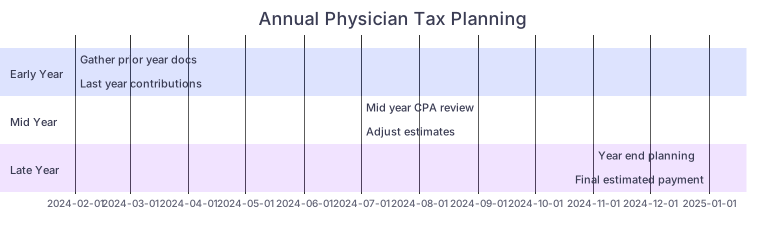
- One proactive planning meeting
- Mid‑year or Q3 with your CPA.
- Confirm you are on track for safe harbor.
- Decide on any additional retirement/DB plan moves.
| Task | Details |
|---|---|
| Early Year: Gather prior year docs | a1, 2024-02, 1m |
| Early Year: Last year contributions | a2, 2024-02, 1m |
| Mid Year: Mid year CPA review | a3, 2024-07, 1m |
| Mid Year: Adjust estimates | a4, after a3, 1m |
| Late Year: Year end planning | a5, 2024-11, 1m |
| Late Year: Final estimated payment | a6, 2025-01, 1m |

Summary: What Actually Matters
Boil this down to three moves:
- Squeeze every remaining, legal, after‑year‑end deduction and contribution (HSA, IRA, SEP/Solo 401(k)) before you file. That is your last real shot at shrinking the bill.
- Control the damage from penalties and cash flow by understanding safe harbor rules, paying as much as you can by the deadline, and using installment plans intelligently if you must.
- Use the pain from this year to hard‑wire a better system: fixed W‑2 withholding, automatic 1099 set‑asides, a mid‑year CPA review, and better entity structure for next year.
You cannot undo last year. You can keep it from being the template for every year that follows.