

The IRS does not care that you are a brand‑new attending.
You go from a resident paycheck to attending money, no one withholds enough, no one warns you clearly, and by the time you file your return you owe five figures you do not have. This is not a moral failing. It is a system problem. But if you handle it wrong, it will follow you for years.
I am going to give you a concrete, step‑by‑step fix plan. Not platitudes. Not “call a professional” and walk away. You will know exactly what to do this week, this month, and this year so this never happens to you again.
Step 1: Stop the Bleeding – Fix Your Withholding Right Now
If you just got hit with a huge tax bill, your first move is not to argue with your CPA, not to Google obscure deductions. Your first move is to stop the problem from repeating next April.
Here is your immediate fix protocol:
Pull your last pay stub.
Look at:- Year‑to‑date gross income
- Year‑to‑date federal withholding
- Your current pay period federal withholding
Estimate your annual income.
- Base salary
- Shift differentials, bonuses, call pay, moonlighting
- 1099 side gigs if you have them
Be honest. If you are “on track” for $420k based on your first months, use that, not the $350k base they quoted at orientation.
Use a solid tax estimator.
Do not guess. Use:- A reputable online tax calculator, or
- Quick projection in software like TurboTax / TaxCaster, or
- A CPA who will run a tax projection (you can ask explicitly for that).
You are not trying to be perfect. You are trying not to under‑withhold by $20k again.
Set a target withholding.
You want your total federal withholding for the year to be slightly more than your projected tax bill. Overpaying by $2k is fine. Underpaying by $20k is not.Change your Form W‑4 aggressively.
Go to HR or your employer portal and:- Set filing status correctly (many new attendings accidentally leave “Single” when they got married last year or vice versa).
- Most important: use line 4(c) “Extra withholding.”
- Take the projected total tax shortfall for the rest of the year and divide by number of remaining paychecks.
- Put that amount in “extra withholding per paycheck.”
Example:
- You are on track to owe $36,000 total federal income tax.
- YTD federal withholding so far: $10,000.
- Months left in the year: 8, paid twice a month → 16 paychecks.
- You need at least another $26,000 withheld.
- $26,000 ÷ 16 ≈ $1,625 extra per paycheck.
That number goes on line 4(c).
If you have 1099 income: start quarterly estimates yesterday.
- No withholding on 1099 = guaranteed tax trap.
- A simple rule of thumb while you set things up: set aside 30–35% of 1099 income in a separate “tax” savings account.
- Then make quarterly estimated payments using IRS Direct Pay or EFTPS.
| Quarter | Income Period | Payment Due Date |
|---|---|---|
| Q1 | Jan 1 – Mar 31 | Apr 15 |
| Q2 | Apr 1 – May 31 | Jun 15 |
| Q3 | Jun 1 – Aug 31 | Sep 15 |
| Q4 | Sep 1 – Dec 31 | Jan 15 (next yr) |
You fix withholding first because if you do nothing else and you at least stop underpaying this year, next year will be survivable.
Step 2: Diagnose Why the Tax Bill Was So Big
You cannot fix what you do not understand. And “my CPA messed up” is almost never the full story. Here is what usually causes the “surprise $20–50k” bill for new attendings:
1. Residency vs Attending Income Mismatch
You spent most of the prior year as a resident or fellow:
- Low salary, decent withholding.
- Last part of the year: big attending income, but your payroll system used your whole‑year income assumption or default W‑4, so it barely ramped withholding.
Translation: your tax bracket jumped, but your withholding did not.
2. Multiple Jobs Without Coordination
Classic problem:
- Hospital #1 uses a W‑4 that assumes you only work there.
- Moonlighting gig or Hospital #2 also assumes they are your only job.
- Both under‑withhold because each sees “only” $150k of your $300k actual income.
There is no automatic coordination. You must fix it on your W‑4s.
3. 1099 Income with No Estimated Tax
Locums. Telemedicine. Urgent care gigs. Consulting.
If you:
- Collected $50k in 1099 income,
- Spent it all,
- Did not make quarterly estimates,
you just guaranteed:
- Regular income tax on that $50k
- Plus self‑employment tax (~15.3% on much of it)
That alone can easily create a $10–20k surprise.
4. Filing Status or Withholding Errors
Common mess‑ups I routinely see:
- Married but both spouses marked “Single” with low withholding.
- Not checking the “multiple jobs” box on the new W‑4.
- Claiming too many allowances / dependents with no projection behind it.
5. Loss of Resident‑Era Deductions and Credits
As your income climbs:
- Student loan interest deduction phases out.
- Certain education credits disappear.
- Child tax credits may start phasing out.
- You stop qualifying for Obamacare premium subsidies if you used the exchange.
You go from “lots of credits and deductibles” to “congratulations, you just phase‑out‑ed yourself.”
Action: Perform a 15‑Minute Autopsy
Your homework:
- Pull your last two years’ tax returns (Form 1040 plus state).
- Look specifically at:
- Total tax (not just refund / balance).
- Total withholding.
- Any Schedule C (1099 income) and Schedule SE (self‑employment tax).
- Compare:
- Did your income more than double?
- Did withholding rise proportionally?
- Do you see self‑employment tax on a big number?
You want a one‑line explanation you can say out loud:
“Last year I made $320k total, but only had $42k withheld and no estimates, so I owed another $18k plus penalties.”
Once you can say that sentence, we can fix it.
Step 3: Stabilize the Immediate Damage – How to Handle the Current Tax Bill
You filed. You owe more than you can pay in one shot. Here is the decision tree.
Scenario A: You can pay in full without wrecking your life
If you can write the check, wipe out consumer debt, and still keep a modest emergency fund, do it. Then immediately jump to Step 4 and fix the system.
But do not drain all liquidity if you are one AC compressor away from credit card debt. Paying the IRS in one lump and then financing your life at 25% APR is bad math.
Scenario B: You cannot pay in full – use IRS tools, not denial
The worst move is ignoring the bill. The IRS collections process is slow but relentless.
Here is the order of operations:
File the return on time (or ASAP if already late).
- This stops the “failure to file” penalty (which is brutal) even if you cannot pay.
- You still get “failure to pay” penalties, but those are smaller.
Pay what you can immediately.
- Use IRS Direct Pay (no login required) or EFTPS (once set up).
- Every dollar you pay now stops further penalties and interest on that dollar.
Set up an online payment plan if balance is ≤ $50,000.
- Use the IRS Online Payment Agreement tool on irs.gov.
- Simple option: up to 72 months to pay. No paperwork.
- You can always pay it off faster with no prepayment penalty.
If you owe more than $50k or have complex issues, talk to a tax pro before calling the IRS.
- “Offer in compromise” ads you see on TV are rarely relevant to high‑income physicians. You do not look “unable to pay” on paper.
- A straightforward installment agreement is usually better, cleaner, and more honest in your situation.
Do not put the IRS bill on a high‑interest credit card unless you are extremely organized.
- The interest rate on IRS payment plans is usually lower than credit cards.
- The exception: a 0% promotional balance transfer card you know you will pay off before the promo ends. If you are not naturally detail‑oriented, skip this trick.
State tax balance? Do not forget it.
- States can be more aggressive than the IRS.
- Set up a separate payment plan with your state if needed.
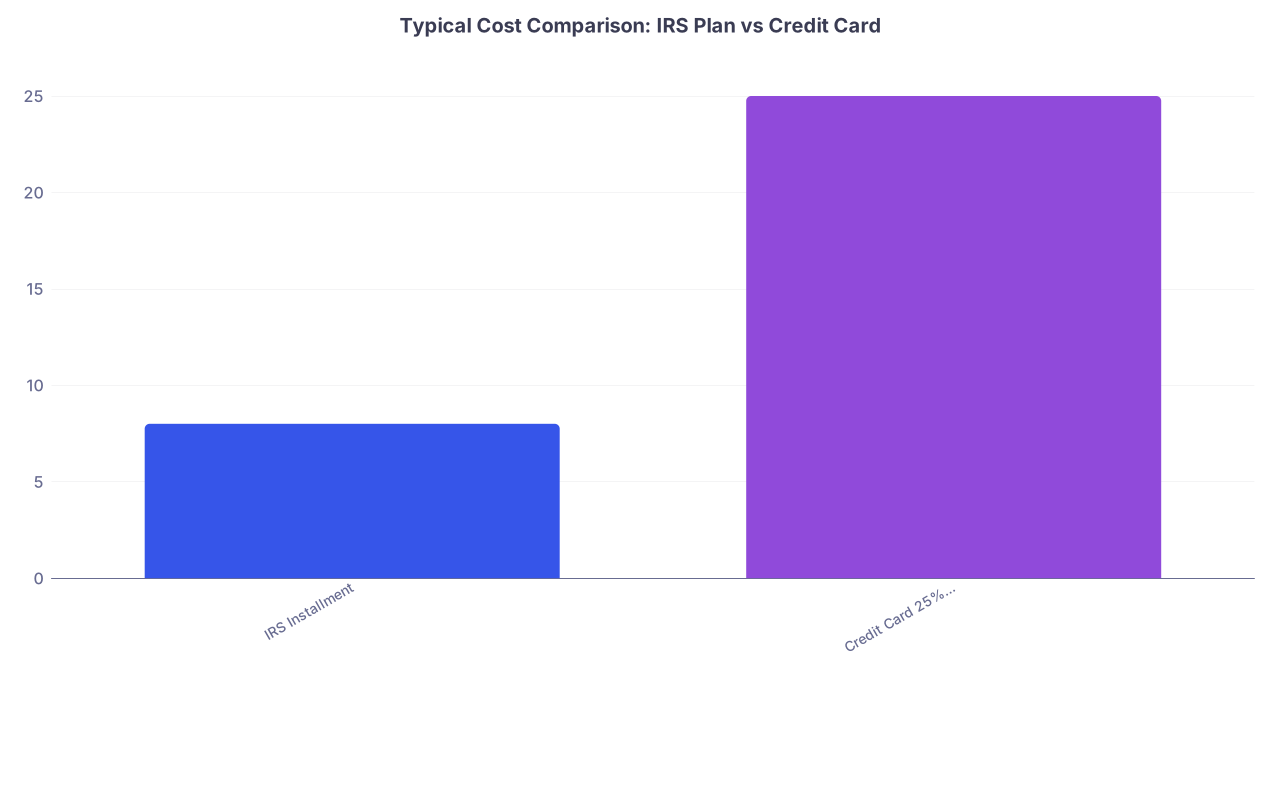
| Category | Value |
|---|---|
| IRS Installment | 8 |
| Credit Card 25% APR | 25 |
(Values approximate annual interest rates; the IRS number includes interest plus penalties that roughly behave like interest.)
Your goal in this step is not optimization. It is containment. You want a clear plan so this year’s mistake does not metastasize into a three‑year mess.
Step 4: Build a Simple Tax System for Attending‑Level Income
Once the fire is under control, you need a durable system. Attending money breaks resident‑level habits.
Here is a structure that works for most new physicians.
1. Create Dedicated “Tax Buckets”
Stop letting tax money mingle with spending money. Set up:
- Operating / Spending Checking – where your paycheck lands and bills get paid.
- Tax Savings Account – high yield savings, used ONLY for:
- Extra withholding you force yourself to transfer, if needed.
- Quarterly estimates for 1099 income.
- Upcoming known tax bills (e.g., when you file an extension).
Flow:
- W‑2 job: max out your withholding via W‑4 so tax is pulled before money hits checking.
- 1099 income: every time you get paid, move 30–35% straight into the Tax Savings Account.
That alone fixes half of what got you here.
2. Respect Estimated Tax “Safe Harbor” Rules
You got hit with penalties? That means you did not meet a safe harbor. The IRS gives you two main ways to stay penalty‑free, even if you owe a lot at year end:
- Pay at least 90% of this year’s total tax, or
- Pay 100% of last year’s total tax (110% if your AGI was > $150k).
Practically:
- Look at last year’s total tax on Form 1040, line “Total tax.”
- If you make quarterly estimates that add up to 110% of that number (since your income is now higher), you are safe from underpayment penalties, even if you owe on April 15.
Example:
- Last year total tax: $30,000.
- You are now making way more, but you pay in $33,000 across the year via withholding and/or estimates.
- You might still owe more in April, but you avoid penalties.
For a new attending, shooting for 110% of last year’s tax as a minimum paid during the year is usually smarter than guessing 90% of this year.
3. Decide: CPA vs DIY – and Use Them Correctly
I will be blunt. With attending income, multiple jobs, student loans, maybe a spouse with their own career, and possibly moonlighting, DIY tax prep is often a false economy.
One bad year of under‑withholding and penalties will burn through a decade of “savings” from skipping a CPA.
You want:
- A CPA or EA who works regularly with physicians,
- Someone who will actually run a mid‑year projection, not just file in April and shrug.
Your role:
- You still must understand your numbers.
- Do not outsource thinking. Outsource mechanics and code fluency.
At minimum, every fall:
- Send your CPA your YTD pay stubs and 1099 earnings.
- Ask for:
- Projected total tax,
- Recommended W‑4 changes or estimated payments.
Step 5: Fix the Structural Issues – W‑2 vs 1099, Entity Choice, and Retirement
Now we step into strategy. Once you are not drowning, you can make moves that lower taxes and prevent surprises.
1. Clean Up Your Job Structures
Look at all your income streams:
- Hospitalist job – W‑2, benefits, 401(k).
- Moonlighting at another hospital – often 1099.
- Telehealth or locums – usually 1099.
- Teaching, consulting, expert witness work – often 1099.
For each 1099 source, you need to decide:
- Stay as sole proprietor?
- Form an LLC or S‑Corp (if income is consistently high)?
For many brand‑new attendings, the first year or two is about:
- Tracking everything,
- Avoiding surprise tax bombs,
- Not rushing into complex entity structures you barely understand.
Rule of thumb:
- If your 1099 income is under $50–70k/year, focus on:
- Meticulous tracking,
- Quarterly estimates,
- Basic deductions.
- Once your 1099 income passes $100k+ consistently, it is time to talk seriously with a tax pro about:
- S‑Corp structure,
- Payroll for yourself,
- Splitting income between “salary” and “distribution.”
Do not form an S‑Corp because a colleague in the call room mentioned it saved them “so much tax” and you liked the sound of that. The savings are real in the right context but can backfire if done sloppily.
2. Max Out Pre‑Tax and Tax‑Advantaged Accounts (Correctly)
Attending‑level tax bills hurt more when you are underusing retirement accounts. Here is a quick hierarchy most physicians should run through:
- Employer 401(k)/403(b) – at least to the match, ideally to the annual max.
- Backdoor Roth IRA if allowed in your situation.
- HSA (if you are in a high‑deductible health plan).
- 457(b) if you have a non‑governmental plan, proceed carefully and understand creditor risk.
- Solo 401(k) for your 1099 side gig if you do not have conflicts with your W‑2 plan.
Each dollar into a pre‑tax 401(k) reduces current taxable income. That means:
- Less tax owed,
- Less risk of big surprise in April.
But do not confuse tax deferral with tax savings. This is part of a broader financial plan, not just a tax stunt.
3. Correct Common Legal and Documentation Gaps
You are now a high‑income professional. Sloppy paperwork is from your student days. Clean it up:
- W‑4s updated anytime your job mix or spouse income changes.
- Written contracts for moonlighting and locums – so you understand pay structure, benefits, and classification (W‑2 vs 1099).
- Liability coverage – make sure malpractice and any business coverage align with how you are actually working.
- Keep receipts and logs for:
- CME,
- Licensure fees,
- Board exams (if still ongoing),
- Required tools and subscriptions (UpToDate, specialty society dues, etc.).
As a W‑2 employee, many job‑related expenses are no longer deductible for federal tax under current rules. But if you have 1099 work, some of those expenses can legitimately be business expenses. Your documentation will decide whether they survive an audit.
Step 6: Build a Simple Annual Tax Calendar (So You Never Get Surprised Again)
You are used to rotation schedules, call lists, OR block time. Treat taxes the same way. Put them on a calendar. Literally.
Here is a baseline template that works for most attendings:
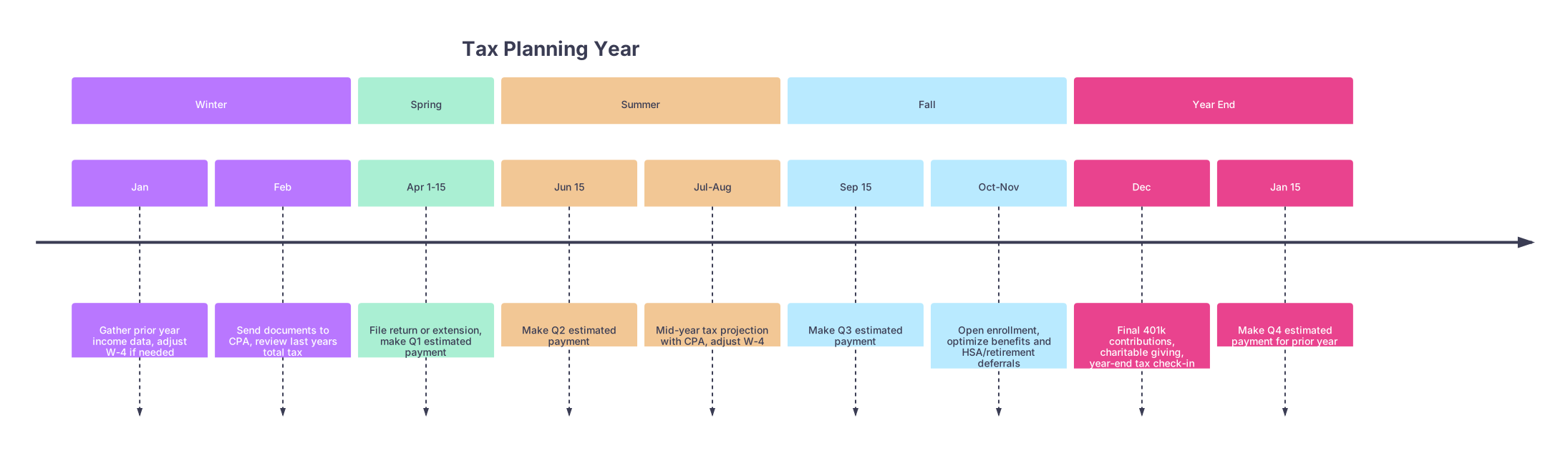
| Period | Event |
|---|---|
| Winter - Jan | Gather prior year income data, adjust W-4 if needed |
| Winter - Feb | Send documents to CPA, review last years total tax |
| Spring - Apr 1-15 | File return or extension, make Q1 estimated payment |
| Summer - Jun 15 | Make Q2 estimated payment |
| Summer - Jul-Aug | Mid-year tax projection with CPA, adjust W-4 |
| Fall - Sep 15 | Make Q3 estimated payment |
| Fall - Oct-Nov | Open enrollment, optimize benefits and HSA/retirement deferrals |
| Year End - Dec | Final 401k contributions, charitable giving, year-end tax check-in |
| Year End - Jan 15 | Make Q4 estimated payment for prior year |
Notice the pattern:
- You front‑load thinking around April (filing) and mid‑year (projection).
- You tie adjustments to times you are already thinking about money (open enrollment, end of year).
If you just follow that simple calendar and use the safe harbor rules, you can almost eliminate tax surprises.
Step 7: Mental Reframe – Stop Treating the IRS as Optional
I have seen this enough times: A new attending treats taxes like one more vague bill in the pile. Rent. Car. Loans. Whatever.
That mindset works on a resident‑level income, where withholding overshoots and you are “pleasantly surprised” each April.
At attending level:
- The IRS is your biggest bill.
- It does not negotiate like Navient.
- It has more power over your life than your landlord, your car lender, and your cell provider combined.
So you change how you think:
- Taxes are a fixed cost of earning attending income, not a year‑end surprise.
- Paying them on time is basic professional hygiene, like charting and signing orders.
- You do not need to love it. You just need to respect it.
This is not about fear. It is about not giving mental energy to avoidable emergencies.
Put It All Together: Your 30‑Day Fix Plan
Let me consolidate this into an exact 30‑day playbook you can follow.
Week 1: Stop the Bleeding
- Pull:
- Last 2 pay stubs,
- Last 2 years’ tax returns.
- Use a tax estimator or CPA:
- Project this year’s total tax,
- Compare to YTD withholding.
- Update W‑4:
- Add extra withholding per paycheck on line 4(c).
- Create a Tax Savings Account and move:
- 30–35% of any unspent 1099 income currently in checking.
Week 2: Contain the Current Damage
- If you have a tax bill due:
- Pay as much as you reasonably can via IRS Direct Pay.
- Set up:
- IRS installment plan (if needed),
- State payment plan (if needed).
- Freeze lifestyle creep:
- No new major recurring expenses (car, house) until you have a clear picture.
Week 3: Design the Ongoing System
- Map all current and likely income streams:
- W‑2 roles,
- 1099 gigs.
- Decide:
- Which 1099 income justifies an entity conversation,
- Which is staying as simple sole proprietor for now.
- Book a planning appointment (not just April filing) with a CPA/EA who works with physicians.
Week 4: Lock in Habits and Calendar
- Build your tax calendar:
- Add quarterly tax dates,
- Add a mid‑year projection meeting,
- Add year‑end review.
- Automate:
- Transfers to Tax Savings Account each time 1099 income hits,
- 401(k)/403(b) and HSA contributions via payroll.
- Share the plan:
- With your spouse/partner if applicable,
- With your CPA so they know you want active planning, not passive filing.
You are not the first new attending to get hammered by a giant tax bill. You will not be the last. But you do not have to be the one still complaining about it five years from now.
Open your latest pay stub right now and compare your year‑to‑date federal withholding to last year’s total tax. If those numbers are clearly out of sync, submit a new W‑4 before your next paycheck hits.


