

The tax code does not hate you. It just heavily favors the people who plan ahead.
If you are a physician in a high‑tax state and you are not deliberately structuring your income, ownership, and investments, then yes—your tax bill will be unnecessarily brutal. The good news: there are completely legal, well‑tested tactics that can meaningfully soften the blow. But you have to stop thinking like a W‑2 employee and start thinking like an owner.
This is not a pep talk. It is a playbook.
1. Face the Math: Why High‑Tax States Hurt Physicians So Much
You are not crazy; it is worse for you than for most people.
States like California, New York, New Jersey, Minnesota, Oregon, Massachusetts, and others combine:
- High marginal state income tax rates
- Local/city taxes in some areas (NYC, Philly)
- High property and sales taxes
- Federal limits on state and local tax (SALT) deductions (capped at $10,000)
So your combined marginal rate (federal + state + payroll) can easily cross 45%–50% on each extra dollar of ordinary income.
Let me put rough numbers on it.
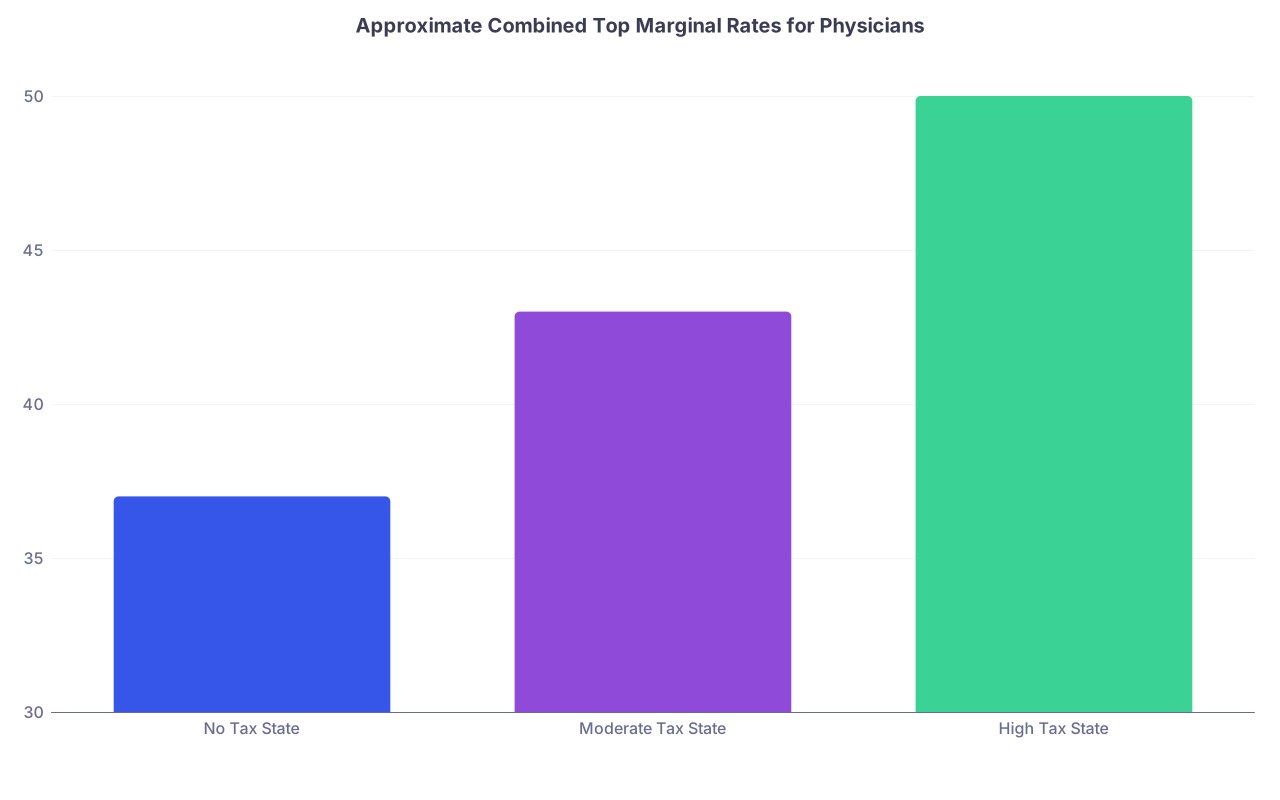
| Category | Value |
|---|---|
| No Tax State | 37 |
| Moderate Tax State | 43 |
| High Tax State | 50 |
- “No Tax State” = federal plus Medicare surtaxes only
- “Moderate” = e.g., Colorado, North Carolina
- “High Tax State” = e.g., CA, NY, NJ, OR
For a $500,000‑earning physician in a high‑tax state, it is entirely realistic that $200,000+ disappears to income and payroll taxes annually.
The goal is not fantasy “0% tax.” That is nonsense for high‑earning U.S. physicians.
The goal is: stop overpaying by ignorance.
2. The Big Levers: How You Actually Move the Needle
You only have a few major levers that materially reduce the tax pain:
- Entity structure and how you’re paid
- Retirement and “bucket” design
- Business vs. personal expenses
- Location choices (state residency, sourcing rules)
- Investment tax strategy
Everything else—credit card points, $500 deductions, cute hacks—is noise.
Let us work through them systematically, with specific physician examples.
3. Fix #1: Stop Being Pure W‑2 If You Can Help It
If you are only W‑2 at a large health system, you are playing on “hard mode.”
Why W‑2 is so punishing for high‑income physicians
- Every dollar is ordinary income
- You cannot deduct typical “business” expenses (CME travel, licenses, board prep, home office, etc.) on Schedule A anymore (post‑TCJA)
- You have no control over payroll taxes, entity choice, or many advanced strategies (e.g., defined benefit plans through your own entity)
If you can negotiate any of the following, your tax planning options improve instantly:
- Independent contractor status (1099) for some or all of your work
- A side LLC/PLLC/PC for consulting, expert witness work, locums, or telemedicine
- Ownership in a group practice/ASC/real estate holding company
You want something that generates business income (Schedule C, partnership K‑1, or S corp K‑1). That is the playground where real tax strategies live.
Practical steps if you are currently W‑2 only
Review your contract
- Is there a non‑compete?
- Do they prohibit outside clinical or non‑clinical work?
- Do you need employer permission for “moonlighting” or consulting?
Identify 1–2 realistic 1099 income streams
Examples I have actually seen physicians do:- Telemedicine shifts a few evenings a month
- Expert witness chart review
- Chart review / utilization review
- Small private practice sessions one day a week
- Locums shifts in underserved areas
- Medical writing, speaking, or coaching
Form a simple entity
Usually:- Single‑member LLC or professional LLC in your state,
- Elect S‑corp status only when profits are meaningful and stable (often once net profit > ~$150k–$200k).
You need a CPA who actually understands physicians, not a generic storefront tax preparer.
Route that 1099 income through your entity
- New tax ID, business bank account, and bookkeeping
- Now you have a legitimate business with options: retirement plan, expense deductions, advanced strategies
If you are locked into pure W‑2 with zero side work allowed, your main weapons become retirement plan optimization, investment strategy, and—honestly—eventual relocation. I will cover those too.
4. Fix #2: Build a Maximum‑Deferral Retirement Stack
Most physicians underuse the biggest legal shelter they already have: tax‑advantaged retirement accounts. You should be maxing or nearly maxing everything you have access to, and if you are a business owner, creating more.
Typical retirement “stack” for a high‑income physician
| Account Type | Typical Annual Limit (Approx.) | Tax Treatment |
|---|---|---|
| 401(k)/403(b) | $23k employee + employer match | Pre-tax or Roth |
| 457(b) governmental | $23k employee | Usually pre-tax |
| Backdoor Roth IRA | $7k | After-tax to Roth |
| Solo 401(k) (side biz) | Up to $69k combined | Pre-tax / Roth / after-tax |
| Defined Benefit / Cash Balance | $50k–$300k+ (age-dependent) | Pre-tax |
Numbers approximate for current limits; verify each year.
If you are in a 50% marginal bracket, pre‑tax contributions are ridiculously valuable. A pre‑tax dollar is effectively “half off” compared to taking it as taxed income and then investing.
Concrete physician setups
Employed cardiologist in California (W‑2)
- Max employer 401(k) or 403(b): $23k employee + whatever employer match
- Use a governmental 457(b) if reasonably safe (second $23k)
- Backdoor Roth IRA for you and non‑working spouse: $7k each
- HSA if HDHP: $4k+
You can easily defer $57k–$65k+ a year this way, even as pure W‑2.
Private practice surgeon in New York with S‑corp
- 401(k)/profit sharing plan within the practice: push to $69k if structured correctly
- Add a cash balance plan: $100k–$250k+ per year depending on age and design
- Backdoor Roths for both spouses
It is entirely realistic to defer $150k–$300k+ of taxable income annually here.
Action steps to implement
- Get your existing plan documents (from HR or your practice administrator) and read the allowable contributions.
- Ask very pointed questions:
- “What is the maximum I can put in this year across all sources?”
- “Can this plan be amended to allow profit sharing or Roth options?”
- If you own a practice or side entity, meet a retirement plan specialist who does cash balance and physician group 401(k) design regularly. Not a generic 401(k) salesperson.
If your answer to “What am I deferring each year?” is still under $50k and you are a high‑income physician in a high‑tax state, that is low‑hanging fruit you have not picked yet.
5. Fix #3: Use an S‑Corp or Entity Strategy (When It Actually Makes Sense)
This is the area where I see the most garbage advice. Let us clean it up.
What an S‑corp actually does
- You pay yourself a “reasonable salary” subject to payroll taxes
- The remaining profit flows through as distributions, which:
- Avoid Social Security and Medicare payroll taxes (subject to some nuances)
- Still face federal and state income tax
- You can potentially reduce self‑employment tax on a portion of your income
For a high‑income specialist with $300k+ in net business profit, this can be meaningful. For someone making $80k as side consulting, it may not be worth the overhead and CPA cost yet.
Where S‑corps help physicians in high‑tax states
- Significant 1099 clinical income: locums, private practice, telemed
- High‑profit non‑clinical ventures (courses, consulting, expert witness)
- Ability to maximize retirement plans through an S‑corp structure
But: S‑corp does not magically remove state income tax. It mainly shifts payroll taxes and can sometimes improve how you structure benefits and retirement contributions.
Implementation checklist
Confirm you actually have meaningful profit
- If your entity nets under $100k after expenses, often not worth S‑corp complexity.
- Between $150k–$200k+ net and up, S‑corp starts to make more sense.
Work with a CPA to set:
- Reasonable salary (often 40–60% of profit as a starting point, but must be defensible)
- Payroll system (Gusto, ADP, etc.)
- Retirement plan integrated with your entity structure
Do the math annually
- If your hours, income, or mix of W‑2 vs 1099 changes, your entity choice may need adjustment.
If your CPA cannot explain in plain English why you are or are not using an S‑corp, get a different CPA.
6. Fix #4: Master the “Business vs Personal” Line (Legally)
The tax code is extremely clear on one principle:
Ordinary and necessary expenses of carrying on a trade or business are deductible.
As a physician business owner (or independent contractor), that means:
Legitimate deductible expenses can include:
- Licensing fees, DEA, board certification fees
- CME courses, conferences, board review courses
- Travel to conferences (airfare, hotel, meals within limits)
- Medical journals, specialty society dues
- Part of your cell phone, internet, and EMR software
- Office rent or a properly structured home office
- Some equipment (computers, iPad for charting, etc.)
- Professional services: legal, accounting, billing consultants
For pure W‑2 physicians, those are personal non‑deductible expenses now. For business‑owner physicians, they become pre‑tax business expenses. Huge difference.
How to keep this clean and defensible
- Use a separate business bank account and credit card
- Write brief business purposes on receipts (e.g., “CME – ACC 2026 conference,” “Telemed laptop”)
- Keep mileage logs for business travel by car
- Do not get cute with obviously personal expenses like family vacations or personal clothing and call them “CME.” That is how you lose audits.
If a high‑tax‑state physician moves $15k–$40k of currently personal expenses into properly documented business expenses, that is thousands of dollars in year‑after‑year savings.
7. Fix #5: Use State‑Specific Angles – Especially SALT Workarounds
High‑tax states know the federal SALT deduction is capped at $10,000. So many created “SALT cap workaround” regimes for pass‑through businesses.
These are typically called Pass‑Through Entity (PTE) tax elections.
How PTE/SALT workarounds help
- Your S‑corp or partnership pays the state income tax directly
- The business then deducts that state tax as a business expense
- You effectively convert non‑deductible personal state income tax into a deductible business expense at the federal level
This can be huge for a practice or physician with large pass‑through income in states like CA, NY, NJ, CT, etc.
You still pay the same state tax, but:
- Your federal taxable income drops
- Net: your overall combined tax bill shrinks
Action steps
- Ask your CPA specifically:
- “Does my state have a pass‑through entity (PTE) SALT workaround?”
- “Should we elect into it for this tax year?”
- Make sure the entity (S‑corp/partnership) is set up correctly and deadlines for elections are not missed. Several states require annual affirmative elections.
If your practice is not using this in a state where it exists, you are leaving money on the table.
8. Fix #6: Be Ruthless About Investment Tax Drag
High‑tax state + high income + taxable brokerage account full of high‑turnover funds is a tax leak that never stops.
You want three big things:
Tax‑efficient asset location
- Put tax‑inefficient assets inside tax‑advantaged accounts where possible:
- High‑turnover active funds
- Bonds and high‑yield funds
- REITs
- Use taxable accounts for:
- Broad index equity ETFs and mutual funds
- Individual stocks (if you insist on picking them)
- Put tax‑inefficient assets inside tax‑advantaged accounts where possible:
Deliberate capital gains planning
- Avoid unnecessary short‑term capital gains (taxed like ordinary income)
- Use longer holding periods
- Tax‑loss harvest in bad years to offset gains and up to $3k ordinary income
Consider municipal bonds—carefully
- For very high brackets in high‑tax states (CA, NY), in‑state municipal bond funds can make sense for your “safe” bond allocation in taxable accounts
- But do the after‑tax yield math, do not just blindly chase “tax‑free”
Example: basic asset location for a high‑income physician
- 401(k)/403(b)/cash balance:
- Bond funds, REITs, high‑turnover or factor strategies
- Roth accounts:
- Highest expected growth assets (small cap, emerging, etc. if you hold them)
- Taxable brokerage:
- Broad market index ETFs (VTI, VXUS, etc.), selective muni bond funds if needed
If you work with an advisor, they should be talking about tax‑efficient asset placement explicitly. If not, ask why.
9. Fix #7: Consider Strategic Relocation and “Partial Residency”
I have watched several physicians grind for years in a high‑tax state, then finally move to Texas, Florida, or Washington and feel like they got a raise without changing jobs.
But you do not have to blow up your life overnight. There are levels to this.
Level 1: Move your future growth, not your current job
- Start acquiring real estate or business interests in low‑tax states (e.g., surgery center ownership in Texas, rental property in Tennessee)
- Allocate your incremental practice or non‑clinical growth to a low‑tax state entity where sourcing rules permit
- Retain your current high‑tax‑state W‑2, but stop building your entire financial future there
Level 2: Genuine residency change
If/when you are ready:
- Move your primary residence to a no‑income‑tax or lower‑tax state
- Move your practice or telemedicine base as feasible
- Change:
- Driver’s license
- Voter registration
- Primary home, kids’ school (if applicable)
- Where you actually spend more than half the year
States like CA and NY do not like to let people go. They will look at:
- Where your home is
- Where your family lives
- Where you work
- Where your “stuff” is
- Days physically present in each state
If you try to fake it with “I have a mailbox in Nevada,” expect a problem.
Level 3: Remote and telemedicine‑heavy practice
Some specialties (radiology, pathology, psych, derm, some tele‑urgent care) have more flexibility. I have seen physicians in these fields:
- Move to a no‑tax state
- Work virtually for entities anywhere
- Pay state tax only where they are resident and where state law sources income
This is heavily state‑specific. You must get real tax advice before assuming your telemedicine income is only taxable where you sit.
10. Fix #8: Use a Structured Annual “Physician Tax Review”
Most physicians delegate taxes entirely and then complain about the bill in April. That is backwards.
You need an annual tax planning meeting in Q3 or early Q4, not just a compliance meeting after the year is already over.
Create a simple annual checklist:
Project this year’s income
- W‑2: base + bonus likely
- 1099: year‑to‑date + expected
- Business K‑1s: estimate from practice administrator or prior year trend
Maximize retirement accounts before year‑end
- Confirm 401(k)/403(b)/457(b) contributions on track
- Decide on cash balance plan contribution range
- Plan backdoor Roth logistics for January–April
Review entity and PTE elections
- Are we using S‑corp optimally?
- Did we elect into pass‑through entity SALT workaround?
- Any changes needed next year?
Harvest gains/losses as needed
- Tax‑loss harvesting in rough markets
- Realize long‑term gains if your bracket will jump next year (e.g., partnership buy‑in coming)
Charitable giving strategy
- Consider donor‑advised fund (DAF) contributions in high‑income years
- Donate appreciated stock instead of cash for extra tax benefit
- Bunch several years of donations into one for itemizing vs standard deduction
Validate state residency and sourcing issues
- Travel patterns, telemedicine licensing, multi‑state work
Throw this on your calendar as “October Tax Strategy Meeting” every single year. Do not skip it.
11. What Actually Moves the Needle (vs. Cute Tricks)
Let me be blunt about a few things I see marketed hard to physicians:
- Captive insurance schemes, obscure conservation easements, and weird offshore arrangements – high audit risk, frequently abused, often mis‑sold. If you do not have a 7‑figure+ practice and a serious tax attorney explaining it, skip it.
- Whole life insurance marketed as a “tax‑free retirement plan” – expensive and inflexible for most physicians. Sometimes appropriate for specific legacy or asset protection needs, rarely the core solution to high income taxes.
- Aggressive home office scams – blowing up your compliance to save a couple thousand in tax is bad math.
What consistently works:
- Very high pre‑tax retirement contributions
- Clean, well‑documented business expense deductions
- Sensible entity structure with potential S‑corp benefits
- State PTE (SALT cap workaround) elections
- Thoughtful investment tax management
- And yes, over time, living and practicing in a lower‑tax jurisdiction
None of these are sexy. They are just effective.
12. Asset Protection Is Not Tax Planning (But You Still Need It)
Do not confuse these two:
- Tax planning = reduce the amount you owe to the IRS/state
- Asset protection = make it harder for a plaintiff or creditor to take your assets
You need both, especially in high‑litigation states.
Key physician moves:
- Maximize assets in protected buckets: retirement accounts, some types of cash balance plans, homestead (varies by state)
- Use proper business entities for side ventures and rentals
- Do not own rental properties in your own name; use LLCs
- Consider umbrella liability coverage ($2–5M or more)
None of this lowers your tax bill—directly. But it keeps what you do keep.
13. Turn This Into a Concrete Plan: A Simple Flow
You are busy. Let me hand you a one‑page mental algorithm.

| Step | Description |
|---|---|
| Step 1 | High tax state physician |
| Step 2 | Max employer plans and backdoor Roth |
| Step 3 | Improve investment tax efficiency |
| Step 4 | Consider long term relocation |
| Step 5 | Create LLC or PLLC |
| Step 6 | Schedule C, simple solo 401k |
| Step 7 | Consider S corp election |
| Step 8 | Add profit sharing or cash balance |
| Step 9 | Elect state PTE if available |
| Step 10 | Annual Q4 tax planning meeting |
| Step 11 | Any 1099 or business income? |
| Step 12 | Net profit > 150k? |
You can refine the details with a competent CPA and advisor, but this is the basic spine.
14. Your Next Step (Today, Not “Someday”)
Do this now:
Open your latest tax return and a blank page.
Write down:
- Your total income and top marginal tax bracket (federal + state).
- How much you actually contributed last year to:
- 401(k)/403(b)/457(b)
- IRA / backdoor Roth
- Any practice retirement plan (profit sharing, cash balance)
- Whether you had any 1099 or K‑1 income.
- Whether your state offers a pass‑through entity (PTE) SALT workaround (quick search plus short email to your CPA).
Then circle the one biggest gap:
- No side entity
- Underused retirement accounts
- No PTE election
- Tax‑inefficient investments
- Or you are simply living in the wrong state for your long‑term plan
That circled gap is your project for the next 90 days.
Call your CPA or advisor this week and say, very directly:
“I am a physician in a high‑tax state. I want a concrete, legal plan to reduce my tax burden over the next 3–5 years. Here is what I see as my biggest gap. How do we fix it?”
If they cannot answer with specifics, find someone who can.


